
What if your forty-year-old brain is actually your greatest asset in the cockpit rather than a liability? While many people ask is 40 too old to become a pilot, the truth is that the aviation industry in 2026 values the maturity and reliable decision-making that only comes with life experience. You might feel anxious about the financial ROI of a mid-life career change or worry that complex medical exams will ground your pilot dreams before they even take flight. These are valid concerns, especially when you're looking at a mandatory airline retirement age of 65.
This guide will prove why starting now is a strategic move that can lead to a rewarding second act. You'll discover how to leverage the current shortage of 24,000 pilots to fast-track your journey into a professional flight deck. We'll provide a clear timeline for our Career Pilot Program, explain how to handle First-Class medical certifications after 40, and show you how Florida's consistent sunny weather helps you build hours faster. Reach out today and let's work together to take your flying skills to the next level.
Key Takeaways
- Learn why the FAA has no maximum age limit for starting flight training, ensuring your path to the cockpit remains wide open for a second career.
- Discover why the answer to is 40 too old to become a pilot is a resounding no, as airlines highly value the professional maturity and decision-making you bring from previous industries.
- Find out how to kickstart your journey with the Wings Foundation course to earn your Private Pilot License (PPL) and build a solid aviation foundation.
- Understand the essential medical requirements for older pilots, including what to expect when applying for your First-Class Medical Certificate to ensure long-term eligibility.
- See how the year-round sunny weather in Kissimmee, Florida, provides a strategic advantage by allowing for more consistent training days and a faster route to certification.
Is 40 Too Old to Become a Pilot? Breaking Down FAA Regulations
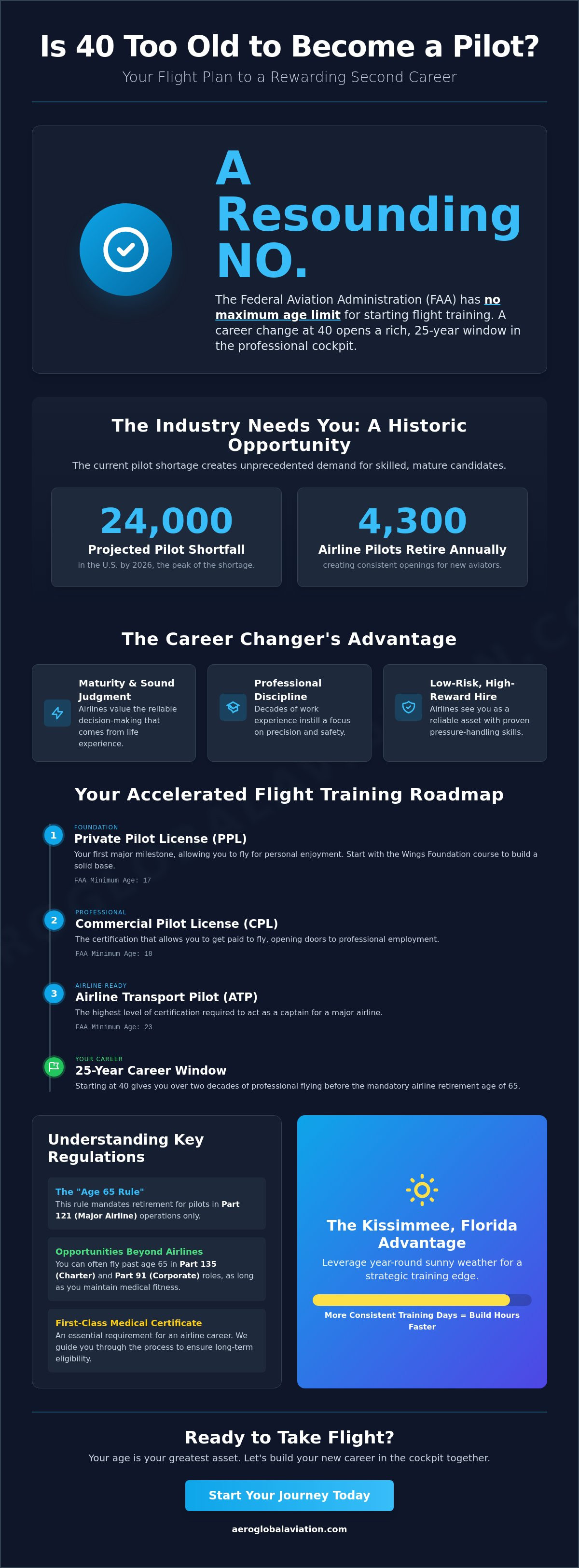
Many aspiring aviators hesitate because they believe the clock has already run out on their aviation goals. If you're asking is 40 too old to become a pilot, the regulatory answer is a clear and resounding no. The Federal Aviation Administration (FAA) sets no upper age limit for beginning your flight training or earning your certificates. You can walk into our flight school at age 40, 50, or even 60 and start working toward your dream. While the major airlines have a mandatory retirement age, starting at 40 still offers you a rich, 25-year window in the cockpit. This long runway provides more than enough time to reach the top of the seniority list and enjoy a full career flying high-performance aircraft.
The current industry landscape makes this the best time to transition. The United States is projected to face a shortfall of approximately 24,000 pilots in 2026, which is considered the peak of the shortage. With roughly 4,300 airline pilots reaching retirement age every year, carriers are looking for reliable, mature candidates to fill their ranks. Beyond the major airlines, the world of corporate, charter, and cargo flying offers even more flexible age windows. These sectors often hire based on experience and skill rather than a strict age cap, providing a world of opportunities for those starting later in life.
Understanding the Mandatory Retirement Age
The "Age 65 Rule" is a specific regulation under 14 CFR Part 121 that requires major airline pilots to retire from commercial service. However, this rule does not apply to Part 135 charter operations or Part 91 corporate flight departments, where you can often fly as long as you maintain your medical fitness. Regional carriers are currently more aggressive in their hiring practices than ever before to combat the 2026 shortage. A student starting flight training at age 40 can expect a high-value career spanning two decades or more before reaching the mandatory airline retirement age.
License Age Requirements at a Glance
To plan your journey, you should understand the baseline FAA pilot certification requirements for each stage of your training. These minimums ensure that every pilot has the maturity and skill to operate safely in the national airspace. Here is the breakdown of the minimum ages for each milestone:
- Private Pilot License (PPL): Minimum age 17. This is your foundation and allows you to fly for personal enjoyment.
- Commercial Pilot License (CPL): Minimum age 18. This certification means you can finally get paid to fly, opening the door to professional employment.
- Airline Transport Pilot (ATP): Minimum age 23. This is the highest level of certification required to act as a captain for a major airline.
Take advantage of Florida's sunny weather and our personalized training approach to move through these milestones efficiently. Reach out to our team today to start your journey toward the flight deck.
The Career Changer’s Advantage: Why Maturity Matters in the Cockpit
Many prospective students worry about their age, but the flight deck is one of the few places where being "seasoned" is a massive competitive edge. If you're wondering is 40 too old to become a pilot, consider that airlines aren't just looking for fast reflexes; they're looking for sound judgment. Older students often bring a level of resource management and emotional regulation that younger candidates are still developing. This maturity translates directly into a higher pass rate for the Checkride, which is the practical exam where a student must prove their flying skills to an examiner to earn their rating. Precision saves lives, and maturity ensures that precision is a priority.
Success in aviation requires a disciplined study habit and a cool head during emergencies. A mid-life career change to pilot allows you to use decades of professional experience to master the cockpit. While a 19-year-old might struggle with the gravity of a pre-flight checklist, a 40-year-old professional understands that cutting corners isn't an option. This reliability makes you a low-risk, high-reward hire for regional carriers who need captains with life experience. They know you've already learned how to handle pressure in the real world.
Transferable Skills from Other Industries
Your previous career wasn't a detour; it was a training ground for leadership. Whether you managed a team in a corporate office or ran a small business, those leadership skills are vital for Crew Resource Management (CRM). CRM is the effective use of all available resources, including people and equipment, to ensure flight safety. Airlines value candidates who can communicate clearly and lead a crew with confidence. This "professionalism edge" means you'll likely adapt to the responsibilities of being a first officer much faster than someone entering their first real job. Reliability is a premium currency in aviation, and your history of meeting deadlines proves you have the grit to succeed.
Stability and Focus in Flight Training
Financial stability at age 40 often leads to more consistent training. Younger students frequently pause their education due to budget constraints, which leads to "skill fade" and more total hours required to reach proficiency. When you treat flight school like a full-time career rather than a college elective, you often complete your Private Pilot License (PPL) and Commercial Pilot License (CPL) in fewer total flight hours. Mastery of complex weather patterns and navigation systems comes easier when you have the life experience to synthesize technical data quickly. Take advantage of Florida's sunny weather to keep your momentum high and your training on track. Explore how Aero Global Aviation Academy can help you reach your goals through a personalized training path that respects your time and previous experience.
Your Accelerated Flight Training Roadmap: From Zero to Commercial
When you're starting a second career, efficiency is your top priority. You don't have years to wander through a self-paced program at a local flight club. If you're asking is 40 too old to become a pilot, the answer depends on how quickly you can reach the flight deck. A structured, full-time approach can take you from zero experience to a commercial certificate in months rather than years. By leveraging the sunny weather in Florida, you can fly almost every day, ensuring your skills stay sharp and your momentum remains high.
Your journey follows a logical, step-by-step progression designed to maximize your training ROI. Each rating you earn acts as a building block toward your ultimate destination. Here is the proven path to professional aviation:
- Step 1: Obtain your FAA First-Class Medical Certificate. Before investing a single dollar in training, ensure you meet the health standards required for airline operations. For pilots over 40, this certificate is valid for six months for airline duties.
- Step 2: Enroll in the Wings Foundation. This is where you earn your Private Pilot License (PPL), the foundational certificate that allows you to fly solo and carry passengers.
- Step 3: Build Instrument and Multi-Engine Ratings. You'll learn to fly solely by reference to instruments and master aircraft with more than one engine, which is essential for any professional role.
- Step 4: Complete the Career Pilot Program. This phase culminates in your Commercial Pilot License (CPL), which means you can finally get paid to fly.
- Step 5: Accumulate 1,500 Hours. To reach the major airlines, you'll need to build time. Most graduates do this by becoming a Certified Flight Instructor (CFI).
The Wings Foundation: Building the Base
A solid start prevents expensive "plateauing" later in your 40s. The Wings Foundation focuses on flight fundamentals, guiding you toward your first solo flight with confidence. By mastering ground school early, you stay ahead of the flight schedule and avoid delays. This initial phase isn't just about learning to land; it's about developing the disciplined mindset required for a high-stakes career change.
Airline Pilot Elite: The Path to 1,500 Hours
The most common hurdle for career changers is the 1,500-hour requirement for airline employment. Our Airline Pilot Elite program solves this by transitioning you from a commercial student to a professional instructor. As a CFI, you'll get paid to build the flight time needed for your airline interview. This path turns a potential obstacle into a world of opportunities, allowing you to refine your own skills while helping others achieve their pilot dreams. Reach out to our team to see how this accelerated route can work for you.
Navigating the Financial and Medical Realities at 40
Transitioning into a cockpit at age 40 requires a practical look at your physical health and your bank account. While the dream of flight is aspirational, the path to achieving it is paved with specific regulatory and financial milestones. If you're still questioning is 40 too old to become a pilot, the data from 2026 suggests the window is wider than ever. You'll need to manage the seniority trade-off, as every pilot starts at the bottom of the list, but the current shortage of 24,000 pilots means you'll likely climb those ranks faster than previous generations. This momentum makes the transition both logical and rewarding for those with the grit to see it through.
Financing your pilot dreams is a major consideration for mid-life career changers who may have existing mortgages or family obligations. In 2026, a complete "zero to CFI" program in Florida typically costs between $65,000 and $96,995. Many students utilize specialized flight training loans or personalized payment plans to bridge the gap. Because the industry is desperate for experienced, airline-ready pilots, many regional carriers now offer significant signing bonuses that can help offset these initial training costs. Reach out to our team to explore our flexible enrollment options and find a path that fits your budget.
Securing Your FAA First-Class Medical
The first step for any aspiring professional is the FAA First-Class Medical Certificate. This exam ensures you meet the rigorous cardiovascular, vision, and hearing standards required to fly for an airline. For pilots aged 40 and over, this certificate is valid for six months for airline duties. You must have 20/20 vision, either naturally or with corrective lenses, and demonstrate healthy heart function through an EKG. It's a smart move to secure this medical clearance before you spend a single dollar on tuition. Most common health issues, such as controlled high blood pressure, are often waiverable through the FAA's special issuance process. Even with the 2024 expansion of the BasicMed program, airline pilots must still maintain these traditional first-class standards to stay eligible for Part 121 operations.
Calculating the ROI of a Mid-Life Career Shift
With some pilot salaries rising by as much as 86% recently, a new first officer can often offset the $80,000 to $100,000 cost of a commercial pilot program within their first three to four years of professional flying. Beyond the initial investment, a 40-year-old pilot still has a 25-year career runway before mandatory retirement. The long-term earning potential at a major airline can reach several million dollars in cumulative salary and retirement contributions. Because 4,300 pilots retire annually, the demand for your skills is guaranteed for the next two decades. This high demand makes flight school one of the safest high-yield investments you can make in your future career.
Why Training in Kissimmee, Florida is the Strategic Choice
Choosing where to train is just as vital as choosing when to start. If you're still asking is 40 too old to become a pilot, remember that time is your most precious resource in this career shift. You can't afford to wait for winter snow to melt or heavy northern clouds to clear. Kissimmee, Florida, offers a strategic advantage that helps you maximize every hour of your training. By training in a region that prioritizes aviation, you're placing yourself in a world of opportunities where professional growth is part of the local culture. This environment is perfect for the mature student who wants to move quickly and efficiently toward their new career.
Training at Kissimmee Gateway Airport (KISM) provides a unique professional edge. Unlike quiet, rural airfields, KISM is a high-traffic environment where you'll share taxiways with corporate jets and charter operations from day one. This exposure builds your communication skills and situational awareness in a complex airspace, which are the exact "soft skills" airlines look for in new hires. It's a rich training ground that prepares you for the high-stakes nature of professional flight decks. Take advantage of this local asset to turn your pilot dreams into a tangible destination.
The 'Florida Weather' Advantage for Fast-Tracking
Central Florida provides over 300 days of flyable sunshine every year, which is a massive benefit for anyone looking to finish their certificates on a tight timeline. Consistency is the secret to flight training success. When you can fly four or five times a week without weather cancellations, your muscle memory develops faster and your knowledge stays fresh. This is especially crucial for older learners who want to avoid "skill fade," a common problem in northern climates where students might go weeks without a lesson. You'll complete your Career Pilot Program with much higher efficiency when you aren't fighting the elements. Faster completion means you can start getting paid to fly sooner, maximizing your career earnings before retirement.
The Aero Global Community
At Aero Global Aviation Academy, we don't believe in the "pilot mill" approach. Our Practical Mentor philosophy is designed specifically for adult learners who appreciate personalized attention and professional respect. We understand that your life experience is an asset, not a hurdle. Our instructors focus on a collaborative spirit, working with you to master complex systems and pass your checkrides with confidence. If you're still wondering is 40 too old to become a pilot, you'll find that our student-centric approach provides the validation and clear timeline you need to succeed. We define each rating and immediately show you the career benefit it provides, making the logic of your journey clear from the start. Contact us to discuss your pilot dreams and book a discovery flight in Orlando to experience the gift of flight for yourself. Reach out today and let's take your skills to the next level together.
Take Command of Your Second Act in Aviation
The regulatory landscape and current market demand have finally aligned for career changers. You now know that the answer to is 40 too old to become a pilot is a definitive no, as the FAA Age 65 Rule still leaves you with a potential 25-year professional career. Your life experience isn't a delay; it's a competitive advantage that regional airlines are actively seeking to fill the 24,000 pilot shortfall projected for 2026. By choosing a path that respects your maturity, you can transition from a beginner to a paid professional with confidence and precision.
Success comes down to choosing the right environment and the right mentors. With our personalized mentoring and the 300+ days of flying weather in Central Florida, you can move through our Career Pilot Program or Airline Pilot Elite track without the seasonal delays found in northern climates. We're here to provide the structure and support you need to reach the cockpit on an accelerated timeline. Start your aviation journey at Aero Global Aviation Academy and book your discovery flight in Kissimmee today! Your pilot dreams are within reach, and we're ready to work together to make them a reality.
Frequently Asked Questions
Is there a maximum age to become a commercial pilot?
There is no FAA-mandated maximum age to begin flight training or earn a commercial pilot certificate. While major airlines have a mandatory retirement age, other sectors like charter, cargo, and corporate aviation often hire based on skill and health rather than a specific birth date. You can pursue your pilot dreams at 40, 50, or beyond as long as you maintain medical eligibility and pass your required checkrides.
Can I get an airline job at 45 if I start today?
Yes, you can transition to an airline career starting at 45. While it typically takes two to four years to build the 1,500 flight hours required for airline employment, you would still have roughly 16 to 17 years of professional service before mandatory retirement. Many regional airlines are actively hiring mature candidates to address the 24,000 pilot shortfall projected for 2026.
What medical conditions disqualify me from being a pilot at 40?
Disqualifying conditions generally include uncontrolled diabetes, severe cardiovascular disease, and certain neurological disorders. However, the FAA grants special issuance waivers for many common age-related issues like managed high blood pressure or corrected vision. If you are asking is 40 too old to become a pilot due to health, securing a First-Class Medical exam early is the best way to confirm your eligibility.
How much does it cost to change careers to aviation in 2026?
The total investment for a career change ranges from $65,000 to $96,995 for a complete zero to CFI program in Florida. This cost covers everything from your initial Private Pilot License to the advanced ratings needed to get paid to fly. Many students view this as a high-yield investment, especially since some pilot salaries have increased by 86% recently to combat the industry shortage.
How long does the Career Pilot Program take for a full-time student?
A full-time student can typically complete our Career Pilot Program in 12 to 18 months. Because Central Florida offers 300 days of flyable weather annually, you can fly more frequently than students in other regions. This consistency helps you retain skills better and move through the Private and Commercial phases without the delays caused by seasonal storms or winter weather.
Do airlines prefer younger pilots over older career changers?
Airlines currently prioritize reliability and sound decision-making over age. Many recruiters value the soft skills and professional history that a 40-year-old career changer brings to the flight deck. When asking is 40 too old to become a pilot, remember that your previous leadership experience makes you a low-risk hire for carriers focused on safety and crew resource management.
Can I train for my pilot license while working a full-time job?
You can certainly train while maintaining a full-time job, though it may extend your timeline. Many students start with our Wings Foundation course on a part-time basis to secure their Private Pilot License before transitioning to full-time training. While flexibility is possible, the most efficient path to a commercial career is treating flight school like a full-time professional commitment.
What is the mandatory retirement age for pilots in the US?
The mandatory retirement age for airline pilots operating under 14 CFR Part 121 is 65. This rule applies specifically to major and regional commercial carriers. Pilots in other sectors, such as Part 135 charter operations or Part 91 corporate flight departments, can often continue flying as long as they can pass their required FAA medical physicals and maintain their flying skills.


