

What if the most useful time-building partner isn’t the pilot with the most open hours, but the one whose goals and planning habits match yours? Finding time building partners in Orlando can help you build experience with purpose, but shared flights work best when both pilots agree on the objective, responsibilities, and how they’ll operate together.
It’s natural to start by looking for someone available to fly. But mismatched schedules, unclear safety-pilot responsibilities, or different expectations about expenses and logbook entries can turn a promising partnership into frustration. A short conversation before booking can surface those differences before they affect a flight.
This guide covers ways to meet Orlando-area pilots, questions to discuss before flying together, and how to plan trips with clear roles, realistic schedules, and accurate records. You’ll also learn how to keep shared flying connected to your longer-term training goals. For pilots pursuing a professional path, Aero Global Aviation Academy’s Career Pilot Program offers structured training from Private Pilot License through Commercial Pilot License certification.
Key Takeaways
- Start finding time building partners in Orlando by defining the experience you need and the milestones you’re working toward.
- Use local aviation communities to make introductions, then discuss schedules, expectations, and experience before planning a flight.
- Compare one-off flights, ongoing partnerships, and safety-pilot arrangements to find a structure that suits both pilots.
- Make every flight deliberate: agree on objectives, assign roles, review conditions, and debrief afterward.
- Keep shared flying aligned with your next certification goal, while using structured instruction to support your broader training path.
Finding a Time-Building Partner in Orlando Starts with Your Flight Goals
A pilot who’s free on the same day isn’t automatically the right person to share a flight with. A good match also needs compatible objectives, practical expectations, sound judgment, and clear communication before and during the flight. That preparation makes finding time building partners in Orlando a purposeful step toward your next aviation goal, rather than simply filling the calendar.
Time-building means flying with a clear reason tied to your experience, proficiency, or longer-term career plans. Before reaching out, write down the experience you’re working toward and what you want each flight to accomplish. The aim isn’t to collect hours without direction. Choose flights that make sense for both pilots, with safety and accurate records at the center.
Set a clear target before you look for a partner
Start by identifying your immediate priority. You might be progressing toward a certificate, building cross-country experience, or maintaining proficiency. These goals can call for different flight plans and are not interchangeable logbook categories. Check the requirements for your next certificate or rating against current FAA guidance, then use them to shape your partner search.
Use a short checklist when you first discuss flying together:
- Target experience: Name the experience or proficiency objective you’re pursuing, and distinguish it from other logbook categories.
- Aircraft needs: Discuss the aircraft type and equipment that suit the planned flight and your experience goals.
- Schedule: Compare days, times, and how much notice you each need to plan.
- Budget approach: Agree how you expect to handle shared expenses before booking or departing.
- Preferred routes: Discuss local practice, longer cross-country flights, or a mix. Let weather, airspace, and pilot readiness shape the final plan.
Be specific, but don’t assume every flight can serve every objective. If one pilot wants local practice while the other is focused on cross-country experience, consider whether a suitable plan can support both aims. If not, recognize the mismatch early and keep looking.
Where Orlando-area pilots can begin meeting
Begin with people who already know your flying goals. Ask instructors and aviation contacts for appropriate introductions, and take part in pilot communities or aviation events to meet other pilots. These settings can start a useful conversation, but they don’t guarantee a compatible partner. For flights around Kissimmee and Orlando, verify current local information for the specific route and airports you plan to use.
As you get to know a potential partner, pay attention to how they make decisions, not just their experience. Can you discuss changing or canceling a plan without pressure? Are you both open about readiness and responsibilities? A sound partnership depends on each pilot being willing to speak up, clarify expectations, and put safe decision-making ahead of convenience.
How to Find and Assess a Compatible Orlando Time-Building Partner
Once you know what you want from shared flying, use a consistent process to find someone whose approach fits. Finding time building partners in Orlando isn’t just about meeting another pilot. It also means discussing compatibility, eligibility, and whether a proposed flight makes sense operationally. Keep those questions separate: a good conversation can reveal personal compatibility, but it doesn’t establish someone’s qualifications for a particular role or prove the aircraft and plan are suitable.
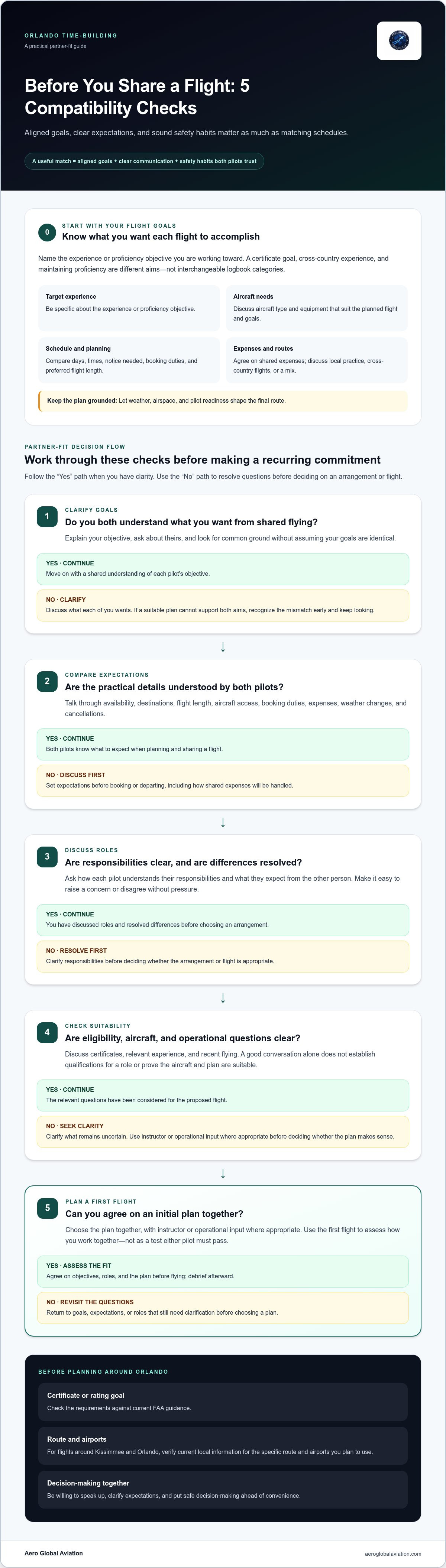
A useful time-building match combines aligned goals, clear communication, and safety habits both pilots trust. Work through these five steps before making a recurring commitment:
- Clarify goals. Explain what you hope a shared flight will accomplish, then ask what the other pilot wants from it. Look for common ground without assuming your objectives are identical.
- Make introductions. Use aviation contacts, pilot communities, or events to start conversations. Briefly explain your experience and the kind of flying you hope to do.
- Compare expectations. Discuss availability, preferred flight length and destinations, cancellations, aircraft access, booking duties, and shared expenses.
- Discuss roles. Ask how each pilot understands their responsibilities and what they expect from the other person. Resolve differences before deciding whether an arrangement or flight is appropriate.
- Plan a first flight. Choose an initial plan together, using instructor or operational input where appropriate. Treat it as a way to assess how you work together, not a test either pilot must pass.
Questions to discuss before agreeing to fly together
Ask about certificates, relevant experience, and recent flying in a neutral, practical way. For example: “What aircraft have you flown lately?” or “What experience are you hoping to gain on this flight?” Share your own background, too. Compare learning objectives, availability, destinations, and preferred flight duration. Agree how you’ll handle bookings, expenses, weather changes, and cancellations. Decide how either pilot can raise a concern or disagree without pressure. A respectful conversation makes it easier to identify what still needs clarification.
Personal rapport is only one part of the decision. Certificate and rating eligibility depends on the proposed operation, while operational suitability depends on the aircraft, conditions, and pilots’ readiness. Don’t treat confidence or experience alone as proof that a planned role is appropriate. For official training information and guidance on requirements, consult the FAA Pilot Training Resources.
Make the first flight a low-pressure compatibility check
Before departure, notice whether both pilots arrive prepared, communicate clearly, and are willing to reassess the plan as conditions change. Afterward, discuss what worked, what felt unclear, and whether your expectations still align. If your broader goal is professional training, the Career Pilot Program provides structured training from Private Pilot License through Commercial Pilot License certification.
Compare Time-Building Partner Arrangements Before You Commit
There’s no single arrangement that suits every pair of pilots. A one-off flight can show how you work together, while a recurring partnership may make planning easier when your goals and schedules align. Safety-pilot flying has a more specific purpose and requires both pilots to understand their roles. Compare the trade-offs before committing, and keep operational responsibility separate from what either pilot may log.
| Arrangement | Coordination and flexibility | Shared responsibilities | Best fit |
|---|---|---|---|
| One-off shared flight | Lower ongoing coordination; flexible if both agree on a single plan. | Agree on the objective, roles, booking, and expense arrangement for that flight. | Pilots testing communication or pursuing a compatible short-term goal. |
| Recurring partnership | More planning to coordinate regular availability; less flexible if schedules change. | Set expectations for scheduling, aircraft access, cancellations, expenses, and how to revisit the arrangement. | Pilots with compatible objectives and dependable availability. |
| Safety-pilot arrangement | Requires planning around simulated-instrument practice and the applicable conditions. | Establish the required roles and responsibilities before flight; log only time supported by the actual roles and rules. | Pilots conducting a flight that calls for a safety pilot, when both meet applicable requirements. |
One-off flights versus a recurring partnership
A one-off flight is a practical way to assess communication without implying a continuing commitment. Agree on the plan, responsibilities, and expense approach for that trip, then decide afterward whether another flight makes sense. A recurring arrangement can support more deliberate planning, but it relies on dependable scheduling and shared expectations. Write down the basics you’ve agreed to and revisit them if availability, objectives, or circumstances change.
Finding time building partners in Orlando may lead to different arrangements, but the same principle applies: sharing expenses does not determine what flight time either pilot may log. Logging depends on the flight’s conditions, each pilot’s role, and applicable FAA rules for that operation. Don’t assume that dividing expenses makes the same hours loggable for both pilots.
Safety-pilot flights and logging responsibilities
A safety pilot serves as the second pilot required for certain simulated-instrument operations, helping maintain visual lookout while the other pilot flies under simulated instrument conditions. Under 14 CFR 91.109(c), a safety pilot must hold a private pilot certificate with the category and class ratings appropriate to the aircraft. The pilot flying and the safety pilot should understand their operational roles before departure. Those duties are separate from logbook treatment: a pilot’s ability to log PIC time depends on the role actually performed and applicable requirements. Confirm current FAA rules and document the flight accurately rather than relying on a blanket assumption.
For pilots planning toward professional flying, partner flights can support experience-building, but they’re one part of a broader path. The Bureau of Labor Statistics’ Airline and Commercial Pilot Career Outlook offers context on the profession, including education and work experience.
Plan Orlando Time-Building Flights with Clear Roles and Safety Checks
A dependable routine makes shared flying easier to prepare for and reassess. For every flight, follow the same sequence: agree on an objective, plan together, brief responsibilities, assess conditions, and debrief afterward. A planned departure time is never a reason to go if weather, aircraft status, airspace, or either pilot’s readiness raises a concern. Be prepared to delay, change the plan, or cancel.
Use this checklist before each flight:
- Objective: Agree on what the flight is intended to accomplish.
- Plan: Review the route, fuel considerations, alternates, and expected workload together.
- Roles: Identify the pilot in command and agree on responsibilities for briefing, navigation, and communications.
- Go/no-go: Review weather, aircraft status, airspace, current charts, NOTAMs, and each pilot’s readiness using authoritative, up-to-date sources.
- Debrief: Compare the plan with what happened and note any changes that should shape future flights.
Agree on the route, roles, and decision-making
Set the objective and divide planning tasks before the day of flight. One pilot might prepare route options while the other reviews weather and NOTAMs, then both discuss the results. Confirm who is acting as pilot in command and how operational decisions will be made. The PIC’s responsibility must be clear. Agree that either pilot can voice a safety concern and that the plan may change if conditions warrant it.
Discuss the route, expected communications, and who will handle each task. For flights around Orlando, verify current airport procedures, airspace, charts, and NOTAMs for the specific trip instead of relying on memory or assumptions about local traffic. Conditions and operational details can change. Check current FAA publications and official aviation weather information before departure, then brief how you’ll respond if the route or conditions differ from the plan.
Review progress after every shared flight
After landing, take a few minutes to compare the plan with the actual flight. Discuss workload, communication, decisions, and any changes made en route. Keep the debrief constructive: identify one thing that worked well and one adjustment for next time. A short review can show whether the partnership is building useful experience or whether the objective, pace, or comfort level needs to change.
Each pilot should record their own flight details and check logbook entries against current FAA requirements. Don’t assume that sharing a flight means both pilots can record the same time in the same way. Each entry should reflect the role actually performed and applicable rules. Revisit the plan when goals, schedules, or comfort levels shift. Deliberate flights can complement structured instruction as you work toward a professional milestone. Explore the Career Pilot Program from PPL through CPL as one structured training pathway.
Connect Time-Building Plans to Your Professional Pilot Path
Shared flights are most valuable when they support a clear next step in your training or career plan. Before agreeing to a flight, compare its objective with your current stage. The experience you’re building should be relevant to your goals, suitable for your proficiency, and accurately recorded. A flight that sounds useful in general may not suit your immediate milestone.
Time-building complements structured instruction; it doesn’t replace lessons, instructor guidance, or applicable certification requirements. If you’re progressing toward a certificate, discuss potential experience-building objectives with your instructor. They can help you distinguish a flight that supports your development from one that may not fit your current training needs. Check the current FAA requirements for the certificate you’re pursuing. Eligibility depends on meeting the applicable requirements, not simply accumulating flight time.
Keep shared flying aligned with training milestones
Map your planned flights to the next milestone in your training. For example, if your immediate focus is cross-country experience, discuss whether a proposed route and plan support that objective and suit your readiness. Keep the goal specific, and avoid treating different experience categories as interchangeable. A commercial pilot training guide can help you understand how training milestones fit into the wider certification process.
Aero Global Aviation Academy’s Career Pilot Program provides structured training from Private Pilot License through Commercial Pilot License certification. This PPL-to-CPL pathway gives you a structured training route to consider alongside partner flights. The career pilot program in Kissimmee and Orlando is one option for pilots looking to connect their current training stage with a longer-term professional goal.
Choose a practical next step for your pilot goals
Before planning your next shared flight, write down three things: your target, your current experience, and the next training milestone you’re working toward. Then compare the flight objective with that list. If the plan doesn’t support your development or feels beyond your readiness, revise it with appropriate instructor input. Clear goals make it easier to explain what you’re seeking in a partner and assess whether a proposed flight belongs in your plan.
Finding time building partners in Orlando can be part of a larger journey toward professional flying, but it works best alongside deliberate training and a sound understanding of requirements. Use partner flights to build relevant experience, reflect on what you learn, and keep your next milestone in view. Explore Aero Global Aviation Academy’s Career Pilot Program as you plan your path from PPL toward CPL.
Turn Your Next Flight Into a Step Forward
A reliable partnership can do more than make it easier to get airborne. It can help you build the discipline to plan, reflect, and make deliberate choices as your aviation goals evolve. After a few flights, pause to consider what you’ve learned, what experience you still need, and whether your plans support your next milestone. That habit keeps your flying connected to the future you’re working toward.
Finding time building partners in Orlando can be one part of a professional path, alongside structured training and current certification requirements. Based in Kissimmee, Aero Global Aviation Academy offers a Career Pilot Program structured from Private Pilot License through Commercial Pilot License certification. Consider how that training pathway fits the direction you want to take.
Explore the Career Pilot Program and take your next step toward the flight deck. Keep your goals clear, fly with purpose, and give your pilot journey room to grow.
Frequently Asked Questions
How do I find a time-building partner in Orlando?
Start with your instructor, classmates, and aviation contacts, then explain your goals and availability clearly. Finding time building partners in Orlando is easier when you can describe what you hope to practice and the schedule you can manage. Ask prospective partners what they’re aiming for, too. An online introduction can open the conversation, but use an appropriate introductory flight and an honest debrief to assess whether working together feels right.
Can two pilots log time on the same flight?
Sometimes, but it depends on the operation and the role each pilot actually performs. For example, the person manipulating the controls and a pilot serving as a required crewmember may have different logging considerations. Sharing expenses or sitting in the same aircraft doesn’t, by itself, determine what either person can record. Check the current FAA requirements that apply to the flight, keep records that reflect what happened, and seek qualified guidance if unsure.
What does a safety pilot do during time-building flights?
A safety pilot helps provide the required visual observation during certain simulated-instrument operations, when the applicable conditions are met. Before flying, discuss who is responsible for aircraft control, communication, and operational decisions, including what happens if either pilot sees a concern. The role doesn’t automatically make flight time loggable. Requirements depend on the operation, so check current FAA rules and make sure each logbook entry reflects the duties actually performed.
Is flying with a time-building partner cheaper?
It may reduce each pilot’s individual outlay when eligible flight expenses are shared, but the result depends on the aircraft arrangement, flight duration, and agreed allocation. Discuss in advance how you’ll handle a route change or a flight that ends earlier than planned. Keep the agreement clear, and don’t let the prospect of splitting expenses push either pilot to fly when weather, aircraft condition, or personal readiness makes the plan unsuitable.
What should time-building partners agree on before flying?
Agree on the objective, scheduling, cancellation process, planning duties, aircraft responsibilities, and expense allocation before the flight. Clarify who is acting as pilot in command and how you’ll handle a disagreement or a change in conditions. A brief written note can help, especially for recurring flights. For example, record who will complete each planning task and how either pilot can raise a concern without feeling obliged to continue.
How can I make Orlando time-building flights more useful?
Choose one clear learning or experience objective for each flight, then check that the route and plan support it. Before departure, review current weather, airspace information, NOTAMs, and applicable rules through authoritative sources. Around Orlando, verify airport procedures and local operational details for the specific trip rather than relying on memory. Afterward, compare the plan with the flight and record your own details while they’re fresh.
Does time-building replace commercial pilot training?
No. Time-building can complement a professional pilot path, but it doesn’t replace instruction or other certificate requirements. Discuss your current experience and training stage with an instructor, then identify which goals belong in structured lessons and which may suit additional flying. Aero Global Aviation Academy’s Career Pilot Program provides structured training from Private Pilot License through Commercial Pilot License certification for students planning a professional path.


