

An intensive flight schedule should compress the calendar, not the learning. The goal of accelerated commercial pilot training Florida students pursue isn’t simply to fly more often. It’s to build skills consistently while giving every lesson, decision, and milestone the attention it deserves.
If you’re considering an accelerated path, it’s natural to wonder whether weather, aircraft scheduling, or your own readiness could disrupt the plan. A faster pace can help maintain momentum, but progress still depends on steady preparation and demonstrated proficiency, not rushing past the fundamentals.
This guide explains what intensive training looks like in practice, how to assess whether the pace fits your schedule and learning style, and why completion-time claims don’t tell the whole story. You’ll also see the key milestones from private pilot training toward a Commercial Pilot Certificate, and how Aero Global Aviation Academy’s Career Pilot Program provides a structured route in the Kissimmee and Orlando area. With a clear view of the process, you can plan toward your professional pilot goal with realistic expectations.
Key Takeaways
- Accelerated commercial pilot training Florida means consistent instruction and study, not skipping the work needed to demonstrate proficiency.
- Use a repeatable learning cycle: prepare, fly, review feedback, study, and demonstrate readiness to move forward.
- Compare intensive and flexible schedules against your availability, study habits, and ability to maintain continuity.
- Plan for travel time, focused study, and possible weather or scheduling changes when organizing training in Kissimmee and Orlando.
- Explore how the Career Pilot Program leads from private training toward commercial certification, and how Airline Pilot Elite continues to advanced instructor certifications.
What Accelerated Commercial Pilot Training in Florida Really Means
Searching for accelerated commercial pilot training Florida can bring up impressive completion-time claims, but speed alone doesn’t explain what a program involves. An intensive route concentrates flight lessons, ground study, practice, and instructor feedback into a regular routine. It does not remove the need to meet applicable eligibility requirements, build sound judgment, or demonstrate the required knowledge and flying skills.
Accelerated training means concentrating the work into a consistent schedule. It doesn’t guarantee a completion date or reduce the proficiency you must demonstrate. Your pace depends on your starting qualifications, preparation, progress, and circumstances that affect training continuity. Florida is a popular place to pursue flight training, but location alone doesn’t make every program or timeline the same.
What does accelerated commercial pilot training include?
Expect training to involve more than time in the aircraft. Prepare for lessons, practise relevant knowledge, fly with an instructor, receive feedback, and review what needs more attention. This cycle turns each flight into a step toward reliable performance rather than a box to check. The exact sequence depends on your starting point and training structure.
Commercial certification is a milestone with eligibility, experience, knowledge, and practical skill requirements under the applicable FAA rules. Requirements can vary with the training pathway, so don’t treat one school’s advertised duration as a universal promise. For a general overview of the credential and how it differs internationally, see Commercial Pilot Licence. A certificate can permit certain paid flying, but it doesn’t guarantee a particular job or complete an airline-career pathway.
Who may benefit from an intensive pace?
An intensive schedule may suit you if you can reliably protect time for lessons, preparation, review, and rest. Consistent practice can help you revisit skills while they’re still fresh and apply instructor feedback in subsequent training. It also requires sustained focus: fitting lessons around an unpredictable schedule can make continuity harder to maintain.
Readiness isn’t measured by speed. Students bring different experience, responsibilities, and learning needs, and progress may vary as new skills take shape. A flexible pace can be a thoughtful choice if it helps you stay prepared and engaged. In either format, the aim is steady development and demonstrated proficiency, not reaching a date at the expense of sound learning.
It also helps to separate commercial certification from the broader goal of becoming an airline pilot. Commercial training is one important professional milestone; an airline career can involve further qualifications, experience, and selection steps. For students in Kissimmee and Orlando, Aero Global Aviation Academy’s Career Pilot Program provides a structured progression from Private Pilot License training through Commercial Pilot certification. The broader Airline Pilot Elite program continues toward advanced instructor certifications. These pathways lay out potential training milestones without promising a fixed completion time.
How Intensive Commercial Pilot Training Builds Skill Without Skipping Steps
A faster training rhythm works only when each lesson builds on the last. For students considering accelerated commercial pilot training Florida, the key is to use the time between flights deliberately, so new knowledge and skills are prepared, practised, and assessed rather than rushed.
A compressed calendar does not remove certification standards. You still need to meet applicable eligibility requirements and demonstrate the required aeronautical knowledge and flying proficiency. Exact FAA requirements depend on the training pathway and current regulations, while a school’s syllabus sets out how its program organizes instruction. For a general overview of the Part 61 commercial certificate pathway, consult AOPA Commercial Pilot Certificate Information, and verify current FAA rules and program-specific details before relying on exact requirements.
How does a consistent lesson rhythm support learning?
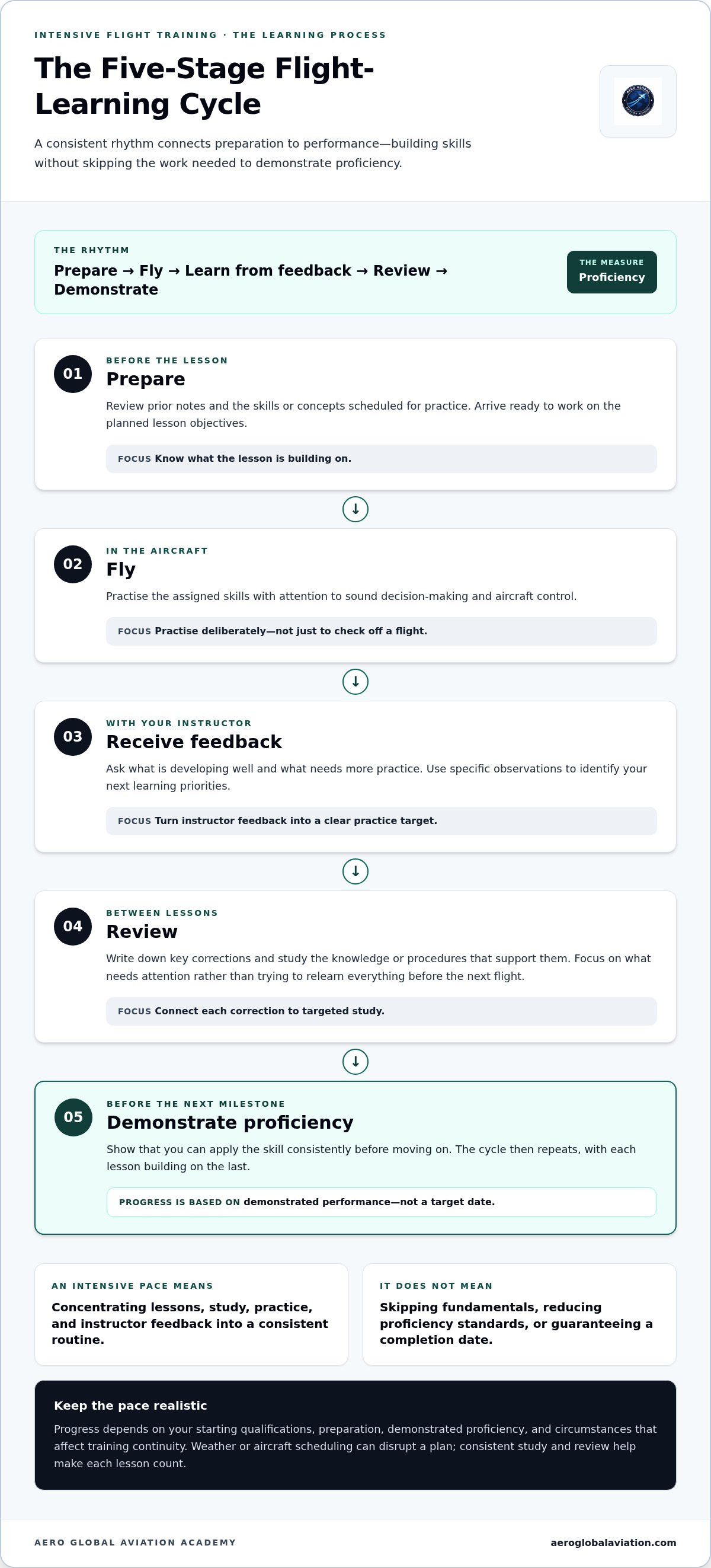
A reliable rhythm connects preparation to performance. Before a lesson, review your notes and the skills or concepts scheduled for practice. Afterward, use the instructor’s feedback to decide what to revisit. This makes study more focused than trying to relearn every detail just before the next flight.
- Prepare: Review prior notes and arrive ready to work on the planned lesson objectives.
- Fly: Practise the assigned skills with attention to sound decision-making and aircraft control.
- Receive feedback: Ask your instructor to identify what is developing well and what needs more practice.
- Review: Write down key corrections and study the knowledge or procedures that support them.
- Demonstrate proficiency: Show that you can apply the skill consistently before moving on to the next milestone.
For example, if a manoeuvre needs more precise control, focus your next preparation on the instructor’s specific observations instead of repeating the entire lesson without a clear goal. Regular progress reviews can reveal gaps early, before an inconsistent technique becomes a habit. The cycle then repeats, with each lesson guided by what you’ve already learned.
What happens when a student needs more practice?
Sometimes a skill takes additional instruction to become consistent. That’s a normal part of learning to fly, not proof that you’ve failed or that an intensive approach can’t work for you. A planned schedule creates momentum, but it can’t predict exactly how much practice every student will need for every task.
Progress should follow demonstrated ability and sound safety practices. If your instructor identifies an area that needs attention, take time to understand the correction, practise it, and review it again. Moving forward when you’re ready supports stronger performance across later lessons and milestones. A responsible plan leaves room for this learning process instead of treating a target date as the measure of success.
At Aero Global Aviation Academy, students in the Kissimmee and Orlando area can follow a structured Career Pilot Program route toward commercial certification, with progress organized around training milestones rather than a promised finish date.
Accelerated vs. Flexible Commercial Pilot Training: Which Pace Fits You?
The best training pace is the one you can sustain. An intensive schedule can build momentum when you have dependable time for lessons and preparation. A flexible schedule may fit better if work, family, or changing commitments make regular availability harder. Compare the practical demands, not just the advertised timeline, before deciding.
Schedule commitment
Intensive: Protect regular, frequent training blocks. Flexible: Fit lessons around other responsibilities, with timing that may vary.
Study time
Intensive: Set aside consistent preparation and review time alongside lessons. Flexible: Study around your available hours, while still keeping up with the work between flights.
Continuity
Intensive: Closely spaced lessons can help keep skills and feedback fresh. Flexible: Longer gaps may require extra review to reconnect with previous lessons.
Flexibility
Intensive: A committed routine leaves less room to shift plans. Flexible: A variable schedule can better accommodate work, family, and other obligations.
Planning challenges
Intensive: Protecting time for travel, rest, and study can be demanding. Flexible: Irregular availability or longer breaks can make steady progress harder to plan.
Choose the fastest sustainable pace that preserves preparation and proficiency. If you're considering accelerated commercial pilot training Florida programs, assess your actual weekly routine before committing to an intensive plan.
Is an intensive schedule realistic for your life?
Look beyond the hours spent in a lesson. Map out time for flying, ground study, travel to training, and recovery, then account for work shifts, family responsibilities, and the routine tasks that fill your week. Be honest about what you can protect consistently. If preparation time disappears whenever life gets busy, closely spaced lessons may not deliver their full benefit.
A simple test is to identify the regular blocks you can reserve for training and study, then consider what happens when one is disrupted. A schedule with some breathing room is often more sustainable than one that works only under perfect conditions.
How can Florida weather affect training continuity?
Weather is one planning factor in Florida, as in any flight-training location. Conditions can change, and a planned flight may need to be adjusted or rescheduled. That doesn’t mean every day is flyable, or that weather affects every student in the same way. Build flexibility into your expectations rather than relying on uninterrupted flying.
Use a disrupted flying day constructively: review lesson notes, prepare for upcoming topics, or work through feedback from a previous flight. Ground study can keep your learning moving even when the aircraft stays parked. For students training around Kissimmee and Orlando, planning for weather-related changes while maintaining a steady study routine can make either pace more manageable.
Planning Accelerated Commercial Pilot Training in Kissimmee and Orlando
Good planning turns an intensive goal into a workable routine. Before beginning accelerated commercial pilot training Florida, map the training milestones you need to reach against your work schedule, family commitments, travel time, and study habits. The aim isn’t to make every week identical. It’s to create enough consistency to keep progressing while leaving room for real life and changes to the flying schedule.
What should you organize before starting in Central Florida?
Start with a typical week, not an ideal one. Reserve repeatable blocks for lessons, ground study, and review, then factor in the trip to training in the Kissimmee and Orlando area. Think through how you’ll protect those blocks during busy periods, too. A simple progress log can help connect each lesson to the next:
- Record the lesson’s goals and what you practised.
- Note instructor feedback and skills to revisit.
- List study tasks to complete before your next lesson.
- Track upcoming training milestones alongside work and personal commitments.
This record gives you a practical view of your progress and makes preparation specific. Use a commercial pilot training plan in Central Florida as a starting point for organizing your schedule around the route ahead.
How can you stay on track when plans change?
Build flexibility into the calendar from the beginning. Weather, aircraft availability, or personal obligations may affect a planned lesson, so avoid making your entire training plan depend on every session going ahead as scheduled. Local operating conditions can shape scheduling; don’t assume that a particular season or location guarantees uninterrupted flying.
If a flight is disrupted, use the time for relevant ground study or to review your instructor’s previous feedback, where appropriate. Then update your plan rather than trying to force every later milestone back onto the original date. Revisit your goals with your instructor and adjust the next steps based on your progress. A realistic schedule supports continuity without treating a change of plan as a setback.
Before training begins, think through how each milestone fits your wider commitments and what you’ll do if a week doesn’t go to plan. A commercial pilot training requirements and steps guide can help you understand the certification journey; turn that information into a schedule you can sustain. Aero Global Aviation Academy’s Career Pilot Program supports progression from Private Pilot License training through Commercial Pilot certification in the Kissimmee and Orlando area. Explore the Career Pilot Program as you plan your next step.
Start Your Commercial Pilot Path with Aero Global Aviation Academy
Choosing a training route starts with knowing your destination. If your immediate goal is a Commercial Pilot Certificate, Aero Global Aviation Academy’s Career Pilot Program provides a structured progression from Private Pilot License (PPL) training through Commercial Pilot certification. Based in the Kissimmee and Orlando area, the academy supports students as they work toward each training milestone.
How does the Career Pilot Program connect PPL and CPL training?
The Career Pilot Program brings private and commercial training together as a connected path. You build from the PPL stage toward commercial certification, with milestones that clarify what comes next. This structure can be useful if you’re planning professional flight training because it lets you think of progress as a sequence of learning goals, rather than one distant finish line.
Students researching accelerated commercial pilot training Florida should distinguish a structured career route from a promise of accelerated availability or a guaranteed finish date. Your starting point, readiness, and progress all matter. A clear pathway helps you understand the intended direction; your development and demonstrated proficiency determine how you move through it.
Aero Global Aviation Academy’s broader Airline Pilot Elite program has a different scope. It continues from private training through advanced instructor certifications, extending beyond the Career Pilot Program’s PPL-to-CPL progression. The right path depends on the milestone you’re aiming for now and how far you want your training to extend.
If the PPL-to-CPL route matches your goal, explore the career pilot program in Kissimmee and Orlando and see how its training milestones fit your plans.
What are your next steps toward professional flight training?
Before you begin, take stock of where you are and what you’re working toward. Write down your current certificates or ratings, your professional goal, and the time you can consistently set aside for lessons, preparation, and review. Use those details to frame a focused discussion about training milestones, schedule expectations, and your readiness.
That preparation makes it easier to connect your ambition with a practical plan. If you’re at the beginning of your flight-training journey, your next step may be building the foundation toward a PPL. If you already hold qualifications, clarify how they relate to your next milestone. In either case, keep proficiency at the center of your decisions and make sure your plan reflects your actual progress.
A commercial certificate is a meaningful professional milestone, not a guarantee of a particular job or the end of every pilot’s training. Build toward it with clear goals, steady preparation, and guidance that keeps the next step in view. Explore Aero Global Aviation Academy’s training path in Kissimmee and Orlando and take the next step toward your aviation career with purpose.
Turn Your Pilot Goal Into a Practical Next Step
The next move isn’t to chase the shortest advertised timeline. It’s to match your starting point, availability, and professional goal with a training path you can approach consistently. That’s the practical way to think about accelerated commercial pilot training Florida: build momentum while keeping readiness and proficiency at the center.
Aero Global Aviation Academy’s Career Pilot Program connects PPL training with the goal of Commercial Pilot certification in the Kissimmee and Orlando area. If you’re considering a broader training destination, Airline Pilot Elite extends through advanced instructor certifications. Think about which milestone matters most to you now, and use that goal to guide your next decision.
Explore the Career Pilot Program at Aero Global Aviation Academy and take a purposeful step toward the professional flying path you want. With a clear goal and a sustainable plan, you can move forward with confidence.
Frequently Asked Questions
What is accelerated commercial pilot training?
Accelerated commercial pilot training organizes instruction and study into a concentrated schedule, with lessons planned to build on one another. The goal is to maintain learning momentum, not reduce the knowledge or flying proficiency required for certification. For example, you might study a topic before a lesson and then apply it during training. The actual pace depends on your starting qualifications, preparation, and progress.
How long does accelerated commercial pilot training take in Florida?
Timelines vary with your starting point and training route. Broad industry estimates place zero-to-commercial accelerated programs at about 6 to 12 months, while some commercial add-on courses for pilots who already hold earlier qualifications take several weeks. These are general ranges, not a promise for any individual student or academy. When evaluating a timeline, consider how it accounts for readiness, training interruptions, and required proficiency.
Can I complete commercial pilot training without already having a Private Pilot License?
Yes, you can begin a training path without holding a Private Pilot License (PPL), but you’ll need to progress through the earlier training milestones before reaching commercial certification. Aero Global Aviation Academy’s Wings Foundation focuses on PPL training, while its Career Pilot Program connects PPL training through Commercial Pilot certification. If you already hold a PPL, your starting point may differ, so map your completed qualifications to the next required steps.
Is accelerated flight training harder than flexible training?
Not necessarily harder, but it can demand more consistent time and attention. Closely scheduled lessons may leave less room to catch up on study if work or personal commitments compete for your focus. A flexible format can spread the workload over a longer period, but long gaps may make it harder to retain recent practice. Consider how you learn and how much time you can reliably devote to preparation.
Does Florida weather affect accelerated flight training?
Yes, weather can affect whether a planned flight can proceed, so an intensive schedule still needs room for changes. Keep study tasks ready for days when flying is disrupted, such as reviewing lesson notes or preparing for upcoming ground topics. Weather varies, and no schedule can assume every planned flight will take place. Build flexibility into your expectations from the outset.
Can I work while completing accelerated commercial pilot training?
Possibly, but the fit depends on your work hours, schedule predictability, and capacity to study outside flight lessons. A job with changing shifts may make it harder to keep a regular training routine than one with predictable hours. Before committing, sketch a typical week that includes work, training, study, travel, and rest. If the plan only works when nothing changes, a more flexible pace may be more sustainable.
Does accelerated commercial training guarantee an airline pilot job?
No. Completing commercial training is a certification milestone, not a job offer. It may support certain paid flying opportunities, but airline hiring can involve additional qualifications, flight experience, and an employer’s selection process. Treat training as one part of a longer professional plan: understand the certificate you’re pursuing, identify the next experience or qualifications your goal may require, and keep your expectations grounded in your individual progress.


