

A strong résumé matters, but it doesn’t tell you whether an instructor can explain a concept clearly, give useful feedback, or adapt when you need more practice. If you’re searching for questions to ask a potential flight instructor Orlando, look beyond flight hours and ratings. Ask how the instructor teaches, discusses safety, and connects lessons to your goals.
Before you start training, clarify how lessons are planned, how progress is reviewed, and how schedule changes are handled. The right conversation can help you compare teaching approaches and decide what kind of support you need, whether you’re beginning private pilot training or working toward a professional career.
Use this checklist to ask about lesson preparation, feedback, safety discussions, progress tracking, and communication. In Kissimmee and Orlando, Aero Global Aviation Academy offers structured pathways from initial pilot training through commercial and advanced instructor certifications. Understanding how a training plan supports your next milestone can help you make a more informed choice.
Key Takeaways
- Look beyond credentials: consider whether the instructor’s communication, teaching style, and approach to safety suit your learning needs.
- Use the questions to ask a potential flight instructor Orlando checklist to compare lesson planning, feedback, progress discussions, and logistics.
- Ask how lessons are prepared and debriefed so you know what to practice and how to prepare between flights.
- Discuss scheduling, weather-related changes, and communication to understand how lessons can fit your routine in Kissimmee and Orlando.
- Connect instructor fit to your next milestone, from PPL training through commercial pilot training and advanced instructor certification.
Questions to Ask a Potential Flight Instructor in Orlando Before Your First Lesson
A good instructor fit involves more than credentials. You also need to understand how the instructor explains concepts, handles safety discussions, responds to questions, and relates lessons to your goals. Use an initial conversation to explore these points and decide whether the approach suits you.
Think of this checklist as a guide, not a formal interview. Choose the questions that matter most, explain what you hope to learn, and ask for examples. A specific explanation of how lessons work can tell you more about the day-to-day teaching approach than a list of qualifications alone. For background on the role and its privileges, see this Flight Instructor Overview and Requirements.
Printable first-conversation checklist
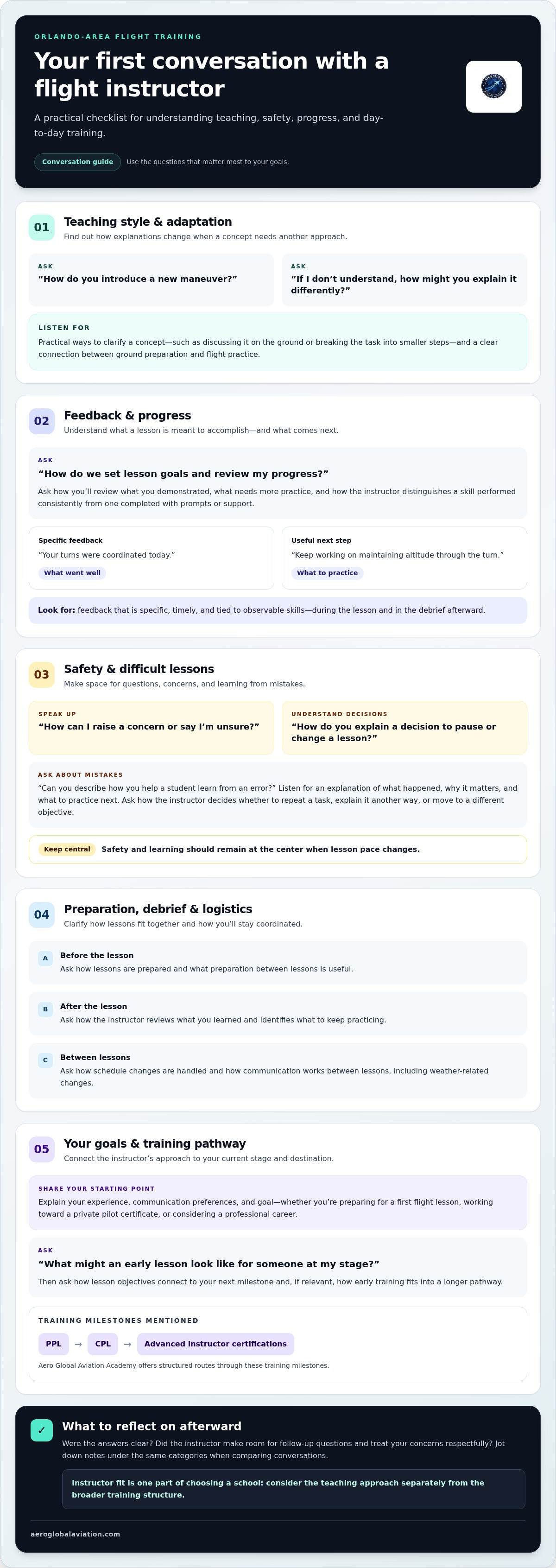
- Teaching: How do you introduce a new maneuver? If I don’t understand an explanation, how might you approach it differently? How do ground discussion and flight practice connect?
- Safety: How can I raise a concern or say I’m unsure? How do you explain a decision to pause or change a lesson?
- Progress: How do you set lesson objectives and discuss what I’ve learned or should keep practicing?
- Logistics: How do you coordinate preparation, schedule changes, and communication between lessons?
How do you adapt lessons to different learning styles?
Ask for an example: “If I’m having trouble understanding a maneuver, what might you try next?” Listen for practical ways to clarify the concept, such as discussing it on the ground or breaking the task into smaller steps. You’re not looking for a single method that works for everyone. You’re trying to understand whether the instructor checks your understanding and adjusts the explanation when needed.
Ask how ground preparation connects to the flight practice that follows. A useful answer should make that relationship clear while recognizing that lessons may vary according to your needs and training objectives.
What should a first conversation help you understand?
Give the instructor a concise picture of your experience, communication preferences, and destination. You might be preparing for your first flight lesson, working toward a private pilot certificate, or considering a professional career. Then ask, “What might an early lesson look like for someone at my stage?” The answer can help you understand what to expect without requiring a fixed script.
Pay attention to how the conversation feels as well as what’s said. Are answers clear? Does the instructor make room for follow-up questions and treat your concerns respectfully? Afterward, jot down a few notes under the same categories you use for other conversations. That makes comparisons more useful. The phrase questions to ask a potential flight instructor Orlando is a starting point for your checklist; your priorities should reflect your own goals.
Instructor fit is one part of choosing a school. Keep the conversation about teaching separate from questions about the broader training structure. That way, you can assess both the instructor’s approach and how the training pathway supports your destination.
Ask About Teaching Style, Feedback, and Your Training Progress
Good instruction should leave you with a clear sense of what a lesson was meant to accomplish and what to work on next. Ask how the instructor sets objectives, reviews your performance, and helps you prepare between lessons. Look for an explanation of how learning is monitored, rather than general reassurance that you’re doing fine.
Useful feedback is specific, timely, and tied to observable skills. “Your turns were coordinated today” identifies something that went well. “Keep working on maintaining altitude through the turn” gives you a clear area to practice. Ask how you’ll receive feedback during a lesson and in the debrief afterward.
How will we set goals and review progress?
Ask, “How do we agree on lesson goals, and how will we revisit them?” A clear process might include identifying the skills for the lesson, reviewing what you demonstrated, and deciding what needs more practice. Ask how the instructor distinguishes a skill you can perform consistently from one you’ve completed with prompts or support.
Your goals should inform training priorities. If you’re working toward a private pilot certificate, ask how lesson objectives relate to that milestone. If you’re aiming for a professional career, ask how early training fits into a longer pathway. Aero Global Aviation Academy offers structured routes from PPL through CPL and advanced instructor certifications, connecting lesson-level goals with broader training milestones.
How do you handle mistakes and difficult lessons?
Ask, “Can you describe how you help a student learn from an error?” Listen for an explanation of what happened, why it matters, and what to practice next. A challenging lesson doesn’t have to become discouraging. The instructor should be able to explain how they adjust the pace while keeping safety and learning at the center.
You can also ask how the instructor decides whether to repeat a task, explain it another way, or move to a different objective. A thoughtful answer recognizes that extra practice is part of learning. It should give you more than vague praise or pressure to progress before you’re ready.
Make the conversation practical by asking what preparation between lessons is useful, such as reviewing notes or thinking through a specific concept. Find out what you can bring to the next debrief, including questions, uncertainties, or skills you’d like to revisit. The goal is an ongoing exchange, not a one-way evaluation.
If you want to understand the regulatory framework separately from an instructor’s teaching approach, consult the Official FAA Regulations for Flight Instructors. Your questions to ask a potential flight instructor Orlando can help you learn how the instructor turns standards into understandable learning goals. Regulatory language isn’t a substitute for clear teaching.
As you compare answers, note whether the instructor explains how progress is reviewed and connects training priorities to your destination. If you’re considering a structured route in Kissimmee or Orlando, explore Aero Global Aviation Academy’s pilot training pathways to see how lesson goals can align with broader milestones.
Evaluate an Instructor’s Safety Mindset and Professional Experience
Experience and credentials matter, but they answer different questions from teaching fit. A certificate or rating describes a qualification; it doesn’t show by itself how an instructor explains risks, listens to a student, or responds when plans change. Use the questions to ask a potential flight instructor Orlando to explore both the qualifications relevant to your training and the instructor’s approach to teaching.
Which experience and ratings are relevant to my goals?
Ask which certificates and instructor ratings relate to the stage of training you’re considering. Then invite the instructor to explain how their teaching experience connects to your immediate objectives. Ask for the exact certificate or rating name instead of relying on a broad description such as “experienced pilot.” Qualifications are important context, but they don’t replace a discussion about instruction, communication, and fit.
For terminology and the applicable framework, consult official FAA regulations. The AOPA Resources for Pilot Training and Safety can also help you think about safety as an ongoing part of pilot development. During your conversation, notice whether the instructor welcomes reasonable questions and explains their approach to decision-making.
How do you teach risk management and decision-making?
Ask how weather, workload, and changing conditions enter lesson discussions, and how students can speak up if they’re uncertain. For example: “If conditions or plans change, how would you explain the options and the decision?” A considered answer should allow for pausing, revising a plan, or making another safe choice, with reasoning you can learn from.
Compare answers with curiosity, not as a pass-or-fail test. If a response is brief, ask a follow-up. Look for a willingness to discuss judgment clearly and respectfully.
Comparing responses: prompts for a follow-up conversation
- Reassuring answer: “I’d explain the concern and talk through the choices with you.” This suggests openness to questions and a learning-focused discussion. Follow up: “How would you help me understand the decision?”
- Worth discussing further: “We just go with the plan,” without explaining how changing conditions are considered. This doesn’t prove an instructor is unsafe, but it leaves an important question unanswered. Follow up: “What might lead you to pause or change the plan?”
- Reassuring answer: The instructor names relevant experience and explains how it applies to your training stage. Follow up: “Which qualification or experience is most relevant to that lesson?”
- Worth discussing further: Broad claims about expertise without clear details. Ask for the exact certificate or rating terminology and how the experience relates to your goals.
Assess the explanation, not just its polish. A safety-minded instructor should be able to discuss uncertainty without dismissing it, explain decisions without blame, and make clear that a plan can change. These habits help you judge whether the instructor’s experience is matched by communication and decision-making you can learn from.
Use These Orlando-Area Questions to Clarify Scheduling and Training Logistics
A training plan needs to work in your calendar as well as on paper. If you’re traveling from Orlando or Kissimmee, the trip to the training location can affect how easily lessons fit around work, school, and other commitments. Clarify how scheduling and communication work before you begin so you can decide whether the routine is sustainable.
What should you ask about lesson frequency and cancellations?
No single schedule suits every student. Explain your typical availability and ask how lessons are arranged and how changes are communicated. Include weather in the conversation: flying plans can change with conditions, so find out how you’ll be notified and how the lesson might be replanned. A clear process helps you know what to expect without assuming every change will be handled the same way.
How does Orlando-area training fit your longer-term plan?
Ask how local conditions factor into lesson preparation and decision-making, without expecting a promise about what a particular flight will involve. Consider the practical journey too: how long will it take to reach the training location, and can you make that trip consistently? These details matter whether your next milestone is a PPL, CPL, or advanced instructor training.
Use this numbered checklist to guide the logistics conversation:
- 1. Lesson rhythm: How do students coordinate lesson times, and what schedule could fit my work or school commitments?
- 2. Changes and cancellations: How should I communicate if I need to reschedule, and how are weather-related changes shared?
- 3. Replanning: If conditions change, how do we decide whether to adjust the lesson, reschedule, or work on another training objective?
- 4. Preparation: What should I review or bring before a lesson, and how will I know if the plan has changed?
- 5. Travel and goals: How should I account for travel time to the training location, and how can a workable routine support my certificate or career objective?
Keep the conversation grounded in your actual schedule. For example, explain if your classes vary by day, then ask how lesson planning and schedule changes are communicated. You’re looking for clear expectations, not a guarantee that every preferred time will be available.
If you’re still deciding whether flight training feels right, reading about a discovery flight can help you understand what an introductory flying experience may involve. Treat it as a way to learn more, not a substitute for discussing how ongoing lessons, schedule changes, and your goals will be handled.
Your questions to ask a potential flight instructor Orlando should connect logistics to your destination: a manageable routine can help keep training aligned with your next milestone. Explore pilot training pathways in the Kissimmee and Orlando area to consider how structured training can support your goals from PPL onward.
Choose an Instructor Who Supports Your Pilot Goals at Aero Global Aviation Academy
Your notes should help you judge whether an instructor’s approach matches your needs: clear explanations, thoughtful safety discussions, useful feedback, and an understanding of where you want your training to lead. No single answer determines fit. Look for a consistent pattern of listening, explaining decisions, and connecting instruction to your next milestone.
Keep the instructor conversation distinct from the wider school decision. Consider the training structure and how it supports your plans, too. The questions to ask a potential flight instructor Orlando are most useful when you assess the answers against your priorities, rather than an imagined one-size-fits-all instructor.
Match instructor conversations to your training stage
If you’re new to flying, focus on how foundational lessons can build toward a Private Pilot License (PPL). At Aero Global Aviation Academy, the Wings Foundation is the PPL-only pathway. Ask how an instructor would help you understand the early learning steps and how your questions will be addressed as you gain experience.
For career-minded students, the Career Pilot Program guides training from PPL through Commercial Pilot License (CPL). If you’re looking further ahead, Airline Pilot Elite extends through advanced instructor certifications. In each case, ask how instruction at your current stage relates to your longer-term destination.
Turn your checklist into a confident next step
Review your notes while the details are fresh. Which answers were specific? Did the instructor explain how you’ll learn, receive feedback, and raise concerns? Can you picture the schedule and communication working with your routine? Comparing the answers with your priorities can make your decision more grounded than relying on credentials or first impressions alone.
You can also read a discovery-flight guide to understand what an introductory flight may involve, then use that perspective to shape any remaining questions. For broader planning, a career pilot program guide and a school-evaluation checklist can help you consider how instructor fit relates to the training pathway and the school’s structure.
Aero Global Aviation Academy serves aspiring pilots in Kissimmee and Orlando with foundational, career-oriented, and advanced training pathways. Whether you’re beginning with PPL training, planning toward CPL, or considering advanced instructor development, choose a next step that fits your goals. Explore pilot training pathways at Aero Global Aviation Academy to see how a structured route can support your aviation plans.
Take the Next Step Toward Your Pilot Goals
Your first conversation with an instructor is a chance to build habits that will carry into the cockpit: curiosity, preparation, and a willingness to keep learning. Use the questions to ask a potential flight instructor Orlando as a starting point, then bring your goals and concerns into the discussion. You don’t need every detail settled before taking the next step. Start by clarifying what you want to work toward and what kind of training relationship will help you progress.
Aero Global Aviation Academy offers structured training pathways for aspiring pilots in Kissimmee and Orlando. Explore how your next milestone could take shape, whether you’re just beginning or planning a professional future.
Explore pilot training pathways at Aero Global Aviation Academy and take your next step toward the cockpit.
Frequently Asked Questions
Is it okay to change flight instructors if the teaching relationship is not working?
Yes. You can respectfully explain what isn’t working and what would help you learn more effectively. Before requesting a change, identify the specific concern: explanations may feel unclear, lesson plans may be hard to follow, or scheduling may create a recurring problem. Describe a recent example rather than making a personal judgment. That gives the school a practical starting point for discussing an adjustment that supports productive, safe training.
Can I meet a flight instructor before starting lessons?
Yes. Ask about speaking with an instructor before lessons begin. Notice whether you can follow the explanations and feel comfortable asking basic questions. One conversation can offer useful context, though it won’t show every part of a longer training relationship. Afterward, consider what you learned about communication and whether the approach seems aligned with your goals.
How do I know if a flight instructor is a good fit for a beginner?
A beginner-friendly instructor explains unfamiliar ideas patiently and checks that you understand before adding complexity. You should be able to say, “I’m not following that yet,” and receive a useful response rather than feeling rushed. Ask how the instructor might introduce a new task to someone with no flying background. The questions students in Orlando ask should reveal how the instructor supports learning, not promise that every lesson will feel easy.
What should I bring to a first meeting with a flight instructor?
Bring a short question list, an idea of what you hope to achieve, and any experience you’d like to share. You might mention that you’re new to aviation, have taken an introductory flight, or are exploring pilot training as a career. If you’re comparing conversations, take notes under the same headings each time. You don’t need technical vocabulary; ask in plain language and request clarification if an answer is unclear.
Should I choose an instructor based on total flight hours alone?
No. Flight hours can provide context, but they don’t show how well someone teaches or whether their experience matches your training stage. Ask which qualifications and experience relate to the instruction you’re seeking, then consider how clearly the instructor explains concepts and responds to questions. An instructor may have substantial experience, but you still need to understand how they’ll help you build skills for your next milestone.
What if weather repeatedly disrupts flight lessons in the Orlando area?
Ask how the instructor communicates weather-related changes and what the revised plan might include. If a lesson can’t proceed as planned, it may still be possible to review concepts or prepare for a future flight, depending on the situation. For students training around Kissimmee and Orlando, find out how updates are shared before making the trip. Weather decisions should support safe training, not pressure anyone to fly.
Do I need to know whether my training follows Part 61 or Part 141 before speaking with an instructor?
No. You can ask about the training structure in your first conversation. Invite the instructor to explain how the applicable program shapes lesson organization, training records, and progress toward your goal. Don’t assume one option is automatically a better fit; the right questions depend on your circumstances and plans. If the answer includes regulatory details, consult current FAA materials or ask for a plain-language explanation you can verify.


