

What separates a capable pilot from an instructor students trust to learn from? Earning a certificate is an important milestone, but knowing how to be a successful flight instructor means turning sound standards into clear, repeatable lessons that help students understand what to do, why it matters, and how to improve.
If you’re unsure how to explain a complex maneuver, respond to a student’s mistake, or build confidence through teaching experience, start with a consistent, safety-first approach. Flight instruction carries real responsibility. It also takes patience, clear communication, and the judgment to try a different explanation when the first one doesn’t click.
This guide covers practical ways to brief and demonstrate maneuvers, manage errors without losing sight of safety, give useful feedback, and gain experience that supports your next career step. For career-oriented pilots in Kissimmee and Orlando, instructor training can also be part of a broader professional journey, including the advanced instructor certifications covered by Aero Global Aviation Academy’s Airline Pilot Elite program.
Key Takeaways
- Strong piloting skills matter, but effective instruction also depends on communication, preparation, awareness, and thoughtful assessment.
- Use a consistent lesson sequence to guide teaching, while keeping safety decisions active from briefing through debrief.
- Help students explain concepts in their own words and track what they can demonstrate over time.
- Review lessons, invite feedback, practise specific teaching skills, and protect student privacy when discussing instruction.
- Compare self-directed preparation with structured training as you plan your next step toward advanced instructor certifications.
What Does It Mean to Be a Successful Flight Instructor?
A successful flight instructor helps learners make safe, steady progress by combining sound piloting, clear explanations, careful preparation, and professional judgment. The goal isn’t simply to complete a planned lesson or guide a student through a checkride. It’s to help them understand what they’re doing, recognize why it matters, and apply that learning with increasing independence. Strong flying skills provide an essential foundation, but teaching requires additional preparation: instructors must organize information, explain it in usable steps, and adjust when a learner needs a different approach.
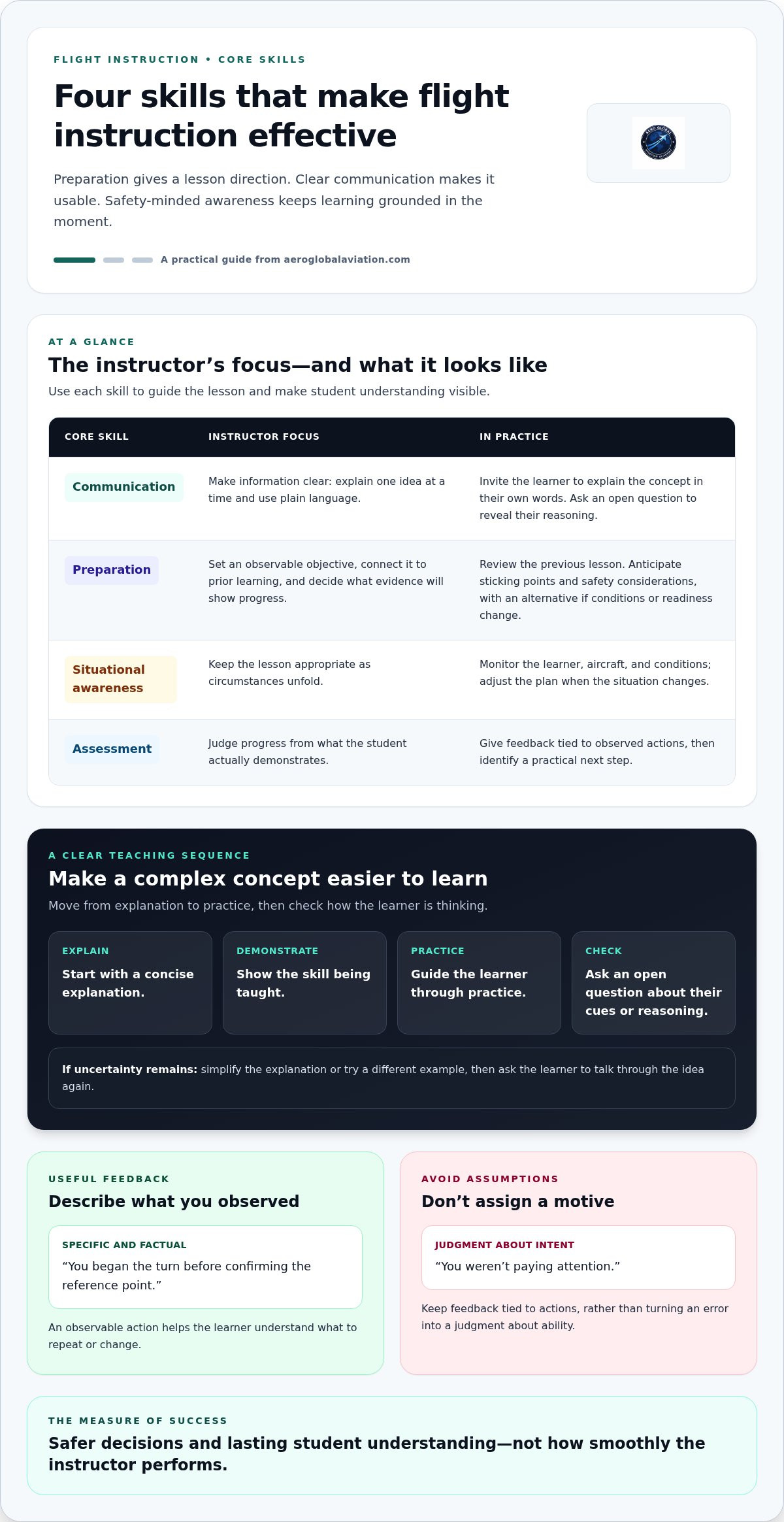
Flight-instructor success is measured by safer decisions and lasting student understanding, not by how smoothly the instructor performs. Use that principle to guide how you plan, teach, and assess each lesson.
How is instructor success different from pilot proficiency?
Pilot proficiency focuses on the pilot’s own knowledge, control, and decision-making. Instruction adds another responsibility: make those decisions visible so a learner can follow the reasoning, not just watch the result. For example, when weather affects a plan, explain which cues matter, how they change the options, and what information the student should consider. Then ask the student to describe a reasonable next step. Their reasoning shows more than a polished demonstration alone.
If a learner remains unsure about a maneuver, repeating the same explanation louder or faster may not help. Try a different entry point: break the maneuver into smaller phases, sketch the sequence, or connect each action to a visual cue. Then ask the learner to talk through the steps. Their explanation helps you identify what they understand and where another example or question could help.
A general overview of the Flight instructor role provides useful background, but day-to-day teaching quality depends on how effectively an instructor turns knowledge into learning.
What responsibilities shape a flight instructor’s role?
Good instruction begins before engine start. Prepare a lesson with a clear objective, suitable references, and a plan that accounts for the student, aircraft, and conditions. During the lesson, explain expectations plainly and stay alert to changing risks. Afterward, give specific feedback: identify what the learner demonstrated, what needs more practice, and what to focus on next. Accurate progress notes help connect future lessons to the student’s development.
Professional judgment also means knowing the boundaries of your role. Instructors must operate within their certificate privileges and limitations and teach in line with applicable standards. Requirements can depend on the certificate, rating, and activity, so don’t rely on memory or informal advice when making a regulatory decision. Verify current eligibility, privileges, limitations, and certification details against FAA publications before applying them. Careful preparation and clear boundaries support both the learner’s development and a dependable safety culture.
Build the Core Skills That Make Flight Instruction Effective
Effective instruction depends on more than knowing the aircraft and maneuver. A flight instructor needs to make information clear, plan lessons with purpose, notice when conditions or a learner’s workload change, and assess progress through what the student actually demonstrates. These skills work together: preparation gives a lesson direction, communication makes it understandable, and situational awareness helps keep it appropriate as the lesson unfolds.
- Communication: Explain one idea at a time, use plain language, and invite the learner to describe the concept back in their own words.
- Lesson preparation: Set an observable objective, connect it to prior learning, and decide what evidence will show progress.
- Situational awareness: Monitor the learner, aircraft, and conditions, and adjust the plan when the situation changes.
- Assessment: Give feedback tied to observed actions, then identify a practical next step.
Preparation gives instruction direction, communication makes it usable, and safety-minded awareness keeps learning grounded in the moment.
How can an instructor explain complex flying concepts clearly?
Start with a concise explanation, demonstrate the skill, and then guide the learner through practice. Pause to check understanding with an open question such as, “What cues will tell you it’s time to adjust?” This reveals the learner’s reasoning better than a yes-or-no question. If the answer shows uncertainty, simplify the explanation or use a different example, then ask the learner to talk through the idea again.
Keep feedback factual. “You began the turn before confirming the reference point” describes an observable action; “You weren’t paying attention” assumes a motive. Specific observations help learners understand what to repeat or change without turning one error into a judgment about their ability.
How should instructors prepare for each lesson?
Write an objective that fits the student’s current stage and applicable standards. Make it observable: the learner should be able to explain a decision, identify a cue, or perform a defined task to the expected standard. Review the previous lesson so the new goal builds on something familiar instead of feeling like an isolated exercise.
Think ahead, too. Identify likely sticking points, relevant safety considerations, and an alternative if conditions or learner readiness make the original plan unsuitable. Decide what you’ll watch and listen for to judge progress. Afterward, use those observations to plan the next lesson rather than relying on a general impression that it “went well.”
Developing these habits is part of becoming an effective instructor. For ongoing professional learning and practical CFI resources, explore AOPA Flight Instructor Resources. Career-oriented pilots in Kissimmee and Orlando can also explore how advanced instructor training fits into a broader aviation pathway through Aero Global Aviation Academy’s Airline Pilot Elite program, which spans Private Pilot training through advanced instructor certifications.
How to Teach Flight Lessons Safely: Briefing to Debrief
A safe lesson follows a clear sequence, but it shouldn’t run on autopilot. Use the objective and the learner’s readiness to guide each stage, then keep reassessing as the flight develops. Conditions, workload, or a student’s understanding may change, so safety decisions remain active in the air as well as during preflight planning.
- Prepare: Set an objective suited to the learner’s current stage. Review relevant procedures, likely challenges, conditions, and alternatives if the planned lesson no longer fits.
- Brief: Explain the goal, sequence, roles, and relevant risks in plain language. Ask the learner to talk through key decisions so you can address gaps before the flight.
- Teach: Demonstrate or explain the task, then let the learner practise. Give only the prompts needed to support safe, purposeful learning.
- Monitor: Stay attentive to aircraft control, conditions, and workload. If risk rises or the learner becomes overwhelmed, intervene or adjust the plan instead of pressing on to finish the exercise.
- Debrief: Compare what happened with the objective. Discuss evidence from the lesson, identify a useful next step, and give the learner time to reflect.
- Record progress: Use the school’s established process to document the lesson and agreed priorities, creating a reliable reference for future instruction.
The amount of prompting should match both the task and the learner’s readiness. A student who can explain the plan and recognize relevant cues may be ready for more independent practice. A learner who is unsure or overloaded may need a clearer prompt, a pause, or a change of plan. Build independence progressively, never at the expense of sound risk management.
A structured debrief turns each flight into evidence the learner can use for the next one. Keep the objective visible, respond to what’s happening, and make the next step clear.
What belongs in a useful preflight briefing?
Keep the briefing focused on the day’s objective, the planned sequence, who is responsible for each task, and the risks that matter for the lesson. Invite the learner to explain a key decision or describe what would prompt a pause or change of plan. Adapt the detail to the learner’s preparation and the day’s conditions. A briefing should prepare, not overwhelm.
How can instructors make debriefs lead to progress?
Begin with the learner’s self-assessment: what felt clear, and where did they need help? Add focused observations tied to the objective, including what they did effectively and what needs practice. Choose one or two actionable priorities, agree on a next step, and record progress through the school’s established process. Specific feedback gives the next lesson a practical starting point.
How to Keep Improving as a Flight Instructor
Certification marks the start of a teaching career, not the end of learning. Build a simple improvement cycle into your work so useful observations turn into better lessons:
- Review: After a lesson, note where the learner made progress and where your explanation, timing, or prompts could have been clearer.
- Seek feedback: Ask a mentor or trusted colleague to discuss a specific teaching challenge, not to judge your overall ability.
- Practise: Choose one behavior to refine, such as asking more open-ended questions or allowing more time for a learner to think.
- Follow up: Apply the adjustment in a later lesson and consider whether it helped the student demonstrate or explain the skill more independently.
Keep the conversation professional. Discuss teaching methods without sharing identifying details about a student, and follow school policies for handling records and confidential information. Peer discussion is most useful when it stays respectful, specific, and focused on better instruction.
How can instructors use feedback without losing confidence?
Treat feedback as information about a teaching behavior, not a verdict on your value as a pilot or instructor. Compare the lesson’s intended outcome with what the learner actually demonstrated and explained. If a student needed repeated prompts to identify a cue, for example, consider whether your explanation or practice sequence prepared them well. Turn one useful observation into a clear goal for the next lesson.
That approach keeps confidence grounded in action. You don’t need to change everything at once. Select a manageable adjustment, try it deliberately, and review what happened. A mentor can help you distinguish a genuine pattern from a one-off difficulty and suggest practical ways to refine your approach.
Which professional habits support long-term effectiveness?
Reliable instruction grows from everyday habits: prepare consistently, maintain accurate records, respect professional boundaries, and create a calm environment where learners can ask questions. Review current FAA publications and applicable school standards as they are updated. Use authoritative guidance when interpreting requirements, and avoid relying on memory for regulatory details that may change.
Ongoing development can also connect teaching experience with wider aviation goals. Explore the advanced flight training guide for context on professional ratings, and consider where instruction fits within your career plans. Effective instructors stay open to improvement while keeping each student’s progress at the center.
For career-oriented pilots in Kissimmee and Orlando, advanced instructor certifications can form part of a broader training journey. The Airline Pilot Elite pathway spans training from Private Pilot through advanced instructor certifications.
Choose a Structured Path to Advanced Flight-Instructor Training
Once you’ve built a foundation in instruction, consider how you’ll prepare for the next stage. Self-directed study offers flexibility, but it puts the responsibility for organizing topics, checking your progress, and finding useful feedback on you. Structured training gives that process a defined framework, with learning objectives, instructor guidance, and progression criteria to help you see what you’ve mastered and where you need more practice.
Neither approach guarantees a particular result or timeline. Your preparation needs, experience, and applicable certification requirements all matter, and FAA rules can change. Use current FAA publications to verify eligibility and requirements for the certificate or rating you’re pursuing. A thoughtful training plan should develop technical knowledge alongside the teaching skills that help you turn knowledge into student understanding.
What should aspiring instructors look for in structured preparation?
Look for a learning process that makes goals and progress visible. Clear objectives show what you’re working toward; consistent evaluation helps identify gaps; and instructor feedback gives you a practical way to address them. Practice teaching is especially valuable because it asks you to explain aviation concepts, respond to questions, and check whether another person understands. For context on the pilot-training stage that can precede instructor development, read this commercial pilot training guide.
As you compare approaches, consider how each helps you move from knowing a procedure to explaining it, assessing a learner’s response, and adapting your teaching. That progression is central to effective instruction. Self-study can strengthen knowledge, while structured preparation can add guided practice and feedback. Choose an approach that reflects how you learn and the experience you bring to training.
How can Kissimmee and Orlando students connect training to career goals?
For students in Kissimmee and Orlando, Aero Global Aviation Academy’s Airline Pilot Elite program offers a pathway spanning training from Private Pilot through advanced instructor certifications. Instructor development can therefore form part of a wider professional-pilot journey, rather than an isolated destination. The airline pilot career path guide can help you consider where instructor training fits into your longer-term goals, without assuming a particular career outcome.
Choose training with care, keep your expectations realistic, and focus on building the knowledge and teaching judgment each stage requires. Explore professional pilot training through the Airline Pilot Elite pathway, from Private Pilot training to advanced instructor certifications.
Take the Next Step in Your Flight-Instructor Journey
Teaching is a craft you continue to shape throughout your aviation career. Choose one area you want to strengthen, then develop it through guided training, mentorship, or deliberate practice. A clear next goal can turn your interest in instruction into purposeful professional progress.
If you’re considering how to be a successful flight instructor, think beyond earning a credential. Build toward the kind of instructor you want to become, and let each stage of training prepare you for greater responsibility and opportunity. Steady progress matters more than rushing toward a milestone.
Aero Global Aviation Academy’s Airline Pilot Elite program connects pilot training with advanced instructor certifications for career-oriented students in Kissimmee and Orlando. Its progression from Private Pilot training through advanced instructor certifications can help you plan your next move.
Explore professional pilot training with Aero Global Aviation Academy and take a purposeful step toward your aviation goals.
Frequently Asked Questions
What makes a flight instructor successful?
A successful flight instructor helps students become safer, more independent pilots by teaching clearly and adjusting to what each learner needs. The practical answer to how to be a successful flight instructor is to focus on what students can understand and apply, not on how impressive a lesson looks. For example, invite a learner to explain a decision in a new scenario to see whether they can apply knowledge beyond a memorized routine.
Do you need airline experience to become a successful flight instructor?
No, airline experience isn’t automatically necessary to be an effective flight instructor. Teaching ability develops through preparation, practice, feedback, and sound judgment, alongside meeting applicable FAA certification requirements. Airline experience may provide useful perspective, but it doesn’t replace the ability to explain concepts or support a student’s learning. Check current FAA publications for the requirements and privileges that apply to the certificate or rating you plan to pursue.
How can a new flight instructor build confidence?
Build confidence through deliberate preparation and small, reviewable goals. Before teaching, rehearse how you’ll introduce a topic and which questions could reveal whether the student understands it. Afterward, write down one thing that worked and one teaching behavior to practise next time. Ask an experienced instructor to discuss a specific challenge, such as how to respond when a learner freezes, rather than seeking a broad judgment of your ability.
What should a flight instructor include in a lesson plan?
A lesson plan should identify its objective, the learner’s prerequisite knowledge, key teaching points, practice activities, and how you’ll judge whether the objective was met. Include relevant references and a backup approach if weather, aircraft status, or learner readiness changes the plan. For a lesson on navigation, for instance, decide which planning decisions the student should explain, not just which route or task they’ll complete.
How do flight instructors handle students who learn differently?
Change the way you present or practise an idea without lowering the applicable standard. A learner who struggles with a verbal explanation might benefit from a simple sketch, a demonstration, or talking through the task in stages. Another may need quiet time to organize a response before discussing it. Ask what part feels unclear, then use a fresh example to check understanding instead of assuming the student lacks ability or effort.
How can a flight instructor continue developing professionally?
Keep learning beyond initial certification by setting a focused development goal, discussing teaching challenges with a mentor, and reviewing current FAA guidance relevant to your work. You might practise giving concise feedback or observe how another instructor introduces a difficult topic, while protecting student privacy. Pilots in Kissimmee and Orlando can also consider how structured training supports longer-term goals, including advanced instructor development, as their experience and aspirations evolve.
Can flight instructing help build a professional pilot career?
Yes, flight instructing can be one way to develop aviation experience while working toward broader professional goals, though it doesn’t guarantee a particular job or outcome. Teaching can strengthen communication, judgment, and the ability to explain operational decisions. For career-oriented students in Kissimmee and Orlando, Aero Global Aviation Academy’s Airline Pilot Elite program connects training from Private Pilot through advanced instructor certifications, making instruction one stage within a wider pilot-training pathway.


