
The city name on a flight school’s website may tell you less than the airport where you’ll actually train. That’s why the Kissimmee vs Orlando for flight training location question is really about airport operations, airspace, and how a school organizes lessons, not just a choice between two nearby cities.
It’s reasonable to ask whether the difference will affect your time in the air, your progress, or the skills you build. Kissimmee Gateway Airport and Orlando-area airports can offer different operating environments, but the right fit depends on the specific airport and training operation a school uses. Your commute and career goals matter, too.
This guide compares locations through practical questions to ask each school: where training takes place, what traffic and airspace you’ll encounter, how lessons fit your schedule, and how the program supports your next milestone. Whether you’re working toward a private pilot certificate or a professional pathway, you’ll be better prepared to choose a training environment that fits your goals instead of relying on broad claims about a city.
Key Takeaways
- For the Kissimmee vs Orlando for flight training location decision, compare the school’s actual training airport and operation, not just the city name.
- Ask each school the same questions about airport access, commute, lesson scheduling, and student support.
- Consider how the airport environment and routes to practice areas may shape the skills you develop as training progresses.
- Match your training pathway to your goal, whether you’re beginning with private pilot training or planning toward commercial and instructor certifications.
- Aero Global Aviation Academy serves the Kissimmee and Orlando area, with training options to explore once you’ve clarified your priorities.
Kissimmee vs. Orlando for Flight Training: What Are You Actually Comparing?
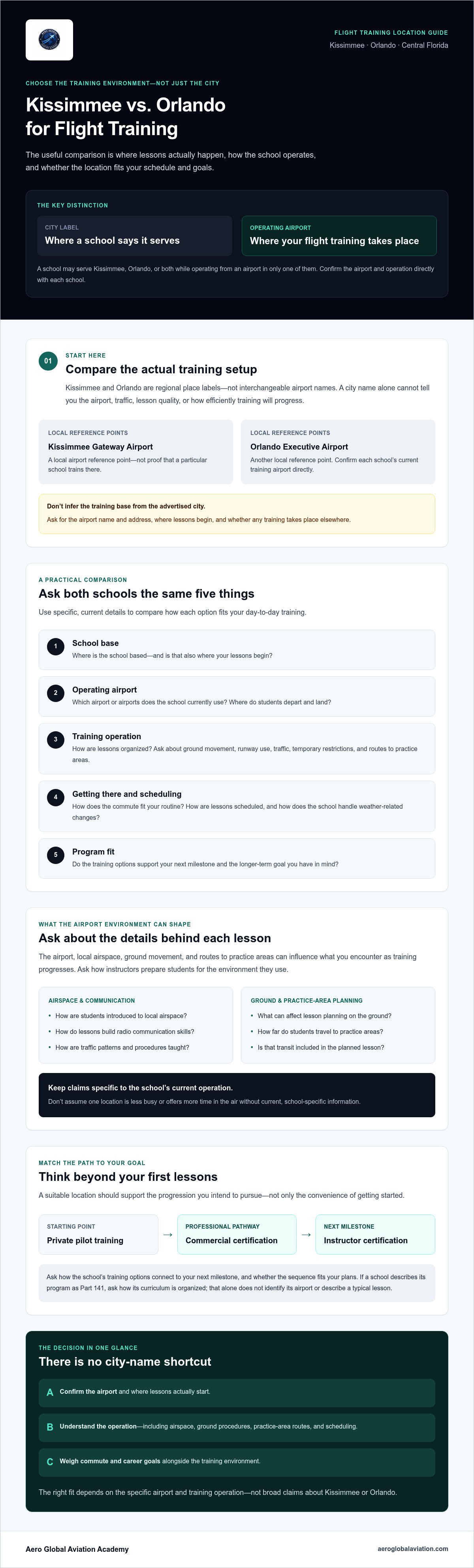
Kissimmee and Orlando are regional place labels, not interchangeable airport names. A school may serve both communities while operating from an airport in only one of them. Its name or marketing therefore doesn’t tell you where lessons begin or what the day-to-day training environment is like.
A flight-school location is where the school is based; its operating airport is where your flight training actually takes place. To compare schools fairly, check five things: the school’s base, the airport it uses, how its training operation works, how you’ll get there, and whether its programs fit your goals. A city label alone can’t establish airport traffic, lesson quality, or how efficiently your training will progress. Ask each school for current, specific details.
Kissimmee and Orlando are part of one broader training market
Schools may describe their service area as Kissimmee, Orlando, or both because they serve students across the wider region. Kissimmee Gateway Airport and Orlando Executive Airport are useful local reference points, but don’t assume either is a particular school’s training base. You can learn more about Kissimmee Gateway Airport, then confirm directly with each academy which airport or airports it currently uses and how its operations are arranged.
Before comparing locations, confirm the airport’s name and address, where lessons start, and whether any part of training takes place elsewhere. Get current airport details from the school rather than inferring them from its advertised city.
Start with your training goal, not the map
Your first step may be private pilot training, or you may already be planning a professional path toward commercial and instructor certifications. A suitable location should support the progression you intend to pursue, not just be convenient for your first lessons. Ask how the school’s training options connect to your next milestone and whether the sequence fits your plans.
For the Kissimmee vs Orlando for flight training location decision, compare each school’s actual airport and training operation with your commute and long-term objective. If you’re considering a professional route, explore this career pilot program guide to understand what a longer training progression involves. Then ask each school the same questions, so you can judge the fit on practical details rather than city names alone.
How Airport, Airspace, and Local Conditions Shape Flight Training
The practical differences between training options aren’t determined by whether a school says “Kissimmee” or “Orlando.” School-specific operations matter more than the city label. For the Kissimmee vs Orlando for flight training location decision, ask how the airport, local airspace, ground movement, and routes to practice areas fit the lessons you’ll take. Don’t assume one location is less busy or provides more time in the air without current, school-specific information.
Ask how the school’s airport environment supports your stage
Find out where students depart and land, and whether training at different stages uses the same airport. Ask how instructors introduce local airspace, radio communications, traffic patterns, and procedures for interacting with other aircraft. These details help you understand what you’ll learn and how to prepare for each lesson.
Ask about ground operations, too. Find out what can affect lesson planning, such as taxi routes, runway use, traffic, or temporary restrictions, and how instructors account for those conditions. Ask how far students travel to practice areas and whether that transit is part of the planned lesson. Look for answers about the school’s current operation, not broad claims about an entire city.
If a school describes its program as Part 141, review the FAA’s information on FAA Part 141 standards and ask how its curriculum is organized. This can help you understand the training structure, but it won’t tell you which airport the school uses or what a typical lesson involves. Confirm those operational details directly.
Treat Orlando-area weather as a planning factor, not a promise
Weather can affect whether a lesson proceeds as planned, so ask each school how it handles weather-related changes and keeps students informed. Find out how you’ll work with your instructor when a flight can’t go ahead, and how ground study or other learning activities fit into the training plan. Local conditions vary, so don’t treat Florida’s climate as a guarantee of uninterrupted flying or a specific completion timeline.
For more questions to use as you compare schools, see this Florida flight school evaluation checklist. Aero Global Aviation Academy serves the Kissimmee and Orlando area; prospective students can ask Aero Global about airport use and training logistics as part of their comparison.
Kissimmee vs. Orlando Flight Training: Compare the Practical Trade-Offs
A convenient airport can make it easier to keep training part of your routine, but convenience shouldn’t be the only deciding factor. Weigh the day-to-day student experience and instructional support alongside whether the school can help you continue through your intended training milestones. For a useful Kissimmee vs Orlando for flight training location comparison, ask every school the same questions and record the answers instead of relying on general claims about either city.
| Factor | Kissimmee option | Orlando option |
|---|---|---|
| Airport | Confirm the airport students use, where lessons begin, and whether training takes place elsewhere. | Confirm the airport students use, where lessons begin, and whether training takes place elsewhere. |
| Commute | Check your route at the times you expect to travel and consider how traffic may affect it. | Check your route at the times you expect to travel and consider how traffic may affect it. |
| Schedule | Ask how lessons are arranged and what can interrupt your regular routine. | Ask how lessons are arranged and what can interrupt your regular routine. |
| Training goal | Check whether the available pathway fits your intended milestone. | Check whether the available pathway fits your intended milestone. |
| Student support | Ask how instruction, progress discussions, and next steps are handled. | Ask how instruction, progress discussions, and next steps are handled. |
Compare the complete training day, not just drive time
Plan beyond the commute. Ask how check-in, preflight briefing, access to the aircraft, and the post-lesson debrief fit together. A shorter drive isn’t the only practical advantage if the rest of the routine doesn’t work for you. Check likely routes using current local travel information, and consider how changes in travel time could affect arriving ready for a lesson. Confirm that the school’s actual operating location matches what you understood from its service-area wording.
Match the location to your certification pathway
If you’re working toward a Private Pilot License (PPL), consider how approachable the beginner experience feels, whether the schedule is realistic for you, and how the school supports continuity of instruction. If your plan extends from PPL toward a Commercial Pilot License (CPL), ask how the school describes progression between milestones and what you should confirm about the next stage before enrolling.
For example, a local learner with a full-time job may prioritize a manageable commute and a routine they can sustain. A career-focused student may accept a different commute if the school’s confirmed program structure better fits a longer professional pathway. Neither choice is automatically better; it depends on your circumstances and the school’s actual arrangements. Review this commercial pilot training guide to explore certification-path details and prepare questions for prospective schools.
How to Choose Between Kissimmee and Orlando Flight Schools
Use the same five-step checklist with every school you consider. Consistent questions make it easier to compare what each operation actually provides, rather than relying on the Kissimmee or Orlando label.
- Define your goal. Decide whether you’re starting with a Private Pilot License (PPL) or planning a longer progression toward commercial and instructor certifications. Ask which program fits your experience and intended certification goal.
- Confirm the airport. Ask which airport you’ll use for departures, landings, and training, and whether any stages take place elsewhere. Confirm the school’s current FAA certification and any school-specific approvals instead of assuming them from its advertising.
- Assess your commute. Check your route at the times you expect to travel, allowing for traffic and other day-to-day variability. Make sure the school’s actual operating location matches your understanding of its advertised service area.
- Ask about operations. Find out how lessons are scheduled and what happens if weather or airport operations disrupt a session. Ask how the school explains its training environment and organizes lessons around your learning stage.
- Compare student support. Request current program details, information about instructor availability, and a written explanation of the training stages. Ask how the school communicates progress and helps students understand their next steps.
Questions to ask during a school visit or conversation
Keep the discussion practical. Which airport will I use, and how will instructors explain the local training environment? How are lessons scheduled, and what happens if weather or airport operations interrupt a session? Which program fits my current experience and certification goal? Ask every school the same questions so you can compare answers fairly.
Evaluate fit using evidence you can verify
Look for clear, current answers rather than broad assurances. Verify any FAA certification or school-specific approval that matters to your training plan through appropriate FAA information and the school’s documentation. Ask for costs and timelines specific to that school and program, preferably in writing, and clarify what assumptions they depend on. Treat a projected schedule or estimate as an estimate, not a guarantee.
The best choice in the Kissimmee vs Orlando for flight training location decision is the school whose confirmed airport, commute, training structure, and student support fit your priorities. If you’re comparing options in the region, ask Aero Global Aviation Academy about its training programs and airport operations before deciding.
Explore Flight Training in Kissimmee and Orlando with Aero Global
The right choice in the Kissimmee vs Orlando for flight training location decision comes down to more than a city name. Compare the school’s actual airport arrangements, how its training operates, and whether its support fits your learning needs and certification goal. Aero Global Aviation Academy serves the Kissimmee and Orlando area, giving prospective students a local academy to include in their comparison.
Find the training path that matches your next milestone
Aero Global’s named training options align with different points in a student’s flight-training journey:
- Wings Foundation is the academy’s course focused on Private Pilot License (PPL) training.
- Career Pilot Program covers flight training from PPL through Commercial Pilot License (CPL) certification.
- Airline Pilot Elite covers initial training through advanced instructor certifications.
Think about the milestone you’re working toward, then ask which option matches your current experience and intended progression. If you’re considering professional training, clarify how the program’s certification sequence supports your longer-term plan. Confirm current program availability and details directly with the academy before making a decision.
Make your next step a direct conversation
Before choosing, bring specific questions about airport use, scheduling, and your target certification. Ask which airport or airports the academy currently uses, where lessons take place, and how its operating arrangements fit your commute. Discuss how lessons are scheduled and what to expect if weather or airport operations affect a planned session. Clear answers help you compare the real training experience instead of inferring it from the academy’s service-area description.
It’s also reasonable to ask for current information about program stages and student support. Use the same questions with any other school you’re considering, then compare the answers against your priorities: a workable commute, a suitable training environment, and a path aligned with your goals. The city label alone can’t make that decision for you.
Ready to check the details for your plans? Explore Aero Global Aviation Academy and ask about current airport arrangements, program availability, and the training path that fits your next milestone.
Choose the Training Environment That Moves You Forward
The Kissimmee vs Orlando for flight training location decision isn’t simply about choosing a city. Compare the airport a school actually uses, the commute and day-to-day logistics, and how its instruction supports your personal or professional goal. Ask each school the same questions, and confirm current airport arrangements, program details, and availability before committing.
Aero Global Aviation Academy serves the Kissimmee and Orlando area, with training pathways that include PPL-focused training, PPL through CPL training, and training through advanced instructor certifications. These options can help you explore a route that matches your next milestone. Discuss your goals with the academy and verify current details directly.
Take the next step with clear questions and a sense of what matters most to you. Explore flight training options with Aero Global Aviation Academy and start shaping a path toward your aviation goals.
Frequently Asked Questions
Is Kissimmee or Orlando better for flight training?
Neither is automatically better; the right choice depends on the school’s actual airport, training operation, commute, and fit with your goals. For the Kissimmee vs Orlando for flight training location decision, compare specific details rather than assuming a city name predicts traffic or lesson quality. Ask where lessons take place, how training is organized, and whether the program supports your intended certification path.
Are Kissimmee and Orlando the same flight training area?
No. Kissimmee and Orlando are distinct places, but schools may describe their service area as covering both communities within the wider Central Florida region. That wording doesn’t tell you where a school is based or where its students fly. Confirm the school’s current operating airport and lesson arrangements directly, then consider the commute from home, work, or another regular starting point.
Which airport do flight schools in Kissimmee and Orlando use?
There isn’t one airport used by every school. Kissimmee Gateway Airport and Orlando Executive Airport are useful local reference points, but don’t assume either is a particular school’s base. Ask each academy which airport students use for departures, landings, and training, and whether any stages use other locations. Confirm current operating arrangements directly before comparing schools or planning your commute.
Does flight training in Orlando mean more air traffic?
Not necessarily. The city name alone doesn’t establish the airport’s traffic level, how much time a lesson involves on the ground, or the airspace students will encounter. Ask the school about its specific airport, local procedures, traffic patterns, and routes to practice areas. Find out how instructors introduce radio communications and airspace as your skills develop, and avoid relying on general claims about the city.
Can I complete professional pilot training in Kissimmee?
Professional training options are available in the Kissimmee and Orlando area, but confirm the program’s current details and operating arrangements with the school. Aero Global Aviation Academy offers the Career Pilot Program, covering training from Private Pilot License (PPL) through Commercial Pilot License (CPL), and Airline Pilot Elite, which covers training through advanced instructor certifications. Ask about availability and the certification sequence that fits your goal.
How should I compare flight schools in Kissimmee and Orlando?
Ask every school the same questions: Which airport will I use? How are lessons scheduled, and what happens when weather or airport operations disrupt them? Which program fits my experience and certification goal? Also compare commute routes at the times you expect to travel, instructor availability, student support, and written program details. Verify relevant FAA certification and school-specific approvals instead of assuming them from promotional wording.
Does Florida weather guarantee year-round flight training?
No. Florida’s climate doesn’t guarantee that every planned lesson can go ahead or that training will follow a set timeline. Weather can affect flight scheduling, so ask each school how it communicates disruptions and handles changes to a lesson plan. Get a clear explanation of its current scheduling approach, and treat any estimated progression as school-specific information rather than a promise of uninterrupted flying.


