

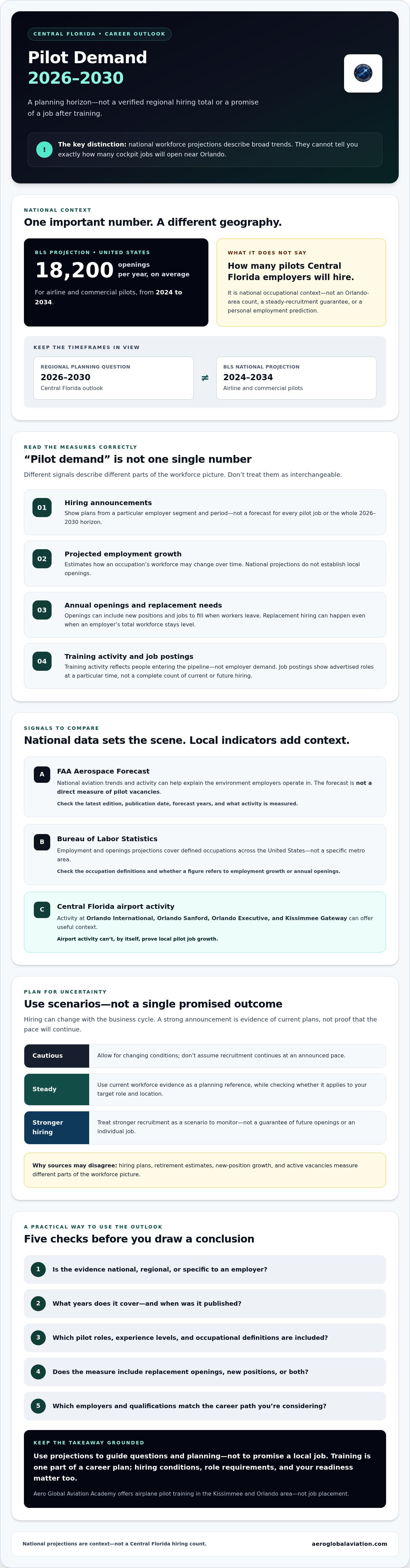
A strong national pilot hiring outlook doesn’t automatically tell you how many cockpit jobs will open near Orlando. That distinction is central to the pilot demand forecast Central Florida 2026-2030: national projections show broader trends, but they can’t promise local openings or a job after training. If airline hiring announcements seem to conflict with long-term workforce forecasts, the measures may be describing different things.
The U.S. Bureau of Labor Statistics projects about 18,200 openings for airline and commercial pilots each year, on average, from 2024 to 2034. That figure provides national context, not a Central Florida hiring count or a guarantee of steady recruitment.
This article explains what national data can and can’t tell you, which local signals to monitor, and how to account for changing hiring conditions and role requirements. Whether you’re considering a first private pilot certificate or a professional training path, use the outlook as one planning tool, not a promise. In Kissimmee and the Orlando area, structured flight training can be one part of your career planning while you evaluate your options.
Key Takeaways
- The pilot demand forecast Central Florida 2026-2030 is a planning horizon, not a verified regional hiring total.
- Check FAA and workforce projections for their dates, geographic scope, definitions, and whether they include replacement openings.
- Airport activity at Orlando International, Orlando Sanford, Orlando Executive, and Kissimmee Gateway can offer context, but it cannot prove local pilot job growth.
- Use cautious, steady, and stronger-hiring scenarios to plan for uncertainty without treating an outlook as a personal employment prediction.
- Compare career roles and requirements before evaluating training options. Aero Global Aviation Academy offers airplane pilot training in the Kissimmee and Orlando area, not job placement.
What a 2026-2030 pilot demand forecast can tell Central Florida career seekers
The pilot demand forecast Central Florida 2026-2030 is best treated as a planning question, not a published regional hiring total. There is no verified quantitative forecast here for how many pilots Central Florida employers will hire during those years. National projections help frame the wider employment picture, but they can’t guarantee local openings or an individual job after training.
Keep four measures separate when assessing the outlook. Airline hiring announcements describe one employer segment and a particular period. Commercial pilot employment covers a broader occupational category. Retirement estimates indicate possible replacement needs, while training activity shows how many people may be entering the pipeline, not employers’ demand for them. Each measure answers a different question.
What does “pilot demand” measure?
Pilot demand is employers’ need for qualified pilots, reflected through workforce projections and hiring activity; it is not the same as training interest or the number of advertised vacancies. Projected employment growth estimates how an occupation’s workforce may change over time. Annual openings can include new positions and jobs that need to be filled when workers leave an occupation. Active job postings show advertised roles at a particular time, not a complete count of current or future hiring.
Replacement openings and new positions have different causes. An employer may recruit to fill a role left vacant through retirement or another departure even if its total workforce stays level. New positions may reflect workforce expansion. Neither an opening projection nor a job posting tells you how many candidates are qualified, where a role is based, or how long recruitment will continue.
Why national forecasts do not automatically predict Central Florida hiring
National figures combine employers and locations that may have little connection to a particular opportunity near Orlando. Before applying a forecast to your plans, check its geographic scope, time period, definition, and the pilot roles and experience levels it covers. An airline hiring plan shouldn’t be treated as a forecast for every commercial pilot job.
Hiring can also change with the business cycle. A strong recruitment announcement is evidence of current plans, not proof that the same pace will continue throughout 2026-2030. Retirement trends, new-position growth, and active vacancies may point in different directions because they measure distinct parts of the workforce picture. For background on licensing and career routes, see this overview of a career as an airline pilot, then compare its general context with current official workforce sources.
Use the forecast to guide questions, not to make promises to yourself. Identify the employers and roles that fit your goals, the qualifications they require, and whether the evidence is local or national. Training is one part of that plan. Hiring conditions, qualifications, and your own readiness matter too.
Which FAA and workforce signals can shape a Central Florida pilot outlook?
To build a useful pilot demand forecast Central Florida 2026-2030, compare sources that measure different parts of aviation. The FAA’s Aerospace Forecast provides national aviation activity context, while the U.S. Bureau of Labor Statistics (BLS) projects employment and openings for defined occupations. Neither source, on its own, provides a Central Florida pilot hiring count.
What the FAA and BLS can, and cannot, show
The FAA’s Aerospace Forecast tracks national aviation trends and activity, helping explain the environment in which employers operate. It is not a direct measure of pilot vacancies. Before using a figure, check the latest FAA edition, its publication date, forecast years, and the activity it measures.
BLS data answers a different question. Its occupational projections cover employment and openings across the United States, not a specific metro area. The BLS Occupational Outlook Handbook projects about 18,200 annual openings for airline and commercial pilots on average from 2024 to 2034. That figure covers national occupational categories; it does not establish how many jobs will be available near Orlando. Review the BLS pilot job outlook and check whether you’re comparing employment growth, annual openings, or another measure.
Citation-ready context: The FAA Aerospace Forecast describes national aviation activity over its stated forecast period, but does not count Central Florida pilot jobs. BLS projects U.S. employment and annual openings for airline and commercial pilots from 2024 to 2034, but does not provide a local hiring total.
How to read aviation industry forecasts responsibly
Industry outlooks can add a wider view, but treat them as forecasts, not confirmed vacancies. Boeing’s 2025-2044 Commercial Market Outlook projects a need for 660,000 new commercial pilots worldwide, including 119,000 in North America. Those long-term estimates apply to broad regions and assumptions, not to Central Florida or the 2026-2030 period alone.
Before comparing sources, note the publisher, publication year, forecast horizon, geography, pilot category, and whether the figure represents new positions, replacement openings, or projected workforce need. Don’t combine estimates with different definitions into one headline number. An aviation activity forecast, a government employment projection, and an industry estimate may all be useful, but they are not interchangeable.
For career-stage context, explore this airline pilot career path guide. If you’re considering structured training in Kissimmee, Aero Global Aviation Academy offers airplane pilot programs from private through commercial and instructor certifications. Training is one part of planning, not a promise of hiring or employment.
Which Central Florida indicators could reveal changing pilot demand?
A useful pilot demand forecast Central Florida 2026-2030 considers local signals, but no single airport statistic can stand in for pilot hiring. Passenger totals, aircraft operations, and airport development describe activity or capacity. They can help you spot changes in the region’s aviation environment, but they don’t show how many pilots employers need or plan to recruit.
Airports and aviation activity around Orlando
Use Orlando International Airport (MCO), Orlando Sanford International Airport (SFB), Orlando Executive Airport (ORL), and Kissimmee Gateway Airport (ISM) as geographic reference points. Their activity reflects different parts of the regional aviation picture, so compare like with like. For current figures, check airport reports and the responsible airport authority, then use the FAA Aerospace Forecast for broader national context.
Interpret each indicator carefully:
| Indicator | What it may suggest | What it cannot prove |
|---|---|---|
| Passenger traffic | Changes in traveler activity at an airport | Airline staffing levels or local pilot vacancies |
| Aircraft operations | Changes in takeoffs and landings across airport activity | Whether those flights require more pilots or are based locally |
| Airport development plans | Planned changes to facilities or capacity | That a project will create pilot jobs or determine hiring timing |
| Employer hiring notices | Roles an employer is advertising at that time | Long-term demand or future hiring across the region |
Flight activity, passenger growth, and pilot recruitment can be related, but they don’t necessarily move together. An airport may handle more passengers without a corresponding rise in local pilot jobs. A carrier may recruit for roles based elsewhere, or adjust staffing for reasons airport traffic data cannot show.
Local signals to monitor through 2030
Build a simple record over time instead of relying on one announcement. Review employer career pages and regional operator updates for repeat recruitment, role location, aircraft segment, and experience requirements. Compare those observations with current Florida aviation workforce publications from primary government sources. Record the date and source beside each item so you can distinguish a sustained change from a temporary one.
For a practical training perspective, explore the Central Florida pilot training pathway. Aero Global Aviation Academy is based in Kissimmee and offers airplane pilot training paths; it is a training provider, not an employer or job-placement service. If you’re evaluating structured training, explore the academy’s pilot programs alongside your research into qualifications and hiring conditions.
How should aspiring pilots interpret uncertainty in the 2026-2030 forecast?
A strong demand forecast can make a flying career look more predictable than it is. A national projection doesn’t guarantee a local opening, a particular employer’s recruitment plans, or an individual job. Use the pilot demand forecast Central Florida 2026-2030 to guide research and training decisions, not to predict exactly when you’ll be hired.
A forecast is a planning signal, not an employment promise. Long-term workforce projections describe a broad direction. Short-term recruitment can still shift as economic conditions, airline fleet plans, retirement patterns, and employer decisions change. A hiring pause or surge may affect when roles appear without invalidating a projection that covers many years.
Use scenarios to plan, not to predict
Instead of treating one outlook as certain, consider three planning frameworks. These aren’t numerical predictions; they’re prompts for thinking through different conditions:
- Cautious: Recruitment slows or pauses in some segments. Consider how you’d manage a longer path to your preferred role.
- Steady: Hiring continues, but openings vary by employer, location, and experience level. Keep checking role requirements as you progress.
- Stronger hiring: More employers recruit, but competition and qualifications still shape who is ready for each position.
These scenarios help you stay flexible. They don’t indicate which outcome will occur in Central Florida, or when.
Match the outlook to your own training plan
Start with the role you’re working toward, then check the qualifications and experience employers require for that specific path. Requirements differ by role and employer, so don’t assume one forecast or job announcement applies to every pilot position. The commercial pilot training requirements guide can help you understand certification stages as you compare options.
Before committing, weigh the training path against your career goals, available time, and financial circumstances. Revisit employer postings and official workforce sources as you progress. This helps you respond to current conditions while keeping your next training milestone clear.
Aero Global Aviation Academy’s Kissimmee-area airplane training paths include the Career Pilot Program, from private through commercial pilot certification, and options that extend to advanced instructor certifications. Explore airplane pilot training options as one part of your career planning. Training does not guarantee employment or a specific hiring outcome.
How to turn the Central Florida pilot outlook into a practical next step
Use the pilot demand forecast Central Florida 2026-2030 as one input in a decision process, not as a reason to rush into training or wait indefinitely. A clear sequence connects workforce evidence to your career goals: check reliable sources, compare pilot roles, review each role’s requirements, then evaluate training options against your goals and circumstances.
A simple checklist for tracking pilot demand
- Choose a few primary sources. Follow current FAA and BLS publications, Florida workforce information, and career pages from employers relevant to your target roles.
- Record the details. Note each source’s publication date, forecast period, geography, and measure. Keep national projections separate from local hiring notices and airport activity.
- Compare roles. Look at the type of flying, location, experience, and qualifications listed in employer postings. Requirements can differ between employers and positions.
- Refresh your picture. Revisit your notes periodically and replace outdated figures with current, verified information. Treat one announcement as a signal to investigate, not proof of a lasting trend.
This routine turns scattered updates into a clearer view of the market. You can see what has changed, what remains unknown, and which assumptions need another check.
Explore a structured flight-training path in Kissimmee
Training milestones can help organize your next steps. A Private Pilot License (PPL) is a foundation; Commercial Pilot certification (CPL) is a further professional training milestone, while advanced instructor certifications represent another stage of development. The right sequence depends on your goals and the requirements of the roles you may pursue.
Aero Global Aviation Academy is a professional flight school in Kissimmee serving the Orlando area. Its Wings Foundation focuses on PPL training. The Career Pilot Program guides students from PPL through CPL, while Airline Pilot Elite covers training from PPL through advanced instructor certifications. These are training pathways, not job-placement services or promises of employment.
As you compare options, ask how a program’s training scope fits your intended career stage and which requirements you should verify for your goals. Explore flight training at Aero Global Aviation Academy and ask the academy about program fit as you plan your next step.
Turn the outlook into a plan you can revisit
The pilot demand forecast Central Florida 2026-2030 can help frame questions, but national projections and airport activity don’t guarantee local openings or employment. Track current FAA and workforce sources alongside employer announcements, and check what each measure covers. Then compare specific roles and qualifications before deciding which training path fits your goals.
Training is a practical step you can plan for even as hiring conditions change. Aero Global Aviation Academy is based in Kissimmee and serves the Orlando region, with training options spanning Private Pilot License foundations, commercial pilot certification, and advanced instructor certification pathways. These programs support training goals, not job placement or guaranteed hiring outcomes.
Ready to explore a path that matches your ambitions? Explore flight training at Aero Global Aviation Academy and ask about program fit. Keep checking the evidence, stay flexible, and take your next step with confidence.
Frequently Asked Questions
What is the pilot demand forecast for Central Florida from 2026 to 2030?
There is no verified Central Florida-wide pilot hiring total for 2026 to 2030 in the available research. The pilot demand forecast Central Florida 2026-2030 is therefore a planning question, not a published local count. FAA, BLS, and industry forecasts offer national context but don’t establish openings near Orlando. Check current employer and airport sources, and label any regional figure with its source, publication date, geographic scope, and measure.
Will Central Florida need more pilots by 2030?
Current evidence doesn’t support a definitive yes or no for Central Florida by 2030. National workforce projections and local aviation activity can identify trends to watch, but neither establishes how many jobs will open in the region. Follow employer hiring pages, airport activity reports, and official Florida workforce data as they’re updated. Compare signals over time and distinguish job postings from longer-term employment projections.
Does a national pilot shortage mean it will be easy to get hired in Orlando?
No. A national shortage claim doesn’t guarantee an opening in Orlando, an entry-level role, or an easy hiring process. Projected workforce demand describes an overall need, while vacancies are specific jobs advertised by employers at a particular time. Hiring depends on employer needs, qualifications, experience, and timing. Check current opportunities directly with employers, and compare each posting’s location and requirements with your career stage.
Which sources should I use to track pilot demand in Florida?
Start with current FAA forecasts and BLS occupational projections for national context, then look for Florida and Central Florida information from government workforce sources, airport authorities, and employers. Check each publication’s date, geographic scope, forecast period, and definitions before comparing figures. Industry outlooks can add perspective, but they’re forecasts, not official local job counts. Keep employer announcements separate from airport activity and government employment projections.
Do Orlando airport growth and passenger numbers prove that pilot jobs are increasing?
No. Passenger totals and airport activity describe transportation demand, not the number of pilots employers will hire. Changes at Orlando International, Orlando Sanford, Orlando Executive, or Kissimmee Gateway may offer useful regional context, but they don’t establish staffing levels or future vacancies. Consider these indicators alongside employer announcements, workforce data, and repeated hiring trends. Don’t convert passenger or operations figures into job estimates without a credible source supporting the calculation.
Is 2026-2030 a reliable period for planning pilot training?
Yes, 2026-2030 can be a useful planning horizon, but forecasts covering several years carry uncertainty. Compare current hiring signals with your career goals, qualifications, finances, and training timeline. Then revisit the evidence as new, verified information becomes available. Don’t base a major training decision on one projection or a headline about a pilot shortage. A flexible plan helps you stay focused while allowing for changes in employer needs and timing.
Can flight training in Kissimmee prepare me for a professional pilot career?
Flight training can help you work toward pilot certifications, but it can’t guarantee employment. In Kissimmee, Aero Global Aviation Academy serves the Orlando region with the Wings Foundation, focused on Private Pilot License training, and the Career Pilot Program, which guides students from PPL through Commercial Pilot certification. Ask the academy how each program’s scope fits your goals and intended career path, and check employer requirements as you plan your next steps.


