

What if airsickness is feedback to work with, not a verdict on your potential as a pilot? Nausea, dizziness, or discomfort can make it difficult to focus during a lesson, and it’s understandable to wonder whether you can keep learning to fly. Overcoming airsickness as a student pilot starts with noticing what may be contributing to your symptoms and speaking up early, not pushing through in silence.
A bout of airsickness doesn’t automatically mean you can’t become a pilot. With your instructor, you can review when symptoms appear, respond safely during a lesson, and discuss a thoughtful way forward. If symptoms persist or you have questions about medication or your health, seek guidance from a qualified medical professional.
This guide covers possible triggers and early warning signs, practical steps to take before and during a flight, and how to talk with your instructor about what you’re experiencing. At Aero Global Aviation Academy in Kissimmee, Florida, one-on-one instruction gives students an opportunity to discuss training concerns directly. Use the guidance here to prepare for that conversation and decide what details will help your instructor understand your experience.
Key Takeaways
- Airsickness can be a temporary response to flight sensations, not a diagnosis or a verdict on your potential as a pilot.
- Movement, visual cues, and cockpit tasks may contribute to discomfort. Notice when symptoms begin and what you’re doing at the time.
- For overcoming airsickness as a student pilot, prepare thoughtfully, brief your instructor, respond early, and debrief after the lesson.
- Discuss persistent, severe, or unusual symptoms with a qualified medical professional, and direct medication questions to them.
- Use one-on-one instructor conversations to discuss your experience and training priorities.
Overcoming airsickness as a student pilot starts with understanding the symptoms
Nausea during a flight lesson can feel discouraging, especially when you’re working hard to focus on new skills. But discomfort in the air doesn’t, by itself, determine your potential as a pilot. Start by noticing what you’re experiencing and when it begins. Describing those details clearly gives you and your instructor a useful starting point for discussing what to do next.
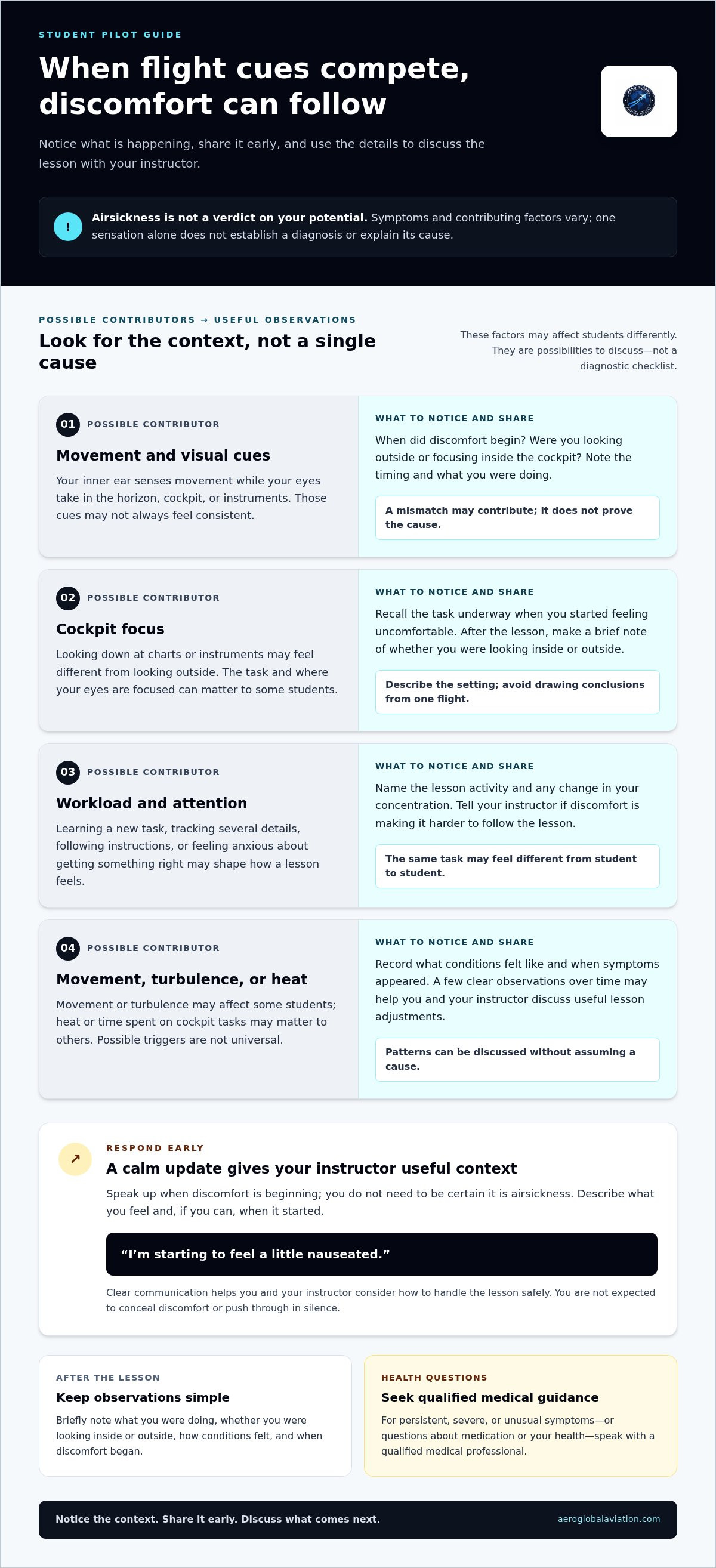
Airsickness is motion-related discomfort that occurs during flight, and experiencing symptoms is not by itself a medical diagnosis. It’s commonly described as a form of motion sickness. As the overview of Airsickness explains, symptoms and contributing factors can vary, so one sensation alone shouldn’t be treated as proof that you have airsickness.
What airsickness can feel like during a lesson
Some students notice a queasy stomach first; others may become dizzy, sweaty, or generally uncomfortable. You might feel slightly unsettled at one point in a lesson and more distracted later, or notice just one symptom. There isn’t a single pattern that every student follows, and a symptom can have more than one possible explanation.
Pay attention to changes rather than trying to label yourself. You may notice that you’re becoming warm and uncomfortable, then realize nausea is making it harder to follow the lesson. Another student might first notice dizziness or a drop in concentration. These are useful observations to share, not a diagnostic checklist.
Even mild symptoms can compete for attention when you’re learning procedures or responding to your instructor. That doesn’t mean you’ve failed the lesson. It does mean your comfort and concentration are worth discussing, so your instructor understands what’s happening and can respond appropriately.
Why early recognition helps a student pilot
Try to speak up when discomfort is beginning, rather than waiting until it feels difficult to manage. You don’t need to be certain that it’s airsickness or find the perfect words. A simple, calm update such as “I’m starting to feel a little nauseated” gives your instructor useful context while there’s still time to discuss how to respond.
Describe what you feel and, if you can, when you first noticed it. Did it begin during a particular part of the lesson, or build gradually? Your instructor can use that account to understand your experience and consider how to handle the lesson safely. You’re not expected to conceal discomfort or push through without speaking up. Clear communication is part of responsible training.
For overcoming airsickness as a student pilot, treat early symptoms as information to share, not a judgment about your ability. A calm conversation gives you and your instructor a clearer basis for deciding what makes sense next.
Why student pilots may feel airsick: motion, vision, and workload
Flight gives your brain several streams of information at once. Your body senses movement, your eyes take in the cockpit and the view outside, and your attention shifts between the lesson and the aircraft. Sometimes these cues don’t seem to match. That mismatch may contribute to discomfort, but it doesn’t affect every student in the same way.
How the inner ear and visual cues affect motion perception
The vestibular system is part of your body’s balance and motion-sensing system. It includes structures in the inner ear that help your brain interpret movement and orientation. Your eyes provide another set of clues, such as the position of the horizon or the cockpit around you. In flight, those sources of information may not always feel consistent.
Motion can feel unsettling when your inner ear senses movement but your eyes don’t see matching cues. For example, focusing inside the cockpit may make it harder to use the outside view to interpret how you’re moving. This sensory mismatch is one factor associated with motion sickness, not a diagnosis or a guarantee that you’ll feel unwell. AOPA's advice on airsickness for student pilots discusses why the experience can arise during training and offers a student-focused perspective.
Possible contributors vary from lesson to lesson. Movement or turbulence may affect some students, while heat or time spent focused on cockpit tasks may matter for others. These are possibilities, not universal triggers. A particular sensation doesn’t prove what caused it, but noting the setting and timing can help you identify patterns to discuss with your instructor.
Why cockpit tasks can change how a lesson feels
Looking down at charts or instruments changes what your eyes are focused on, and some students may find that less comfortable than looking outside. At the same time, learning a new task requires attention. Concentrating on instructions, tracking several details, or feeling anxious about getting something right may also shape how the lesson feels. These factors aren’t necessarily the sole cause of discomfort, and students can respond differently to the same task.
Keep your observations simple. After a lesson, make a brief note of what you were doing when discomfort began, whether you were looking inside or outside, and what the conditions felt like. You don’t need to draw conclusions from one flight. A few clear observations over time may help you and your instructor discuss useful adjustments to the lesson.
Understanding possible triggers can make overcoming airsickness as a student pilot feel more manageable. You’re gathering information to guide a conversation, not diagnosing yourself. If you’re training in Kissimmee, Florida, one-on-one flight instruction provides a setting to discuss training concerns directly with an instructor.
Does airsickness mean you cannot become a pilot?
A bout of nausea or dizziness during a lesson can quickly raise a bigger worry: “Does this mean I’m not cut out to fly?” One episode alone can’t answer that question. It doesn’t establish your long-term ability to learn, and it doesn’t determine your medical status. Treat it as one experience to discuss, not a final verdict on your future.
Airsickness is not, by itself, a verdict on your potential
Students can respond differently to flight, and your own experience may vary from lesson to lesson. Discomfort that is manageable on one flight may feel different under other conditions or during a more demanding task. Some students find their experience changes over time; others need more guidance to understand what’s happening. There isn’t one outcome to assume for everyone.
That uncertainty is a reason to communicate, not to make an all-or-nothing decision alone. Tell your instructor what you felt, when it started, and whether it affected your concentration. Together, you can discuss what’s appropriate for training rather than treating one uncomfortable flight as proof that you should quit or as a reason to carry on unchanged. Raising a concern is a responsible part of safety-focused instruction.
When symptoms call for medical guidance
There’s a difference between brief discomfort you can describe to your instructor and symptoms that are persistent, severe, recurring, unusual, or otherwise concerning. If symptoms continue or worry you, seek advice from a qualified medical professional. An instructor can help with training decisions and lesson communication, but shouldn’t be expected to diagnose a health concern.
Keep the roles clear. Your instructor can use what you report to understand how the lesson is affecting you and discuss an appropriate training approach. A medical professional can assess health questions and advise you based on your circumstances. If you’re unsure whether symptoms are significant, seek medical guidance rather than trying to label or manage them on your own.
Medication decisions deserve particular care. Don’t start, stop, or choose a medication based on another student’s experience or general flight-training advice. Ask a qualified medical professional familiar with your circumstances about medication and flying. A product that seems suitable on the ground may not be appropriate for your individual situation in flight, so get professional guidance before making a decision.
Overcoming airsickness as a student pilot doesn’t mean promising yourself that symptoms will disappear or deciding in advance that training must continue exactly as planned. It means taking each experience seriously, sharing useful details with your instructor, and seeking medical input when symptoms or medication questions warrant it. From there, the next step can be based on your circumstances, with safety and your long-term goals in view.
What to do before, during, and after a flight lesson
A clear routine can turn an uncomfortable experience into useful information for your next conversation with your instructor. Use this sequence as a guide, not a promise that symptoms can be prevented. Your instructor’s safety direction comes first, and completing a planned exercise should never take priority over responding appropriately to discomfort.
- Prepare before the lesson. Aim to arrive rested and comfortable, and give yourself time to settle in. Avoid making major changes to your usual routine based only on general advice. If you’ve felt unwell during a previous flight, recall what you noticed and when it began. Those details can help you explain your experience without needing to diagnose the cause.
- Brief your instructor. Before takeoff, mention any previous symptoms and patterns you’ve noticed, such as discomfort during a particular task or at a certain point in a lesson. Be direct about how you’re feeling that day, too. This gives your instructor context and a chance to discuss how you’ll communicate if your symptoms change in the air.
- Speak up early during the flight. Students should report symptoms promptly during training. If discomfort starts, tell your instructor in clear, simple words rather than waiting for it to worsen or trying to hide it. Follow the instructor’s safety direction and let them guide what happens next. The planned lesson can be adjusted. Finishing every exercise isn’t the goal if you’re struggling to stay comfortable or focused.
- Debrief after landing. Once the lesson is over, describe what you felt, when it started, and what you were doing at the time. Note the context while it’s fresh, including whether symptoms changed as the lesson progressed. Keep your observations factual. A short record across lessons may make it easier to discuss patterns without jumping to conclusions.
Before takeoff: prepare and set expectations
A preflight conversation doesn’t need to be complicated. You might say, “I felt dizzy during my last lesson, and I’d like to tell you if it starts again.” If you feel uncomfortable before departure, share that as well. This helps you and your instructor begin with a shared understanding, while leaving room to make a thoughtful decision based on how you’re feeling.
In the air and after landing: respond, then review
Focus on communicating and following your instructor’s guidance, not on proving you can push through. Afterward, use your notes to make the debrief specific: what you noticed, when you noticed it, and how it affected your concentration. If symptoms recur, feel severe, or concern you, seek advice from a qualified medical professional. Direct medication questions to a qualified professional familiar with your circumstances.
A consistent routine supports overcoming airsickness as a student pilot by connecting preparation, honest communication, and review into one instructor-guided process. To discuss your training goals and concerns, explore one-on-one flight training at Aero Global Aviation Academy in Kissimmee, Florida.
How an instructor can help you keep learning in Kissimmee
A calm, specific conversation can help your instructor understand what you’re experiencing and what matters to you as a student. You don’t need to arrive with a diagnosis or a complete solution. Describe what you notice; your instructor can use that context to discuss lesson priorities and respond appropriately to safety concerns. Any health or medication questions belong with a qualified medical professional.
What to tell your flight instructor
Share the details you remember, even if they seem small. Explain when the discomfort began, what the lesson involved at that point, and whether anything seemed to change how comfortable you felt. For example, you might describe symptoms starting while you were focused on a cockpit task, or appearing only later in the flight. These observations can guide a useful discussion without assuming a cause.
Before flying, ask to review the lesson goals and agree on how you’ll communicate if you start feeling unwell. You could say, “If I notice discomfort, I’ll tell you right away. What should I expect us to do next?” Your instructor can clarify how to raise a concern and how they’ll respond in the moment. That conversation helps set clear expectations for both of you.
Afterward, discuss what you noticed and what questions remain. You might review whether a task felt manageable, when your concentration changed, or what you’d like your instructor to know before the next flight. Keep the focus on shared understanding and safe decisions, rather than trying to prove you can complete every planned exercise.
Continue training with a supportive local team
One-on-one instruction creates space to discuss training concerns directly and consider your priorities as an individual student. Aero Global Aviation Academy provides flight training at Kissimmee Gateway Airport in Kissimmee, Florida, in a safety-focused learning environment. The academy’s chief flight instructor, Habib, is praised for his knowledge, patience, and focus on safety. This instructional setting supports conversations about training, but it isn’t a substitute for medical care.
Progress can mean making informed decisions together, lesson by lesson. For overcoming airsickness as a student pilot, sharing clear observations gives your instructor a more useful picture of your experience, while qualified medical guidance can address health concerns when needed. Your goals still matter, and thoughtful communication keeps them part of the conversation.
If you’re considering flight training or want to learn more about the academy’s approach, explore training with the Aero Global Aviation Academy team.
Take your next step with a thoughtful plan
Your next lesson doesn’t need to answer every question at once. Treat it as an opportunity to notice how you feel, communicate clearly, and make training decisions with the right support. If symptoms keep returning or cause concern, include a qualified medical professional in the conversation. Your path forward can be shaped by what you learn over time, rather than by one difficult moment in the air.
Overcoming airsickness as a student pilot is about approaching the challenge with patience and good judgment, not demanding an instant fix. Keep your aviation goals in view while making safety the priority. To take a considered next step in flight training, contact Aero Global Aviation Academy in Kissimmee, Florida.
Frequently Asked Questions
Is airsickness common among student pilots?
Airsickness is a recognized concern during flight training, though students’ experiences vary and a single episode doesn’t predict what will happen in future lessons. Some may feel discomfort early in training, while others may not. There’s no need to compare your experience with another student’s. Focus on describing what you notice and discussing its effect on your lesson with your instructor.
Can airsickness happen even when the weather feels calm?
Yes. Calm-feeling weather doesn’t rule out discomfort, because your senses can still receive different information during flight. You might feel movement while your eyes are focused on the cockpit, for example. If symptoms occur in apparently smooth conditions, note what you were doing and where your attention was focused. That context may help your instructor understand the situation, but it can’t establish a cause by itself.
How can I tell airsickness from anxiety during flight training?
You may not be able to distinguish them reliably on your own. Anxiety and motion-related discomfort can overlap, and sensations such as sweating, nausea, or unease don’t identify a single cause. Note what you felt and when it started, including whether worry came before or after physical discomfort. Discuss recurring or concerning symptoms with a qualified medical professional, and share relevant lesson context with your instructor.
Should I take motion sickness medicine before a flight lesson?
Don’t choose or take medication for a lesson based on general advice or another pilot’s experience. Some medicines can cause drowsiness or affect alertness, which matters during flight training. Ask a qualified medical professional familiar with your circumstances about any medication and flying before you use it. If you’ve already taken something and feel impaired or unsure about your fitness to fly, tell your instructor before the lesson.
Can looking down at charts make a student pilot feel worse?
It may affect comfort for some students, but it won’t bother everyone. Looking down shifts your visual focus from the view outside to material inside the cockpit, which may change how you perceive movement. If you notice a pattern while using charts, record when it happens and tell your instructor. Don’t assume the chart task is the definite cause; other factors may be involved.
What should I write down after feeling airsick during a lesson?
Make a brief, factual note while the details are fresh. Include when discomfort began, what you were doing, where you were looking, the symptoms you noticed, and whether they changed as the lesson continued. You can also note what you told your instructor and any questions you want to discuss next time. This record supports a more specific debrief without requiring you to diagnose yourself.
Can a flight simulator help me understand what triggers discomfort?
A simulator may help you notice how cockpit tasks, visual focus, or workload feel in a practice setting, but it can’t confirm what causes discomfort in an aircraft or predict how you’ll feel in flight. Aero Global Aviation Academy has a Redbird BATD flight simulator with VFR/IFR capability and Garmin GPS. Treat simulator observations as discussion points, not a medical assessment.


