

What if the best route to a safety-pilot opportunity isn’t a conventional job application? If you’re searching for safety pilot opportunities Central Florida, you may find paid openings, but you may also encounter flying arrangements where pilots coordinate practice and share the flying. Knowing the difference helps you choose a path that fits your experience and goals.
A safety pilot serves as an extra set of eyes while another pilot practices simulated instrument flight under a view-limiting device. Before taking off, both pilots need to understand the responsibilities, eligibility requirements, aircraft setup, and who will act as Pilot in Command. These details matter whether you’re building experience or helping another pilot stay current.
This guide explains what the role can involve, what to clarify before agreeing to fly, and how to explore job listings and experience-building routes around Kissimmee and Orlando. You’ll also find local starting points, including Aero Global Aviation Academy’s Flying Club and Job Opportunities. If you’re building toward a broader aviation goal, personalized flight instruction can help you plan a practical next step.
Key Takeaways
- Understand what a safety pilot does and which FAA eligibility requirements to review before flying.
- Clarify who will act as Pilot in Command, how duties will be shared, and what the flight is intended to accomplish.
- Compare safety pilot opportunities Central Florida pilots may find through posted jobs, pilot-to-pilot arrangements, and training-related pathways.
- Use a practical search plan to explore aviation connections around Kissimmee Gateway Airport and the wider Orlando area.
- Discover how Aero Global Aviation Academy’s one-on-one training, Flying Club, and Job Opportunities can support your next aviation step.
Safety Pilot Opportunities in Central Florida: What the Role Involves
Search for safety-pilot opportunities around Orlando and you may land on broad pilot-job pages rather than guidance about the role itself. That distinction matters: a safety pilot might be part of a paid position, but pilots also arrange flights directly with one another for practice. Understanding what the role involves helps you look for the right kind of opportunity.
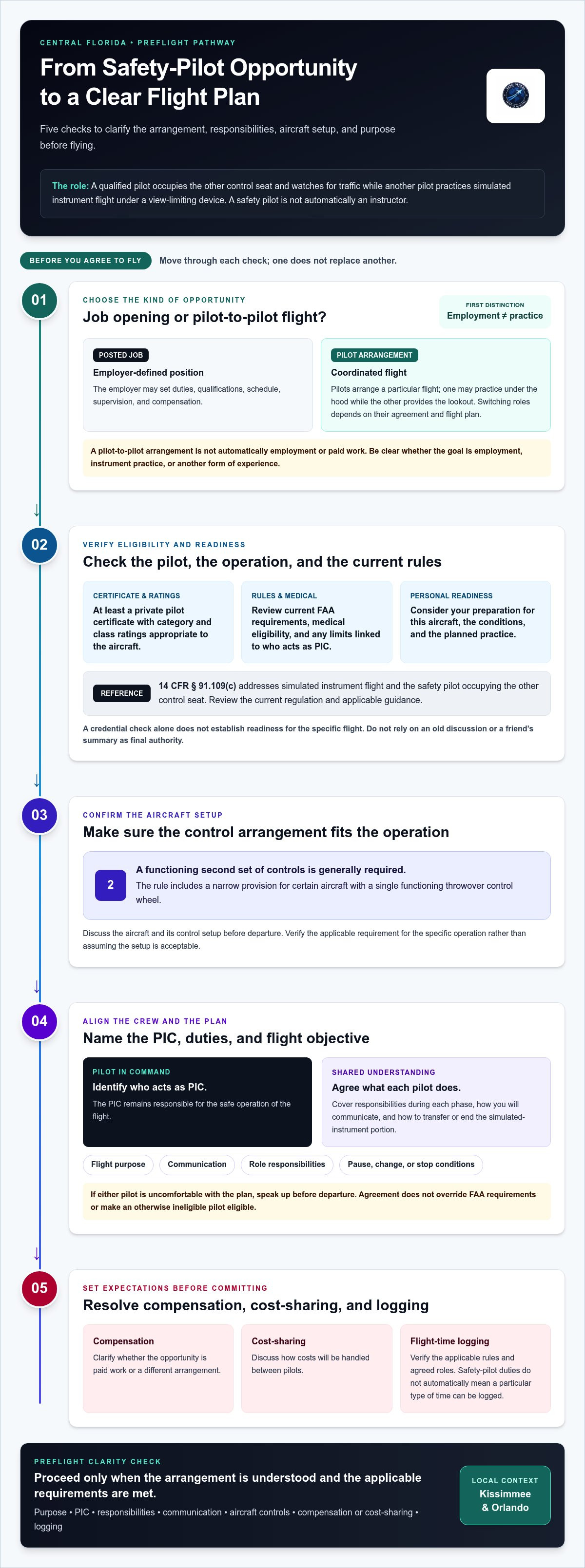
A safety pilot is a qualified pilot who occupies the other control seat and watches for traffic while another pilot practices simulated instrument flight under a view-limiting device. The role is not automatically a flight-instructor position. An instructor teaches and evaluates; a safety pilot performs the required lookout function, though the two roles may overlap when someone is acting as an instructor.
For a general overview, see Safety Pilot Definition and Role. For the operating rule, 14 CFR § 91.109(c) addresses simulated instrument flight and the safety pilot occupying the other control seat. The rule generally requires a functioning second set of controls; it also includes a narrow provision for certain aircraft with a single functioning throwover control wheel. Review the current FAA regulation and applicable guidance before planning a flight.
What does a safety pilot do during a flight?
The safety pilot keeps a visual lookout for other aircraft and obstacles while the pilot flying focuses on instruments beneath a view-limiting device. The safety pilot must hold at least a private pilot certificate with category and class ratings appropriate to the aircraft. This is a required crewmember role, not simply a passenger offering an extra pair of eyes.
Before departure, agree on the flight’s purpose, who will act as Pilot in Command (PIC), how you’ll communicate, and how you’ll transfer or end the simulated-instrument portion. The PIC remains responsible for the flight’s safe operation. Discussing responsibilities in advance reduces cockpit uncertainty and helps both pilots understand what they’re agreeing to do.
How is a safety-pilot opportunity different from a pilot job?
A posted job is an employer-defined position. It may set duties, qualifications, schedule, supervision, and compensation. A pilot-to-pilot arrangement is different: two pilots coordinate a particular flight, often with one practicing under the hood and the other providing the required lookout. They may switch roles, but that depends on their agreement and the flight plan. It isn’t automatically employment or paid work.
In either case, clarify expectations before committing. Discuss compensation or cost-sharing, the aircraft and control setup, each pilot’s responsibilities, and whether the goal is employment, instrument practice, or another form of experience. Logging flight time also depends on the applicable rules and the roles agreed upon; don’t assume that acting as safety pilot automatically means you can log a particular type of time.
For pilots exploring safety pilot opportunities Central Florida, start by identifying whether you want paid employment or a flying partner. Then assess your qualifications and goals against the specific arrangement. Aviation communities and training programs around Kissimmee and Orlando can help you learn about relevant pathways.
Safety Pilot Requirements and Responsibilities to Clarify Before Flying
A safe plan starts with three separate checks: are you personally ready for this flight, does everyone understand their role, and do you meet the applicable FAA requirements? Passing one check doesn’t guarantee the others. A pilot may hold the necessary credentials yet still need more preparation for the aircraft, conditions, or planned practice. Treat each question on its own, and don’t let a flight-time goal rush the decision.
Which eligibility details should you verify?
Start with the current FAA rules for the specific operation, including 14 CFR § 91.109(c) when simulated instrument flight is involved. Review the applicable certificate and aircraft-rating requirements, medical eligibility, aircraft control setup, and any limits that depend on who acts as Pilot in Command. The relevant details can vary with the flight’s circumstances, so don’t rely on a friend’s summary or an old discussion thread as your final authority.
Logging is another point to verify rather than assume. Safety Pilot Requirements and Logging Time offers background on certificates, medical considerations, and flight-time logging, but it shouldn’t replace current FAA guidance or qualified advice. If you’re unsure how a particular arrangement affects eligibility or logbook entries, resolve that question before the flight with an appropriate instructor or other qualified source.
What should the pilots agree on before the flight?
Make the plan specific enough that both pilots can describe it clearly. A short preflight conversation can cover the flight objective, each person’s responsibilities, how you’ll communicate, and what would cause you to pause, change, or stop the activity. If either pilot is uncomfortable with the plan, speak up before departure. Agreement promotes coordination, but it never overrides FAA requirements or makes an otherwise ineligible pilot eligible.
- Roles: Identify who is acting as PIC and who is responsible for each task during each phase.
- Flight objective: Agree on the planned practice and the conditions under which it will take place.
- Communication: Set clear words or signals for a concern, a change of plan, or ending the practice.
- Readiness: Discuss relevant experience, workload, aircraft familiarity, and any concern that could affect safe participation.
- Records and expenses: Set expectations for any cost-sharing and determine how each pilot will handle records, without assuming a particular time can be logged.
When the flight supports instrument training, bring the plan to an instructor who understands your training context. They can help you identify questions to resolve before you coordinate with another pilot. Personalized, one-on-one flight training can also give you a supportive setting to discuss your broader aviation goals and next steps. Explore flight training in Kissimmee as you build a thoughtful pathway toward those goals.
Compare Safety-Pilot Job Searches with Local Experience-Building Routes
Searching around Kissimmee and Orlando can mean looking for very different things. A formal pilot vacancy, a one-off flying arrangement, and a structured training path may all appear relevant, but each serves a different purpose. Compare the route with your current goal before investing time in applications or planning flights. Openings, terms, and opportunities to gain experience vary, so evaluate each specific role or arrangement on its own terms.
| Route | Main purpose | What to clarify | May suit you if |
|---|---|---|---|
| Posted employment | Fill an employer-defined pilot position. | Published duties, qualifications, compensation, schedule, and whether the work specifically involves safety-pilot duties. | You’re seeking paid work with defined responsibilities and meet the role’s stated qualifications. |
| Pilot-to-pilot arrangement | Coordinate a flight for practice or another shared aviation goal. | Each pilot’s responsibilities, flight objective, expenses, PIC designation, and any expectations about logging time. | You want to arrange a specific flight with another pilot rather than apply for a job. |
| Training-related progression | Build skills and qualifications as part of a broader pilot-development plan. | Your training objectives, current experience, next milestones, and how the activity fits your longer-term goals. | You’re developing as a pilot and want a structured learning path. |
When is a posted pilot job the right route?
Job boards and professional listings make sense when you want an employer to define the position and its terms. Read the full posting rather than relying on a broad search label: “pilot” doesn’t necessarily mean the role involves safety-pilot duties. Compare the listed responsibilities and qualifications with your own background, and clarify the employment terms through the employer’s application process. A search result is a lead, not confirmation that a suitable opening exists.
When might a flying club or training route fit better?
If your priority is aviation participation or development rather than employment, a club or training pathway may be more relevant. Aero Global Aviation Academy’s Flying Club is a local option in Kissimmee for pilots seeking aviation connections. Flight training offers a structured way to work toward broader pilot goals through instruction and skill development.
Choose based on the destination you have in mind. If you’re pursuing professional ratings, this guide to advanced flight training can help you understand how further training fits into a career pathway. Whether you’re exploring routes in Kissimmee or elsewhere in the Orlando area, keep employment searches, peer flying arrangements, and training progression distinct. That clarity helps you judge what each option can offer.
How to Find and Evaluate Safety Pilot Opportunities Around Kissimmee and Orlando
A clear search starts with your goal, not a job-board keyword. Around Kissimmee Gateway Airport (KISM) and across the wider Kissimmee-Orlando area, distinguish paid employment from a pilot-to-pilot flying arrangement or a training step. Central Florida’s year-round flying conditions are an appealing backdrop for building aviation experience, but each opening or arrangement has its own requirements and terms.
Use this sequence to make your search more focused:
- Define the outcome you want. Decide whether you’re seeking paid work, a flying partner, or progress toward a broader pilot goal. State that purpose clearly when you reach out.
- Explore relevant local routes. Look at employer-posted roles, aviation communities, and training-related options around Kissimmee and Orlando. Treat each lead according to what it actually offers, not what its title suggests.
- Prepare for a conversation. Summarize your experience accurately, then bring specific questions about duties, planning, expectations, and any compensation or cost-sharing.
- Verify before committing. Review current FAA guidance for the planned flight and resolve questions about eligibility or logging with a qualified source. Pause if a key safety detail remains uncertain.
How can you prepare for a local conversation?
Keep your introduction brief and factual: describe your certificate and relevant experience without implying qualifications you don’t hold. Then name your goal, whether that’s employment, training progression, or coordinating a flying partnership. Specificity helps the other person understand what you’re looking for and makes it easier to discuss whether the opportunity’s scope fits.
Prepare questions about responsibilities, the flight’s purpose, planning, and the applicable requirements. If training is part of the picture, explain what you’re working toward and bring questions to an appropriate instructor. A well-prepared conversation doesn’t need to be formal; it does need to leave both people with a shared understanding of the next step.
How should you assess whether an opportunity is a good fit?
Look for alignment between the stated purpose and the actual expectations. A job should be evaluated against its published duties and qualifications; a peer arrangement should make its scope and terms clear; a training route should connect to your development goals. If the responsibilities are vague, safety concerns are unresolved, or eligibility is uncertain, pause and seek qualified guidance rather than feeling pressured to proceed.
Before pursuing an arrangement, confirm the goal, role, expectations, planning, and applicable requirements. If any safety or eligibility question remains unclear, pause and get qualified guidance.
Use this checklist as a starting point, then make your next move match your aviation destination. If you’re building skills through structured instruction, explore one-on-one flight training in Kissimmee as a way to discuss your goals and training progression.
Explore Flight Training and Pilot Opportunities with AGA in Kissimmee
For pilots exploring local aviation pathways, Aero Global Aviation Academy offers a Kissimmee-based place to consider how flight training can support broader goals. The academy provides personalized one-on-one instruction at Kissimmee Gateway Airport (KISM), along with its Flying Club and Job Opportunities. These local resources give pilots ways to explore training, aviation connections, and professional possibilities.
Keep your objective in view. If you’re searching for safety pilot opportunities Central Florida, separate that search from your training plan: a safety-pilot arrangement depends on the pilots and flight involved, while instruction supports a structured progression toward your own aviation milestones.
Which AGA resources may support your aviation goals?
AGA’s training options address different stages and destinations. The Wings Foundation is a PPL-only course. The Career Pilot Program covers PPL through CPL flight training, while Airline Pilot Elite extends from PPL to advanced instructor certification. One-on-one instruction offers a personalized setting to discuss where you are now, what you’re working toward, and how a course may fit your progression.
The Flying Club and Job Opportunities are additional local resources for pilots exploring aviation connections and professional possibilities. If your goal is a professional pathway, the career pilot program guide can help you consider how structured training relates to future milestones.
What should a first visit or conversation look like?
Arrive with a short, accurate summary of your experience and a clear question. You might want to discuss course progression, the Flying Club, or Job Opportunities as part of your broader aviation plans. Bring your current training goals, and be ready to explain whether you’re focused on a private pilot certificate, commercial training, or an instructor pathway. A focused conversation makes it easier to explore relevant next steps and keep training plans distinct from employment goals.
Plan your visit in advance. Visits are By Appointments Only. No Walk-ins. Visitors are encouraged to book an appointment in advance. The academy’s hours are:
- Enrolled Students - Flight Operations Hours: 6:00 AM - 10:00 PM.
- Walk-In Consultation Hours: Tuesdays & Thursdays 3:00 PM - 5:00 PM; Saturdays 11:00 AM - 2:00 PM.
Take the next step at a pace that fits your goals. Explore flight training options in Kissimmee and start a conversation about the training path you want to pursue.
Take the Next Step Toward Your Aviation Goals
Turn your interest in safety pilot opportunities Central Florida into a clear personal plan. Decide what you want your next stage of flying to accomplish, then choose a step that builds toward it. That could mean pursuing an employment lead, developing a flying partnership, or investing in structured training. Keep your goals ambitious, but let safety and sound preparation guide your pace.
At Aero Global Aviation Academy, personalized one-on-one flight training gives you space to discuss your direction with an experienced chief flight instructor praised for a safety-focused approach. Based at Kissimmee Gateway Airport (KISM), the academy can help you explore how flight training may fit into your broader aviation path.
Explore flight training and pilot opportunities at AGA, and take the next step with a clearer sense of where you want to go. Every aviation goal begins with a thoughtful decision. Keep moving forward with confidence.
Frequently Asked Questions
Is a safety pilot opportunity always a paid job?
No. An employer might advertise a paid position, while two pilots could instead coordinate a flight for shared practice or another agreed purpose. Before accepting either arrangement, clarify whether compensation is offered, whether expenses are shared, and what duties are expected. For example, a posting with an employer-defined schedule differs from an informal plan to alternate flying tasks. Don’t treat a search result or a conversation as confirmation of employment terms.
Can a student pilot act as a safety pilot?
Don’t assume student status is enough to qualify. Whether someone may serve in this role depends on current FAA requirements and the specific flight, so avoid a blanket yes or no based on informal advice. Before participating, review the applicable official guidance and discuss the planned activity with a qualified flight instructor. Be ready to describe the aircraft, the intended operation, and each pilot’s role so the question can be assessed in context.
How do I find safety pilot opportunities in Central Florida?
First decide whether you’re seeking paid work, a pilot-to-pilot arrangement, or experience connected to training. Then search local aviation communities and employer postings using terms that match that goal, and read each opportunity closely. Around Kissimmee and Orlando, Aero Global Aviation Academy’s Flying Club, Job Opportunities, and flight training are local avenues to explore. Assess each lead based on its stated terms and purpose.
What should pilots discuss before flying together?
Agree on the flight’s purpose and what each person expects to do, then make a clear plan for raising concerns or stopping the activity. For instance, both pilots should know how they’ll communicate if the flight no longer feels comfortable or the plan needs to change. Confirm the arrangement fits applicable requirements, too. A conversation can prevent mismatched expectations, but it can’t replace eligibility checks or required preparation.
Does safety-pilot time count toward a pilot’s experience?
It depends on the applicable rules and the details of the flight, so don’t assume every safety-pilot outing can be logged or credited toward a certificate or career goal. Before recording time, identify the role you actually performed and the circumstances of the flight. Then check current FAA guidance and seek qualified instruction if the entry is uncertain. Keep personal records accurate, and don’t rely on a proposed flight to meet a requirement until verified.
Is Kissimmee a practical base for exploring pilot opportunities?
Yes, Kissimmee can be a useful starting point for exploring aviation training and connections in the Kissimmee-Orlando area. Aero Global Aviation Academy is based at Kissimmee Gateway Airport (KISM), and Central Florida’s flying conditions support a regional training appeal. Use the local setting to focus your search and consider how training fits your goals, while evaluating each job or flying arrangement on its own terms.


