With a projected shortage of 24,000 pilots by the end of 2026, why do so many talented flyers stop after their initial certification? You've likely felt that spark of ambition after your first solo, yet the technical demands of advanced flight training can make the leap to a professional career feel out of reach. It's common to feel anxious about the precision of instrument flying or the financial logistics of building multi-engine time.
We believe the path forward should feel like an open runway, not a maze of regulations. This guide provides the clarity you need to master the complex certifications required to transition from a private pilot to a professional airline aviator. We'll explore the strategic roadmap from your Instrument Rating to the Commercial Pilot License, explaining the return on investment for each milestone and how to select a structured environment that leverages local conditions to help you graduate faster. It's time to turn your passion into a tangible destination.
Key Takeaways
- Understand how advanced flight training transforms you from a recreational flyer into a professional systems manager capable of handling complex aircraft.
- Discover the five essential steps to earning your Instrument Rating, the critical gateway that allows you to fly safely through clouds and low-visibility conditions.
- Learn why the Multi-Engine Rating is a non-negotiable asset for airline careers and how to master the unique aerodynamics of high-performance twins.
- Explore how becoming a Certified Flight Instructor helps you master aviation concepts while efficiently building the 1,500 hours required for airline employment.
- Identify the strategic advantages of structured professional programs like Airline Pilot Elite and how regional flight conditions can accelerate your path to the cockpit.
What is Advanced Flight Training? Beyond the Private Pilot License
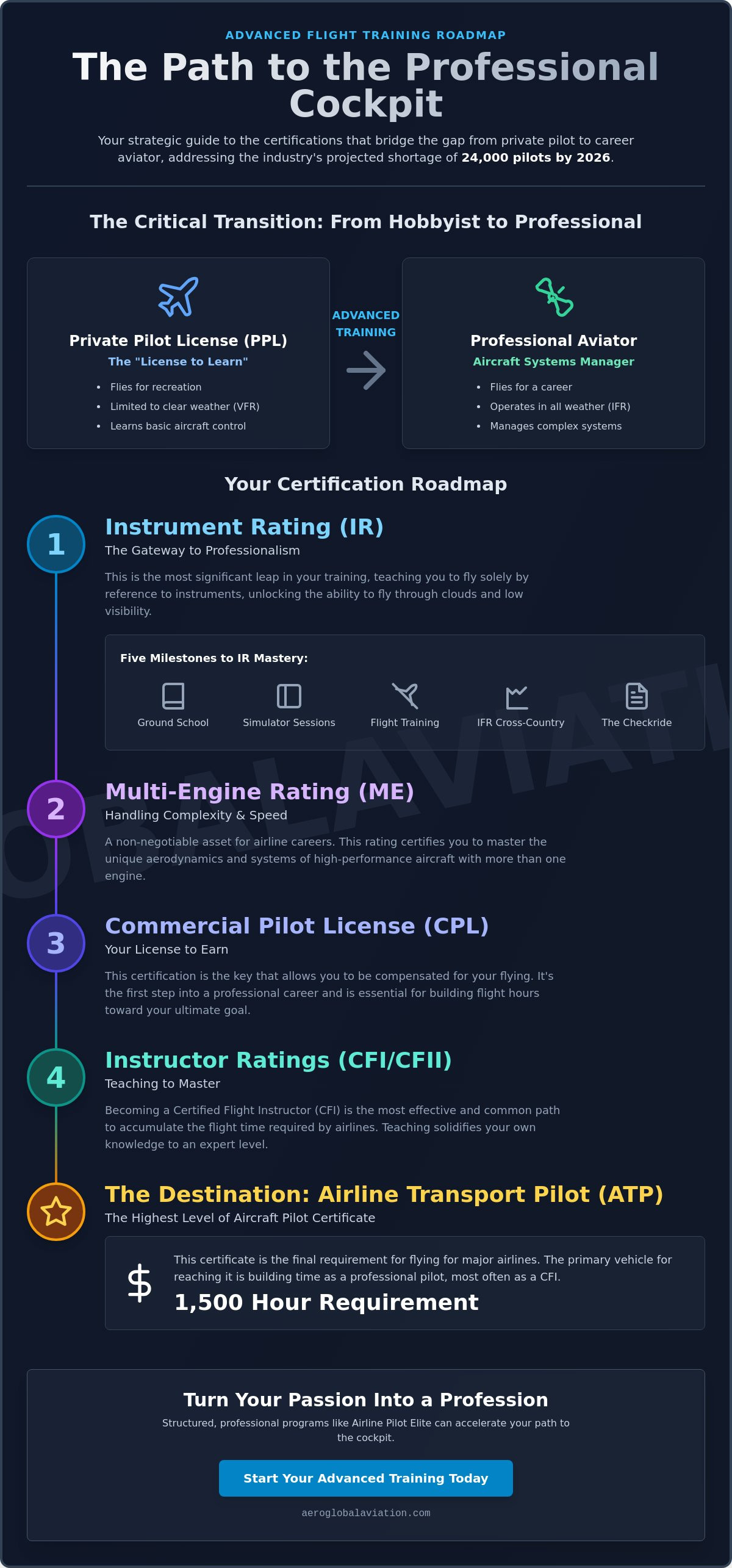
You've earned your Private Pilot License (PPL). Congratulations. You've joined a small percentage of the population that can legally command an aircraft. But if your goal is the captain's seat of a commercial jet, you've only just cleared the threshold. Advanced flight training is the critical bridge that spans the gap between flying for fun and flying for a living. It's the transformative phase where you stop "learning to fly" and start "learning to manage an aircraft system."
This stage isn't just about adding more hours to your logbook. It's a professional filter that separates hobbyists from career aviators. While many can master a light aircraft on a sunny afternoon, only those who pursue advanced training develop the discipline to handle complex emergencies, low-visibility approaches, and high-performance engines. This journey is built on three core pillars:
- Instrument Rating (IR): Learning to fly solely by reference to your instruments, regardless of the weather outside.
- Multi-Engine Rating (ME): Mastering the complexity and speed of aircraft with more than one engine.
- Instructor Ratings (CFI/CFII): Proving your mastery by teaching others, which is the most effective way to solidify your own knowledge.
The "License to Learn" vs. Professional Certification
In the aviation community, we often call the PPL a "license to learn." It grants you the basic skills to navigate in clear weather, but it doesn't prepare you for the high-stakes environment of commercial aviation. Moving into advanced certifications requires a significant psychological shift. You're no longer just a pilot; you're a professional decision-maker. Understanding the full scope of pilot certification in the United States reveals that each subsequent rating layers new levels of safety onto your foundation. By setting professional standards early, you ensure that you're prepared for the technical scrutiny of future airline interviews.
Why Advanced Training is Mandatory for Career Pilots
The FAA doesn't just suggest these ratings. They're legal requirements for almost every paid flying position in the industry. Beyond the legalities, advanced flight training is a major factor in aviation safety and insurance. Most commercial operators won't consider a candidate who lacks an Instrument Rating. These certifications are also the primary vehicle for reaching the 1,500-hour requirement for an Airline Transport Pilot certificate. Completing your commercial pilot training allows you to start working as a professional, which is the only realistic way to build the experience needed for the major airlines. You're investing in your own marketability and a lifetime of career safety.
Mastering the Instrument Rating (IR): The Gateway to Professionalism
If the Private Pilot License is your ticket to the sky, the Instrument Rating (IR) is your passport to the world. It marks the most significant leap in your advanced flight training journey. You're no longer restricted by clear skies; you're learning to command an aircraft when the horizon disappears and "the soup" of thick clouds surrounds you. This isn't just a technical skill. It's a fundamental shift in how you think, plan, and execute every flight. You'll move away from seat-of-the-pants flying and toward the "IFR Mindset," which prioritizes precision, meticulous planning, and standardized operating procedures (SOPs).
Earning your IR is a structured process that builds your confidence layer by layer. We break this down into five key milestones:
- Ground School: Mastering the complex rules of the IFR system and weather theory.
- Simulator Sessions: Building muscle memory and procedural habits in a controlled, cost-effective environment.
- Flight Training: Taking those procedures into the cockpit to master aircraft control without visual cues.
- IFR Cross-Country: Navigating long distances through multiple air traffic control jurisdictions.
- The Checkride: Proving your mastery to an FAA examiner.
While the Commercial Pilot federal regulations outline the legal minimums for professional certification, the Instrument Rating is what truly prepares you for those high-performance standards. It’s the stage where you stop being a passenger in your own cockpit and start being a manager of the flight environment.
Transitioning from VFR to IFR Flight
The biggest challenge for new instrument students is the transition from "looking outside" to "trusting the panel." When you lose the horizon, your inner ear can play tricks on you. We teach you to ignore those physical sensations and rely entirely on your instruments. You'll develop a disciplined "scan," constantly monitoring your altitude, heading, and airspeed in a rhythmic loop. You'll also master the language of Air Traffic Control. IFR communications are faster and more precise, requiring you to stay two steps ahead of every instruction. If you're ready to start building this professional foundation, explore our Career Pilot Program to see how we structure your journey.
Glass Cockpit Mastery: Garmin G1000 and Beyond
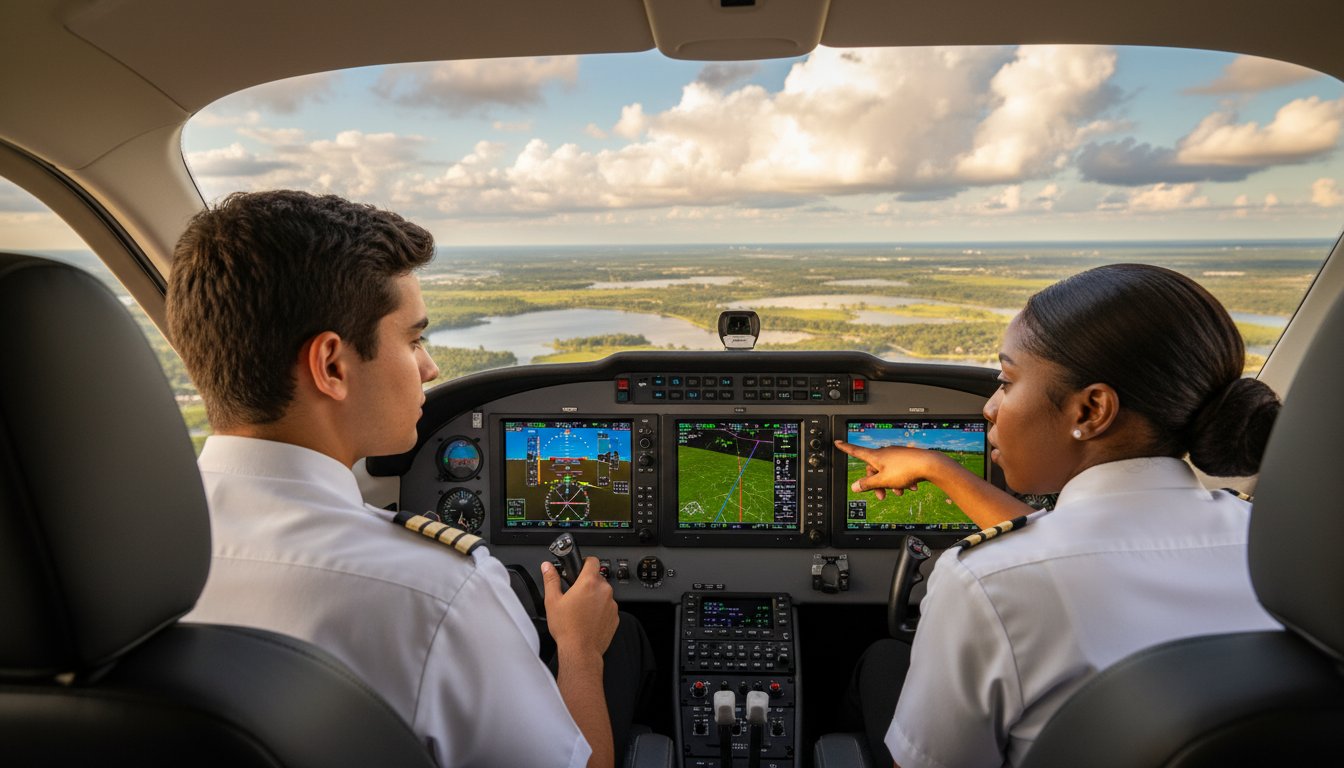
Many flight schools still rely on traditional "steam gauge" cockpits, but the airline industry has moved on. Modern advanced flight training must include proficiency in Electronic Flight Instrument Systems (EFIS). We utilize Technologically Advanced Aircraft (TAA) equipped with the Garmin G1000 suite. This provides you with incredible situational awareness through synthetic vision and integrated weather data. By training on the same types of glass displays found in regional jets, you’re not just getting a rating; you’re preparing for the exact environment you’ll face in your first airline job. We integrate this high-tech approach into every advanced certification to ensure our graduates are the most competitive candidates in the field.
Multi-Engine Commercial Training: Handling Complexity and Speed
Stepping into a multi-engine aircraft feels like a promotion. For any student targeting the flight deck of a major carrier, the Multi-Engine Rating is the "holy grail" of advanced flight training. It represents a significant shift in performance, moving you away from the forgiving nature of single-engine trainers into the world of high-speed, complex systems. You'll master retractable landing gear, constant speed propellers, and the increased workload that comes with managing two powerplants simultaneously. This certification is essential for anyone looking to fly under Part 135 charter or Part 121 airline operations, as it proves you can handle the responsibility of a multi-million dollar aircraft.
The transition is about more than just speed. It's about safety and redundancy. Professional airlines operate under rigorous standards, often utilizing the FAA Advanced Qualification Program to ensure pilots are trained for specific, data-driven scenarios. Your multi-engine training mirrors this high-level approach, focusing on how to manage the aircraft when things don't go as planned. It's the stage where you truly become a commander, balancing technical checklists with split-second aerodynamic decisions.
Aerodynamics of Multi-Engine Flight
The most critical challenge you'll face is One Engine Inoperative (OEI) flight. When an engine fails in a twin, the aircraft doesn't just lose half its power; it loses its symmetry. You must learn to manage asymmetric thrust to maintain directional control. We focus heavily on Vmc, which is the minimum controllable airspeed with a critical engine failed. You'll practice the "dead foot, dead engine" mantra, a vital skill where you use your rudder to counteract the yawing motion of the working engine. Mastering these maneuvers builds a level of stick-and-rudder proficiency that single-engine flying simply cannot provide.
Building Multi-Engine Time for Airline Requirements
Airlines value multi-engine experience because it demonstrates you can handle complexity. While you might have hundreds of total hours, many regional carriers look for a specific "multi-time" threshold, often between 25 and 50 hours, before they'll consider you for a first officer role. Building this time can be expensive, so efficiency is key. Our career pilot program is designed to streamline this progression, integrating multi-engine time into your commercial training to maximize every dollar spent. We help you reach those professional milestones faster, ensuring you're ready for the airlines as soon as you hit your total hour requirements.
The Certified Flight Instructor (CFI) Path: Teaching to Master
Most pilots view the Certified Flight Instructor (CFI) rating simply as a tool to build hours. While it's true that instructing is the most common path to reaching the 1,500-hour requirement for an Airline Transport Pilot (ATP) certificate, its value goes much deeper. This stage of advanced flight training is where you truly master your craft. There's a profound difference between performing a maneuver and explaining the underlying aerodynamics to a student who is seeing it for the first time. By stepping into the instructor role, you transition from a skilled operator to an expert authority in the cockpit.
The journey doesn't stop at the initial CFI certificate. To become a truly competitive candidate for the airlines, most pilots pursue a stack of instructor ratings. This includes the CFII (Instrument Instructor) and the MEI (Multi-Engine Instructor). Each of these certifications adds a new layer of professional depth to your resume. They prove to future employers that you possess the leadership, patience, and communication skills necessary to manage a crew and a cabin full of passengers. If you're ready to take this step, our Airline Pilot Elite program is designed to guide you through every one of these professional instructor milestones.
Why Teaching Makes You a Better Airline Pilot
The "Learning by Teaching" principle is a cornerstone of professional aviation. When you teach a student about FAA regulations or complex weather patterns, you're forced to internalize that information at a much higher level. This deep knowledge ensures you're never caught off guard during an airline interview or a technical checkride. Beyond the books, instructing develops a "Captain’s Mindset." You learn to manage the cockpit environment, anticipate mistakes, and maintain situational awareness while someone else is flying the plane. Airline recruiters value this experience because it shows you can remain calm and professional under the pressure of a training environment.
The Roadmap to CFI, CFII, and MEI
The path to becoming an instructor begins with the Fundamentals of Instructing (FOI) exam. This covers the psychology of learning and effective teaching techniques. From there, you'll master the "right-seat perspective." Flying from the other side of the cockpit feels foreign at first, but it quickly becomes second nature as you build your own library of lesson plans. Adding the CFII and MEI ratings offers a strategic advantage. It allows you to teach advanced students in more complex aircraft, which helps you build the high-quality multi-engine and instrument time that major carriers look for. This isn't just about building hours; it's about building a reputation for excellence in advanced flight training.
Advancing Your Career at Aero Global Aviation Academy
Choosing where to complete your advanced flight training is just as important as the ratings themselves. At Aero Global Aviation Academy, we don't just process students; we cultivate future captains. Our "Airline Pilot Elite" program is the definitive path for those who want to transition from a Private Pilot License all the way to advanced instructor certifications. It's a structured, high-standards environment that mirrors the professional world you're about to enter. We provide the tools, but more importantly, we provide the mentorship to ensure your career goals become tangible destinations.
We believe that your training environment should prepare you for the realities of the airline industry from day one. This means training with modern equipment, following professional operating procedures, and learning in an environment that demands excellence. Our academy is designed to be your dedicated local partner, offering a collaborative spirit that you won't find in large, impersonal corporations.
The Orlando Advantage: Weather and Airspace
Geography is one of our greatest strategic assets. While flight schools in Northern climates often struggle with winter weather that grounds flights for weeks, our students benefit from the Florida sun. Central Florida offers over 300 days of flyable sunshine each year. This consistency is vital for skill retention and allows you to accelerate your training timeline significantly. You won't waste time waiting for the clouds to clear; instead, you'll be building hours and mastering systems while others are stuck on the ground.
Training in Kissimmee and Orlando also puts you in some of the most complex airspace in the country. You'll regularly interact with Air Traffic Control at major international hubs, providing you with real-world experience that rural schools can't offer. This exposure builds a level of radio proficiency and situational awareness that makes the transition to a regional airline much smoother. You'll be comfortable in high-traffic environments long before you reach a professional flight deck.
Your Professional Mentor in Kissimmee
We pride ourselves on being a "Practical Mentor" rather than a massive pilot factory. Every student at Aero Global receives personalized attention from instructors who are deeply invested in their individual success. We understand that your journey is unique, and we tailor our guidance to fit your specific airline goals. You'll have access to modern aircraft and simulators that are designed to feel like the cockpits you'll eventually fly for a living. It's this combination of advanced technology and personal support that sets our graduates apart.
Ready to see the difference for yourself? Schedule your introductory flight lesson in Orlando to tour our facility and meet our team. It's the first step toward a lifelong career in the sky, and we're here to help you navigate every mile of the way. Your future as a professional aviator starts here.
Your Destination is Within Reach
Transitioning from a private pilot to a professional airline aviator is a journey defined by discipline and strategic certification. You've seen how mastering instrument precision and multi-engine complexity builds the foundation for a career in the flight deck. By choosing the right environment, you ensure that every hour in your logbook brings you closer to that dream. This isn't just about collecting ratings; it's about becoming a leader in the cockpit through dedicated practice and expert mentorship.
At Aero Global Aviation Academy, we provide an FAA-certified structured curriculum and a modern glass-cockpit fleet to give you a competitive edge. Our high-volume training environment in Kissimmee, FL, leverages perfect weather and complex airspace to keep your momentum high. It's time to stop dreaming and start doing. Explore our Airline Pilot Elite Program and start your advanced flight training journey today. We're ready to help you earn your wings and secure your place in the future of aviation. The sky isn't the limit; it's your office.
Frequently Asked Questions
What is considered advanced flight training?
Advanced flight training encompasses the specialized certifications earned after your Private Pilot License to prepare you for professional employment. This includes the Instrument Rating, Commercial Pilot License, Multi-Engine Rating, and Flight Instructor certifications. It's the transformative stage where you transition from basic aircraft control to mastering complex systems and professional decision-making required for a career in the airlines.
Do I need an Instrument Rating before my Commercial Pilot License?
While you can technically earn a Commercial Pilot License without an Instrument Rating, it's highly impractical for any professional career path. Most commercial jobs and all airline positions require an Instrument Rating to operate safely in diverse weather conditions. Completing your instrument training first ensures you have the precision and technical skills necessary to meet the higher standards of the commercial checkride.
How hard is the Multi-Engine Rating compared to the PPL?
The Multi-Engine Rating is typically shorter than the PPL but requires much higher intensity and focus on aerodynamics. You'll need to master the complexity of managing two engines and handling asymmetric thrust during critical engine-out emergencies. While the flight hours required are fewer, the mental workload increases as you learn to manage retractable gear, constant speed propellers, and faster approach speeds.
Is it better to get a CFI rating or just build hours elsewhere?
Earning your CFI rating is widely considered the most effective way to build the 1,500 hours required for airline eligibility. Instructing forces you to master aviation concepts at a deeper level by teaching them to others, which sharpens your professional knowledge. It also provides a steady income and consistent flying time, making it more financially sustainable than self-funding hundreds of solo hours in a rental aircraft.
Can I do advanced flight training part-time while working?
You can certainly pursue advanced flight training on a part-time basis while maintaining a full-time job. However, we recommend flying at least two to three times per week to ensure skill retention and steady progress through complex ratings like the Instrument Rating. Consistency helps you avoid repeating lessons and keeps your training costs manageable by reaching proficiency milestones more efficiently without long gaps between flights.
What are the FAA requirements for an Instrument Rating in 2026?
To earn an Instrument Rating in 2026, the FAA requires a minimum of 40 hours of actual or simulated instrument time. This must include at least 15 hours of instrument flight training from an authorized instructor and a cross-country flight of at least 250 nautical miles performed under IFR flight rules. You must also hold at least a current Private Pilot Certificate and pass a dedicated FAA knowledge test.
How long does it take to complete the Airline Pilot Elite program?
The timeline for the Airline Pilot Elite program varies based on your flying frequency, but most full-time students complete the journey from zero experience to instructor certification in 10 to 14 months. This structured path moves you through your PPL, Instrument, Commercial, and CFI ratings with professional momentum. Training at our Kissimmee facility helps accelerate this timeline by minimizing weather-related delays that often plague other regions.
Why should I choose a flight school in Orlando for advanced ratings?
Orlando and Kissimmee offer a strategic advantage for advanced flight training due to over 300 days of annual sunshine and complex, high-traffic airspace. You'll gain invaluable experience communicating with Air Traffic Control at major international hubs while enjoying a climate that allows for year-round flying. This combination ensures you graduate with superior situational awareness and a much faster training timeline than you would find in colder, less active regions.


