

Steady progress toward your pilot goals comes from a realistic routine, not a packed calendar. A study-life balance for student pilots Kissimmee trainees can maintain leaves room for flight preparation, ground study, work, and time to recharge. When weather or scheduling changes shift a lesson, a flexible plan helps you keep moving without treating every adjustment as a setback.
It can be hard to estimate the workload at first. Flight training combines practical skill-building with aviation study, while work, school, and other commitments continue. The answer isn’t to fill every spare hour. Create a repeatable weekly rhythm, protect time to rest, and keep a backup task ready for sessions that need to move.
This guide explains how to organize training, study, work, and personal time, then adapt when the week changes. At Aero Global Aviation Academy in Kissimmee and Orlando, structured pathways connect day-to-day learning with longer-term goals, from PPL training through the Wings Foundation to the Career Pilot Program and Airline Pilot Elite. A manageable plan can keep your pilot ambitions moving forward while leaving room for life beyond training.
Key Takeaways
- Build a sustainable study-life balance for student pilots Kissimmee by planning around fixed responsibilities and leaving room to recover.
- Use a prepare, train, review routine to turn each lesson into a clear next step for your aviation study.
- Make a flexible weekly plan that can adapt when training or study sessions need to move, without overloading your calendar.
- Plan travel from your actual starting point and route, and allow a buffer so getting to training fits smoothly into your day.
- Connect your weekly routine to a longer-term goal by choosing between PPL training through the Wings Foundation and the PPL-to-CPL Career Pilot Program.
What Study-Life Balance Means for Student Pilots in Kissimmee
For student pilots, balance isn’t an equal split between flying, studying, work, and personal life. It’s a sustainable rhythm that gives each responsibility appropriate attention while protecting time for rest, relationships, and activities that matter to you. The broader idea of work-life balance offers a useful starting point. Aviation adds lesson preparation, flight training, and review to the mix.
Your week may include college classes, a job, family commitments, errands, or travel around Kissimmee and Orlando. You don’t have to clear your calendar of those responsibilities to pursue pilot training. Instead, build a routine that makes room for learning and recovery without assuming every week will go exactly to plan.
Progress isn’t a race to reach each milestone as quickly as possible. Flight training involves building knowledge and skills, and students’ schedules, learning needs, and training demands differ. A sustainable pace helps you return to the work consistently. The right weekly commitment is one you can maintain alongside your other obligations, not a fixed number of hours that applies to everyone.
What does a balanced student pilot schedule look like?
A balanced routine reserves time for lessons, preparation, and study while leaving space for classes, work, family, and personal commitments. It also protects sleep and leaves flexibility for a busy day or an unexpected change. Assess your routine over several weeks, not by whether a single week goes perfectly. If the plan repeatedly squeezes out rest or essential responsibilities, adjust it.
Why can flight training feel difficult to fit in?
Flying is only one part of learning. You also need to prepare for training and review what you’ve learned so you can identify what to focus on next. These tasks compete with existing priorities, but they don’t mean you must give up school or work. Break study into manageable sessions and fit them around commitments you can’t move, rather than relying on last-minute cramming.
Sustainable balance for a student pilot means making steady room for training, study, responsibilities, and recovery without expecting every week to be perfect. Use that definition to assess your routine: does it support continued learning and leave enough capacity to reset when plans change? Start with a schedule that fits your life now, then refine it as you learn how much preparation and review require.
How Flight Lessons, Ground Study, and Rest Fit Together
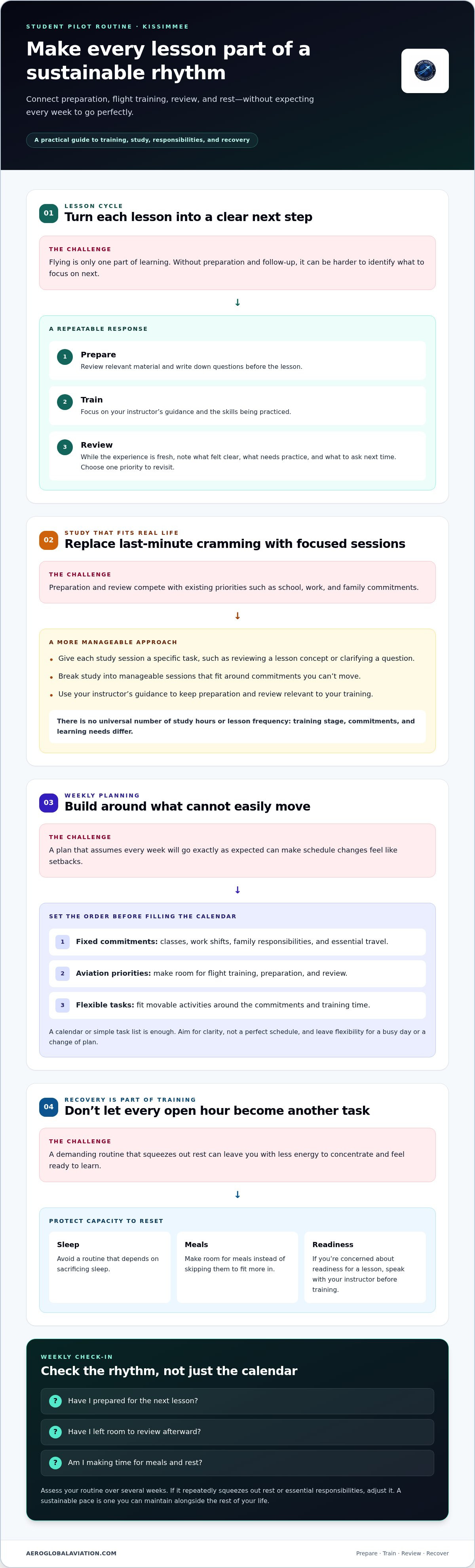
Flight training works best as a learning cycle, not a single appointment. Before a lesson, review the relevant material and write down questions. During training, focus on your instructor’s guidance and the skills being practiced. Afterward, note the key points while the experience is fresh, then choose one priority to revisit before your next lesson.
This sequence connects ground study to flying: preparation gives you context, practice turns concepts into action, and review helps you identify what to work on next. For a practical example of organizing a repeatable preflight routine, see the student pilot preflight inspection guide.
Plan preparation and review around each flight lesson
Make each study session about a specific task, such as reviewing a concept from your lesson or clarifying a question for your instructor. Short, purposeful sessions are often easier to fit around school or work than one large block saved for the last minute. After training, jot down what felt clear, what needs practice, and what you want to ask next time.
There’s no universal number of study hours or lesson frequency for every student. Your training stage, commitments, and learning needs all affect how much preparation and review make sense. Use your instructor’s guidance to keep study relevant, then adjust your routine based on what supports your progress.
Protect rest and focus during training
Rest is part of preparation, not leftover time. Poor rest or a demanding day can make it harder to concentrate and feel ready to learn, so avoid a routine that depends on sacrificing sleep, skipping meals, or studying when you have no energy. If you’re concerned that your readiness could affect a planned lesson, speak with your instructor before training.
For a simple weekly check-in, ask yourself: Have I prepared for the next lesson? Have I left room to review afterward? Am I making time for meals and rest? These questions can help you maintain the study-life balance for student pilots Kissimmee training calls for, without turning every open hour into another task.
A structured training path can connect day-to-day learning to a longer-term aviation goal. Explore the flight training pathways at Aero Global Aviation Academy as you consider which direction fits your ambitions.
How to Build a Realistic Weekly Plan for Student Pilot Training
Start a useful weekly plan with the parts of your life that can’t easily move, then make room for aviation priorities. This reduces last-minute scheduling and helps you see what your available time can realistically support. A calendar or simple task list is enough. The goal is clarity, not a perfect schedule.
Set priorities before filling the calendar
Sort your week into three groups: fixed commitments, flexible tasks, and flight training or study. Add classes, work shifts, family responsibilities, and essential travel first. Then reserve time for aviation preparation and review before placing lessons into the remaining spaces. Choose a few specific goals, such as preparing for an upcoming lesson and reviewing a topic afterward. Don’t turn every open block into another obligation.
Build in practical buffers, too. A lesson takes more than the time spent in the aircraft, so account for getting there, preparing beforehand, and reviewing afterward. Leaving room between commitments also helps when plans shift. Base your schedule on your actual starting point, travel needs, and responsibilities rather than an idealized week.
Adjust when lessons or responsibilities move
Flight plans and everyday commitments can change. If a lesson doesn’t happen as expected, have a backup study task ready, such as reviewing notes, revisiting a ground-study topic, or writing down questions for your next session. A change can then redirect your effort without forcing you to rebuild the whole week.
When something moves, reschedule by priority. Keep essential responsibilities and rest in place, then find a realistic alternative for training or study. If there isn’t room, carry the task forward and revise your goals instead of crowding the next day. A changed plan is information, not proof that you’ve failed.
- Fixed: Classes, work, family commitments, and other appointments.
- Flexible: Errands and tasks that can shift to another day.
- Aviation priorities: Lesson preparation, flight training, and review.
At the end of each week, compare what you planned with what actually happened. Notice which study blocks were manageable, where travel or other demands took longer than expected, and what needs to move into the next week. This quick review makes your routine more useful over time and supports a study-life balance for student pilots Kissimmee trainees can sustain.
Buffer time turns schedule changes into manageable adjustments, not a chain reaction that crowds out rest and responsibilities. Keep that principle in mind as you shape your routine around your pilot goals. Aero Global Aviation Academy’s structured flight training pathways connect foundational training with longer-term aviation qualifications.
Balancing Flight Training with Kissimmee and Orlando Life
Training in Kissimmee and Orlando means fitting lessons into the same calendar as work, classes, family plans, and travel to and from training. A schedule that looks open on paper may feel tight once you account for getting ready, traveling, and resetting before your next commitment. Build your routine around your actual starting point and route rather than assuming every training day will take the same amount of time.
Build local travel and timing into your routine
Estimate your own journey and add a practical arrival buffer. If a training day is already busy, group preparation tasks where possible, such as reviewing lesson notes before you leave instead of creating separate trips or rushed transitions. Use the Kissimmee and Orlando flight-training location guide for a deeper comparison of the area.
Keep the rest of the day realistic, too. If you can, avoid placing a demanding work or study commitment immediately after a lesson. Your route, starting location, and other obligations will determine the buffer you need; there’s no single travel plan that fits every student.
Make room for changing Central Florida conditions
Weather can affect flight plans, so build flexibility into your routine rather than treating a planned lesson as guaranteed. Follow current conditions and your instructor’s guidance when making training decisions. If flying doesn’t proceed as planned, switch to a useful ground-study task, such as reviewing lesson material or organizing questions for your next session. This keeps the day productive without assuming in advance what conditions or lesson decisions will be.
When plans change, move the affected task to a realistic opening, not automatically to the first available space. Preserve time for sleep, meals, work, and family commitments. Then update the rest of your week so one change doesn’t crowd out everything else. That flexibility is central to study-life balance for student pilots Kissimmee trainees can maintain through changing schedules and everyday demands.
Use a weekly review to note how much time travel and transitions actually took, then adjust future plans accordingly. To connect regular learning with longer-term aviation goals, explore flight training pathways at Aero Global Aviation Academy.
Choose a Pilot Training Path That Supports Your Long-Term Goal
Your training pathway shapes the milestones you’re working toward, so connect that choice to both your aviation ambitions and the time you can realistically make available. A clear starting goal can make weekly study and lesson planning feel purposeful. A longer-term view also helps you see how foundational training can lead toward professional qualifications.
Match your starting point to a training pathway
If your immediate aim is to earn a Private Pilot License (PPL), the Wings Foundation focuses on PPL training. It’s a starting point for students whose current priority is building foundational flying knowledge and skills, whether or not they have settled on a career destination.
For students planning to continue toward commercial certification, the Career Pilot Program provides a pathway from PPL through Commercial Pilot License (CPL) training. Airline Pilot Elite extends from private pilot training to advanced instructor certifications. These programs cover different scopes of training, so consider both the milestone you want to work toward now and where you hope to go later.
To explore the professional route in more detail, read the Kissimmee and Orlando career pilot program guide. If you’re focused on foundational training, the Florida private pilot license guide explains the PPL path.
Turn your plan into a supported next step
Before choosing a direction, write down your current commitments, the time you can protect for training and study, and the first aviation milestone you want to reach. Then consider whether your goal is PPL training, progression through CPL, or a path that continues to advanced instructor certifications. This gives you a practical basis for deciding how training can fit into your life.
Structured programs provide a defined progression that connects everyday learning to a larger goal. Your routine may need to evolve as your responsibilities or training priorities change, so revisit your plan and adjust it to fit your circumstances. Consistency matters more than building an ambitious schedule you can’t sustain. That’s a useful principle for study-life balance for student pilots Kissimmee trainees pursuing either a personal milestone or a professional future.
Explore pilot training pathways with Aero Global Aviation Academy to see how the available programs align with your next aviation goal.
Build a Training Routine That Moves You Forward
A sustainable study-life balance for student pilots Kissimmee students can maintain comes from a repeatable routine, not a perfect week. Set aside time for preparation, lessons, review, and rest, then leave enough flexibility to adapt when responsibilities or plans change. Realistic priorities keep training connected to your longer-term goal without requiring you to put the rest of life on hold.
Aero Global Aviation Academy serves student pilots in Kissimmee and Orlando with structured options spanning foundational Private Pilot License training, progression through Commercial Pilot certification, and advanced instructor certifications. Choose a pathway that fits the milestone you’re working toward, and connect today’s study with the next step in your aviation journey.
Ready to connect your goals with a structured training path? Explore pilot training pathways with Aero Global Aviation Academy. Keep your plan realistic, protect time to recharge, and take the next step with confidence.
Frequently Asked Questions
Can I become a student pilot while working or attending college?
Yes, you can pursue pilot training while working or attending college if you plan around your existing commitments. Start by marking fixed class times, shifts, family responsibilities, and travel, then identify realistic blocks for lessons, preparation, and review. Leave some time uncommitted for rest and changes to your plans. Your routine may differ from another student’s, so focus on a pace you can sustain.
How many hours a week should a student pilot study?
There isn’t one weekly study-hour target for every student pilot. The time you need depends on your current training, lesson objectives, learning needs, and other responsibilities. Rather than setting an arbitrary number, ask your instructor what material to prepare and review, then schedule focused sessions you can maintain. Track how well the routine works and adjust it as your training progresses.
What happens if weather or scheduling changes interrupt my flight training?
If a flight lesson changes, follow your instructor’s guidance and update your plan rather than treating the change as a failure. Use the time for a relevant ground-study task, such as reviewing notes, revisiting a lesson topic, or listing questions for your next session. Reschedule training or study when it fits without sacrificing essential commitments or rest. A flexible plan helps you keep learning between flights.
Is flight training in Kissimmee manageable for beginners?
Flight training can be a manageable goal for beginners when you approach it step by step and plan around your actual schedule. Start by identifying your first milestone and the time you can set aside for lessons, preparation, and review. In Kissimmee and Orlando, Aero Global Aviation Academy offers structured pathways from foundational Private Pilot License training to commercial and advanced instructor certifications, connecting early learning with longer-term goals.
How can I stay motivated when pilot training takes longer than expected?
Stay motivated by focusing on the next learning milestone rather than measuring progress only by how quickly you advance. Keep a record of the skills and topics you’ve worked on, note questions to revisit, and review your plan when responsibilities or training needs change. A moved lesson or slower period doesn’t erase what you’ve learned. Build a routine you can return to, and recognize steady effort along the way.
Should I study ground-school material before every flight lesson?
Reviewing material related to an upcoming lesson can help you arrive with context and useful questions. Focus on the concepts or procedures your instructor has asked you to prepare, rather than trying to study everything before every flight. After training, capture key points and identify what to revisit. Your preparation needs may vary by lesson, so use your instructor’s guidance to decide what deserves attention next.
What pilot training path should I choose if I want to fly professionally?
If your goal is professional flying, consider a pathway that matches the qualifications you want to pursue. Aero Global Aviation Academy’s Career Pilot Program progresses from Private Pilot License through Commercial Pilot certification. Airline Pilot Elite extends from private pilot training to advanced instructor certifications. If you’re still building your foundation, the Wings Foundation focuses on PPL training. Compare your immediate milestone with your longer-term ambition as you plan.


