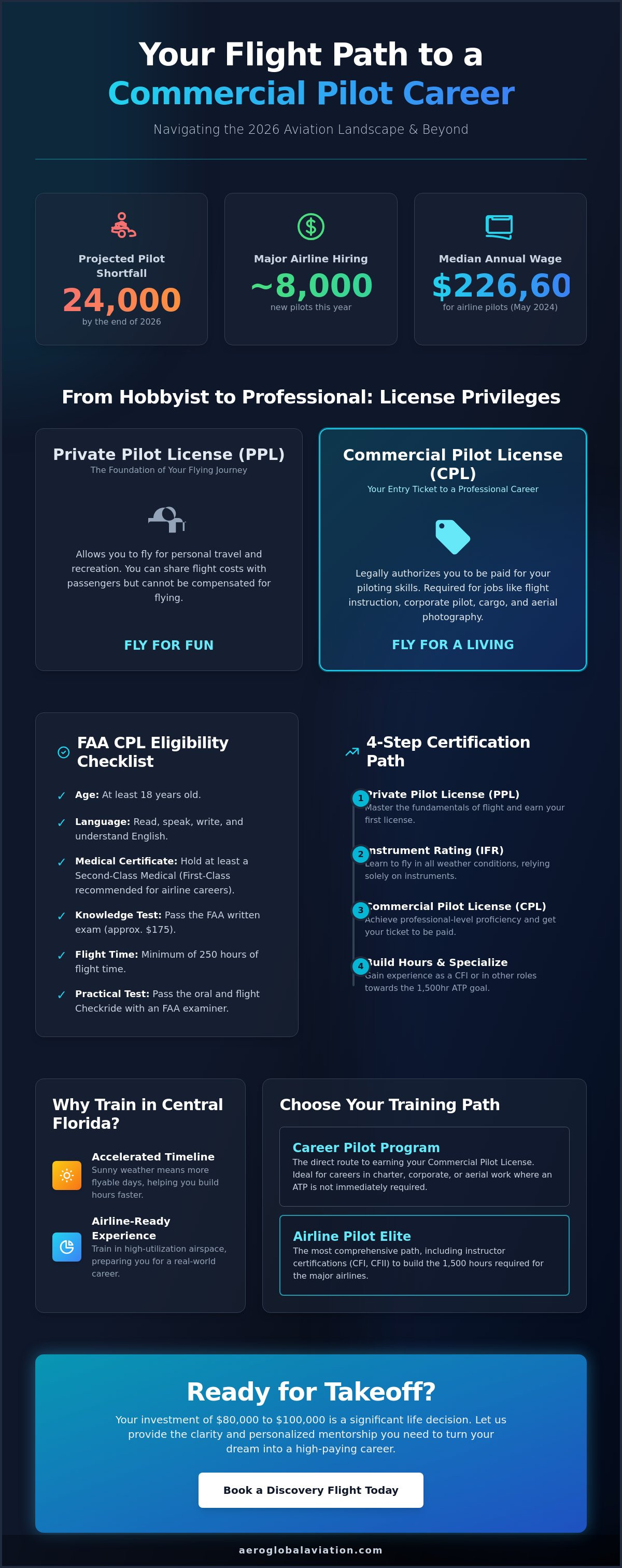
Did you know that the aviation industry is facing a projected shortfall of 24,000 pilots by the end of 2026? While major airlines are actively hiring up to 8,000 new professionals this year, starting your commercial pilot training can still feel like flying through heavy fog. You want to fly, but the 1,500-hour ATP requirement and the technical jargon of Part 61 versus Part 141 curriculums often create more questions than answers.
We understand that the $80,000 to $100,000 investment represents a significant life decision. You aren't just looking for a license; you're looking for a reliable path to a career where the median annual wage has reached $226,600. This guide provides the clarity you need to move forward with confidence. We'll outline a clear timeline to employment, break down the latest 2026 FAA medical standards, and show you how personalized mentorship in the sunny Florida skies can accelerate your journey. Let's work together to turn your pilot dreams into a professional reality.
Key Takeaways
- Understand how the Commercial Pilot License acts as your essential entry ticket to transition from a student pilot to a paid aviation professional.
- Review the 2026 FAA eligibility standards, including the 250-hour flight time requirement and the importance of logging hours with strategic purpose.
- Discover how the sunny weather and high-utilization airspace in Central Florida can accelerate your commercial pilot training timeline.
- Compare the direct route of the Career Pilot Program against the advanced Airline Pilot Elite path to determine which certification level meets your career goals.
- Learn the practical first steps to take flight, including how to book a discovery flight and navigate modern financing options for your education.
What is Commercial Pilot Training? Defining the Path to Getting Paid to Fly
Transitioning from a student to a professional is more than just a change in status; it's a total shift in mindset. While a Private Pilot License (PPL) lets you fly for fun and share costs with friends, commercial pilot training is the rigorous process that transforms you into a pilot who can legally receive compensation for their skills. With a projected shortfall of 24,000 pilots across the industry by the end of 2026, the demand for new talent has never been higher. Major airlines are forecasted to hire approximately 7,672 to 8,000 pilots this year alone, making this the perfect moment to take your flying skills to the next level.
Think of the Commercial Pilot License (CPL) as your professional entry ticket. Without it, you cannot legally work as a flight instructor, a corporate pilot, or an aerial photographer. Obtaining this certification means you've moved beyond basic navigation into high-precision operations. This mastery doesn't just look good on a resume; it translates directly into higher salary potential. When you consider that the median annual wage for airline pilots reached $226,600 in May 2024, the path from student to professional becomes a clear and rewarding investment in your future.
PPL vs. CPL: The Core Differences
The primary difference lies in your legal privileges. As a private pilot, you can fly a plane for personal travel, but you can't make a profit. Once you complete your commercial pilot training, you're cleared for commercial air work. This requires a much higher standard of flight proficiency. You'll need to demonstrate mastery of complex maneuvers with tighter tolerances for altitude, heading, and airspeed. For a deeper look at how these roles fit into the broader aviation landscape, you can refer to this U.S. pilot certification overview. The CPL is the definitive legal threshold where your passion for flight officially becomes a career.
The ROI of Professional Pilot Programs
Choosing a structured training path, such as our Career Pilot Program, eliminates the "dead time" often found in self-paced training. By following a clear progression from PPL to CPL, you ensure every hour in the cockpit counts toward your ultimate goal. This efficiency is vital because the 2026 market favors candidates who can transition quickly through their ratings.
Building hours in a professional environment like Central Florida prepares you for the high-utilization airspace of the airlines. For those aiming for the major carriers, the Airline Pilot Elite path adds instructor certifications, allowing you to build the 1,500 hours required for an ATP certificate while getting paid to teach. This strategic approach ensures you aren't just logging time; you're building a rich foundation for a world of opportunities.
FAA Commercial Pilot License (CPL) Requirements for 2026
To earn your wings as a professional, you must meet specific federal standards. The FAA requires applicants to be at least 18 years old and proficient in the English language. Beyond these basics, you'll need a valid medical certificate to prove you're fit for the flight deck. While a Second-Class Medical is the legal minimum to exercise commercial privileges, we often suggest securing a First-Class Medical early on. This ensures you're medically qualified for a long-term airline career before you invest deeply in your education. You can find the full list of eligibility criteria and aeronautical experience in the FAA Commercial Pilot regulations.
Before you can take your final practical exam, you must pass the FAA Knowledge Test. This written exam costs approximately $175 and covers advanced topics like navigation, weather theory, and federal air regulations. Once the paperwork and tests are cleared, the ultimate hurdle is the Checkride. This is a rigorous, multi-hour evaluation with an FAA examiner who will test both your oral knowledge and your physical flying skills. Passing this means you've officially moved from a student to a certified commercial pilot.
The 4-Step Certification Process
Professional flight training follows a logical, structured progression. It starts with our Wings Foundation, where you earn your Private Pilot License (PPL) and learn the fundamentals of flight. Next, you'll master Instrument Flight Rules (IFR). This step is crucial; it gives you all-weather capability by teaching you to fly solely by referencing your instruments. The third phase focuses on building cross-country and night flight experience to prepare you for the demands of commercial operations. Finally, you'll perfect advanced maneuvers like lazy eights and steep spirals before completing your commercial pilot training and earning your certificate.
Logging Quality Hours vs. Quantity
The FAA mandates a minimum of 250 flight hours for a Part 61 commercial certificate. However, simply reaching 250 hours isn't enough to impress modern recruiters. Airlines look for pilots who have spent their commercial pilot training hours wisely. Mastering complex aircraft and glass cockpit technology makes you a much more attractive candidate than someone who only has experience in basic trainers. Aero Global optimizes your hour-building by focusing on professional skill-building in every session, ensuring you're ready for the cockpit of a jet rather than just a trainer.
If you want to see how we turn hours into expertise through personalized mentorship, you can explore our career-focused programs today to start your journey.
Why Central Florida is the Premier Hub for Commercial Pilot Training
Florida isn't just a vacation destination; it's the global headquarters for professional flight education. The legendary "Sunny Florida" advantage provides over 300 days of VFR weather annually, which drastically accelerates your timeline. This consistency is vital for your success. When you don't have to worry about snow or long stretches of low clouds, you spend more time in the cockpit and less time in the classroom. Frequent flying builds the sharp muscle memory needed to master advanced maneuvers with precision. For those beginning their research, this Commercial pilot training guide from AOPA offers a great foundation for understanding the national standards you'll meet in the Sunshine State.
Maximizing Training Days per Year
Northern flight schools often battle seasonal delays that can stall progress for weeks at a time. In contrast, Central Florida's climate supports a steady, uninterrupted training rhythm. This reliability helps students in our Career Pilot Program finish their commercial pilot training 3 to 6 months earlier than peers in colder climates. Finishing sooner isn't just about pride; it's a financial win. It allows you to enter the job market and start earning a professional salary while others are still grounded by winter storms. You'll move from student to paid professional with a sense of momentum that's hard to find elsewhere.
Airspace Diversity in Central Florida
Training at Kissimmee Gateway Airport puts you right in the middle of one of the world's busiest aviation corridors. You'll learn to navigate the Orlando complex, which includes everything from quiet rural strips to massive International Class B airspace. This variety is a massive strategic advantage. Dealing with air traffic control in these busy environments builds immense confidence in your radio communication skills. For pilots aiming for peak professional clarity, resources like the American Accent Program can be an excellent supplement to technical flight training. You won't just be flying; you'll be mastering the complex systems used by major airlines every day. Our location is perfect for building cross-country hours, offering diverse destinations that turn every flight into a rich learning experience.
Aero Global offers a unique community feel that the massive "pilot factories" simply can't match. We focus on personalized mentorship rather than just processing students through a system. You aren't just logging hours to meet a requirement. You're preparing for the high-stakes reality of a professional cockpit in a supportive, expert environment. Take your skills to the next level and open up a world of opportunities in the heart of Florida. Let's work together to make your pilot dreams come true in the best training environment in the country.
Comparing Training Paths: Career Pilot Program vs. Airline Pilot Elite
Choosing the right program is a strategic decision that depends entirely on your final destination. If you want to enter the workforce as quickly as possible, the Career Pilot Program provides a direct route from your Private Pilot License (PPL) to your Commercial Pilot License (CPL). This path is designed for rapid employment in specialized fields like aerial photography, pipeline patrol, or cargo operations. However, for those aiming for a seat at a major airline, the Airline Pilot Elite path is the gold standard. By adding advanced instructor certifications to your commercial pilot training, you gain the ability to get paid to fly while working toward the mandatory 1,500-hour ATP requirement.
We also want to address a common concern for many aspiring aviators: the "too old" myth. Many people believe that if they didn't start in their early twenties, the cockpit is out of reach. That simply isn't true. As of 2026, the mandatory retirement age for Part 121 airline pilots remains 65, which leaves a massive career runway for those starting in their 30s, 40s, or even early 50s. We take pride in supporting career changers with personalized attention, ensuring that your previous professional experience is an asset rather than a hurdle.
The Instructor Route: Faster Hour Building
The Airline Pilot Elite program is the most efficient way to reach the 1,500-hour airline minimum. When you earn your Certified Flight Instructor (CFI) and CFII ratings, you stop paying for flight time and start earning a paycheck for it. Teaching others is also the most effective way to master complex aviation knowledge. It forces you to understand every regulation and maneuver at a deep level, which makes you a much safer and more competent pilot. These instructor ratings act as a career insurance policy, providing you with a steady income and job security throughout your journey to the airlines.
Accelerated vs. Personalized Learning
Finding the right balance between speed and true proficiency is the key to a successful career. Massive "factory" schools often prioritize student throughput over individual success, which frequently leads to higher attrition rates and student burnout. We believe that commercial pilot training should be a mentor-based experience. Smaller class sizes and dedicated instructors lead to higher Checkride pass rates because the training is tailored to your specific learning style. Choosing a path that fits your financial plan and your pilot dreams is the first step toward a world of opportunities.
Ready to find the path that fits your specific goals? Explore our professional training programs and start your journey with a dedicated mentor today.
Taking Flight: How to Start Your Commercial Training in Kissimmee
Your journey into the professional cockpit doesn't begin with a mountain of textbooks; it starts with a single Discovery Flight. This initial experience allows you to take the controls under the guidance of a professional instructor, giving you a firsthand look at the career that awaits. It's the moment your pilot dreams become a tangible reality. Moving into commercial pilot training requires a shift in mindset. You're no longer just a student learning a hobby; you're a professional aviator in training. At Aero Global, our "Practical Mentor" philosophy means we treat you as a future colleague from day one, focusing on the real-world skills you'll need to succeed in a high-stakes industry.
Transitioning to a professional role means embracing a higher level of accountability. You'll learn to prioritize safety, precision, and decision-making in every flight. This mental preparation is just as vital as the physical maneuvers you'll master in the sunny Florida skies. We work together to ensure you're ready for the responsibility of a paid flight deck, helping you build the confidence needed to navigate complex airspace and professional expectations.
Financial Planning for Your Aviation Career
We know that the investment for a full professional pilot program, which typically ranges from $93,500 to $96,838 in 2026, is a major commitment. Making this career attainable requires a smart financial strategy. Many students take advantage of federal student loans, which currently offer interest rates of 6.39% for undergraduate Direct Loans. Private flight school loans are another popular option, with 2026 rates starting around 11.74% and reaching up to 13.74% APR. Aero Global provides complete transparency with a strict no hidden fees policy, ensuring your financial planning remains accurate from day one. By budgeting for the entire path from PPL to CPL early, you can focus on your commercial pilot training without unexpected financial stress.
Your First Week at Aero Global Aviation Academy
Your first week is designed to set the foundation for your success. You'll go through a comprehensive orientation and meet the dedicated instructor who will guide your progress. We'll integrate you into ground school and help you set a personalized timeline based on your desired training frequency. Whether you're aiming for a rapid transition or balancing other commitments, we'll create a structured path that keeps your momentum high. The goal is to get you comfortable with the aircraft, the Kissimmee airspace, and our supportive community as quickly as possible. Reach out to our Kissimmee team today to start your journey and take your first step toward a world of opportunities.
Take Control of Your Future in the Cockpit
The path to becoming a professional aviator is clearer than ever. With a projected shortfall of 24,000 pilots by the end of 2026, the aviation industry is ready for new talent. You've seen how the 300+ days of sunny Florida weather can shave months off your timeline, allowing you to reach the 250-hour FAA requirement faster than your peers in other regions. Whether you choose the direct Career Pilot Program or the comprehensive Airline Pilot Elite path to reach the 1,500-hour airline minimum, your success depends on having the right partner for your commercial pilot training.
At Aero Global Aviation Academy, we provide the professional mentorship and structured paths you need to transition from a student to a paid professional. Our experienced airline pilots are dedicated to your individual success, ensuring you're prepared for every checkride and professional milestone. Don't let your ambitions stay grounded. Start your professional pilot journey at Aero Global Aviation Academy today! We're excited to work together to make your pilot dreams come true and help you take your flying skills to the next level.
Frequently Asked Questions
How long does it take to become a commercial pilot in Florida?
It typically takes 6 to 12 months to complete a full professional flight program in Florida. Because our region offers over 300 days of favorable flying weather each year, you can maintain a consistent schedule that isn't possible in northern states. This steady pace helps you build muscle memory quickly and graduate ahead of schedule so you can start your career sooner.
Can I get a commercial pilot license without a private pilot license?
No, you cannot obtain a commercial license without first holding a private pilot license. The PPL serves as your essential foundation where you learn basic aircraft control and navigation. Our Wings Foundation program is designed to guide you through this first critical step before you move on to advanced instrument and commercial ratings that allow you to get paid to fly.
What is the difference between Part 61 and Part 141 flight schools?
The main difference lies in the level of flexibility and the structure of the curriculum. Part 141 schools follow a rigid, FAA-approved syllabus that is highly structured and often used by large universities. Part 61 schools offer more flexibility, allowing you and your mentor to tailor the training to your specific schedule and learning pace while still meeting all federal standards for certification.
How much does commercial pilot training cost in Orlando?
The estimated cost for a Commercial Pilot License starting from zero experience ranges from $80,000 to $100,000 as of 2026. This investment covers your flight hours, instructor time, and ground school. Many students choose our Career Pilot Program to ensure their training is structured efficiently, which helps manage long-term costs by avoiding unnecessary flight hours and focusing on professional skill-building.
Is being a pilot a good career in 2026?
Aviation remains an excellent career choice in 2026 due to a projected shortfall of 24,000 pilots across the industry. Major airlines are hiring roughly 8,000 new pilots this year to keep up with fleet growth and mandatory retirements. This high demand has led to record-high pay and improved quality of life, with the median annual wage for airline pilots reaching $226,600.
What are the medical requirements for a commercial pilot license?
You must hold at least a Second-Class Medical Certificate to exercise the privileges of a commercial license. For those under the age of 40, a First-Class Medical is valid for 12 months and requires 20/20 distant vision in each eye, with or without correction. We recommend getting a First-Class exam early to ensure you meet the physical standards for a long-term airline career.
How do I build the 1,500 hours required for the airlines?
Most pilots build the 1,500 hours required for the airlines by working as a Certified Flight Instructor (CFI). Our Airline Pilot Elite path includes these instructor ratings so you can get paid to fly while logging time. Other options include flying for regional cargo carriers or performing aerial surveys once you complete your commercial pilot training and earn your initial certificates.
Can I train for my commercial pilot license while working a full-time job?
You can absolutely complete your commercial pilot training while maintaining a full-time job. Part 61 training is particularly well-suited for this because it allows for a flexible schedule that fits your life. While it may take longer than an accelerated program, our mentors work with you to ensure you stay on track toward your pilot dreams and reach your career goals at a pace that works for you.


