What if the gleaming aircraft on a flight school's homepage is actually the only one in their fleet, and it's booked solid for the next three months? It's a common worry for students who want to avoid the pitfalls of overcrowded schedules and stagnant training. You likely feel a mix of high-stakes pressure and pure excitement as you look toward the horizon. This guide details the questions to ask a flight school before enrolling Orlando to ensure your career starts on the right runway.
We understand that the choice between Part 61 and Part 141 structures can feel like flying through heavy clouds without an instrument rating. You want transparency on costs and a guarantee that an instructor will actually be available when you're ready to learn. This article provides a clear framework to evaluate your options with total confidence. We'll preview fifteen essential questions that cover everything from hidden fees to how Orlando's 300 flyable days and busy Class B airspace will actually make you a sharper, more employable pilot.
Key Takeaways
- Evaluate fleet size and student-to-aircraft ratios to ensure you have consistent access to the planes you need for timely certification.
- Master the specific questions to ask a flight school before enrolling Orlando to determine if a structured Part 141 or flexible Part 61 program best fits your professional timeline.
- Assess instructor quality and mentorship styles to find a dedicated partner who is genuinely invested in your individual success as a pilot.
- Secure financial transparency by identifying potential hidden costs like fuel surcharges and insurance that often stay out of initial brochures.
- Leverage Orlando’s unique geography and airspace to gain a competitive edge in your aviation career through high-density traffic experience.
Evaluating the Fleet and Safety Standards
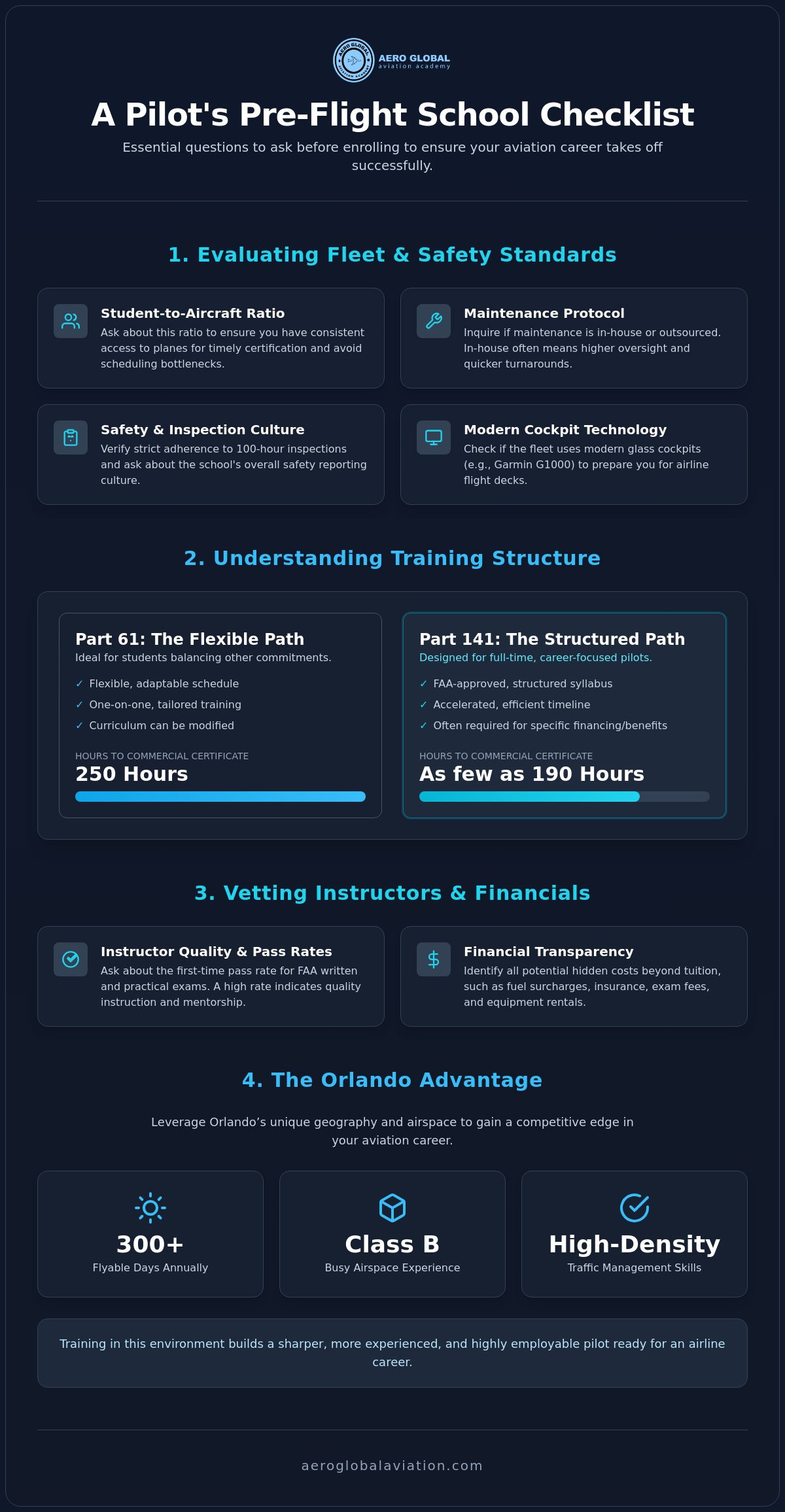
Your progress in the cockpit depends heavily on the tools at your disposal. A flight school might have a long row of planes on the ramp, but if half of them are grounded for repairs, your training schedule will stall. One of the most vital questions to ask a flight school before enrolling Orlando is how they manage their student-to-aircraft ratio. Ideally, you want to see a ratio that allows for consistent flying without battling fifty other students for a single time slot. Seeking out specialized Flight Training and Aircraft Rentals that feature advanced Garmin Glass avionics can ensure you're training on the most modern systems available. Ask specifically how many aircraft are designated for your current stage, whether you are starting with the Wings Foundation course or moving into complex maneuvers.
Safety is the foundation of every successful aviation career. Inquire whether the school performs maintenance in-house or outsources it to a third party. In-house maintenance often suggests a higher level of oversight and quicker turnaround times for minor issues. It's helpful to understand the broader FAA regulations for pilot certification to recognize why rigorous inspection cycles are non-negotiable for student safety. A school with a transparent safety culture will openly discuss how they handle minor incidents and encourage students to report concerns without fear of penalty.
Aircraft Availability and Backup Plans
Ask what happens when your scheduled aircraft goes into unscheduled maintenance. A reliable school should have a contingency plan to keep you in the air. If you are enrolled in the Airline Pilot Elite program, verify if you have priority access to multi-engine aircraft for your advanced ratings. You don't want to reach the end of your commercial training only to find a three-week wait for the twin-engine trainer you need to finish.
Transparency in Maintenance and Safety Culture
Verify that the school strictly adheres to 100-hour inspections and ask who signs off on the final airworthiness certificates. This level of detail ensures the fleet remains in peak condition for the high-utilization environment of a busy flight academy. You should also check if the school utilizes modern glass cockpit training for all career-track students. Standardizing on tech like the Garmin G1000 prepares you for the flight decks you will encounter at the airlines, making your transition from student to professional much smoother.
Understanding Training Structure: Part 61 vs. Part 141
The regulatory framework of a school acts as the blueprint for your entire education. Choosing between Part 61 and Part 141 isn't just about paperwork; it dictates your daily rhythm and your eventual timeline to the airlines. One of the primary questions to ask a flight school before enrolling Orlando is whether they hold Part 141 certification. This designation means the FAA has approved their specific syllabus and training facility, often allowing students to reach their Commercial Pilot Certificate in just 190 hours instead of the 250 hours required under Part 61. It's a structured, fast-paced environment designed for those who want to treat flight training like a full-time job.
Flexibility is the main draw of a Part 61 program. If you're balancing a current career or family obligations, this path allows you to modify the curriculum to suit your personal schedule. You should investigate how the school manages these different tracks. A great mentor will help you weigh these questions your flight-school research should cover to ensure you don't overcommit or under-train. With the FAA recently concluding public comments on Part 141 modernization in May 2026, the industry is seeing a shift toward even more technology-integrated, streamlined curricula that benefit career-track students.
Choosing the Right Regulatory Path
Understanding the nuances of Part 61 vs Part 141 training is essential for mapping out your professional milestones. Ask the admissions team how they track student progress through each stage. You want to ensure that if you start with the Wings Foundation PPL course, the school has a clear, documented path for you to transition seamlessly into the Career Pilot Program. This continuity prevents you from repeating lessons and wasting valuable flight hours.
Ground School and Knowledge Exam Prep
Flying is only half the battle. You must also master the complex theory behind aerodynamics, weather, and regulations. Inquire about the first-time pass rate for FAA written exams among current students. Does the school provide dedicated instructors for ground school, or is it a self-led online program? Utilizing high-quality flight simulators can bridge the gap between classroom theory and cockpit reality. If you're curious about how a structured environment can accelerate your goals, you might want to explore our training philosophy to see how we prioritize student outcomes. A school that invests in your ground education is one that is invested in your long-term safety and success.
Vetting Instructor Quality and Mentorship
Your flight instructor is the most influential person in your early aviation career. While the aircraft provides the classroom, the instructor provides the wisdom, safety habits, and professional network you'll carry into the airlines. When you are compiling your list of questions to ask a flight school before enrolling Orlando, the human element should sit at the very top. You need to know the average tenure of the instructors at the academy. In an industry where many pilots are building time to reach 1,500 hours, you want to ensure your mentor is committed to your success and not just watching the clock.
This need for dedicated, professional instruction isn't limited to the sky; for instance, the team at White Plains Driving Center emphasizes the same level of safety-first mentorship for students learning to navigate busy roads. Whether you are in the cockpit or behind the wheel, the quality of your teacher determines your foundation.
Ask directly about the instructor-to-student ratio. A school might have twenty talented instructors, but if they are each juggling ten students, you'll struggle to book the consistent blocks of time required for rapid progress. A reliable starting point for your research is AOPA's guide to choosing a flight school, which highlights how vital instructor credentials and availability are to your overall safety. You should also inquire about what happens if an instructor leaves for a regional airline mid-way through your training. A professional academy will have a structured handover process to ensure your new instructor understands exactly where you left off in the syllabus.
The "Practical Mentor" Relationship
Personality compatibility is often overlooked, but it is essential for effective learning in a high-pressure environment. Inquire if you can meet or even take a discovery flight with an instructor before committing to a full program. A school that prioritizes your success will have a clear policy on switching instructors if your learning styles don't align. This ensures you move smoothly through your PPL to CPL progression without losing momentum or confidence. Consistent guidance from a mentor who understands your specific goals makes the difficult days of training much more manageable.
Career Guidance and Placement Support
Look beyond the cockpit to see how the school supports your long-term professional aspirations. Does the academy have established partnerships with regional airlines or offer "flow-through" advice? Many top-tier schools hire their own graduates as instructors, providing a clear path to reach those critical flight hours while remaining in a familiar, supportive environment. If you are targeting the Airline Pilot Elite track, ask how the school prepares you for technical interviews and simulator evaluations. Your training should feel like a bridge to your first airline job, not just a series of disconnected lessons.
Financial Transparency and Total Investment
Investing in your future as a pilot is a significant decision that requires a partner who values honesty as much as you do. One of the most critical questions to ask a flight school before enrolling Orlando is whether their cost estimates are based on FAA minimum hours or realistic completion averages. While the regulatory minimum for a private pilot is 40 hours, most students across the industry require 60 to 75 hours to reach proficiency. A school that quotes you only the bare minimum might be setting you up for a financial surprise later in your training. You deserve a clear, data-driven budget that accounts for the time it actually takes to master the cockpit in Orlando's complex and rewarding airspace.
Beyond the hourly rate for the aircraft and instructor, you must look for the "hidden" costs that often stay out of the glossy brochures. These can include fuel surcharges, renter’s insurance, landing fees, and the cost of pilot supplies like headsets and charts. You should also inquire about the school's refund policy. Life happens, and you need to know if your funds are protected if you need to pause your training or move to a different program. A transparent academy will provide a line-item breakdown of every anticipated expense, from your first lesson to your final checkride.
Decoding the "Total Cost" Quote
Minimum hours represent the regulatory floor, not a realistic ceiling, for your training budget. When you ask for a breakdown of private pilot license florida costs, ensure the quote includes third-party fees such as FAA knowledge and practical tests, which can range from $4,500 to $6,000 for a full career track. Don't forget to ask about the cost of "re-training" if you happen to fail a stage check. Knowing these figures upfront allows you to plan your finances with confidence rather than anxiety.
Financing and Payment Flexibility
Check if the school offers pay-as-you-go options or if they require large upfront deposits. Many career-track students utilize third-party lenders like Sallie Mae or Meritize to fund their journey. You should also verify if the school provides "block time" discounts, which can offer significant savings when you prepay for a certain number of flight hours. If you are ready to see how we prioritize your financial success, you can view our transparent pricing models to find a plan that fits your career goals. A mentor's job is to ensure your dream of flight stays within reach without unnecessary financial turbulence.
Orlando-Specific Factors: Weather, Airspace, and Location
Orlando is widely recognized as a premier global hub for aviation training because of its unique mix of infrastructure and environment. The region's geography provides a high-performance setting that prepares you for the fast-paced realities of commercial flight. Crucial questions to ask a flight school before enrolling Orlando should focus on how they turn these local conditions into a strategic advantage for your education. For instance, you should ask how the school leverages the more than 300 days of flyable VFR weather each year to accelerate your progress through the career pilot program. This consistent access to the sky is a primary reason why students from around the world choose Central Florida to reach their professional goals.
Training at a specialized hub like Kissimmee Gateway (KISM) offers distinct benefits compared to massive commercial airports like MCO. At KISM, you'll avoid the exhausting taxi times and high landing fees associated with international terminals, yet you'll still operate right next to complex Class B airspace. This proximity ensures you gain frequent, hands-on experience communicating with air traffic control in a high-density environment. You'll graduate with the confidence to navigate busy arrivals and departures that often intimidate pilots trained in quieter, rural areas. It's about building the "radio muscles" and situational awareness that airline recruiters value most.
Navigating Central Florida Airspace
Instructors must teach you more than just basic maneuvers; they must guide you through the unique regulatory landscape of the region. Ask how the school integrates training on the Disney Temporary Flight Restriction (TFR) into their daily syllabus. Learning to handle these restricted zones while managing traffic from nearby coastal and rural airports makes you a more competent, precise pilot. This exposure to diverse training environments is a cornerstone of becoming a professional who is truly ready for the demands of a modern flight deck.
Weather Resilience and Scheduling
Central Florida's afternoon summer thunderstorms are a reality, and a professional school will have a clear strategy to manage them. Inquire about how the academy utilizes early morning and late evening flight blocks to avoid peak heat and convective activity. You should also ask about hangar availability to protect the fleet during inclement weather, which helps ensure your schedule remains as stable as possible. A school that provides weather-briefing mentorship during every pre-flight helps you develop the critical decision-making skills needed to call a "no-go" day when safety demands it.
Launch Your Aviation Career With Confidence
Choosing where to train is the first major decision of your professional pilot career. You now have the tools to look beyond flashy marketing and evaluate a school based on its safety culture, instructor commitment, and financial honesty. By mastering these questions to ask a flight school before enrolling Orlando, you transform from a prospective student into a prepared candidate ready to succeed in a high-stakes industry.
At Aero Global Aviation Academy, we take our role as your practical mentor seriously. Our strategic location at Kissimmee Gateway Airport provides the perfect balance of complex airspace experience and training efficiency. We invite you to experience our professional mentorship-driven approach and see our transparent Career Pilot Program curriculum in action. The transition from a beginner to a professional is a structured, attainable process when you have the right partner by your side.
Schedule a tour at Aero Global Aviation Academy in Kissimmee today to see how we can help you reach your professional destination. The horizon is waiting, and we're ready to help you clear for takeoff.
Frequently Asked Questions
What is the most important question to ask a flight school?
The most important question involves the school's transparency regarding realistic completion times and total costs. You should ask if their quotes are based on the FAA minimum of 40 hours or the industry average of 60 to 75 hours for a private pilot license. Understanding the true commitment required helps you avoid financial stress. It also reveals whether the school acts as a dedicated mentor or just a service provider during your journey.
Is it better to pay for flight school upfront or as I go?
Paying as you go is generally safer for most students because it protects your funds if your circumstances or goals change. While some schools offer "block time" discounts for upfront deposits, you must verify their refund policy before committing large sums. A pay-as-you-go model ensures you only pay for the training you actually receive. This approach allows you to maintain financial flexibility while progressing through your Career Pilot Program without unnecessary pressure.
Can I visit the flight school and see the maintenance hangar before I enroll?
You absolutely should visit the facility and ask to see the maintenance hangar before signing any enrollment agreements. A professional academy will welcome your interest in their safety standards and fleet health. Observing whether maintenance is performed in-house or outsourced gives you a clear picture of their operational quality. This visit is one of the essential questions to ask a flight school before enrolling Orlando because it confirms the aircraft are meticulously maintained.
How many hours a week should I spend at the flight school for a career track?
For a dedicated career track like the Airline Pilot Elite program, you should treat your training like a full-time job by spending 30 to 40 hours a week at the school. This time includes flight lessons, ground school, and self-study. Consistency is the key to building muscle memory and retaining complex knowledge. Immersing yourself in the airport environment also allows you to network with instructors, which is vital for your professional growth.
What happens if I don’t get along with my flight instructor?
A reputable school will have a clear policy for matching you with a different instructor if your personalities or learning styles don't align. You shouldn't feel guilty about requesting a change; it's a common part of the aviation industry. Effective learning requires a supportive and comfortable environment. Your academy should prioritize your individual progress over personal feelings, ensuring that your path to certification remains positive and productive throughout every stage of your training.
Do Orlando flight schools offer discovery flights for beginners?
Yes, most professional academies in Orlando offer discovery flights to give you a hands-on taste of the cockpit before you commit to a full course. This introductory lesson allows you to take the controls under the guidance of a mentor and see the Central Florida landscape from a new perspective. It’s an excellent way to vet the school’s aircraft quality and instructor style. A discovery flight is often the first step for students entering the Wings Foundation course.
What is the difference between a Part 61 and Part 141 school in Florida?
The primary difference lies in the level of FAA-approved structure and the required flight hours for certification. Part 141 schools follow a rigid, FAA-audited syllabus that can reduce the commercial pilot requirement to 190 hours. Part 61 schools offer more flexibility in scheduling, which is ideal for students balancing other jobs. Both paths lead to the same pilot certificates, but your choice depends on whether you prefer a structured classroom environment or a self-paced approach.
How long does it take to finish the Career Pilot Program in Orlando?
Most dedicated students can complete a full Career Pilot Program in Orlando within 12 to 18 months. This timeline is achievable because of Florida's 300+ days of flyable weather, which minimizes cancellations. Your individual pace will depend on your weekly flight frequency and how quickly you master the complex airspace. Training in a high-density environment like Kissimmee prepares you for the airlines faster than training in regions with frequent weather delays or simpler traffic patterns.


