
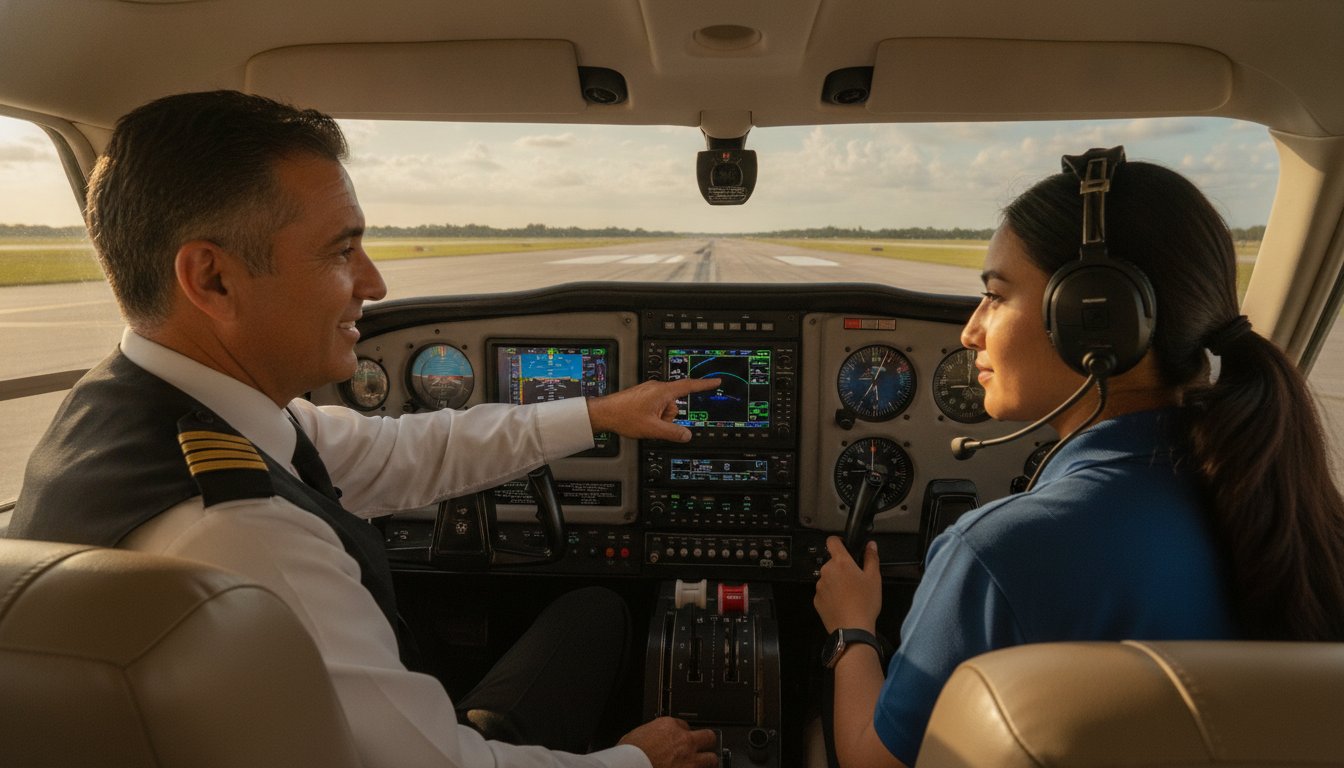
The most talented pilot in the sky isn't always the person who should be sitting in the right seat during your training. While technical skill is vital, the ability to translate complex maneuvers into clear, actionable lessons is what separates a person simply building hours from a true mentor. Identifying the specific qualities of a good flight instructor Kissimmee students should prioritize is the first step toward avoiding wasted lessons and safety concerns. You likely feel the pressure of making every hour count while navigating the 400 daily operations at Kissimmee Gateway Airport, and you deserve a teacher who values your time as much as you do.
We are here to help you bridge the gap between technical jargon and real-world mastery. This guide explores how to find a mentor who is deeply invested in your individual success and long-term career goals in Central Florida. You'll learn how to evaluate an instructor's communication style and check their recent experience levels under the latest FAA standards. By the end of this read, you'll have a clear roadmap for choosing a partner who ensures you pass your checkrides and build a solid foundation for your future in the cockpit.
Key Takeaways
- Understand how your choice of mentor directly impacts your training budget and determines how quickly you transition from a student pilot to a commercial professional.
- Identify the essential qualities of a good flight instructor Kissimmee students should look for, focusing on adaptability and the ability to simplify complex technical concepts.
- Recognize why local knowledge of Kissimmee Gateway Airport and Florida's unique weather patterns is vital for building a safe and efficient flight foundation.
- Learn to vet your instructor by evaluating their lesson preparation and their commitment to active monitoring during every minute of your dual instruction.
- Discover how the right mentorship turns flight training into a career-building experience that prepares you for the high standards of airline employment.
Why Your Choice of Flight Instructor in Kissimmee Is Your Most Critical Career Decision
Choosing who will sit beside you in the cockpit is the most significant financial and professional decision you'll make at the start of your aviation journey. Flight training is a major investment, and every hour spent in the air carries a specific cost. When an instructor lacks a clear lesson plan or fails to provide concise feedback, your training timeline stretches, and your budget evaporates. Identifying the qualities of a good flight instructor Kissimmee schools provide is essential because the right mentor doesn't just teach you to fly; they protect your capital by ensuring every minute of engine-run time translates into progress toward your certificate.
The right partnership accelerates your transition from PPL to CPL by focusing on efficiency and mastery. Beyond the numbers, there is a psychological component to flight training. An instructor's calm confidence creates a safety net that allows you to perform at your best, even when practicing high-stress maneuvers in the busy airspace around Kissimmee Gateway Airport. We often hear about the "hour-builder" stigma, where instructors are simply waiting to hit their 1,500-hour airline minimum. You deserve a mentor whose primary intent is your success, ensuring that their career goals never take precedence over your learning milestones.
The High Stakes of Aviation Mentorship
A poor instructor-student match is the leading cause of training plateaus and student dropouts. If the communication styles don't align, you might find yourself repeating the same lessons without understanding why you aren't progressing. This mismatch directly impacts your first-time checkride pass rates, which is a metric future employers look at closely. The foundational habits you form during the Wings Foundation program will stay with you for the rest of your career. Starting with an elite mentor ensures those habits are professional, safe, and disciplined from day one.
The "Teacher vs. Pilot" Paradigm
It's vital to recognize that being a skilled pilot doesn't automatically make someone a skilled teacher. Technical flying ability is a baseline, but instructional ability is a separate craft entirely. This is why the FAA requires a specific Certified Flight Instructor (CFI) rating, which focuses on the fundamentals of instruction. As of late 2024, these certificates no longer expire, but instructors must still meet rigorous experience requirements every 24 months to remain active. The qualities of a good flight instructor Kissimmee candidates should look for include an understanding of diverse learning styles. Whether you learn best through visual demonstrations, auditory explanations, or kinesthetic "hands-on" practice, your instructor must be able to adapt their syllabus to fit your brain's unique wiring.
The 5 Essential Qualities of a Top-Tier Certified Flight Instructor (CFI)
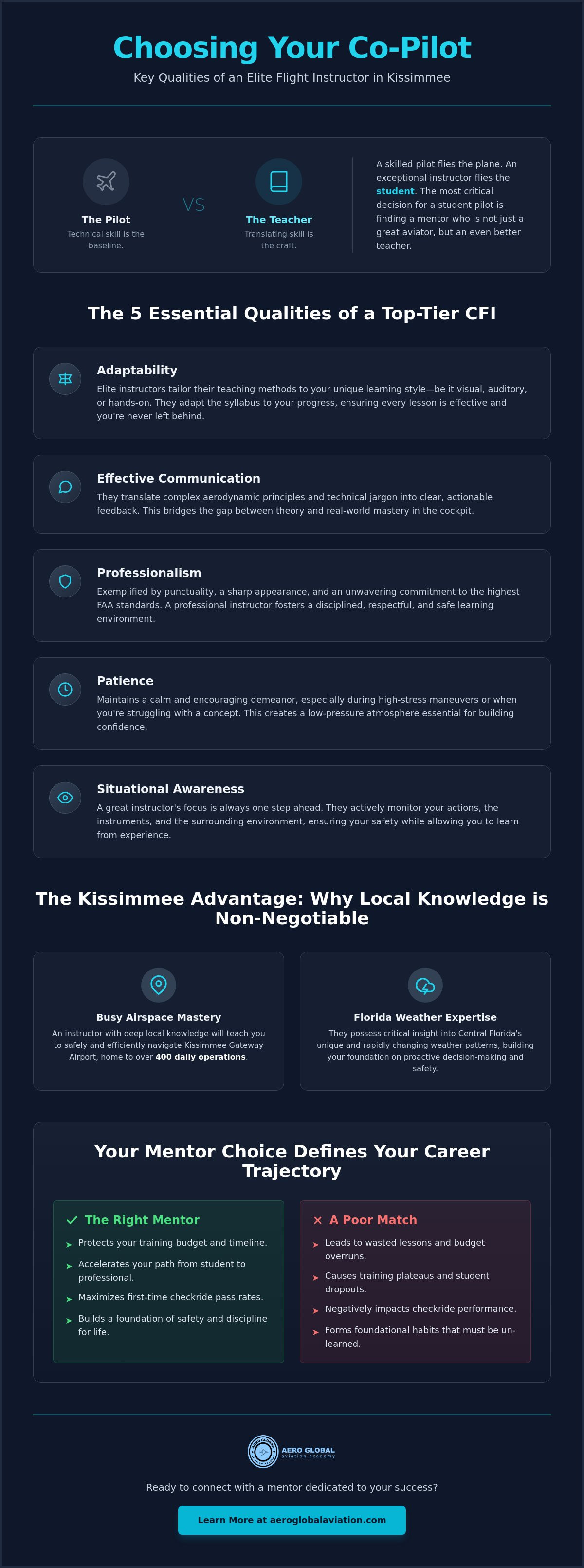
Technical proficiency is the baseline for any pilot, but elite instruction requires a much deeper set of skills. The qualities of a good flight instructor Kissimmee students should prioritize go beyond a pilot's ability to stick a landing or navigate a flight computer. A top-tier mentor acts as a translator, a safety net, and a career coach all at once. They don't just follow a syllabus; they breathe life into it, ensuring that every hour you spend in the cockpit builds toward a professional standard. When you are scouting for a mentor at Kissimmee Gateway Airport, look for these five pillars of excellence: adaptability, effective communication, professionalism, patience, and situational awareness.
Professionalism is perhaps the most visible quality. It manifests in punctuality, a sharp appearance, and an unwavering commitment to FAA standards for flight instructors. A professional instructor treats your training like the high-stakes career move it is. They also possess a high degree of situational awareness, which allows them to predict student errors before they become safety hazards. This "sixth sense" keeps the cockpit safe while giving you the room to learn from minor mistakes without compromising the aircraft.
Mastery of Communication in the Cockpit
Communication is the bridge between theory and practice. A great instructor utilizes the "Brief-Fly-Debrief" cycle to ensure no lesson is wasted. They spend time on the ground explaining the "why" behind a maneuver so that the "how" becomes intuitive in the air. They use vivid analogies to explain difficult concepts, such as comparing being "behind the power curve" to trying to walk up a down-escalator. Instructional communication is the ability to provide calm, clear, and corrective feedback under pressure. This clarity is what helps you master the busy Orlando-area airspace without feeling overwhelmed by radio chatter or technical jargon.
Patience and the Learning Plateau
Every student eventually hits the "mid-PPL slump," a period where progress feels like it has stalled despite your best efforts. This is where patience becomes a critical instructional tool. A mentor with high emotional intelligence recognizes when you're frustrated and knows how to manage that energy. They understand when to push you toward a breakthrough and when to take a step back to review fundamentals. If you're looking for a team that prioritizes this level of personalized mentorship, you might want to explore the Career Pilot Program to see how expert guidance can smooth out these inevitable learning plateaus.
Adaptability is the final piece of the puzzle. No two students learn the same way. A top-tier CFI tailors their teaching style to your specific background, whether you're a recent high school graduate or a professional transitioning from another industry. They adjust the pace of the syllabus to match your progress, ensuring you're never bored but also never out of your depth. This bespoke approach is what ensures you don't just pass your checkride, but you do so with the confidence of a true pilot.
Navigating the Kissimmee Airspace: Why Local Knowledge Is a Non-Negotiable Quality
Flying in Central Florida offers some of the most dynamic training environments in the country. When you evaluate the qualities of a good flight instructor Kissimmee schools provide, you must look for someone who possesses deep local expertise. Kissimmee Gateway Airport (ISM) handles approximately 400 operations a day and around 135,000 takeoffs and landings annually. This high volume means you need a mentor who understands the specific flow of local traffic and maintains strong relationships with the tower controllers. This familiarity isn't just about comfort; it's about training efficiency. An instructor who knows the local practice areas can minimize your transit time, ensuring you spend your budget on learning maneuvers rather than flying in straight lines.
The proximity to Orlando International Airport (MCO) adds another layer of complexity to your training. Navigating the surrounding Class B airspace requires precision and confidence that only comes from regular exposure. A local expert will guide you through these busy corridors, helping you master radio communications while staying clear of restricted zones like the "Disney TFR." This level of mentorship and the Aero Global Advantage ensures that you are prepared for the high-pressure environments of a professional airline career. These specific insights into local conditions are among the most valuable qualities of a good flight instructor Kissimmee students can find.
Mastering the Orlando Airspace Complexity
Training in high-traffic environments produces superior commercial pilots. Your instructor should teach you to anticipate the moves of regional jets and private charters that share the Florida skies. This exposure builds a level of situational awareness that rural training programs simply can't replicate. A local instructor ensures you are comfortable with frequent radio handoffs and complex approach instructions, making you a more versatile pilot from your very first solo. They turn the "complexity" of the Orlando airspace into a strategic advantage for your resume.
The Florida Weather Advantage
Central Florida is famous for its convective activity and rapid afternoon thunderstorms. A top-tier instructor uses these patterns as a classroom. Instead of simply canceling a flight, they teach you how to read radar, understand the nuances of density altitude in high humidity, and make safe go or no-go decisions. This real-world experience is invaluable. You'll learn to plan cross-country flights that account for the unique geography of the Florida peninsula, ensuring you have the skills to handle diverse weather conditions throughout your long-term career.
Red Flags vs. Green Flags: How to Vet Your Instructor Before Your First Solo
Before you commit your training budget to a specific mentor, you need a strategy to separate the professionals from the placeholders. Identifying the qualities of a good flight instructor Kissimmee academies provide requires you to be an active observer from the moment you walk into the hangar. You aren't just looking for a pilot; you're looking for a dedicated educator who prioritizes your solo endorsement as much as you do. A green flag is an instructor who arrives early with a printed lesson plan tailored to your specific progress. Conversely, an instructor who spends your expensive flight time scrolling through their phone or looking at their watch is a major red flag that signals a lack of professional discipline.
Consistency is the engine of flight training. If an instructor's schedule is constantly shifting, your muscle memory will suffer, and you'll spend more money repeating previous maneuvers to regain lost ground. Ask about their student success rate. A high history of first-time checkride passes and safe solo endorsements is a strong indicator of a mentor who knows how to prepare a student for the high standards of the FAA. Don't be afraid to talk to other students at the academy to get an honest assessment of their teaching style. Recognizing these qualities of a good flight instructor Kissimmee experts possess will help you avoid the frustration of a stalled training journey.
This careful vetting process is essential in any field where personal well-being is at stake, much like how one would research the professional home care services of Elite Caregivers United LLC to ensure the highest standards of personal attention and safety.
The Instructor Interview: Questions You Must Ask
Treat your first meeting like a job interview. Ask them directly about the syllabus they follow for the Career Pilot Program. You want to hear a structured plan, not a vague attitude toward your milestones. Inquire about how they handle students who struggle with specific tasks like crosswind landings or emergency procedures. Finally, ask about their personal career goals for the next 12 months. While many instructors eventually move to the airlines, you want to ensure they'll be present for the critical phases of your current rating.
Observing Professionalism in the Hangar
The way an instructor treats the equipment and their colleagues says a lot about their instructional mindset. Look at the cleanliness and maintenance of the training aircraft they use. A mentor who respects the machine is more likely to respect the safety protocols required for your first solo. There should also be total transparency regarding costs, flight hours, and logbook entries. If you're ready to partner with an academy that holds its staff to these elite standards, contact Aero Global Aviation Academy today to find your ideal flight mentor.
Beyond the Logbook: Mentorship and the Aero Global Advantage
At Aero Global Aviation Academy, we believe that the true value of a mentor isn't measured just by the hours they log, but by the careers they launch. When we evaluate the qualities of a good flight instructor Kissimmee pilots deserve, we look for individuals who view themselves as career counselors first. Our selection process for the Airline Pilot Elite track is rigorous, ensuring our instructors possess the foresight to prepare you for the flight deck, not just the checkride. This long-term focus is a cornerstone of our philosophy. While some schools might be satisfied with instructors who are simply "building hours" to leave, our team is committed to your individual progress and professional destination.
A structured training environment is essential for this level of success. Whether training under Part 61 or Part 141 regulations, the discipline instilled by a professional mentor makes the difference. Our instructors bring a wealth of experience from military, corporate, and airline backgrounds, providing you with a broad perspective on the industry. This diversity allows them to offer practical advice on everything from cockpit resource management to the lifestyle expectations of a commercial pilot. Aero Global Aviation Academy bridges the gap between basic certification and professional career readiness.
Building the Next Generation of Elite Pilots
Our mentors do more than teach maneuvers; they prepare you for the high-stakes environment of airline interviews and simulator evaluations. They understand the specific qualities of a good flight instructor Kissimmee students need to succeed in a competitive global market. By simulating professional scenarios and demanding high standards of precision, they ensure that your transition to a turbine aircraft feels like a logical next step rather than a daunting leap. You'll gain both the technical proficiency and the professional polish that recruiters look for in top-tier candidates.
This focus on discipline often begins in early childhood; for example, parents interested in building a strong foundation for their children can explore Little Tigers Program (4-6 years) at Flinn Taekwondo Academy to see how expert mentorship shapes development from a young age.
Your Next Steps in Kissimmee
The best way to see the Aero Global advantage is to experience it for yourself. We invite you to visit our facility at Kissimmee Gateway Airport to meet our instructional team and feel the culture of excellence we've built. A discovery flight is a perfect opportunity to sit in the cockpit, handle the controls, and see if our mentorship style aligns with your career goals. Choosing the right partner is a personal decision, and we want you to feel confident in the support system you'll have behind you. Book your introductory lesson at Aero Global Aviation Academy today.
Take Command of Your Aviation Career
Your transition from a student to a professional pilot depends on the quality of the foundation you build today. We've discussed how a mentor's local expertise at Kissimmee Gateway Airport and their commitment to structured lesson plans can accelerate your progress while protecting your training budget. Identifying the qualities of a good flight instructor Kissimmee students deserve means looking for a teacher who focuses on your career-ready certifications rather than just their own flight hours. By prioritizing adaptability, clear communication, and professional ethics, you ensure that every hour in the cockpit brings you closer to your ultimate destination.
Aero Global Aviation Academy offers clear, structured paths from our Wings Foundation to the comprehensive Airline Pilot Elite program. We are dedicated to providing the personalized attention and regional expertise you need to succeed in Central Florida's busy airspace. Don't leave your professional future to chance by settling for anything less than excellence. Start your journey with an expert mentor—Apply to Aero Global Aviation Academy. The horizon is wide open, and we're ready to help you reach it with confidence and skill.
Frequently Asked Questions
How much flight time should a good instructor have?
A good instructor typically has at least 250 to 500 hours of total flight time to meet FAA certification requirements, but their teaching ability is more critical than the number in their logbook. To train initial CFI applicants, an instructor must have held their certificate for at least 24 months and given 200 hours of instruction. Focus on their track record of student success rather than just their total time in the air. Quality instruction saves you more money than a high-hour pilot who can't teach.
Can I change flight instructors if we don’t get along?
You absolutely have the right to change instructors if your learning styles don't align or if you don't feel comfortable in the cockpit. Flight training is a significant investment, and your progress depends on a positive, professional relationship. Most reputable academies encourage students to find the best fit to ensure they stay motivated. Switching early can save you money and prevent you from developing poor habits or losing interest in your aviation career. Your success is the priority.
What is the difference between a CFI and a CFII?
A CFI is a Certified Flight Instructor authorized to teach the fundamentals of flight for private and commercial certificates. A CFII has earned an additional Instrument Rating, which allows them to provide instruction on flying solely by reference to instruments. If you're pursuing a professional career, you'll eventually work with a CFII to master navigation in clouds or low-visibility conditions. Both roles are essential milestones in the journey toward becoming an elite airline pilot through a structured training path.
Do instructors in Kissimmee need special certifications for the local airspace?
While the FAA doesn't issue a specific regional certificate, the qualities of a good flight instructor Kissimmee pilots should look for include a deep understanding of local traffic flows and restricted zones. Instructors must be proficient in navigating the complex Orlando Class B airspace and Kissimmee Gateway Airport’s 400 daily operations. This local expertise ensures you learn to handle high-traffic environments safely and efficiently. It's a massive advantage when you eventually transition to professional airline roles in busy corridors.
How do I know if my instructor is teaching me the right FAA standards?
Your instructor should consistently reference the Airman Certification Standards (ACS), which outlines the exact tasks and tolerances required to pass your checkride. Ask to see their syllabus and how it aligns with these official FAA documents. A professional mentor will provide regular progress reports and stage checks to ensure you're meeting every requirement. This transparency is one of the key qualities of a good flight instructor Kissimmee students should expect to see during every stage of their training.
Should I choose an older, experienced instructor or a younger one building hours?
Both have advantages, so your choice should depend on your personal learning style and career goals. Older instructors often bring decades of wisdom and diverse industry experience, while younger instructors are often deeply familiar with the latest technology and testing standards. The best choice is someone who acts as a practical mentor regardless of their age. Focus on their dedication to your success rather than their reason for being in the right seat. Ensure they have the patience to guide you.
How often should I meet with my instructor to stay on track for my PPL?
Flying at least two to three times per week is the ideal frequency for maintaining muscle memory and steady progress toward your certificate. Through the Wings Foundation, this consistency helps you minimize the "forgetting curve" and reduces the total number of hours needed for certification. If you meet less frequently, you'll likely spend a portion of each lesson reviewing previous material. Frequent interaction with your instructor helps you build confidence and move through the syllabus more efficiently and affordably.
What happens if my instructor leaves for an airline during my training?
It's common for instructors to move on to airline careers, but a structured school will ensure your training doesn't stall. Your logbook and progress records allow a new instructor to pick up exactly where you left off without missing a beat. Programs like the Career Pilot Program are designed with this continuity in mind, providing a team of mentors who follow the same high standards. This ensures your journey toward a commercial certificate remains on schedule and within your planned budget.


