
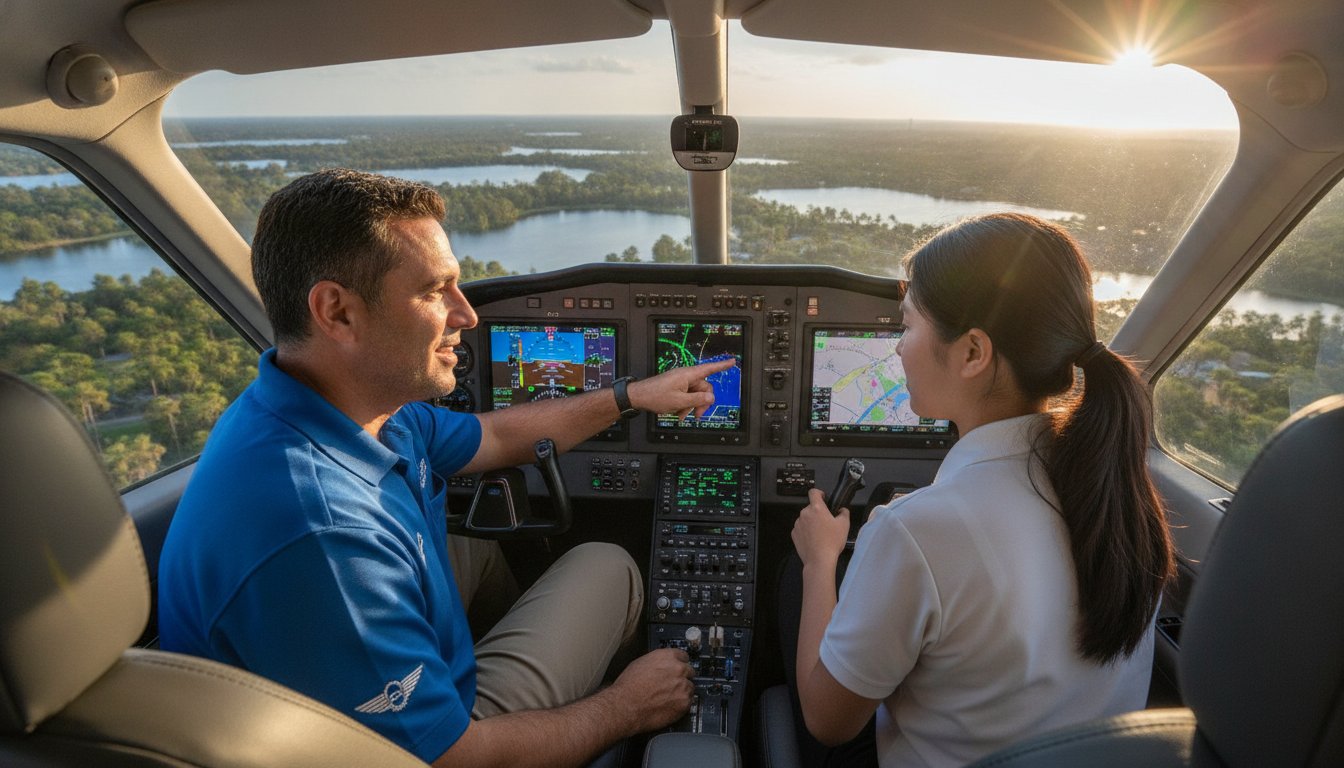
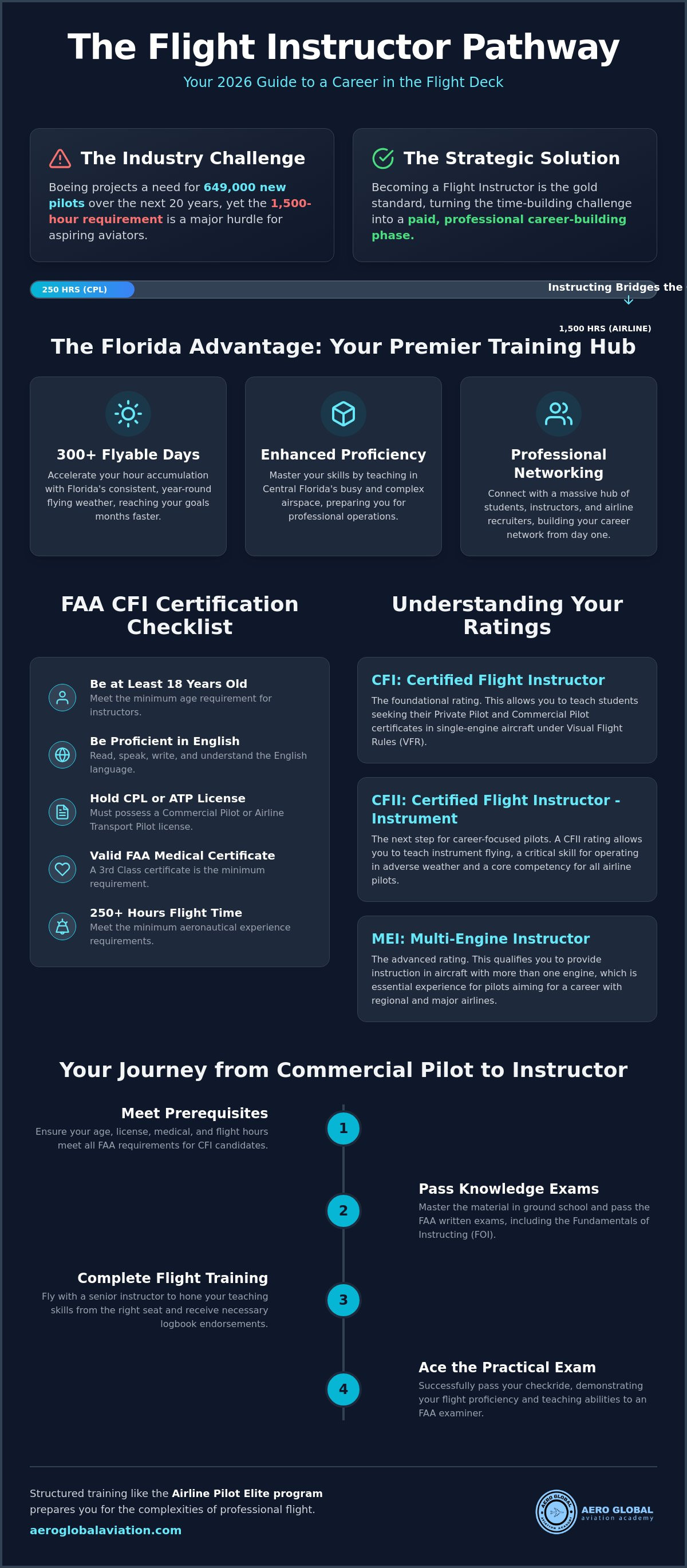
With Boeing projecting a demand for 649,000 new pilots over the next twenty years, the most efficient path to the flight deck isn't just logging hours; it's teaching others to fly. Most aspiring aviators feel the pressure of the 1,500-hour airline requirement and the high costs associated with building time. Learning how to become a flight instructor in Florida transforms this challenge into a strategic career move. It allows you to gain experience in one of the world's premier aviation hubs while earning a living.
We understand that the FAA Fundamentals of Instructing (FOI) exams and the complexity of choosing between CFI, CFII, or MEI ratings can feel overwhelming. This 2026 guide simplifies the process. You'll master the specific FAA requirements, such as the 250-hour flight time minimum and medical certifications, while discovering how to leverage your ratings for a major airline career. We'll outline a structured timeline and show you why Central Florida’s climate offers the most reliable training environment for your journey from student to professional mentor.
Key Takeaways
- Discover why instructing is the gold standard for meeting the 1,500-hour airline requirement while sharpening your own technical flying skills.
- Learn the specific FAA mandates, including holding a valid Commercial Pilot License and meeting the minimum age requirement of 18.
- Understand the distinctions between CFI, CFII, and MEI ratings to determine which certifications best align with your long-term career goals.
- Master the step-by-step process of how to become a flight instructor in Florida, from passing your initial ground school to acing the FAA knowledge exams.
- Explore how structured training like the Airline Pilot Elite program prepares you for the complexities of professional flight in Florida’s busy airspace.
Why the Flight Instructor Path is the Gold Standard for Florida Pilots
Most pilots view the 1,500-hour requirement as a daunting barrier. It's the gap between earning a commercial license and stepping into a regional jet. Choosing how to become a flight instructor in Florida turns this waiting period into a period of professional mastery. You aren't just burning fuel; you're building a resume that airlines actually respect. Instructing is widely considered the gold standard for time building because it forces you to live and breathe aviation every single day.
Florida offers a unique strategic advantage with over 300 days of flyable weather each year. This consistency means you can reach your hour goals months faster than peers in northern climates who are grounded by snow or low ceilings. Central Florida, particularly around the Orlando and Kissimmee airspace, provides a dense networking environment. Here, you'll rub shoulders with future colleagues and airline recruiters daily. Teaching complex maneuvers forces you to understand the physics of flight at a cellular level. You move from simply performing a task to explaining the "why" behind it, which solidifies your technical skills for life.
- Rapid hour accumulation thanks to Florida's near-constant sunshine.
- Enhanced technical proficiency gained by teaching advanced maneuvers.
- Professional networking within the massive Central Florida aviation hub.
- A paycheck that supports your career instead of personal debt for flight time.
Bridging the Gap to the Airlines
Understanding the airline pilot career path helps you see the CFI rating as a bridge rather than a detour. Regional airlines prioritize applicants with instruction backgrounds because they know these pilots possess superior communication skills and situational awareness. Meeting the foundational Flight Instructor requirements is your first step toward becoming a professional mentor. You'll stop thinking like a student and start acting like a captain long before you wear the fourth stripe of a major carrier.
The Financial Logic of Instructing
The return on investment for a CFI certificate is unmatched in the 2026 market. Instead of paying hundreds of dollars per hour to fly solo, you receive a paycheck to share your passion. Most flight schools in Florida provide a steady stream of domestic and international students, ensuring your schedule stays full year-round. Whether you work for a structured academy or pursue independent instruction, the CFI rating is a revenue-generating asset. It's a transformative step that turns your training expenses into a sustainable professional income while you march toward your 1,500-hour goal.
FAA Requirements for CFI Certification in Florida
The journey toward teaching in the cockpit begins with meeting strict federal standards. While the excitement of flight is what draws many to the industry, the FAA ensures that every instructor possesses the maturity and technical expertise required to train the next generation of safe pilots. Understanding how to become a flight instructor in Florida starts with the legal framework provided by the FAA. To begin your training, you must be at least 18 years of age and be able to read, speak, write, and understand the English language. These foundational criteria ensure that communication between instructor and student remains clear and effective during high-stakes maneuvers.
Beyond age and language, you must hold a valid FAA Medical Certificate. While a 3rd Class Medical is the legal minimum required to act as pilot in command while instructing, many career-minded pilots maintain a 1st or 2nd Class Medical to stay consistent with airline hiring standards. You also need to hold either a Commercial Pilot License (CPL) or an Airline Transport Pilot (ATP) certificate. These are the core FAA Eligibility Requirements for Flight Instructors that every candidate must satisfy before they can receive the necessary logbook endorsements from an authorized instructor for their practical and knowledge tests.
Prerequisite Flight Experience
Your logbook serves as the primary evidence of your readiness. To meet FAA aeronautical experience requirements, a CFI applicant must have logged at least 250 hours of flight time, which includes the specific night, cross-country, and solo requirements already completed during their commercial pilot training. While a single-engine rating is the starting point for most, having an instrument rating is practically essential for modern instructors. Most flight schools require this because it allows you to teach a wider range of students and prepares you for the CFII rating later. If you're looking for a clear path through these regulations, a Career Pilot Program offers the structure you need to organize these milestones effectively.
Knowledge Test Mastery
The FAA requires you to pass two distinct knowledge exams before your checkride. The first is the Fundamentals of Instructing (FOI) exam, which focuses on the psychology of learning and effective teaching methods. It's a shift from being a pilot to being an educator; you'll learn how students retain information and how to manage the learning environment. The second is the Flight Instructor Airplane (FIA) knowledge test. This exam covers advanced technical subject areas, from complex aerodynamics to federal regulations. Preparing for these requires dedicated ground school study, but mastering this material ensures you can answer any question a student might throw at you in the Florida heat. This deep dive into the "why" of flying is what truly separates a commercial pilot from a professional instructor.
Choosing Your Ratings: CFI, CFII, and MEI Explained
Deciding which path to take is a strategic choice that defines your career trajectory. If you're researching how to become a flight instructor in Florida, you'll quickly realize that not all certificates are created equal. While the initial CFI rating gets you into the right seat, adding specialized ratings makes you a "Triple Threat" in a competitive hiring market. This combination of single-engine, instrument, and multi-engine instruction capabilities ensures you're never short of students or flight hours. It signals to future employers that you possess a comprehensive mastery of the sky.
- CFI (Certified Flight Instructor): Your foundational rating. It allows you to teach primary students in single-engine aircraft and is the first step for most instructors.
- CFII (Certified Flight Instructor Instrument): This rating authorizes you to teach students seeking their instrument rating. It's vital for navigating Florida’s complex afternoon weather patterns.
- MEI (Multi-Engine Instructor): The most prestigious of the three. It allows you to teach in twin-engine aircraft, which is where the most valuable flight time is logged.
The Value of the Multi-Engine Rating
Stepping into the world of advanced flight training is the most direct way to secure an MEI rating. For those aiming for the airlines, multi-engine time is the single most sought-after metric. Airlines don't just want to see 1,500 hours; they want to see that you've managed the complexities of asymmetric thrust and multi-engine systems. Training in complex aircraft at Kissimmee Gateway Airport puts you in a high-traffic environment that mirrors the operations of a professional flight deck. By teaching others how to handle a twin-engine plane, you're proving you're ready for the heavy metal of a major carrier.
Instrument Instruction (CFII) Advantages
Florida’s busy airspace, particularly around Orlando and Kissimmee, makes instrument proficiency a non-negotiable skill. Holding a CFII rating allows you to meet the constant demand for IFR training from students looking to advance their own careers. You'll spend your days mastering the G1000 and glass cockpit systems, which are the industry standard for modern instruction. Teaching instrument flight doesn't just help your students; it keeps your own IFR skills razor-sharp. You'll find that your situational awareness and radio work improve significantly when you're responsible for guiding a student through a simulated or actual instrument approach in one of the nation's busiest training corridors.
Step-by-Step: The Journey from Commercial Pilot to Instructor
Transitioning from the left seat to the right seat is more than a physical move; it's a mental shift from performing to explaining. If you're mapping out how to become a flight instructor in Florida, you need a clear, structured path that moves beyond general pilot skills into the art of pedagogy. This journey isn't just about logging time. It's about refining your knowledge until you can explain complex aerodynamics to someone who has never touched a flight control. You're moving from being the one who does to being the one who guides.
- Step 1: Finalize Your Commercial Foundation. You must hold a Commercial Pilot License and an instrument rating before you can officially begin your instructor training.
- Step 2: Intensive Ground School. Enroll in a dedicated CFI ground program to pass the FOI and FIA knowledge exams. These tests prove you understand both the physics of flight and the psychology of learning.
- Step 3: Right Seat Flight Training. You'll relearn all commercial maneuvers from the right seat, focusing on precision and the ability to demonstrate them perfectly every time.
- Step 4: Portfolio Development. Create a library of lesson plans. These documents serve as your professional scripts for every ground and flight session you'll lead.
- Step 5: The CFI Checkride. This final practical examination with a Designated Pilot Examiner (DPE) confirms you're ready to be trusted with a student's safety and education.
To navigate these steps with confidence, many students find that a structured Airline Pilot Elite program provides the necessary mentor-led environment to bridge the gap between pilot and professional educator.
The Right Seat Transition
Flying from the right seat feels alien at first. Your perspective on the runway changes, and your muscle memory for the throttle and yoke must be recalibrated. The biggest challenge is developing "patter." This is the ability to talk through a maneuver, explaining the "why" and "how" while simultaneously performing it to commercial standards. Safety is paramount here. You'll practice how to guard the controls without interfering and how to intervene if a student makes a mistake. It's a delicate balance of giving them enough room to learn while maintaining absolute command of the aircraft.
Acing the CFI Checkride
The CFI checkride is notoriously thorough. A DPE isn't just checking if you can fly; they're checking if you can teach. The oral exam is the centerpiece of the day. You'll be asked to teach technical subjects on a whiteboard, demonstrating deep technical knowledge and a welcoming, professional instructional ability. Common pitfalls often involve "over-explaining" or failing to reference the Airman Certification Standards (ACS) correctly. During the flight portion, the examiner may act as a "struggling student" to see how you identify and correct common errors. Staying calm and maintaining your role as a practical mentor is the key to success.
Launching Your Career with Aero Global’s Airline Pilot Elite Program
Transitioning from a commercial pilot to a certified instructor is a high-stakes evolution that requires more than just technical skill. At Aero Global, we've designed the Airline Pilot Elite program to do more than just check boxes; it's a comprehensive path that streamlines your progression from a Private Pilot License through to advanced instructor ratings. When you are researching how to become a flight instructor in Florida, you want a program that understands the specific demands of the 2026 hiring climate. Our curriculum focuses on turning you into a professional mentor who is truly ready for the responsibilities of the right seat.
Training at the Kissimmee Gateway Airport puts you in the heart of one of the nation's most dynamic aviation environments. You'll navigate the complexities of the Orlando Class B airspace and interact with a diverse mix of traffic daily. This exposure is invaluable for an aspiring instructor. It builds a level of situational awareness and radio proficiency that simply can't be replicated in quieter, rural flight paths. You'll graduate not just with a certificate, but with the confidence to lead students through some of the busiest training corridors in the country. Our "Practical Mentor" approach means you're learning from experts who are deeply invested in your individual success, ensuring you're never just a number in a large corporation.
Professional Pilot Track in Kissimmee
Your choice of training partner is the most critical decision you'll make for your future career. Choosing the best flight school in Florida involves looking beyond the aircraft fleet to the quality of the mentorship you'll receive. The Airline Pilot Elite program provides you with access to modern aircraft equipped with the latest glass cockpit technology, mirroring what you'll find in modern regional jets. You'll work alongside experienced mentors who have successfully navigated the path to the airlines themselves. This supportive environment ensures you build a career-ready resume that reflects high-quality instruction and technical precision.
Your Future in the Flight Deck Starts Here
The goal of becoming a CFI is the ultimate stepping stone toward a major airline destination. We support a diverse community of both domestic and international students in their transition from being an Aero Global instructor to becoming a first officer. Our philosophy ensures that we stay connected to your professional growth long after your initial checkride. We provide the structured environment and the professional network needed to bridge the gap to the airlines efficiently. Join the Airline Pilot Elite program and start your journey today! Whether you're just starting your first hour or you're ready to master the right seat, your future in the flight deck is within reach.
Take Command of Your Aviation Future
At Aero Global, we offer structured career tracks that guide you from PPL to MEI with the support of highly experienced "Practical Mentor" instructors. We take pride in helping you navigate the transition from student to professional educator with confidence and precision. The demand for skilled pilots is higher than ever, and there's no better place to start your ascent than right here in Central Florida. Begin your journey to the flight deck with our Airline Pilot Elite program and transform your passion for flight into a lifelong career. We can't wait to see you in the right seat.
Frequently Asked Questions
How long does it take to become a flight instructor in Florida?
The timeline depends on your current experience level. If you're starting from zero, a comprehensive track like the Airline Pilot Elite program typically takes about 12 months to complete all ratings through CFI. If you already hold a Commercial Pilot License, a dedicated instructor course can often be finished in 4 to 8 weeks. Florida's consistent sunshine prevents weather delays, ensuring your training stays on a predictable and efficient schedule.
Is the CFI checkride really the hardest pilot exam?
Many aviators consider the initial CFI checkride the most rigorous because it evaluates your ability to teach rather than just your ability to fly. The oral portion is notoriously thorough, often lasting several hours as you demonstrate technical knowledge on a whiteboard. While the standards are high, it's a manageable milestone if you've practiced your instructional "patter" and refined your lesson plans under the guidance of an experienced mentor.
Do I need a second-class medical to be a flight instructor?
You only need a valid 3rd Class FAA Medical Certificate to act as pilot in command while providing flight instruction. While this is the legal minimum, many career-track instructors choose to maintain a 1st Class Medical. Doing so ensures you remain eligible for airline hiring once you reach your hour requirements. It's a smart way to confirm you meet the physical standards of the major carriers while you build your professional experience.
Can I work as a CFI while I am still a student?
You cannot legally work as a flight instructor until you have passed your CFI checkride and received your certificate from the FAA. To be eligible for that certificate, you must already hold a Commercial Pilot License or an Airline Transport Pilot certificate. Once you've earned your instructor rating, you can begin teaching, which is the most effective way to log the 1,500 hours required for airline employment.
How much can a flight instructor earn in Orlando?
Earnings vary significantly based on your specific ratings and the volume of students at your flight school. Instructors in the Orlando and Kissimmee area benefit from a high density of both domestic and international students, which typically leads to more billable flight and ground hours. Holding advanced ratings like CFII or MEI often increases your earning potential because you can provide specialized training that is in high demand.
What is the FOI exam and why is it important?
The Fundamentals of Instructing (FOI) exam is a FAA knowledge test that covers the psychology of learning and effective communication techniques. It's important because it marks your transition from a pilot to a professional educator. Understanding how students retain information and how to manage a learning environment is essential. This knowledge helps you become a "Practical Mentor" who can tailor instruction to each student's individual needs and learning style.
Do I need a multi-engine rating to become a CFI?
A multi-engine rating isn't required for the initial single-engine CFI certificate, but it's a vital asset for your long-term career goals. Mastering how to become a flight instructor in Florida usually includes obtaining your MEI (Multi-Engine Instructor) rating. This allows you to teach in twin-engine aircraft and log the multi-engine time that airline recruiters value most. Bundling these ratings makes you a much more competitive candidate in the professional pilot market.
Why is Florida considered the best place for flight instructor training?
Florida is the top choice for instructor training because it offers over 300 days of flyable weather each year and access to complex airspace. Training in the Central Florida hub near Orlando provides experience with high traffic volume and Class B airspace, which mirrors the environment of professional airline operations. The sheer number of active flight schools in the region also means there are abundant job opportunities once you complete your certification.


