

What if managing stress is part of becoming a safer, more prepared pilot, not a distraction from training? Checkrides, finances, demanding lessons, and uncertainty can weigh on your wellbeing, especially when you’re also wondering how asking for help might relate to FAA medical certification. If you’re exploring pilot training and mental health support Orlando, those concerns deserve clear, practical guidance.
You don’t have to wait until pressure feels unmanageable to build support into your training plan. This guide explains how flight-training demands can affect wellbeing, where aviation-aware support and crisis resources may fit, and why certification questions call for accurate, current guidance rather than guesswork.
You’ll also find practical steps for managing stress, organizing support, and deciding what to do when you need help. When you’re ready to map out your aviation goals, Aero Global Aviation Academy in Kissimmee and Orlando offers structured pathways with clear training milestones, from private pilot training through commercial and advanced instructor certifications.
Key Takeaways
- Notice persistent changes in sleep, concentration, mood, or daily functioning, and treat them as a reason to seek support, not a personal failing.
- Build a support network that may include trusted people, aviation-aware professionals, peers, and urgent help when needed.
- Seeking mental-health care does not automatically determine an FAA medical outcome. Certification decisions depend on individual circumstances and current FAA rules.
- Use a practical five-step wellbeing plan to track patterns, identify support, communicate needs, review progress, and respond if a situation becomes urgent.
- Explore pilot training and mental health support Orlando alongside a structured training path, from Wings Foundation for PPL to advanced instructor certifications through Airline Pilot Elite.
Pilot training and mental health support in Orlando: why student wellbeing matters
Learning to fly can be deeply rewarding, and it can ask a lot of you at the same time. New procedures, repeated practice, ground study, checkride preparation, scheduling, and financial planning all compete for attention. Students training in Kissimmee and the wider Orlando area may experience these demands differently depending on their circumstances, responsibilities, and pace of learning. Feeling pressure doesn’t, by itself, mean you have a mental-health condition.
Wellbeing support can help you manage everyday demands and stay connected to the people and routines that matter. Mental-health treatment is care from a qualified professional for a health concern. These can complement one another, but general wellbeing guidance isn’t a substitute for clinical care. The field of aviation psychology considers how human thought and behavior relate to aviation, including the mental demands involved in flight.
What can make pilot training emotionally demanding?
Flight training asks you to learn unfamiliar skills while applying knowledge in real time. You might be reviewing procedures for a lesson, preparing for an evaluation, coordinating training around work or family, and keeping up with expenses. A schedule change or a skill that takes longer to master can add pressure. Notice your own response rather than comparing it with another student’s. Stress is personal and doesn’t establish a diagnosis.
What does support look like for a student pilot?
Support can start with a candid conversation with someone you trust or a fellow student who understands the training environment. If concerns persist or affect daily life, a qualified mental-health professional can provide counseling or clinical care. Crisis response is different: it’s for situations requiring immediate help. Asking early is a practical step, not a personal failing, and it may help you protect the routines and attention you need for learning.
It also helps to understand what each kind of support can and can’t do. A trusted conversation or peer connection may help you feel less alone, but it doesn’t diagnose or treat a health condition. Professional care addresses concerns that call for clinical expertise, while urgent support is appropriate when safety is at immediate risk. Each has a distinct role.
For students exploring pilot training and mental health support Orlando, the aim isn’t to remove every challenge from training. It’s to recognize when you need support and choose a suitable next step, whether that means talking with someone you trust, seeking professional care, or accessing urgent help. Wellbeing is part of preparation, alongside the steady work of building knowledge and flight skills.
How flight-training stress can build, and when to seek support
Some pressure is part of learning a demanding skill. Notice whether it eases with rest and preparation or continues to grow and affect everyday life. A challenging lesson or pre-checkride nerves alone don’t mean you have a mental-health condition. Your experience is individual, so look for changes and patterns rather than trying to label yourself.
Which training pressures can affect student wellbeing?
Performance expectations can feel sharper around milestones such as preparing for a first solo or a checkride. You may also be balancing ground study with work, family, finances, and time to rest. In Central Florida, weather or scheduling changes can shift a planned lesson and require you to adjust. One changed plan may be manageable; repeated disruptions alongside other demands may feel harder to absorb.
How can a student recognize when stress needs attention?
Pay attention to persistence, intensity, and interference. Are sleep, concentration, mood, or usual responsibilities changing over time? Is worry making it difficult to study, attend lessons, or keep up with daily routines? These observations aren’t a diagnosis. They can help you decide whether to talk with someone you trust or a qualified professional.
If it feels useful, keep brief notes for a week or two. Record what was happening, how you felt, whether it affected sleep or focus, and what helped. Bring those observations and your questions to a professional if you seek care. If certification concerns are part of your worry, read the FAA guidance on pilot mental fitness. Individual circumstances and current FAA rules matter, so don’t rely on assumptions or general advice to predict an outcome.
Routine training stress calls for practical support and conversation, not panic. A crisis is different. If you or someone else may be in immediate danger, call 911. In the United States, you can call or text 988 to reach the Suicide & Crisis Lifeline for crisis support. Don’t wait to seek urgent help if safety is at risk.
Taking stock early can help you respond before stress disrupts more of your routine. To see how training milestones fit together locally, explore pilot training pathways in Orlando as one practical part of planning your next step.
Seeking mental-health care and FAA medical certification: what Orlando students should understand
Worry about an aviation medical certificate can make it tempting to delay asking for help. But seeking mental-health support does not automatically end a pilot career. Certification decisions depend on individual circumstances and the FAA’s current standards, so no general article can predict an individual outcome.
What should students know about FAA medical questions?
FAA medical certification involves specific requirements, and relevant details can depend on a person’s circumstances. Don’t conceal symptoms, treatment, diagnoses, or medication, and don’t assume that one general account applies to you. For a personal question about disclosure or eligibility, use current guidance from an authoritative FAA source and qualified advice from an aviation medical professional familiar with the applicable process.
For an individualized FAA medical question, use current authoritative guidance and qualified advice. A general resource or article can’t determine your certification outcome.
Where can aviation-aware support fit?
Different resources serve different needs. AOPA’s Mental Health Resource Center offers pilot-focused information and support resources; it is not a certification authority. Choose the kind of help that fits the question you’re facing:
| Type of support | What it can help with |
|---|---|
| General support | Talking with someone you trust or connecting with peers about training pressures and everyday wellbeing. |
| Clinical care | Discussing persistent concerns with a qualified mental-health professional, who can assess needs and provide appropriate care. |
| FAA medical questions | Understanding current certification requirements through FAA information and qualified aviation medical guidance. |
| Emergency support | Getting immediate help when safety is at risk. Use emergency services or an appropriate crisis resource rather than relying on an information directory. |
These roles can overlap, but they aren’t interchangeable. A resource directory can point you toward information; it can’t provide a personal clinical assessment or decide how FAA standards apply to you. Privacy practices also vary by service, so don’t assume that every conversation is confidential on the same terms.
For students considering pilot training and mental health support Orlando, separating these questions can make the next step clearer: seek personal care for wellbeing concerns, and use current aviation-specific guidance for certification questions. You deserve support without having to guess what a resource can decide.
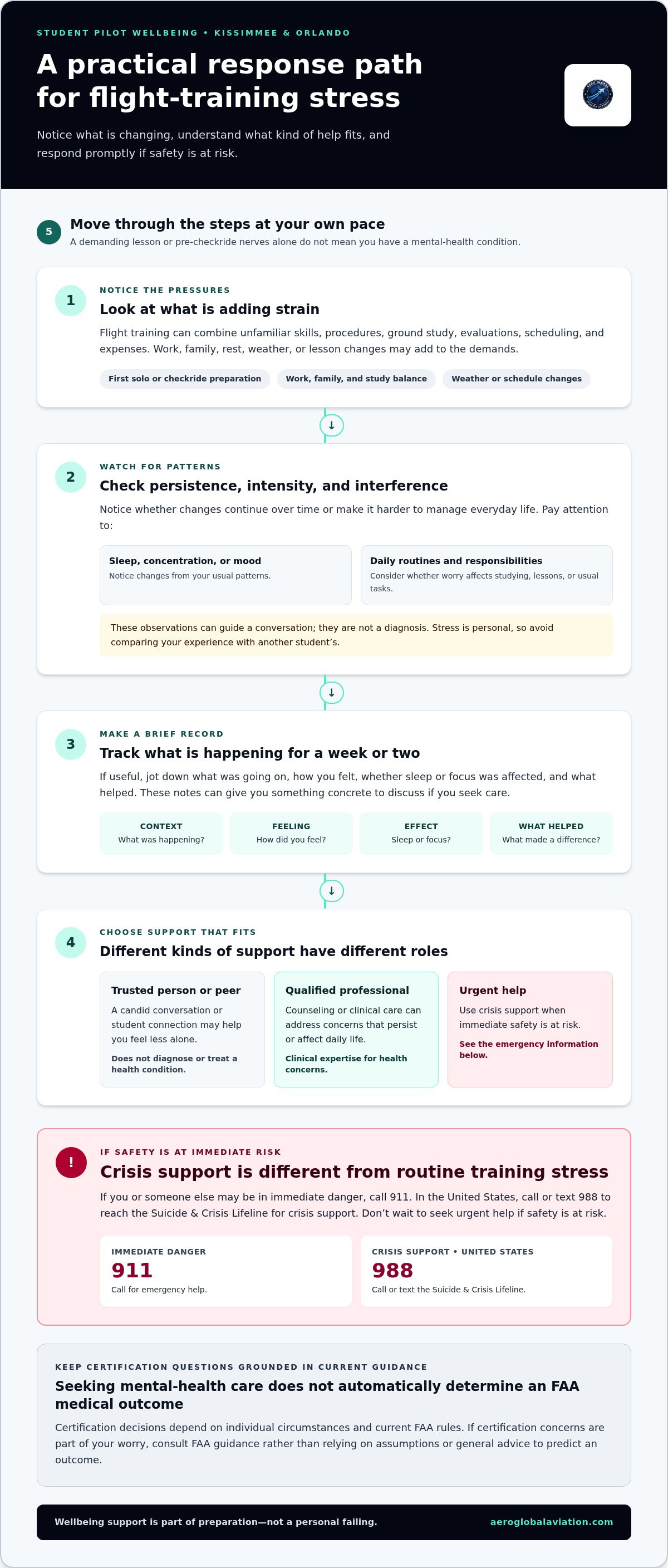
A practical wellbeing plan for flight training in Kissimmee and Orlando
A useful support plan should be simple enough to use during a busy training week. Pair everyday routines with clear next steps if concerns persist, and adjust the plan as your training schedule changes. Weather can affect lesson timing in Central Florida, so leave room for flexibility instead of treating every schedule shift as a setback.
How can students make a support plan they can use?
Start with five steps: notice patterns, identify support, communicate needs, review progress, and escalate if urgent. Write down who you’d speak with, such as a trusted person, a qualified mental-health professional, or an appropriate aviation resource. For a study or scheduling concern, prepare a calm, specific message: explain what’s getting difficult and ask to discuss a workable next step.
Keep the plan practical:
- Notice patterns: Track changes in sleep, focus, mood, or daily responsibilities.
- Identify support: Note trusted contacts and professional or aviation resources relevant to your concern.
- Communicate needs: Raise a concern early and describe what would help you plan.
- Review progress: Check whether your routines and support are helping, and revise them as needed.
- Escalate if urgent: If you’re in immediate danger, call 911. In the United States, call or text 988 for crisis support.
For training milestones, the PPL-to-CPL professional training timeline can help you see how stages fit together. A clearer picture of the path can help you plan questions and responsibilities one step at a time.
How can Orlando-area training routines reduce avoidable pressure?
Build a weekly outline that includes lesson time, focused study blocks, short breaks, and time to rest. Prepare materials ahead of a lesson, then leave flexibility for weather-related changes or rescheduling. If a shift affects work, family, or study plans, revisit the week’s priorities instead of trying to fit everything into the original timetable.
Use a planning tool that suits you, such as a calendar or simple checklist. The Orlando-area flight-school evaluation checklist offers additional context as you consider how a training pathway aligns with your goals and schedule.
Good planning can’t remove every challenge, but it can make the next action easier to see. If you’re ready to connect training milestones with a local pathway, explore pilot training in the Orlando area.
Choose a structured pilot-training path in Orlando and take your next step
A clear training pathway can make the next milestone easier to identify and plan around. Pair that structure with wellbeing routines and support options that fit your needs, while keeping the roles distinct: a flight-training program provides an aviation learning path, not mental-health care or a promise about medical certification.
Which training milestone matches your current goal?
At Aero Global Aviation Academy in Kissimmee and Orlando, students can choose among three structured pathways based on their training goals:
- Wings Foundation: A private pilot license (PPL) pathway for students focused on foundational flight training.
- Career Pilot Program: Training from PPL through commercial pilot license (CPL), for students pursuing professional aviation employment.
- Airline Pilot Elite: A pathway from PPL through advanced instructor certifications.
Start with the milestone you’re working toward, then consider what you want your next stage to be. A student beginning flight training may focus on a PPL, while someone with that foundation may be planning toward commercial training. For a deeper overview, read the Orlando career pilot program guide.
How can readers move forward with confidence?
Review the program structure and write down the next training milestone that fits your goal. Then consider the practical pieces that support steady progress, such as time for study, rest, and responsibilities outside the cockpit. If you need mental-health support, address that separately with trusted people or qualified professionals; flight training does not replace care or determine an FAA medical outcome.
For students exploring pilot training and mental health support Orlando, progress means planning aviation steps while taking wellbeing seriously. You don’t have to solve the whole career journey at once. Choose a sensible next milestone, keep your support plan accessible, and adjust your approach as your circumstances change.
When you’re ready, explore structured pilot-training options and identify a pathway that aligns with your current stage and long-term goals.
Take your next step with a clear plan
Pilot training asks for consistent effort, and caring for your wellbeing is part of preparing for that journey. Notice patterns that affect your daily life, reach out to trusted or qualified support when needed, and use current FAA guidance for individual medical-certification questions. Support and flight training serve different purposes, but both can be part of a thoughtful plan.
Aero Global Aviation Academy offers structured training pathways in Kissimmee and Orlando, from private pilot training through commercial pilot training and advanced instructor certification. A clear milestone can help you see what you’re working toward and plan your next step without expecting every part of the journey to happen at once.
Explore Aero Global Aviation Academy’s pilot-training programs to find the pathway that aligns with your current stage and aviation goals. Whether you’re preparing to begin or planning what comes after your PPL, steady progress starts with a manageable next step. With a training plan and appropriate support in place, your goal of flying professionally can feel more within reach.
Frequently Asked Questions
Can you get mental-health support while training to become a pilot?
Yes, student pilots can seek support while training. Everyday support might mean talking with someone you trust or connecting with peers; a qualified mental-health professional can provide clinical care when needed. These options serve different purposes, and general wellbeing guidance doesn’t replace treatment. If you have an aviation medical question, seek current FAA information and qualified guidance rather than assuming that a particular kind of support determines your future certification.
Does seeing a therapist mean you cannot become a pilot?
No, seeing a therapist does not automatically mean you can’t become a pilot. FAA medical certification decisions depend on individual circumstances and current FAA rules, so no general answer can predict an outcome for a particular person. Don’t conceal symptoms, treatment, diagnoses, or medication based on fear or assumptions. For a personal concern, review current FAA guidance and speak with an aviation medical professional who can address your circumstances.
How can flight students manage stress during training?
Use a simple routine that leaves room for study, breaks, sleep, and responsibilities beyond flying. Prepare lesson materials ahead of time, set manageable study blocks, and adjust your schedule when weather or lesson timing changes. Notice whether stress is affecting your sleep, concentration, mood, or daily functioning. If difficulties persist, talk with someone you trust or a qualified professional instead of trying to handle everything alone.
Is mental-health support available for pilots in Orlando?
Students in Kissimmee and the wider Orlando area can seek support through trusted personal contacts, qualified mental-health professionals, and aviation-focused information resources. The AOPA Mental Health Resource Center is one place to find pilot-oriented information; it isn’t an FAA certification authority or a substitute for clinical care. Choose the type of support that fits your need, and use emergency or crisis resources if safety is at immediate risk.
Can stress affect flight training performance?
It can. Stress may make it harder to concentrate, retain information, follow study routines, or feel prepared for a lesson, though people respond differently. Feeling nervous before a new skill or checkride doesn’t by itself indicate a disorder. Pay attention to whether difficulties persist or interfere with daily activities and training. Adjusting your schedule, taking study breaks, or seeking appropriate support can help you address concerns early.
What should a student pilot do if they are worried about FAA medical certification?
Start with current FAA information and get qualified advice about your individual question. Certification standards and outcomes depend on specific circumstances, so another pilot’s experience or a general online explanation may not apply to you. Don’t hide symptoms, treatment, diagnoses, or medication because you fear an assumed outcome. Write down your questions and discuss them with an aviation medical professional familiar with the FAA process.
Where can someone in the United States get immediate crisis support?
If you or someone else is in immediate danger, call 911. In the United States, you can also call or text 988 to reach the Suicide & Crisis Lifeline for crisis support. These options are for urgent situations, not a replacement for ongoing mental-health care. If it’s safe to do so, stay with the person at risk while help is being contacted, and follow the responder’s guidance.


