

What if an economic downturn changes your pilot career timeline without changing your destination? It’s understandable to worry about hiring freezes, furloughs, reduced schedules, or whether flight training will lead to a job. But what happens to pilots during an economic downturn depends on more than the economy. Employer decisions, the aviation sector, experience, and timing can all shape the impact.
This guide explains the possible effects, from slower hiring and schedule changes to income pressure and, in more severe cases, furloughs. It also compares how passenger airlines, cargo operators, and other aviation employers may respond, so you don’t mistake headlines for a forecast that applies to every pilot.
You’ll learn which hiring indicators and reliable sources to watch, along with practical ways to prepare, such as reviewing your finances, maintaining professional connections, and considering whether additional ratings may broaden your options. For aspiring pilots, a structured training pathway can support skill development and long-term planning, but it can’t guarantee employment. The goal is to make informed decisions, stay adaptable, and keep your career plan grounded in current conditions.
Key Takeaways
- What happens to pilots during an economic downturn varies by employer and role. Distinguish slower hiring from reduced flying, furloughs, and delayed advancement.
- Compare airlines, regional carriers, cargo, charter, corporate aviation, and flight instruction by their work context and potential exposure. Don’t assume any sector is recession-proof.
- Use dated employer announcements, official labor data, and aviation industry reporting to track hiring conditions and make decisions based on current information.
- Build flexibility into your career plan by reviewing finances, maintaining professional connections, and considering whether additional ratings may broaden your options.
- Explore how training pathways can support long-term skill development, while treating certifications as preparation rather than a promise of employment.
What happens to pilots during an economic downturn?
Economic headlines can make aspiring pilots question whether training will lead to a career. Working pilots may worry about job security, schedules, or income. The answer to “what happens to pilots during an economic downturn” isn’t the same for everyone. Employers may adjust hiring, routes, flying schedules, or other business activity, and those changes can affect career timing in different ways.
A downturn can change the pace and conditions of pilot work, but it doesn’t automatically mean pilots lose their jobs or that demand disappears. The impact depends on the employer’s finances and operating needs, the aviation segment, a pilot’s qualifications, and how long the slowdown lasts. A broad economic contraction is a reason to pay attention, not proof of a specific outcome.
Does a downturn mean pilots immediately lose their jobs?
No. Employers can respond in different ways. An airline might slow new hiring or postpone advancement without laying off current pilots. Another employer could reduce flying, change schedules, or, in more serious circumstances, furlough or lay off employees. These are possible responses, not a universal sequence or prediction.
Individual circumstances matter. Contract terms may shape protections and procedures, while an employer’s financial position and operational requirements can influence its choices. For aspiring pilots, a hiring pause could mean a longer wait for a particular role. It doesn’t necessarily mean a completed training pathway has no value, but it does make flexible career planning useful.
Why aviation can respond differently from other industries
Air travel demand and aviation business activity can shift as households and companies change their spending. The cyclical nature of the airline industry offers broad context for why airline activity and financial performance can rise and fall. That context can help explain exposure, but it can’t predict what a specific employer will do in a particular downturn.
Passenger airlines depend on travelers and route decisions. Cargo operations relate to the movement of goods, while charter and corporate flying can be affected by business and personal travel choices. Flight instruction has its own considerations, including student demand and training activity. These differences don’t make one segment automatically safe. To assess current conditions or compare a downturn with past periods, look for dated employer announcements and reliable aviation or labor reporting instead of relying on generalizations.
For pilots in Kissimmee, Orlando, and elsewhere, the practical takeaway is to separate broad economic news from direct signs in the sectors and employers they’re targeting. That distinction helps turn uncertainty into better questions about hiring timelines, qualifications, and alternative career steps.
How an economic slowdown can affect pilot hiring, schedules, and careers
A slowdown can influence several steps in a pilot’s career, but not always at the same time. An employer might first adjust recruitment plans, then review routes or schedules if demand changes. Any later effect on staffing, pay, or benefits depends on the employer’s circumstances and applicable employment agreements. A hiring pause is not the same as a furlough, and neither automatically means a pilot has been laid off.
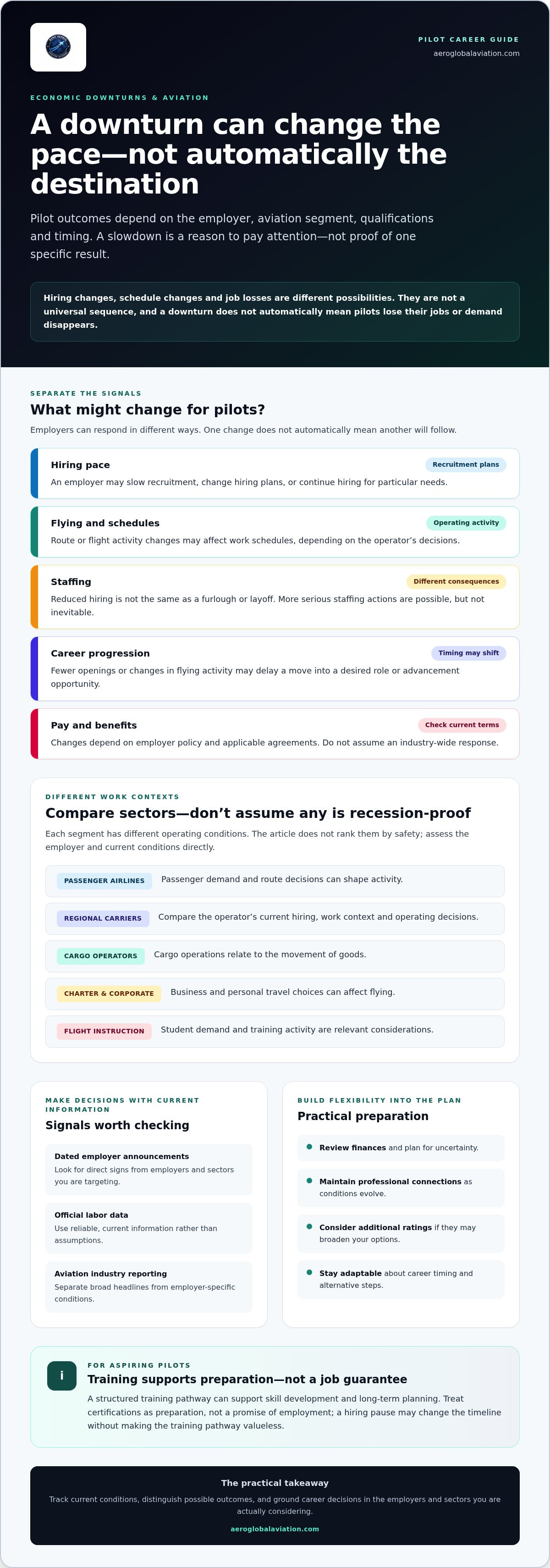
To understand what happens to pilots during an economic downturn, consider the possible effects separately rather than treating them as one inevitable outcome:
- Hiring pace: An employer may slow recruitment, change its hiring plans, or continue recruiting for particular needs.
- Flying and schedules: Changes to routes or flight activity may affect work schedules, depending on the operator’s decisions.
- Staffing: Reduced hiring is different from layoffs or furloughs, which have different employment consequences.
- Career progression: Fewer openings or changes in flying activity may delay a move into a desired role or advancement opportunity.
- Pay and benefits: These may depend on employer policy and applicable agreements. Check current documents and reliable reporting rather than assuming an industry-wide response.
What could change for airline pilots?
Airlines may revise hiring plans or recruitment pace, but a slowdown doesn’t establish that every carrier will stop hiring. If an airline changes routes or reduces flying, schedules and opportunities to advance could also shift. The details are employer-specific, so check dated company announcements and filings for current staffing or operational changes. For historical context, California Aeronautical University discusses how economic events, including the 2008 recession, can affect pilot hiring, schedules, and careers. Past cycles offer context, not a forecast for 2026.
What could change for student pilots and new graduates?
If employers recruit more slowly, the transition from training to a first job may take longer than planned. Certificates and ratings show that a pilot has met particular qualifications; they don’t guarantee a specific role or hiring date. Keep your plan adaptable: monitor current employer requirements and hiring announcements, and check FAA information for applicable certification requirements. Avoid making financial or career decisions based on a fixed hiring timeline.
For aspiring pilots, training is a foundation for building skills and qualifications, not protection from industry cycles. If you’re planning your next step in the Kissimmee or Orlando area, Aero Global Aviation Academy’s flight training pathways provide information to consider as you plan foundational and professional training.
Why downturn effects differ across pilot jobs and aviation sectors
A sector comparison can show where business pressures may arise, but it can’t predict an individual pilot’s job security. Each operator has its own business model, staffing needs, finances, and current vacancies. To understand what happens to pilots during an economic downturn, look beyond job titles to the work an employer does and the requirements of the role.
| Pilot sector | Work context | Factors to assess |
|---|---|---|
| Airlines | Scheduled passenger service | Passenger demand, route plans, recruitment updates, and staffing decisions |
| Regional carriers | Regional passenger flying | Route and operator plans, hiring requirements, and current openings |
| Cargo operators | Air transport of goods | Business activity, network needs, and employer-specific hiring |
| Charter | On-demand flights | Customer demand, operator business activity, and available roles |
| Corporate aviation | Flying connected to business operations | Company priorities, operating needs, and current vacancies |
| Flight instruction | Training and instructional flying | Student demand, training activity, and the qualifications required |
Use this table to frame questions, not to rank jobs by safety. A cargo operator may face different business conditions from a passenger airline, while two employers in the same sector may make different staffing decisions. Check current market examples against dated employer announcements and reliable industry reporting instead of drawing conclusions from broad sector labels.
Are airline pilots affected differently from other pilots?
Potentially. Scheduled passenger operations, cargo networks, charter trips, corporate flying, and instructional work serve different purposes. But those differences don’t establish which employer will keep hiring or how a slowdown will affect an individual. Look at the operator’s business activity, staffing announcements, and open positions. A segment-level trend is useful context, not a guarantee about a particular job.
Can qualifications and experience change a pilot’s options?
Yes. Certificates, ratings, flight experience, and role-specific requirements can determine which opportunities a pilot is eligible to pursue. Some qualifications may apply across more than one career path, but hiring standards and experience expectations vary by employer. A certificate or added rating doesn’t create a vacancy, guarantee employment, or protect someone from a staffing change. Check current FAA information for certification details, then compare your qualifications with requirements in actual job postings.
For aspiring pilots, map desired roles against their stated requirements, then identify which skills and qualifications to build over time. This can help you consider options without assuming any one sector will be unaffected by economic conditions.
How pilots and student pilots can prepare for uncertainty
You can’t control airline hiring or the broader economy, but you can make decisions with better information. A practical plan can help you respond to changing conditions without treating every headline as a prediction. To assess what happens to pilots during an economic downturn, track reliable updates and check how they relate to your training stage, qualifications, and career goals.
- Follow dated information. Check employer announcements and job postings, official labor data from the U.S. Bureau of Labor Statistics, and credible aviation industry reporting. Note publication dates and distinguish confirmed staffing decisions from forecasts or social media speculation.
- Map your training milestones. Understand the curriculum, certification pathway, expected training commitments, and what each milestone qualifies you to pursue. Use a private pilot license guide and a flight-school evaluation checklist to organize questions before enrolling.
- Review the financial commitment. Understand all costs, payment obligations, loan terms, and what happens if training takes longer than planned or your circumstances change. Loans aren’t risk-free. Personal finance decisions depend on your situation, so consider advice from a qualified financial professional before making commitments.
- Keep your records organized. Maintain accurate training and qualification records, and compare your experience and credentials with current requirements for the roles you’re considering.
- Build professional connections. Stay in touch with instructors, peers, and aviation professionals. A strong network can help you learn about opportunities, but it can’t guarantee a particular outcome.
What should aspiring pilots check before beginning training?
Compare schools by curriculum, the certifications their pathway covers, instructor access, and training expectations. Ask how progress is tracked and what support is available if your schedule or plans change. Review funding obligations and make a contingency plan before committing. Aero Global Aviation Academy’s pathways include private pilot training, a program progressing from PPL through CPL, and training through advanced instructor certifications. Match a pathway to your goals, and verify current FAA requirements independently.
How can working pilots respond to changing conditions?
Watch your employer’s communications and current openings instead of relying on broad online claims. Keep relevant certifications and records current under applicable regulations and role requirements, and review job postings to see whether your experience aligns with other roles you may consider. Maintain professional relationships and revisit your plan as conditions change. These steps support adaptability, not certainty.
For an overview of structured training options in the Kissimmee and Orlando area, review Aero Global Aviation Academy’s pilot training pathways and consider how each stage fits your longer-term plan.
How structured flight training can support a flexible pilot career plan
Training can give you a clear sequence for building skills and qualifications, but it can’t guarantee a job or protect you from changes in the aviation industry. Understanding what happens to pilots during an economic downturn is one reason to plan carefully: choose a pathway that fits your goals and circumstances, and check current certification requirements before committing.
How the academy's training pathways fit different starting points
Aero Global Aviation Academy serves the Kissimmee and Orlando area and offers three pathways with different stated scopes:
- Wings Foundation: a Private Pilot License (PPL) course.
- Career Pilot Program: flight training from PPL through Commercial Pilot License (CPL).
- Airline Pilot Elite: a pathway from PPL through advanced instructor certification.
These pathways provide different training milestones, not employment outcomes. Before deciding, consider the role you’re working toward, your current experience, and whether the stated scope matches the qualifications you need to pursue your next step. For more background, review a commercial pilot training guide and a career pilot program overview as part of your research.
What prospective students should ask before choosing a path
Get clear answers before making a commitment. Ask which certifications a program includes, what prerequisites apply, how progress is tracked, and how training expectations and scheduling are explained. Understand the total financial commitment and any payment or financing terms, including what happens if your plans or circumstances change. Compare the answers with your goals, budget, and current FAA information rather than relying on assumptions about future hiring.
A structured pathway can help you work toward qualifications one milestone at a time. It’s a practical foundation for a longer-term plan, while staying adaptable if your preferred role or the hiring environment changes.
For details on the academy’s training options, explore Aero Global Aviation Academy’s training pathways and consider which scope fits your next step.
Build a pilot career plan that can adapt
What happens to pilots during an economic downturn depends on the employer, aviation sector, qualifications, and timing. Hiring may slow, schedules may shift, or career milestones may take longer, but those changes don’t affect every pilot in the same way. Track reliable, dated hiring information and keep your plans flexible instead of treating headlines as predictions.
Training can help you build skills and qualifications for future opportunities, but it can’t guarantee employment or shield you from industry changes. Match your next step to your career goals, finances, and current requirements. Aero Global Aviation Academy serves the Kissimmee and Orlando area, with pathways covering Private Pilot License (PPL), Commercial Pilot License (CPL), and advanced instructor certification training.
Ready to explore a training path that fits your goals? Explore Aero Global Aviation Academy’s pilot training programs.
Frequently Asked Questions
Do pilots lose their jobs during an economic downturn?
What happens to pilots during an economic downturn varies by employer; job losses aren’t automatic. Some operators may slow hiring or adjust flying, while furloughs and layoffs are separate possible actions. Outcomes can depend on an employer’s finances, operational needs, and applicable contract terms. Check dated updates from the specific airline or operator rather than treating a recession headline as proof that an individual pilot’s position is ending.
Are pilots in demand during a recession?
Some pilot opportunities may remain available during a recession, but hiring can vary across employers and aviation sectors. Demand isn’t a single industry-wide yes-or-no measure. Check current vacancies and dated employer announcements for the roles you’re targeting, then compare them with official labor-market data. Treat forecasts as projections, not promises of openings or employment, and revisit the information as conditions change.
Can you become a pilot during an economic downturn?
Yes, you can begin or continue flight training during an economic downturn if the commitment fits your goals and circumstances. Before enrolling, review the curriculum, training milestones, full financial obligations, and contingency options if training or hiring takes longer than expected. Training builds qualifications, but doesn’t guarantee a job or start date. Check current FAA certification requirements and consider how the pathway fits your longer-term career plan.
What happens to student pilots if airline hiring slows?
Student pilots can continue working toward qualifications, but a slower hiring environment may lengthen the transition from training to employment. Track your progress, keep accurate training records, and review current employer requirements as you advance. A Private Pilot License or Commercial Pilot License is a qualification, not a promise of an airline job. Plan for different possible timelines and adjust your next steps as hiring information changes.
Are cargo pilots safer from downturns than airline pilots?
No. Cargo flying isn’t automatically safer or immune to an economic downturn. Cargo and passenger operators serve different markets, so conditions may affect them differently, but exposure depends on each employer’s business, staffing needs, and current situation. Compare actual vacancies and dated hiring announcements instead of choosing a career path based on claims that a sector is recession-proof. The same caution applies to charter, corporate, and instructional flying.
Should I delay flight training because of an economic downturn?
There’s no universal answer; consider your finances, timeline, career goals, and comfort with uncertainty. Review training pathways, total commitments, payment terms, and your options if plans change before deciding. Students in Kissimmee and Orlando can compare Aero Global Aviation Academy’s pathways, from PPL training to CPL and advanced instructor certification training. Personal financial choices depend on individual circumstances, so consider advice from a qualified professional.
How can pilots track hiring conditions during a downturn?
Use dated, reliable information rather than relying on social media claims. Check target employers’ official announcements and hiring pages, review current job postings, and consult U.S. Bureau of Labor Statistics data for broader labor-market context. Aviation industry reporting can add perspective, but check whether it describes confirmed actions or projections. For licensing and certification requirements, refer to current FAA information relevant to your intended role.


