
A pilot career tied to one employer can feel vulnerable when airline hiring slows. Long-term career stability for pilots in Florida is better approached through adaptability: building skills and credentials that keep more than one professional route in view. That cannot remove uncertainty, but it can help you make informed choices as the industry changes.
If you’re concerned that a hiring cycle could disrupt your plans, it’s worth looking beyond a single employer or job title. This guide explains what can shape career resilience, compares airline and instructor pathways, and outlines training decisions that may preserve future options. It also considers how Florida’s aviation activity fits into a career plan, from early training milestones to advanced instructor certifications. Credentials can support a broader plan, but they don’t guarantee employment or a particular hiring outcome. Understanding the steps ahead can help you choose training that matches your goals while staying ready to adapt.
Key Takeaways
- Build long-term career stability for pilots in Florida by developing adaptable skills and credentials rather than relying on one employer or hiring cycle.
- Compare airline, instructor, charter, corporate, and cargo paths by their requirements, work settings, and trade-offs.
- Use a step-by-step training plan, review your goals as you progress, and confirm current FAA requirements and medical eligibility with qualified sources.
- Use Florida’s aviation activity as context, not as proof of an opening for an individual pilot.
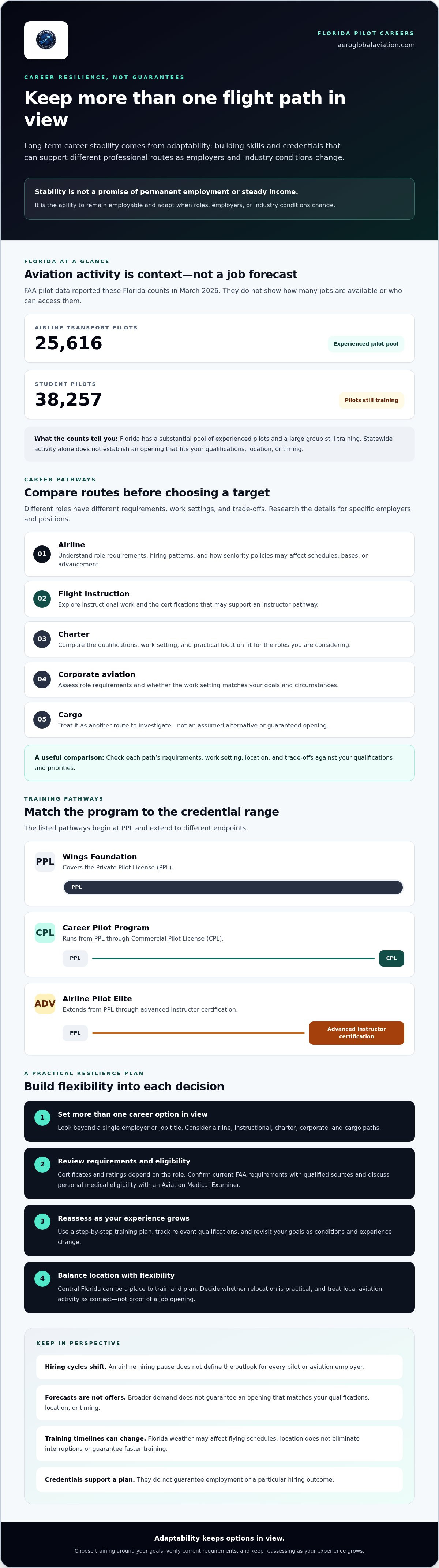
- Match your starting point to a training pathway: Wings Foundation covers PPL, Career Pilot Program runs from PPL through CPL, and Airline Pilot Elite extends from PPL through advanced instructor certification.
What Does Long-Term Career Stability Mean for Pilots in Florida?
Career stability isn’t a promise of permanent employment or steady income. It’s the ability to remain employable and adapt when roles, employers, or industry conditions change. That distinction matters when you’re weighing flight training. Long-term career stability for pilots in Florida depends partly on the wider aviation market, and partly on a pilot’s qualifications, experience, health, location, and openness to different types of work.
An airline hiring pause can affect its applicants without defining the outlook for every pilot or aviation employer. Broader demand may create opportunities, but it doesn’t guarantee an opening that fits your qualifications, location, or timing. Planning for uncertainty means understanding the requirements for your target roles, keeping track of relevant qualifications, and reviewing your options as your experience grows.
What factors can change a pilot’s career outlook?
Hiring patterns rise and fall with airline business needs and wider conditions. A forecast is not a job offer. Airline progression can also be shaped by seniority. At many airlines, a pilot’s position on the seniority list can influence access to schedules, bases, or advancement, subject to the employer’s policies and applicable agreements. Details vary, so research specific employers instead of assuming every airline follows the same career path.
Qualifications and medical eligibility matter, too. The certificates and ratings required depend on the role, and pilots must meet applicable FAA requirements to exercise their privileges. For airline-bound pilots, the Airline Transport Pilot (ATP) certificate is one credential to understand. Requirements and terminology can differ by jurisdiction. Certification rules and medical circumstances can change, so verify current details with the FAA and consult an Aviation Medical Examiner about personal eligibility.
Why a Florida location matters without guaranteeing stability
Central Florida is relevant as a place to train and plan a career, not as proof that employment will be easier to secure. Aero Global Aviation Academy serves students in Kissimmee and Orlando. Florida has varied aviation activity, but statewide industry presence alone doesn’t show how many openings are available to a particular pilot or whether they match that person’s experience and goals.
Location can shape practical decisions: where you train, where you’re willing to work, and whether relocating is an option. Weather may affect flying schedules, but it doesn’t eliminate interruptions or guarantee a faster training timeline. Build flexibility into your plan, check local conditions and current opportunities, and reassess as you progress. A promising location is useful context, not a guarantee of career stability.
How Florida’s Aviation Market Can Shape a Pilot Career
Florida’s aviation activity provides a broad backdrop for a pilot career, but statewide scale isn’t the same as a job opening you can qualify for. FAA pilot data for March 2026 reported 25,616 Airline Transport Pilots and 38,257 student pilots in the state. Those figures show both a substantial pool of experienced pilots and a large group still training, but they don’t reveal how many jobs are available or who can access them.
For long-term career stability for pilots in Florida, consider the fit between your qualifications, employers that are hiring, and places you’re prepared to work. Airline, charter, corporate, cargo, and instructional roles have different requirements and locations. Relocation flexibility may widen your search, while family, financial, or personal commitments may make staying near Central Florida a priority. Neither choice is automatically better. Each affects which opportunities are practical to pursue.
What Central Florida can offer aspiring pilots
Kissimmee and Orlando provide a local setting for training, not proof of superior employment outcomes. Aero Global Aviation Academy serves students in the area, where aspiring pilots can plan training milestones while researching employers and roles separately. Airports such as Orlando International or Kissimmee Gateway may help you understand local aviation activity, but their presence alone doesn’t establish current hiring demand. Check airport and employer information directly before treating local activity as a career opportunity.
Florida’s environment may make it possible to fly in a range of seasonal conditions, but weather can still interrupt training. Don’t build a timeline on the assumption that location removes delays. Ask how training plans account for weather and other scheduling factors, and allow room for changes.
How to read aviation hiring trends responsibly
Use each source for what it can tell you. The U.S. Bureau of Labor Statistics’ career information for airline and commercial pilots offers national occupational data, not a count of openings in Orlando. Employer hiring announcements can show a company’s current plans, but those plans may change and don’t guarantee an individual offer. The Boeing Pilot and Technician Outlook 2025-2044 projects global demand for 660,000 new pilots over 20 years. That long-range worldwide estimate isn’t a Florida hiring forecast.
Compare dated sources, distinguish national or global projections from Florida evidence, and revisit them as your training progresses. To connect career questions with a local training pathway, review the pilot training options in Kissimmee and Orlando and consider which milestones match your goals.
Which Pilot Career Paths Offer Different Forms of Resilience?
No pilot role is universally the most stable. Each route depends on different employers, qualifications, schedules, and hiring needs. Comparing them can help you identify paths that fit your priorities and decide where to keep options open. The qualifications below are general guideposts, not a substitute for checking current FAA rules and each employer’s requirements.
| Route | Relevant qualifications | Considerations | Evidence source to check |
|---|---|---|---|
| Airline | Commercial pilot qualifications and, for many airline roles, ATP or restricted ATP eligibility, subject to applicable rules and employer requirements. | Airline hiring can change, and progression may depend on seniority systems and employer policies. Confirm current hiring and advancement details with each carrier. | FAA regulations; airline hiring notices and applicable pilot agreements. |
| Flight instructor | Applicable flight instructor certification and qualifications for the instruction provided. | Instruction can be a way to build experience, but certification doesn’t guarantee a paid position. Check local openings, experience expectations, and work arrangements. | FAA certification rules; current school and employer postings. |
| Charter | Requirements vary with the operator, aircraft, and type of operation. | Ask about routes, schedules, bases, and minimum experience. Don’t assume one charter employer’s requirements represent the whole segment. | FAA operating rules; individual operator job postings. |
| Corporate | Qualifications depend on the aircraft and the company’s flight operation. | Consider the employer’s location, travel expectations, schedule, and hiring needs before treating the role as a fit. | Company flight department postings; applicable FAA rules. |
| Cargo | Requirements vary by carrier and whether operations fall under different operating rules. | Compare the specific employer’s schedules, routes, base, and experience thresholds. Demand in one segment doesn’t establish security across the sector. | Carrier job notices; FAA operating rules. |
Airline flying versus instructing
Airline careers may offer a defined progression, but seniority can influence advancement and work preferences. Details vary by carrier and agreement. Instructor certification offers a different professional direction and may help pilots build experience, but it doesn’t promise employment. Before committing to either route, check current experience thresholds, nearby openings, and the qualifications employers actually request.
Charter, corporate, and cargo flying
These categories include different employers and operations, so compare specific roles rather than relying on broad labels. One opening may involve a schedule or location that works for you; another may not. For long-term career stability for pilots in Florida, flexibility across routes can broaden the roles you consider, but it can’t eliminate employment or income uncertainty. Match training milestones to your goals, then reassess as your experience and local hiring evidence develop.
How Can Pilots Build Career Resilience Before and During Training?
A resilient plan starts with research and stays flexible as you gain experience. Choose a preferred flying role, but identify at least one alternative worth investigating. For example, an airline goal could sit alongside flight instruction as a possible route to build experience. Neither path guarantees a job, so compare actual employer requirements and local openings instead of planning around assumptions.
Create a flexible training and career plan
Turn your research into milestones. List the qualifications your target roles require, then confirm current rules with the FAA or another qualified source before committing to a training sequence. Check medical eligibility with an Aviation Medical Examiner, especially before making major training decisions. As you progress, keep a record of completed certificates, ratings, and experience, and compare that record with current job postings.
Review your plan when circumstances change. Your finances, health, experience, preferred location, and employer demand can all affect which next step makes sense. Regular check-ins can help you adjust your timeline or explore a different role while keeping your broader goal of long-term career stability for pilots in Florida in view. For background on professional certification milestones, see this commercial pilot training guide.
Evaluate training choices for long-term usefulness
Compare schools on more than a course title. Ask about curriculum, instructor qualifications, aircraft access, and the student support included. Find out how training milestones connect to your intended roles, and ask what the program does not cover. If a school discusses graduate outcomes, request clear definitions and supporting evidence. Individual stories are not the same as verified placement data.
Use a consistent checklist to compare options fairly. The Florida flight school evaluation checklist can help structure your questions. Then match the training scope to your starting point and goals. In Kissimmee and Orlando, Aero Global Aviation Academy offers paths ranging from PPL-only training through PPL-to-CPL training and training through advanced instructor certification. Instructor certification is a training milestone, not a promise of instructor employment.
Ready to connect your goals with a training pathway? Discuss which pilot training program fits your starting point, and ask how its milestones align with the roles you’re considering.
How Can a Florida Training Plan Keep Your Pilot Options Open?
A training plan can give your career direction without locking you into one employer or outcome. Start with the role you’re aiming for, identify the qualifications it requires, and compare those needs with the training available. A structured sequence of milestones helps you see what you’re working toward and when to reassess your options. That informed planning can support long-term career stability for pilots in Florida, but training prepares you for certifications. It can’t guarantee employment, income, or career stability.
Match your starting point to a confirmed training pathway
Aero Global Aviation Academy serves students in Kissimmee and Orlando, with three pathways at different scopes:
- Wings Foundation focuses on private pilot (PPL) training.
- Career Pilot Program provides structured training from PPL through commercial pilot (CPL).
- Airline Pilot Elite covers training from PPL through advanced instructor certifications.
Choose based on your current experience and intended next milestone, not on the assumption that a longer pathway guarantees a particular job. Instructor certification can prepare you for an instructional route, but it doesn’t promise an instructor position. Confirm current course details and FAA requirements before enrolling.
Questions to ask before choosing a training program
Clear answers can help you compare programs and set realistic expectations. Ask the academy:
- Which milestones and certifications does this program cover, and what falls outside its scope?
- What instructor qualifications are relevant to the training I’m considering?
- How is progress assessed, and what factors can affect the pace of training?
- What schedule should I plan around, and what financing options, if any, are available?
- How does this pathway relate to my career goals, and what additional requirements might employers set?
For a closer look at the PPL-to-CPL pathway, read the career pilot program guide. Discuss your starting point, schedule, financing questions, and goals directly with the academy so you can confirm details rather than rely on assumptions. Then explore pilot training options in Kissimmee and Orlando and decide which pathway best fits your next step.
Build Your Next Step Around Flexibility
Long-term career stability for pilots in Florida doesn’t come from predicting every hiring shift. It comes from understanding your preferred route, keeping other options in view, and choosing training milestones that support an informed plan. Revisit that plan as your qualifications, circumstances, and the aviation market change.
Aero Global Aviation Academy serves students in Kissimmee and Orlando with pathways for different training goals. The Career Pilot Program runs from PPL through CPL, while Airline Pilot Elite extends from PPL through advanced instructor certifications. These programs prepare students for training milestones, not guaranteed employment or a specific career outcome.
Take a practical next step: clarify where you’re starting, what role you’re aiming for, and which program scope fits your goals. Explore your pilot training options in Kissimmee and Orlando. Thoughtful planning and a willingness to adapt can help you move toward your aviation goals with greater clarity.
Frequently Asked Questions
Is becoming a pilot a stable long-term career in Florida?
It can be a sustainable career, but no location or training path guarantees steady employment or income. Long-term career stability for pilots in Florida depends on factors such as qualifications, experience, medical eligibility, employer demand, and willingness to consider different roles or locations. Airline hiring can shift, so plan for adaptability rather than relying on one employer or assuming statewide aviation activity guarantees an opening.
Can pilots work outside the airlines if hiring slows?
Yes, pilots may pursue roles such as flight instruction, charter, corporate, or cargo flying, depending on their qualifications and the employer’s requirements. These routes have different operating contexts, schedules, locations, and hiring needs. A credential for one role may not meet another employer’s standards, so check current job postings and applicable FAA requirements before treating an alternative as immediately available.
What factors affect long-term career stability for pilots?
Career resilience can be influenced by your certificates and ratings, flight experience, medical eligibility, location, and flexibility about employers or schedules. Industry hiring cycles also matter, but they don’t determine every pilot’s prospects equally. Review the requirements for your target roles, confirm medical questions with an Aviation Medical Examiner, and revisit your plan as your experience and personal circumstances change.
Does flight training in Florida improve a pilot’s employment prospects?
Training in Florida can provide a local starting point, but it doesn’t by itself guarantee better employment prospects. Aero Global Aviation Academy serves students in Kissimmee and Orlando, with pathways ranging from PPL-focused training to PPL-through-CPL and advanced instructor certification. Compare each program’s scope with your goals, then check employer requirements and current openings separately. Training prepares you for milestones, not a job offer.
Can becoming a flight instructor help build a pilot career?
Flight instructor certification can prepare a pilot for instructional work and may be one route to consider while building a broader career plan. However, certification alone doesn’t guarantee a paid position, and schools or employers may set additional requirements. Ask what qualifications local openings require and confirm current FAA rules. Aero Global Aviation Academy’s Airline Pilot Elite covers training from PPL through advanced instructor certifications.
What happens if airline hiring slows after I complete pilot training?
A hiring slowdown may mean waiting, applying to different employers, or considering other flying roles for which you meet the requirements. Start by checking current openings and their experience thresholds, then identify any additional qualifications needed. Keep your records organized and review your plan rather than assuming a slowdown ends your options. Hiring conditions can change, so base next steps on current evidence, not forecasts alone.
Does completing a pilot program guarantee a job?
No. Completing a training program helps you work toward the certifications included in its scope, but it can’t guarantee employment, airline placement, income, or career stability. Before enrolling, confirm which milestones the program covers and which requirements you may still need to meet for a particular role. Ask the school about documented outcomes and limitations, and evaluate job opportunities directly with prospective employers.


