
What if the biggest financial risk in professional flight training isn't the upfront capital, but the lost time spent waiting to reach an airline cockpit? When you evaluate the flight school cost vs potential pilot salary Orlando offers, the numbers can feel overwhelming without transparent long-term benchmarks. You're likely weighing the intense commitment needed to log your first 1,500 flight hours while wondering whether weather delays or training bottlenecks will slow your momentum.
Central Florida turns that equation in your favor. Benefiting from over 300 days of flyable visual weather annually, training here provides the velocity needed to transform flight hours into accelerated career equity. In this 2026 guide, you'll discover how flight training expenses compare against lifetime airline earnings to evaluate your pilot career investment in Central Florida. We'll break down the complete pathway from private certification to commercial flight, examine realistic salary projections from regional carriers to legacy cockpits, and establish a clear break-even roadmap for your aviation journey.
Key Takeaways
- Understand the core expenses behind flight training, from dual instruction and solo flight time to FAA examiner fees.
- Examine realistic airline pay scales, tracing compensation growth from flight instructor hourly rates to senior captain salaries.
- Analyze the flight school cost vs potential pilot salary Orlando equation to calculate realistic five-year and ten-year returns on investment.
- Discover how completing the 1,500-hour ATP requirement as a paid flight instructor eliminates out-of-pocket hour-building expenses.
- Learn why training out of Central Florida hubs like Kissimmee maximizes schedule reliability and speeds up your career progression.
Evaluating the Investment: What Goes Into Flight School Costs in Orlando?
Viewing flight training purely as an educational expense misses the mark. It's an operational capital investment in a highly regulated commercial qualification. When evaluating the flight school cost vs potential pilot salary Orlando pathways deliver, you have to look past base tuition estimates. The true cost of professional pilot training encompasses every Hobbs meter tick on an aircraft engine, every hour of individualized pre-flight briefing, and the regulatory testing required by the Federal Aviation Administration.
Understanding regulatory frameworks is vital. The official structure of pilot certification in the United States establishes specific minimum flight experience benchmarks across private, instrument, and commercial ratings. Knowing where every dollar goes helps you protect your capital and build flight hours efficiently.
Primary Expense Categories in Professional Pilot Training
Your direct investment breaks down into four essential buckets:
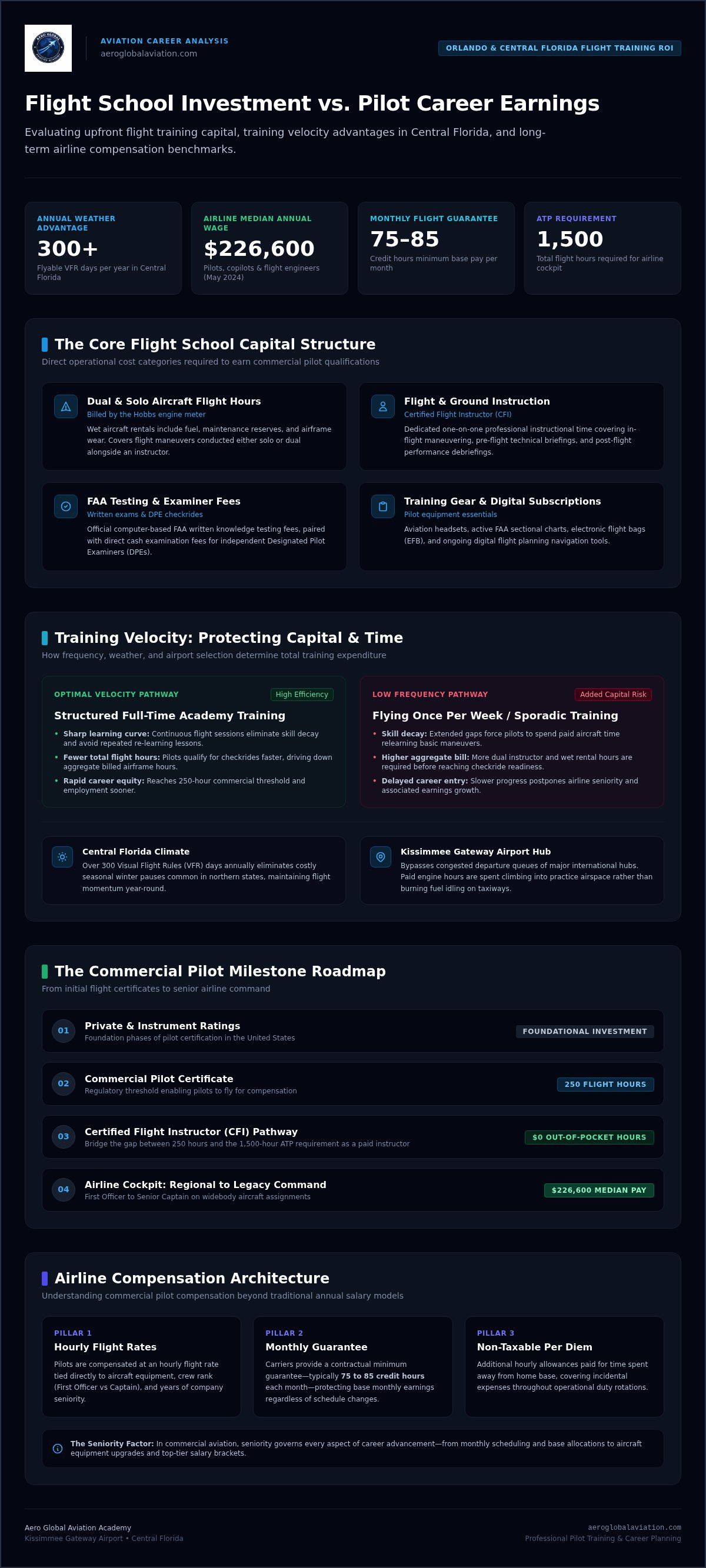
- Aircraft Dual and Solo Flight Hours: Billed by the flight hour, wet aircraft rentals cover fuel, maintenance reserves, and airframe wear. You log these hours flying dual with an instructor or solo practicing maneuvers.
- Flight and Ground Instruction: Dedicated one-on-one time with a Certified Flight Instructor (CFI) during flight lessons, pre-flight preparations, and post-flight debriefings.
- FAA Testing and Examiner Fees: FAA computer-based written exam testing fees and cash fees paid directly to independent Designated Pilot Examiners (DPEs) for practical flight checkrides.
- Training Equipment and Subscriptions: Aviation headsets, current sectional charts, electronic flight bags, and digital flight planning subscriptions. For those mapping the baseline phase, our guide on how to get your private pilot license in Florida details initial equipment and cert requirements.
How Training Velocity Affects Your Overall Investment
Training frequency directly dictates your final bill. Flying only once a week causes skill decay. You spend paid airframe hours re-learning maneuvers rather than advancing your syllabus. Structured, full-time academy tracks keep your learning curve sharp, driving down the aggregate hours needed to pass checkrides.
Location plays an equally massive financial role. Central Florida provides over 300 flyable Visual Flight Rules (VFR) days each year. That climate eliminates the costly seasonal winter pauses common in northern states. Choosing an efficient operational base like Kissimmee Gateway Airport also bypasses the congested airline departure lines of major international hubs. You spend your paid engine time climbing into clear airspace, not burning fuel on a holding taxiway. When you calculate the flight school cost vs potential pilot salary Orlando equation, high training velocity protects your capital and gets you to the airlines faster.
Commercial Airline Pilot Salary Trajectories: From First Officer to Senior Captain
Aviation compensation works differently than traditional salaried careers. Airline pilots are paid an hourly flight rate tied to a minimum monthly guarantee, typically between 75 and 85 credit hours each month, alongside non-taxable per diem allowances for time spent away from base. Because seniority governs every aspect of scheduling and equipment assignments, advancing your career quickly is what unlocks top-tier compensation brackets.
Federal data highlights the substantial upside of this career trajectory. According to official reports on pilot salary and job outlook metrics, the median annual wage for airline pilots, copilots, and flight engineers reached $226,600 as of May 2024. Knowing how those figures scale from your initial certificate up through widebody command helps you accurately measure the flight school cost vs potential pilot salary Orlando flight programs present.
Entry-Level Commercial Earnings: Building the First 1,500 Hours
Fresh commercial pilots rarely step directly into airline cockpits. You first bridge the gap between your 250-hour commercial certificate and the FAA's 1,500-hour Airline Transport Pilot (ATP) minimum. Certified flight instructors typically earn hourly instructional pay while logging 70 to 100 hours per month. Aerial survey flying and banner towing offer alternative routes, but instructing remains the most reliable way to maintain consistent flight time while receiving a steady income.
Regional Carrier Progression vs. Major Legacy Pay Scales
Modern regional airline collective bargaining agreements have transformed entry-level compensation across the industry:
- Regional First Officer (Years 1 to 2): Starting first officers at regional carriers earn between $70,000 and $90,000 annually under updated collective bargaining agreements.
- Regional Captain Upgrade (Years 3 to 5): Fast-tracked upgrades place third-year regional captains into six-figure base earnings, often exceeding $110,000 to $130,000 per year.
- Legacy Carrier Transition (Years 5+): Transitioning to a major carrier like Delta, United, or American, or a cargo giant like FedEx, triggers another sharp pay hike. First-year legacy first officers earn competitive six-figure compensation.
- Senior Legacy Captains: Career-peak widebody captains flying international routes regularly earn upwards of $350,000 to $400,000 annually.
Mapping these benchmarks makes it clear that your early training costs represent a fraction of your long-term earnings. If you want to explore the complete timeline across every career stage, read our in-depth guide on the airline pilot career path. Prospective aviators ready to take their first step can explore professional training pathways with Aero Global Aviation Academy to kickstart this progression.
Orlando Flight School Cost vs Potential Pilot Salary: The Financial ROI Breakdown
Every dollar you spend in flight training must be weighed against your projected career earnings curve. When prospective students analyze the flight school cost vs potential pilot salary Orlando flight academies produce, they frequently overlook the massive opportunity cost of delayed career entry. Spending four years pursuing a traditional collegiate aviation degree often costs double the tuition while delaying your entry into a paid commercial cockpit by two full years.
Reviewing the official FAA requirements to become a pilot reveals that airlines hire based on flight certificates, logged hours, and medical qualifications, not academic degrees. Choosing an accelerated career academy model allows you to complete commercial ratings rapidly, start earning wages as a flight instructor, and position yourself on an airline seniority list years ahead of collegiate peers.
Calculating the Break-Even Milestone for New Pilots
Reaching financial break-even follows a structured, predictable timeline across your first several professional years:
- Years 1 to 2 (Training and Hour Building): You fund your core ratings and transition into a paid instructor position. Working as a flight instructor covers daily living costs while you log 1,500 hours without paying for aircraft time.
- Years 3 to 4 (Regional First Officer): Earning starting airline pay allows you to aggressively service any training debt. Many pilots dedicate a significant portion of their monthly guarantee toward eliminating initial training capital.
- Year 5 (The Break-Even Pivot): Upgrading to regional captain or transitioning to a major carrier rapidly increases your net cash flow. By year five, cumulative airline earnings comfortably surpass total training expenditures, yielding an entirely debt-free career asset.
The Hidden Cost of Career Delays on Seniority Lists
Seniority is everything in commercial aviation. It governs your monthly flight schedule, the airframe you operate, your base location, and your promotion from first officer to captain. Mandatory airline pilot retirements at age 65 create constant upward movement, meaning every month of training delay represents a quantifiable loss in career seniority.
Entering the airline hiring pool twelve months late can cost hundreds of thousands of dollars in cumulative lifetime earnings, primarily because your final career year would have been spent at top-tier senior captain pay scales. Training out of a dedicated hub like Kissimmee Gateway Airport protects your entry date. You avoid the heavy convective weather shutdowns common elsewhere while taking advantage of direct runway access. High training velocity is your best financial safeguard, turning your upfront flight school cost vs potential pilot salary Orlando balance into an engine for long-term wealth creation.
Strategic Pathways to Build 1,500 Hours Efficiently in Central Florida
Completing your commercial certificate at 250 flight hours is a pivotal milestone, yet it leaves a 1,250-hour gap before you qualify for the Airline Transport Pilot minimums. Paying out of pocket for those remaining hours would wreck your training budget. The secret to mastering the flight school cost vs potential pilot salary Orlando equation lies in monetizing this bridge phase, turning flight-hour accumulation into a paid professional role rather than an added financial drain.
While niche roles like pipeline patrol, banner towing, or flying drop planes for skydiving centers exist, they offer irregular schedules and seasonal instability. In contrast, working as an active flight instructor provides steady logbook growth, structured flight routines, and direct preparation for airline multi-crew cockpit environments.
The Certified Flight Instructor Pathway to Airline Minimums
Securing your Certified Flight Instructor (CFI) and Certified Flight Instructor Instrument (CFII) credentials transforms your financial model overnight. Instead of renting aircraft, you sit in the right seat teaching initial students, logging high-quality instructional hours while drawing hourly compensation. Review our guide on commercial pilot training to understand the foundational prerequisites required before taking your instructor checkrides.
In Florida's high-tempo flying environment, a full-time instructor averages 70 to 100 logged flight hours each month. That consistent flying pace allows motivated pilots to bridge the 1,250-hour requirement in roughly 12 to 18 months, all while building deep mastery of aeronautical decision-making and flight fundamentals.
Maximizing the Central Florida Aviation Environment
Central Florida offers unmatched airspace variety that sharply elevates your piloting skills. Training out of Kissimmee Gateway Airport places you directly inside Class D airspace, situated immediately beneath the shelf of Orlando International's Class B operations. This operational setup yields distinct career advantages:
- Professional Radio Mastery: Interfacing with Orlando air traffic control on every flight builds seamless phraseology and professional radio habits from day one.
- Instrument Approach Accessibility: Local airports offer diverse ILS, RNAV, and VOR navigation procedures, allowing you to fly real-world instrument profiles without long transit flights.
- Year-Round Weather Advantage: Central Florida's persistent sunshine prevents the month-long winter shutdowns typical of northern academies, ensuring your logbook builds without interruption.
Ready to turn flight training into a rewarding aviation career? Contact the flight training specialists at Aero Global Aviation Academy to map out your zero-to-airline strategy today.
Accelerate Your Aviation Career with Aero Global Aviation Academy
Maximizing the return on your training investment comes down to school selection. While massive flight factories often treat students as numbers on a waiting list, Aero Global Aviation Academy in Kissimmee provides a personalized mentorship model designed around commercial career timelines. By combining rigorous safety standards, reliable fleet maintenance, and direct airspace access, the academy optimizes the flight school cost vs potential pilot salary Orlando equation for serious career aviators.
Structured Career Pilot Programs Tailored to Your Ambitions
Clear, purposeful pathways ensure you never spend money on unnecessary flight hours. The academy structures training into dedicated tracks based on your ultimate aviation goals:
- Wings Foundation: A focused course taking you through private pilot certification, building solid airmanship and core stick-and-rudder confidence from your very first flight.
- Career Pilot Program: An accelerated commercial track taking you from zero time through your Commercial Pilot License (PPL to CPL), qualifying you for professional single- and multi-engine flying positions. You can explore the ultimate career pilot program in Kissimmee to review exact syllabus milestones.
- Airline Pilot Elite: The premier comprehensive track taking you from your initial flight all the way through advanced flight instructor ratings, creating a direct bridge to paid instructional positions.
The Kissimmee Gateway Airport Advantage
Location directly impacts your training budget and flight frequency. Based out of Kissimmee Gateway Airport, students enjoy immediate runway access without wasting paid Hobbs meter time idling behind commercial airliners. Paired with Central Florida's exceptional climate of over 300 flyable VFR days annually, this operational hub ensures your aircraft stays airborne and your training progresses without weather stalls.
Taking Your First Step Toward the Flight Deck
Launching your professional flying career starts with concrete preparation. Schedule an admissions consultation with the flight operations team to review your background, evaluate medical certification requirements, and build a timeline matched to airline hiring cycles.
You can also book an initial discovery flight to take the flight controls alongside an experienced instructor over Central Florida. Experiencing hands-on flight confirmed by personalized mentorship will give you total clarity as you weigh your flight school cost vs potential pilot salary Orlando pathway. Connect with the flight mentors at Aero Global Aviation Academy today and begin your structured journey toward the airline flight deck.
Chart Your Direct Course to the Flight Deck
Investing in your wings isn't just about training expenses; it's about securing your future on an airline seniority list. When you balance the flight school cost vs potential pilot salary Orlando delivers, the return on investment becomes clear. Bridging your flight hours as a paid instructor and stepping into modern regional pay scales quickly offsets your initial capital outlay.
Training efficiency makes all the difference. Operating out of Kissimmee Gateway Airport provides immediate airspace access without ground delays, while Central Florida's climate offers over 300 flyable VFR days annually to keep your training on track. Whether you start with the Career Pilot Program or aim for advanced instruction through the Airline Pilot Elite track, personalized mentorship ensures every flight hour counts.
Your professional cockpit is within reach. Schedule an admissions consultation with Aero Global Aviation Academy today, take the controls, and turn your passion for aviation into a lifetime of high-altitude success.
Frequently Asked Questions
How much does it cost to go to flight school compared to starting pilot pay in Orlando?
Professional flight training represents a substantial upfront capital commitment, but entry-level commercial earnings quickly offset this initial expense. In Central Florida, regional airline first officers earn starting salaries between $70,000 and $90,000 annually. When evaluating the flight school cost vs potential pilot salary Orlando provides, students who complete structured training and build flight hours rapidly often recoup their investment within three to five professional flying years.
Can you work as a commercial pilot with just 250 flight hours?
Yes, earning your Commercial Pilot License at 250 flight hours legally qualifies you to fly for compensation under FAA regulations. While passenger airlines require 1,500 hours for transport certification, 250-hour pilots often fly aerial photography, banner towing, or pipeline patrol. Most aspiring airline pilots complete instructor ratings through tracks like the Airline Pilot Elite program to earn hourly instructional pay while accumulating the remaining hours.
How long does it take for a pilot to break even on their flight training investment?
Most professional aviators reach their financial break-even point within three to five years after completing their initial ratings. You spend your first year or two working as a paid flight instructor to cover living expenses while logging hours at zero aircraft cost. Once you advance to regional first officer pay, you can aggressively clear any training debt before upgrading to six-figure captain positions.
What happens if weather cancels flight training sessions in Central Florida?
Flight sessions affected by brief afternoon storms are quickly rescheduled thanks to Central Florida's exceptionally consistent flying climate. The Orlando region provides over 300 flyable visual flight days annually. Morning flights offer calm winds and clear skies for cross-country routes. If convective weather develops, instructors pivot to ground briefings, oral exam preparation, or flight simulators to keep your timeline on track.
Is taking out a loan for professional flight school training financially sensible?
Financing professional flight training can be financially sound when you pursue an accelerated career track that places you on an airline seniority list quickly. The greatest financial risk is training delays that stall your earning years. By training full-time in high-tempo airspace like Kissimmee, you enter airline cockpits faster, allowing competitive first officer wages to service debt without compromising your long-term earnings.
How do regional airline pilot salaries compare to major airline captain earnings in 2026?
Regional first officers start between $70,000 and $90,000 annually, whereas senior captains at major legacy carriers frequently exceed $350,000 to $400,000 each year. Regional airlines serve as the crucial stepping stone where you build turbine command experience. When you transition to major passenger or cargo carriers, hourly flight rates and contractual guarantees rise significantly, unlocking peak career earning power.
What is the fastest way to accumulate the 1,500 flight hours required for the airlines?
Working as a Certified Flight Instructor in Central Florida is the fastest, most reliable method to reach 1,500 flight hours. Instead of renting aircraft, active instructors log 70 to 100 hours per month while getting paid. Navigating the busy airspace between Kissimmee and Orlando accelerates logbook progress, allowing motivated pilots to balance the flight school cost vs potential pilot salary Orlando dynamic within 12 to 18 months.


