
What if a pilot career could be resilient without being completely immune to recessions? If you're asking, “is becoming a pilot recession-proof 2026,” the honest answer is more nuanced than yes or no. Concerns about training investment, airline furloughs, and conflicting industry headlines are reasonable.
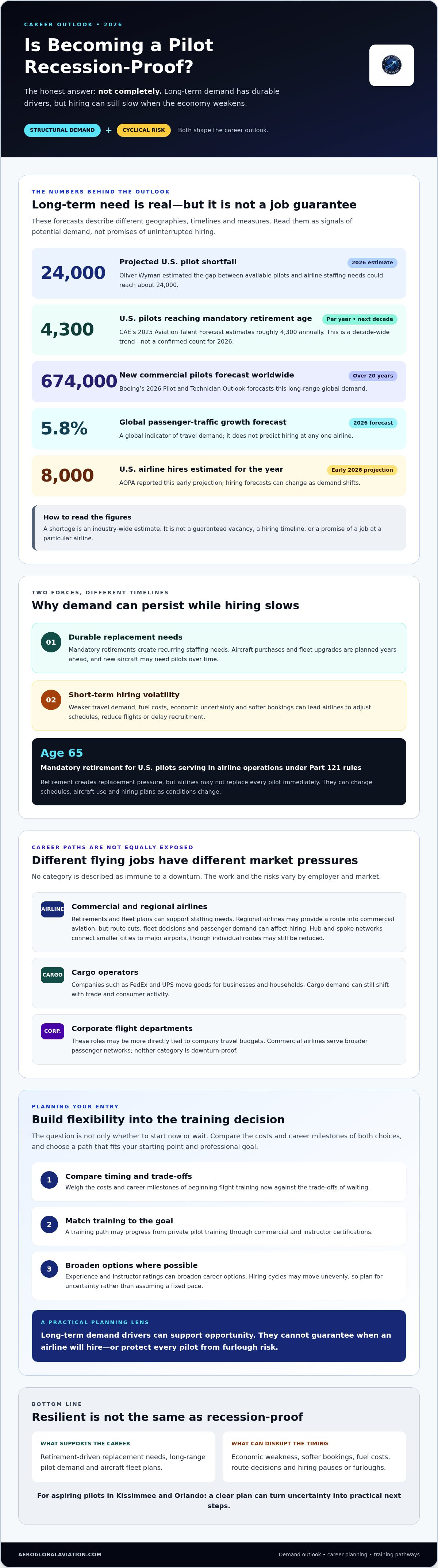
There are reasons for cautious optimism. Oliver Wyman projected a U.S. pilot shortfall of about 24,000 in 2026, while CAE’s 2025 Aviation Talent Forecast estimated that roughly 4,300 U.S. pilots will reach mandatory retirement age each year over the next decade. Those demographic pressures support long-term demand, but they can’t prevent airlines from adjusting hiring when the economy weakens.
This article separates durable demand from short-term risk, explains what shortage figures do and don’t mean for your career, and offers practical questions to ask before choosing flight training. It also looks at how experience and instructor ratings can broaden your options. For aspiring pilots in Kissimmee and Orlando, a clear plan can turn uncertainty into practical next steps.
Key Takeaways
- Retirement-driven demand can support pilot hiring even as economic conditions change, but furlough risk remains.
- Shortage figures suggest potential long-term opportunities, not a guaranteed airline job.
- Compare the costs and career milestones of starting flight training now with the trade-offs of waiting.
- Choose a training path that matches your starting point and professional goal, from private pilot training through commercial and instructor certifications.
- Instead of asking only “is becoming a pilot recession-proof 2026,” consider how to build flexibility into your training and career plan.
The State of Aviation in 2026: Demand vs. Economic Volatility
Airline hiring can slow when travel demand weakens, so a projected pilot shortage shouldn’t be mistaken for a promise of uninterrupted jobs. Several forces affect demand on different timelines. Retirements create recurring replacement needs, while fleet plans and passenger growth shape longer-term staffing. These pressures may support career opportunities, but airlines can still adjust hiring in response to fuel costs, economic uncertainty, or softer bookings.
Boeing’s 2026 Pilot and Technician Outlook forecasts demand for 674,000 new commercial pilots worldwide over the next 20 years. Separately, a 2026 passenger-traffic forecast projects global growth of 5.8%. These are long-range and global indicators, not guarantees about hiring at any one airline. Aircraft purchases and fleet upgrades are planned years ahead, so a short-term downturn may delay growth without removing the need to replace retiring pilots or staff newer aircraft over time.
Projected Pilot Shortage Data for the Late 2020s
Oliver Wyman estimated that the projected U.S. gap between available pilots and airline staffing needs could reach about 24,000 in 2026. CAE’s 2025 Aviation Talent Forecast adds a demographic signal: about 4,300 U.S. pilots are expected to reach mandatory retirement age annually over the next decade. AOPA reported that early 2026 projections estimated 8,000 U.S. airline hires for the year, but hiring forecasts can change with demand.
IATA’s 2026 airline-profit outlook provides context on the industry’s financial conditions, not a direct forecast of pilot demand. International travel can support domestic staffing through connecting traffic and airline network growth, but the effect varies by carrier and route. If you’re learning about the pilot profession, keep the distinction in mind: a shortage is an industry-wide estimate, not a hiring guarantee.
Essential vs. Luxury Travel: Where Pilot Jobs Sit
Air travel supports tourism, business, freight, and connections between communities. That makes aviation important, but it doesn’t make every flying job recession-proof. Regional airlines can offer a route into commercial aviation, yet they remain exposed to route cuts, fleet decisions, and changes in passenger demand. A hub-and-spoke network can keep connecting smaller cities to major airports, although individual routes may still be reduced.
Cargo operators such as FedEx and UPS provide another employment path because businesses and households continue to move goods. Cargo demand can still shift with trade and consumer activity. Corporate flight departments may be more directly tied to company travel budgets, while commercial airlines serve broader passenger networks. Neither category is immune to a downturn. If you’re asking, “is becoming a pilot recession-proof 2026,” plan for a cyclical industry with long-term demand drivers rather than assuming every employer will hire at the same pace.
Why Pilot Careers Defy Standard Recession Logic
Airlines can pause hiring during a downturn, but they can’t indefinitely defer every staffing need. One structural pressure is mandatory retirement: U.S. pilots serving in airline operations under Part 121 rules must retire at age 65. This creates predictable departures, though it doesn’t guarantee each retiring pilot will be replaced immediately. Airlines can change schedules, aircraft use, or hiring plans when passenger demand falls.
CAE’s retirement forecast describes an annual trend across the coming decade. It doesn’t provide a confirmed count of pilots retiring specifically in 2026. That distinction matters: the retirement wave supports long-term replacement demand, but it isn’t a precise annual hiring promise. For a broader career outlook, review the U.S. Bureau of Labor Statistics’ long-term projections alongside individual airline hiring updates.
Retirement Creates Replacement Needs, Not Guaranteed Vacancies
Retirements are part of workforce planning. Airlines need qualified pilots to operate their schedules, so they must recruit and train replacements over time. Economic conditions still influence when those pilots are hired. A carrier facing weaker bookings may reduce flights or delay recruitment even as retirements continue. Retirement is a more durable source of demand than growth alone, but it doesn’t shield pilots from every downturn.
That’s the practical answer to “is becoming a pilot recession-proof 2026?” The profession has structural supports, but timing and employer choices matter. Build a career plan that accounts for hiring cycles that may move unevenly.
Seniority and Furlough Protection
Once hired, an airline pilot’s seniority generally affects scheduling, bidding, promotion opportunities, and, where applicable, furlough order. The exact rules depend on the airline’s policies and labor agreement. “First in, last out” is a useful shorthand, not a universal guarantee. A new first officer is usually more exposed during staffing reductions than a more senior colleague, and a furlough can still happen.
Starting training earlier may help you reach hiring eligibility sooner, but it can’t guarantee a place on an airline seniority list or protect you from market shifts. Previous downturns have shown that aviation employment can contract when travel drops; the effects differ by carrier, role, and contract. Union agreements may provide processes for representation, furloughs, and recalls, but they don’t eliminate economic risk.
Focus on options you can build: progress through training milestones, understand the terms of potential employers’ agreements, and consider qualifications that may offer flexibility. In Kissimmee, Aero Global Aviation Academy’s Airline Pilot Elite training track covers training from private pilot through advanced instructor certifications, which may broaden your professional options as you work toward an airline career.
Comparing Career ROI: Flight School vs. Traditional Paths
Flight training and a four-year degree are different investments, so compare more than tuition. A university route typically takes about four years; a focused flight-training path may reach commercial pilot certification sooner, often within the 12-to-18-month range outlined for this comparison. Actual timelines depend on training pace, aircraft and instructor availability, weather, and individual progress. A Commercial Pilot License is an important milestone, not an automatic airline job offer. U.S. airline pilots generally need to meet the applicable experience requirements for an Airline Transport Pilot certificate.
Ask what each path costs in total, how long you may study before earning an income, and what borrowing would mean for your first working years. Compare flight-school fees and living expenses with university tuition, other costs, and the time needed to complete each program. Don’t assume a faster route guarantees a better return. The right choice depends on your finances, career goals, and ability to complete the required training.
Compare Time, Cost, and Career Milestones
Waiting for a “better” economy has an opportunity cost: it postpones training and the experience-building stages that follow. Starting now doesn’t remove the risk of an airline hiring slowdown, but it may let you progress through milestones while long-term demand continues to develop. Boeing’s long-range forecast provides one industry perspective on future pilot needs. Treat it as context, not a personal employment guarantee.
To assess the return, map your route from private pilot training through commercial certification, then identify the experience and qualifications needed for your target roles. Aero Global Aviation Academy in Kissimmee offers a commercial pilot training guide to help you understand that certification pathway.
Advanced Ratings Build Options, Not Guarantees
Instrument and multi-engine qualifications can prepare pilots for a wider range of flying roles, depending on employer requirements. They don’t guarantee work, but they may strengthen your qualifications as you pursue opportunities across commercial aviation. Learn how ratings fit into a professional pathway through this guide to advanced flight training.
Flight instructing can be one way to build experience, but a CFI certificate does not guarantee an instructor position. Availability depends on hiring needs and your qualifications. Aero Global Aviation Academy’s Airline Pilot Elite track includes instructor certifications, providing a potential avenue for experience-building while you work toward longer-term career goals. In Kissimmee and Orlando, year-round flying conditions can support consistent training, though weather and scheduling still affect individual progress.
So, is becoming a pilot recession-proof 2026? No training path can promise job security or a specific salary. A more useful measure of return is whether your plan balances time, total education costs, transferable qualifications, and realistic options at each career stage.
Strategic Training: Insulating Your Career from Market Shifts
You can’t control airline hiring cycles, but you can make practical choices about how you train and which qualifications you pursue. A focused plan can help you keep progressing through milestones; it doesn’t guarantee a faster finish or a job. Ask schools how they structure lessons, track progress, and help students plan around weather, aircraft availability, and instructor schedules.
Location is one part of that plan. Aero Global Aviation Academy is in Kissimmee, near Orlando, where Florida’s climate supports year-round flying. That can offer more opportunities to schedule training than a location where winter weather regularly limits flying. It doesn’t mean every lesson will go ahead or that you’ll finish a set number of months earlier. Before enrolling, compare realistic completion timelines and ask how missed flights are handled so you understand potential effects on your schedule and budget.
Build a Training Plan That Fits Your Career Goal
A consistent training routine can help students maintain momentum, but the right pace depends on your circumstances and the school’s program structure. In Kissimmee and Orlando, you can also learn about local aviation employers, attend industry events, and build professional relationships. Treat networking as a way to understand the market, not as a promise of job placement or access to airline hiring.
Use Instructor Ratings to Broaden Your Options
Airline Pilot Elite at Aero Global Aviation Academy includes advanced instructor certifications. Instructor qualifications may create another path to apply your skills and build flight experience if you meet an employer’s requirements and a suitable position is available. They’re not a guaranteed job or a complete safety net during a downturn. Still, teaching experience can give your career plan more flexibility than relying on a single hiring route.
For U.S. airline pilots, 1,500 flight hours is identified as the typical threshold for eligibility for an Airline Transport Pilot certificate. Instructing can be one way to build hours, but the time it takes depends on opportunities, scheduling, and your own progress. Ask how an advanced training track fits into your experience-building plan, and check the requirements for the roles you’re targeting.
If you’re wondering whether is becoming a pilot recession-proof 2026 has a practical answer, focus on what you can influence: steady progress, adaptable qualifications, and informed career planning. Review the Airline Pilot Elite training track to see how its path from private pilot training through instructor certifications may fit your goals.
Launching Your Career at Aero Global Aviation Academy
A stable aviation career starts with a training plan that matches your goal and gives you clear milestones. In Kissimmee, Aero Global Aviation Academy offers three training paths: Wings Foundation for private pilot training, the Career Pilot Program from private pilot to commercial pilot, and Airline Pilot Elite, which extends through advanced instructor certifications. Compare the Career Pilot Program with your intended career route and starting point.
Choose a Track That Fits Your Starting Point
Think of training as a sequence, not a shortcut to an airline cockpit. Private pilot training establishes the foundation; commercial certification develops qualifications for professional flying; instructor ratings can add another direction for building experience. Wings Foundation focuses on private pilot training, while the Career Pilot Program takes students from private pilot through commercial pilot certification. Airline Pilot Elite covers the path from private pilot training through advanced instructor certifications.
U.S. airline pilots generally need to meet the experience requirements for an Airline Transport Pilot certificate, with 1,500 flight hours identified as the standard threshold. Training in Kissimmee gives students access to Florida’s favorable flying climate, which can support regular practice, but it doesn’t guarantee a faster path to that hour requirement. Progress depends on training frequency, weather, available instruction, and opportunities to build experience.
Make an Informed Start in 2026
If you’re asking, “is becoming a pilot recession-proof 2026,” remember that industry demand can create opportunity without guaranteeing a particular job or hiring timeline. A clear plan can help you make decisions based on your finances, readiness, and preferred career route rather than headlines alone. Read about the airline pilot career path and compare it with the qualifications required for the roles you’re considering.
Before choosing a training track, ask what each program includes, which milestones it covers, and how you can monitor your progress. Those details can help you decide whether flight training is the right next step.
Ready to explore a professional training path in Kissimmee? Review Aero Global Aviation Academy’s programs and contact the academy with questions about the track that fits your goals. Base your next step on program details and realistic expectations, not a promise that any career is recession-proof.
Is Becoming a Pilot Recession-Proof in 2026? Plan for Flexibility
If you’re asking, “is becoming a pilot recession-proof 2026,” the honest answer is that no career is immune to economic shifts. Aviation has long-term demand drivers, but hiring can still vary by airline and market. Build a plan that prepares you for more than a single outcome: add qualifications step by step, consider how instructor ratings could broaden your options, and make training decisions with realistic expectations.
Your training environment matters, too. Aero Global Aviation Academy’s Kissimmee location offers year-round flying opportunities, while its Career Pilot Program takes students from private pilot training through commercial certification. For a broader professional pathway, Airline Pilot Elite includes advanced instructor certifications. These programs provide milestones to explore as you map your goals, but neither promises airline placement.
Ready to learn more about flight training in Kissimmee and Orlando? Explore Aero Global Aviation Academy’s training programs and ask which path fits your starting point and career goals.
Frequently Asked Questions
Is being a pilot actually recession-proof in 2026?
No, pilot jobs aren’t completely recession-proof. Retirements and long-term demand can support hiring, but airlines may still slow recruitment, reduce routes, or furlough staff when travel demand weakens. The question “is becoming a pilot recession-proof 2026” is best answered with cautious optimism: aviation has structural sources of demand, not immunity from economic cycles. Build qualifications and a flexible career plan, and evaluate employers individually rather than relying on shortage headlines alone.
What happens to student pilots if an airline goes bankrupt?
An airline bankruptcy doesn’t automatically end a student’s flight training, because students aren’t airline employees simply by pursuing pilot certification. The impact depends on whether the student has already been hired by that airline and on the circumstances of the bankruptcy. Keep copies of your training records and certificates, and continue working with your flight school on your training plan. If you’re employed by an affected carrier, seek guidance about your specific employment and contractual situation.
How many pilots are expected to retire in 2026?
The available forecast doesn’t specify a confirmed total for 2026 alone. CAE’s 2025 Aviation Talent Forecast estimates that approximately 4,300 U.S. pilots will reach mandatory retirement age each year over the next decade. U.S. Part 121 airline pilots are subject to a mandatory retirement age of 65. Treat the annual figure as a projection across the decade, not a precise count of pilots retiring in 2026.
Can I get a job as a pilot with just a Commercial Pilot License?
A Commercial Pilot License can qualify you for some paid flying roles, but it doesn’t by itself qualify you for every professional pilot job. Airline positions have additional experience and certification requirements. In the United States, 1,500 flight hours is identified as the typical threshold for eligibility for an Airline Transport Pilot certificate. Check the specific qualifications required by each employer, and plan how you’ll build experience after earning your CPL.
Is it better to go to a flight school or get an aviation degree in 2026?
It depends on your career goals, finances, and preferred learning path. Flight school focuses on earning pilot certificates and ratings; an aviation degree adds academic study, but it isn’t automatically a substitute for flight training or required certifications. Compare the full cost, expected timeline, training structure, and career requirements for the roles you’re targeting. In Kissimmee and Orlando, ask flight schools to explain each training milestone and what their programs include before deciding.
What is the average salary for a new commercial pilot in 2026?
There isn’t one dependable salary figure that applies to every new commercial pilot in 2026. Pay varies by job type, employer, location, experience, and schedule, and a CPL doesn’t automatically lead to an airline position. Compare current job postings for the roles you’re qualified to pursue, and distinguish starting pay from industry-wide wage medians. Build your financial plan around realistic employment options rather than assuming a particular salary immediately after certification.
How does the Kissimmee weather affect my training costs?
Kissimmee’s Florida climate supports year-round flying opportunities, which may make it easier to schedule practice than in places where seasonal weather often limits flying. More consistent opportunities can help maintain training momentum, but they don’t guarantee fewer delays or lower overall costs. Your progress also depends on instructor and aircraft availability, your schedule, and individual readiness. Ask the flight school how weather interruptions are handled and how they affect your expected training timeline.
What is the fastest way to build 1,500 flight hours?
Flight instructing is one possible way to build experience after earning the required instructor qualifications, but an instructor job or a particular timeline isn’t guaranteed. The right route depends on available roles, your qualifications, and how consistently you can fly. Ask prospective employers what experience they require, and track which flights count toward your certificate goals. Aero Global Aviation Academy’s Airline Pilot Elite track includes advanced instructor certifications for students planning a professional training pathway in Kissimmee.


