
The global pilot shortage isn't just a headline; it's your invitation to a career that spans continents. You've likely spent hours researching M-1 visa flight training Kissimmee, worrying if a single mistake on your DS-160 could ground your dreams before you even reach the cockpit. It's natural to feel overwhelmed by financial proof requirements and the high stakes of a visa interview. We understand that the transition to a foreign country involves more than just flying; it's about handling a complex legal landscape with absolute precision while preparing for a life in the sky.
This guide simplifies your path to the flight deck and helps you master the 2026 international student requirements. You'll discover why the consistent Florida sunshine makes Kissimmee the most efficient place to build your professional foundation while staying within your visa timelines. We'll provide a clear roadmap from your initial I-20 application to finding local housing, helping you choose between the Career Pilot Program or the Airline Pilot Elite track with total confidence. By the time you finish reading, you'll have a structured plan to turn your aviation aspirations into a tangible destination.
Key Takeaways
- Discover why Kissimmee’s 360 days of flyable weather and the KISM airport environment allow you to complete your ratings faster than in other regions.
- Master every step of the 2026 M-1 visa flight training Kissimmee process, from securing your I-20 to paying the current SEVIS and TSA fees.
- Compare structured training tracks like the Career Pilot Program and the Airline Pilot Elite to find the path that matches your professional aspirations.
- Learn how to confidently prove your financial ability and intent to return home, two critical factors for a successful M-1 visa interview.
- Prepare for your arrival with insights into local housing and logistics that make your transition to the Central Florida pilot community seamless.
Why Kissimmee is the Premier Destination for M-1 Flight Training in 2026
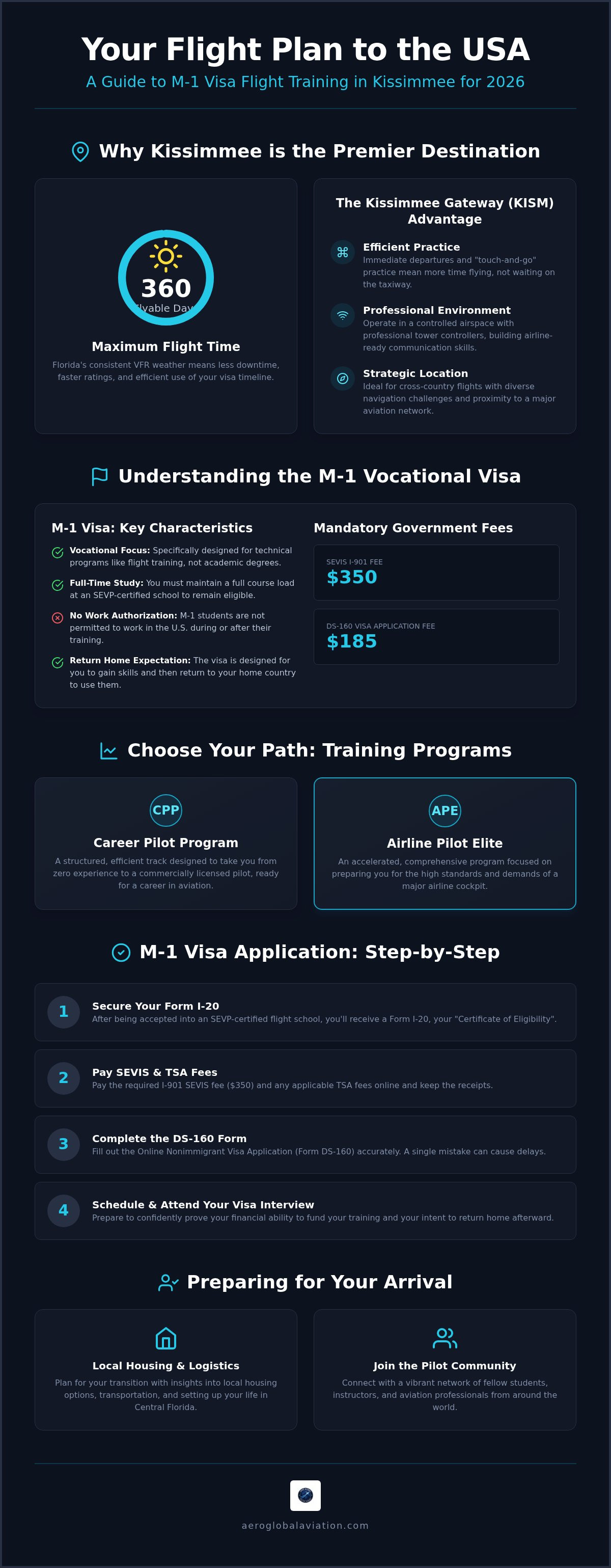
Central Florida offers a unique ecosystem for aviators that few other places on earth can match. Choosing the right location for your M-1 vocational visa training determines how quickly you'll move from student to professional. Kissimmee Gateway Airport (KISM) serves as the heart of this experience. It's perfectly positioned near Orlando, giving you access to international travel and a vibrant regional aviation network. The proximity to major international airports means your family can visit easily, but more importantly, it places you in a corridor of intense aviation activity. You'll find yourself surrounded by charter operations and regional carriers, creating a natural environment for professional networking while you're still in school. This exposure builds a professional mindset that's hard to replicate in isolated training centers.
The Kissimmee Gateway Airport (KISM) Advantage
KISM offers the ideal balance for M-1 visa flight training Kissimmee. Unlike major international hubs where you might wait on a taxiway for thirty minutes, Kissimmee allows for immediate departures and efficient "touch-and-go" practice. This efficiency means you spend your money on actual flight time rather than idling on the ground. You'll still operate in a controlled environment with professional tower controllers. This prepares you for the high-stakes radio communications required by major airlines, ensuring you're "airline ready" from day one. KISM also serves as a strategic launchpad for your cross-country flight requirements. Whether you're heading south toward the Florida Keys or north toward the panhandle, the peninsula's geography provides diverse navigation challenges without the extreme terrain risks found elsewhere. You'll discover that training in Kissimmee feels like joining a community where every takeoff is a deliberate step toward your career goal.
Maximizing Your Training Days in 2026
Weather is the biggest variable in flight training. Central Florida boasts over 360 days of Visual Flight Rules (VFR) conditions annually. In northern climates, winter snow or persistent low clouds can cause "training plateaus" where skills get rusty during long breaks. You don't want to spend your visa time waiting for clouds to clear. In Kissimmee, you'll fly consistently. This momentum helps you finish your ratings faster, which is a massive financial benefit. By choosing M-1 visa flight training Kissimmee, you are positioning yourself at the center of the world's most active training environment. With the global pilot shortage intensifying in 2026, every week you save during your training brings you one week closer to a professional paycheck. Starting your journey here ensures your progress remains as steady as the Florida sun, allowing you to focus entirely on mastering your craft.
Understanding the M-1 Vocational Visa for International Pilots
The M-1 visa is the primary tool for international students who want to complete vocational training in the United States. Unlike the F-1 visa, which is designed for long-term academic degrees at universities, the M-1 is specifically tailored for technical programs like flight school. When you enroll in M-1 visa flight training Kissimmee, you're entering a structured environment focused on skill acquisition rather than general education. To remain eligible, you must maintain a full-time course of study at an SEVP-certified institution. Your visa duration is usually tied to the expected length of your training program, with a short grace period afterward to wrap up your affairs. You should budget for the mandatory government fees, which include a $350 SEVIS I-901 fee and a $185 DS-160 visa application fee.
Understanding the limitations of this visa is just as important as knowing its benefits. The M-1 does not permit you to work while you're in the United States. While F-1 students sometimes have opportunities for post-graduation work as instructors, M-1 holders are expected to return to their home countries immediately after their training concludes. This makes the M-1 the ideal choice if your goal is to secure your ratings and quickly transition to a commercial cockpit in your home region. If you're ready to start this journey, you can explore our Career Pilot Program to see how our structured timeline fits your visa requirements.
M-1 vs. F-1: Which Visa Fits Your Goals?
Choosing between these two paths depends on your final destination. The M-1 visa is the standard for the Career Pilot Program because it prioritizes speed and technical proficiency. It's the preferred route for students who already have a job waiting for them or want to minimize their time away from home. The F-1 visa is better suited for those who want a four-year degree alongside their flight ratings. For most professional pilot candidates in 2026, the M-1 provides the most direct and cost-effective route to the flight deck.
TSA and AFSP Requirements for 2026
Security is a top priority in American aviation. All international students must undergo a background check through the TSA Flight Training Security Program before they can begin training. This process involves a security threat assessment, mandatory fingerprinting, and a fee of $130 per training request. For 2026 students, the TSA clearance is a mandatory prerequisite that must be approved for each major milestone, including your Private Pilot and Instrument ratings. Plan for a processing time of approximately two to four weeks for your initial application to ensure your training starts on schedule.
Choosing Your Path: Career Pilot vs. Airline Pilot Elite Programs
Securing your visa is the first step, but choosing the right training track is what ultimately defines your professional trajectory. At Aero Global Aviation Academy, we act as your practical mentor to ensure your training hours translate directly into career milestones. Every international student starts with a clear objective, and our programs are designed to meet those specific goals without wasting time or resources. Whether you're looking for a focused start or a comprehensive instructor rating, your journey begins with the Wings Foundation. This initial phase provides the Private Pilot License (PPL) fundamentals, giving you the confidence to handle an aircraft before you move into more complex commercial operations.
The Career Pilot Program: Your Direct Route to the Flight Deck
For most students pursuing M-1 visa flight training Kissimmee, the goal is to reach a commercial cockpit as efficiently as possible. The career pilot program is our flagship track, taking you from a beginner to a fully certified Commercial Pilot (CPL). This program isn't just about logging hours; it's about mastering the professional standards that airlines demand. We integrate Instrument Rating (IR) and Multi-Engine (ME) training into a seamless curriculum. This approach ensures that you're comfortable navigating by instruments and managing complex aircraft systems long before your final checkride. By training to these high standards from day one, you'll be ready to meet the rigorous entry requirements of airlines in your home country. It's a fast-track solution that respects your visa timelines while maximizing your skill development.
Airline Pilot Elite: Building the Ultimate Resume
If you want to stand out in a competitive global market, the Airline Pilot Elite track offers the most comprehensive preparation available. This program extends your training beyond the commercial level to include advanced instructor certifications like CFI and CFII. While the M-1 visa doesn't allow for US employment, these instructor ratings are incredibly valuable for your international license conversion. They demonstrate a deep, technical mastery of aviation that simple commercial ratings cannot match.
The Elite track also prioritizes modern technology. You'll spend significant time in glass cockpit environments, mastering the G1000 system used by modern regional and major carriers. This technical proficiency makes the eventual transition to heavy jets much smoother. When you return home with an Elite certification, you aren't just a pilot; you're a highly qualified candidate with the leadership skills and technical knowledge to fast-track your way into a first officer seat.
Choosing the right M-1 visa flight training Kissimmee path depends on where you see yourself in five years. We're here to help you map out that destination and provide the structured environment you need to reach it. Your career isn't just a dream; it's a tangible destination that starts with the right training choice today.
Step-by-Step Guide to the M-1 Visa Application Process
Securing your legal status to train in the United States is a structured process that rewards early preparation and attention to detail. It starts with choosing your specific training track and securing your enrollment at Aero Global. Once you're accepted, we begin the SEVIS registration to generate your Form I-20. This document is the foundation of your M-1 visa flight training Kissimmee journey because it proves to the US government that you're a legitimate student at a certified institution. You'll need this form to pay your $350 SEVIS I-901 fee and to schedule your mandatory interview at the nearest US Embassy or Consulate.
The I-20 Form: Your Golden Ticket
To issue your I-20 in 2026, you'll need to provide several key documents, including a valid passport, your educational history, and detailed financial statements. These statements must clearly show that you have sufficient funds to cover your tuition and living expenses for the duration of your program. We act as your practical mentor during this phase, reviewing your paperwork to ensure it meets strict SEVP standards. You should expect the I-20 issuance to take approximately two to three weeks once all your documents are verified. Having this "golden ticket" in hand allows you to move forward with the $185 DS-160 visa application fee and lock in your interview date.
Acing the US Embassy Interview
The interview is often the most stressful part of the journey, but clear communication makes all the difference. Consular officers primarily look for financial capability and "non-immigrant intent." You must demonstrate that you have a clear plan to return home after completing your ratings. Be prepared to explain why you chose M-1 visa flight training Kissimmee and how the specific FAA certifications you'll earn will help you secure a job with airlines in your home country. Bring evidence of ties to your home region, such as family connections or property, to show you don't intend to stay in the US permanently. If you are ready to secure your I-20 and start the enrollment process, apply today to begin your journey.
After your visa is approved, the final administrative step is the TSA Alien Flight Student Program (AFSP) application. This requires a $130 fee for each training request and a background check that includes fingerprinting. While the visa allows you to enter the country, the TSA clearance is what permits you to actually start your flight lessons. Many students choose to complete their fingerprinting locally in Florida to speed up the process. Once these pieces are in place, you're clear for takeoff and ready to arrive at Kissimmee Gateway Airport to begin your professional pilot career.
Arriving in Kissimmee: Housing, Logistics, and Student Life
Landing at Orlando International Airport (MCO) marks the official start of your professional career. It's the moment your M-1 visa flight training Kissimmee transition moves from paperwork to practice. Central Florida is a welcoming region with a deep history of aviation, and you'll find the local community is well-equipped to support international students. While the initial move feels like a major shift, the lifestyle here is designed for efficiency and comfort. You'll have access to world-class amenities and a professional network that stretches across the entire Florida peninsula. We prioritize your comfort because a focused student is a successful student.
Settling into Your New Home
Finding the right base is crucial for your academic focus. If you're enrolled in our intensive Career Pilot Program, you'll want to look for long-term housing within a short commute of Kissimmee Gateway Airport. The area offers a variety of furnished apartments and shared living spaces tailored to student budgets. You'll find plenty of grocery stores, fitness centers, and international community support right in the heart of Kissimmee. For those just starting out, you can review our guide on obtaining your PPL in Florida to understand the early-stage logistics of setting up your new life. Navigating the Orlando area is straightforward, but it's important to plan your transportation early. Many students rely on rideshare services initially, while others choose to purchase a reliable used vehicle for maximum flexibility during their training months.
The Aero Global Community
We pride ourselves on being more than just a school; we're your practical mentor. Our instructors have years of experience working with students from diverse backgrounds and understand the unique challenges of training in a foreign country. You'll be part of a global cohort of aspiring pilots, creating a networking environment that lasts long after you return home. This collaborative spirit ensures that you never feel like just another number in a large corporation. We provide the personalized attention you need to master your ratings and transition into a professional role with confidence. Success in aviation is built on reliability and community, and you'll find both here in Central Florida. If you're ready to take the final step toward your professional wings, Apply for your M-1 training in Kissimmee today and join a community dedicated to your individual success.
Take Command of Your Aviation Career in 2026
Navigating the transition to a professional pilot career involves more than just mastering the controls; it's about executing a precise plan from your first visa application to your final commercial checkride. You've seen how the consistent Florida weather and the professional environment at Kissimmee Gateway Airport provide the perfect foundation for your training. By choosing a SEVP-certified training facility like Aero Global, you ensure that every hour logged moves you closer to your professional goals. Whether you select our mentorship-driven Career Pilot Program or the advanced Airline Pilot Elite track, you're investing in a future defined by quality and reliability.
Mastering the M-1 visa flight training Kissimmee process is the final hurdle between you and the cockpit. With a clear roadmap for your I-20 and a solid understanding of the 2026 requirements, you're ready to make your dream a tangible reality. Don't let administrative complexity hold you back from the lifestyle you've always wanted. Your journey to the flight deck starts with a single, decisive step.
Start Your International Pilot Journey: Apply for the M-1 Program
We're here to guide you through every milestone. The sky isn't just a limit; it's your new office. We can't wait to see you on the flight line in Kissimmee.
Frequently Asked Questions
Can I work in the US while on an M-1 flight training visa?
No, you cannot work in the United States while holding an M-1 visa. This vocational visa is strictly for full-time study at a certified institution like Aero Global. Unlike academic visas that may offer work authorization, the M-1 requires you to focus entirely on your ratings. You're expected to return home to begin your professional career after completing your chosen track at our Kissimmee Gateway Airport facility.
How much money do I need to show for my M-1 visa interview?
You must demonstrate that you have the immediate financial means to cover the entire cost of your training and all living expenses for your stay. Consular officers look for liquid assets that prove you won't need to work illegally. This typically includes bank statements or sponsorship letters that match the estimated costs listed on your Form I-20 for M-1 visa flight training Kissimmee.
How long does the M-1 visa application process take in 2026?
The entire timeline usually spans two to three months. It starts with the two to three weeks required for Aero Global to issue your Form I-20. After that, your local embassy interview wait times vary by country. You should also account for the TSA background check, which currently takes approximately two to four weeks to process once you've submitted your fingerprints and the mandatory fee.
What happens if I need more time to complete my flight training?
If you need more time to finish your ratings, you must apply for an extension of stay through the school's Designated School Official (DSO). This requires filing Form I-539 before your current authorization expires. We act as your practical mentor to ensure your paperwork is submitted correctly, allowing you to stay within legal status while you finalize your Commercial Pilot certification or instructor ratings.
Do I need to take an English proficiency test like TOEFL or IELTS?
The FAA requires all pilots to read, write, and speak English fluently to ensure safety in the cockpit. While Aero Global doesn't always mandate a specific TOEFL score, we must verify your proficiency before issuing an I-20. This assessment ensures you can understand complex technical instructions and communicate clearly with air traffic control during your M-1 visa flight training Kissimmee sessions.
Can I transfer from another flight school to Aero Global on an M-1 visa?
Yes, you can transfer, but you must do so within the first six months of your arrival in the United States. The process involves coordinating with the DSO at your current school to release your SEVIS record to Aero Global. Transfers after the six-month mark are rarely approved by the government, so it's vital to choose the right training environment early in your journey.
Is housing provided for international students at Aero Global?
We don't own on-campus dormitories, but we provide extensive support to help you find local housing near the airport. Kissimmee offers a wide range of furnished apartments and shared living options designed for student budgets. We guide you toward reliable neighborhoods and community resources, ensuring you have a comfortable and safe base while you progress through the Career Pilot Program or Airline Pilot Elite track.
What is the difference between TSA and SEVIS fees?
The $350 SEVIS I-901 fee is a mandatory payment to the Department of Homeland Security to maintain your record in the student tracking system. The $130 TSA fee is specifically for the Flight Training Security Program background check. While the SEVIS fee is required for your visa, the TSA fee must be paid for each major training request, such as your initial Private Pilot License.


