What if you could turn Florida's famous 300 days of sunshine into a strategic tool that accelerates your flight training by months? Earning your private pilot license florida is more than just a personal milestone. It's a calculated first step into an industry projected to need 300,000 new professional pilots over the next ten years. In the optimal flying climate of Central Florida, your path to the cockpit is paved with clear skies and high-quality instruction.
It's completely normal to feel a bit of turbulence when you first look at the requirements. You might be weighing the flexibility of Part 61 against the structure of Part 141, or perhaps you're feeling some anxiety about the FAA medical exam and the total time commitment involved. We understand those hurdles because we've helped countless students clear them. This 2026 guide provides a clear, step-by-step roadmap to help you master the journey from your initial discovery flight to earning your FAA private pilot certificate. You'll learn how to manage your training hours efficiently and choose the right mentorship to turn your aviation dreams into a tangible reality.
Key Takeaways
- Leverage the "350 days of sunshine" advantage in Central Florida to maintain training momentum and avoid costly weather-related delays.
- Confirm your eligibility by reviewing FAA standards for age and language proficiency before you begin your official flight hours.
- Navigate the specific milestones required to secure your private pilot license florida, including the process for obtaining your student pilot certificate and medical clearance.
- Evaluate whether a flexible Part 61 or a structured Part 141 training environment best fits your schedule and long-term aviation aspirations.
- Identify how foundational training through the Wings Foundation can seamlessly transition into professional tracks like the Career Pilot Program.
Why Florida is the Global Destination for Private Pilot Training
Florida is widely recognized as the global capital for flight training, and for good reason. When you pursue a private pilot license florida, you're positioning yourself in an environment designed for student success. The state consistently leads the nation in total flight hours logged, a trend that remains solid in 2026. This isn't just about regional pride; it's about the strategic advantage of being surrounded by world-class infrastructure and a community that lives and breathes aviation. From the moment you arrive, you'll feel the energy of a hub where professional goals are treated as tangible destinations.
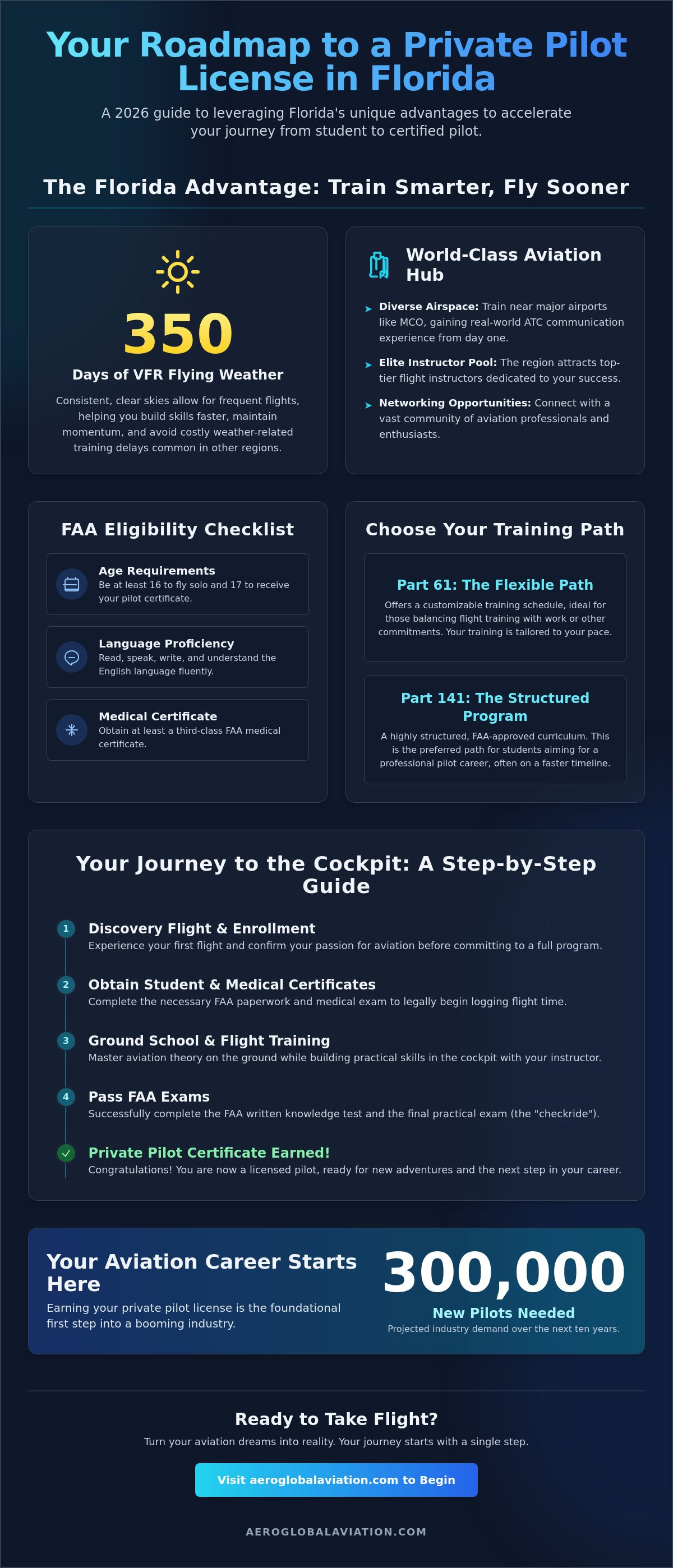
The legendary 350 days of sunshine is your greatest asset. In other regions, student pilots often face weeks of grounded planes due to snow, ice, or persistent low ceilings. These gaps cause training plateaus where you spend your next flight relearning what you forgot during the forced break. In Central Florida, the consistency allows you to fly several times a week. This steady rhythm ensures your skills stay sharp and your momentum stays high, making the path to certification feel both logical and rewarding.
The Impact of Weather on Your Training Timeline
Flying frequently is the secret to building muscle memory. When you're in the cockpit every other day, procedures like landings and radio communications become second nature much faster than seasonal training allows. Florida's weather also offers a unique educational mix. While the skies are generally clear, you'll learn to navigate around localized convective activity and coastal breezes. This provides real-world experience that prepares you for the FAA Requirements: Are You Eligible for a Private Pilot Certificate? standards. This balance makes you a more competent, confident pilot from your very first solo flight.
Proximity to Aviation Hubs in Kissimmee and Orlando
Training at the Kissimmee Gateway Airport (KISM) places you at the heart of a high-density aviation hub. You aren't just flying in a vacuum; you're operating near major international terminals like Orlando International (MCO). This proximity gives you early exposure to sophisticated Air Traffic Control (ATC) environments, which is a massive advantage for your future career. Central Florida provides a wealth of resources for the aspiring aviator:
- Diverse Airspace: You'll have access to a variety of airport types for complex cross-country requirements, all within a short flight.
- Elite Instructor Pool: The region attracts the industry's best talent, ensuring you receive high-quality, personalized attention.
- Networking Opportunities: You'll connect with the vast Florida pilot community early on, opening doors to professional possibilities.
Choosing this location means your training happens in the same skies where the professionals operate. Whether you're starting with our Wings Foundation course or aiming for the full Career Pilot Program, the infrastructure here supports your growth at every stage. Aero Global Aviation Academy is here to be your dedicated local partner, using our geographic advantages to help you reach the cockpit faster.
FAA Requirements: Are You Eligible for a Private Pilot Certificate?
Before you climb into the cockpit for your first lesson, you need to understand the legal guardrails that keep the skies safe. The FAA sets clear standards for every aspiring aviator. To earn your private pilot license florida, you must meet specific age and language benchmarks that align with international aviation standards. You can start your training at any age, but you must be at least 16 years old to fly solo and 17 years old to receive your certificate. Additionally, you must be proficient in English, meaning you can read, speak, write, and understand the language to ICAO standards.
Success in flight training requires a dual-track approach to learning. You'll balance ground school, where you master the theory of flight and navigation, with actual flight time under the guidance of an instructor. Moving through this Step-by-Step: The Journey to Your Private Pilot License ensures that your practical skills are always backed by a deep understanding of the "why" behind every maneuver. If you're looking for a structured start, our Wings Foundation course is designed to guide you through these initial requirements with personalized attention.
Understanding FAA Medical Classes
One of the most critical steps is obtaining your FAA Medical Certificate. We strongly advise completing this before you spend significant time or money on flight lessons. You'll need to visit an Aviation Medical Examiner (AME) in the Orlando area for a physical exam. There are three primary classes:
- Third Class: The minimum requirement for private pilots, valid for 60 months if you're under 40.
- Second Class: Required for those who plan to fly for compensation or hire.
- First Class: The highest standard, necessary for anyone pursuing a professional airline career.
If your goal is a professional career, aiming for a First Class medical from the start is a smart move. It confirms no medical hurdles stand between you and the captain's seat.
Knowledge and Skill Fundamentals
Your certification process culminates in two major milestones. First, you'll tackle the FAA Private Pilot Knowledge Test. This 60-question written exam covers everything from weather patterns to federal regulations. Once you've mastered the theory and logged the required flight hours, you'll face the Practical Test, commonly known as the "checkride." A Designated Pilot Examiner (DPE) will evaluate both your verbal knowledge and your ability to handle the aircraft safely. Remember that the PPL is the essential foundation for every advanced rating you'll earn in the future.
Step-by-Step: The Journey to Your Private Pilot License
Embarking on the path to your private pilot license florida is a structured process that transforms an aspiring aviator into a confident pilot. While the technical requirements might seem daunting at first glance, following a logical sequence ensures you build a solid foundation without unnecessary delays. By starting in the high-activity environment of Central Florida, you're choosing a training ground that prepares you for almost any operational scenario you'll encounter in your flying career.
Your journey typically follows these five essential milestones:
- Step 1: Book a Discovery Flight. This is your chance to take the controls and confirm that the cockpit is where you belong.
- Step 2: Secure Your Documentation. Apply for your Student Pilot Certificate through IACRA and schedule your FAA medical exam to clear the path for solo flight.
- Step 3: Enroll in Ground School. Start the academic portion early to ensure your theoretical knowledge keeps pace with your practical skills.
- Step 4: Master Flight Maneuvers. Work through your syllabus until you reach the pivotal moment of your first solo flight.
- Step 5: Complete Cross-Country Training. Navigate to distant airports to meet FAA requirements and refine your skills for the final checkride.
As you evaluate your options, Choosing the Right Path: Part 61 vs. Part 141 Training will be one of your first major decisions. This choice dictates the rhythm of your education and how your curriculum is structured to meet FAA standards.
The Discovery Flight Experience
A discovery flight is more than just a scenic tour; it's your first official lesson. During this 30 to 60 minute session, a certified instructor will guide you through basic maneuvers, allowing you to feel the aircraft's responsiveness. This time counts as your very first entry in your official pilot logbook. It's also the perfect opportunity to interview the school, meet the instructors, and get a feel for the training culture. Don't be afraid to ask questions about aircraft maintenance and instructor availability while you're on the ground.
Ground School and Solo Milestones
Our Wings Foundation program simplifies complex topics like aerodynamics and weather patterns, turning difficult concepts into practical tools you'll use every day. As you progress, you'll reach the first solo, an emotional and technical peak where you fly the aircraft alone for the first time. In 2026, we also utilize advanced digital simulators to augment your real-world hours. These tools allow you to practice emergency procedures and navigation in a controlled environment, making your time in the actual cockpit of a private pilot license florida course much more efficient and rewarding.
Choosing the Right Path: Part 61 vs. Part 141 Training
Deciding between Part 61 and Part 141 training is one of the most significant choices you'll make on your way to a private pilot license florida. Both paths lead to the exact same FAA certificate; however, the structure and rhythm of your training will differ greatly depending on which regulation your school follows. Think of it as choosing between a self-paced university course and a rigorous, scheduled academy. Your choice should align with your ultimate aviation destination, whether that is flying for weekend fun or a career in the airlines.
Part 61 training is often the preferred choice for hobbyists and busy professionals who need a flexible schedule. It allows you to progress at your own pace, working closely with an instructor to tailor the curriculum to your specific availability. Conversely, Part 141 schools follow an FAA-approved, highly structured syllabus. This path is often ideal for those looking to transition into a career pilot program, as it emphasizes consistency and professional standards from day one.
The FAA sets the minimum flight hour requirements differently for each. Under Part 61, you must log at least 40 hours of flight time. Part 141 programs allow for a minimum of 35 hours due to their structured nature. In reality, most students across the United States require closer to 60 or 70 hours to reach proficiency, but the structured environment of a 141 school can often help you reach that checkride readiness more efficiently by preventing training plateaus.
Which Regulation Fits Your Lifestyle?
If your work schedule is irregular or you have family commitments, the flexibility of Part 61 ensures you don't fall behind a rigid class schedule. For those with their sights set on the flight deck of a major airline, the discipline of a structured academy provides the professional foundation needed for advanced ratings. Both options are available in the Central Florida region, allowing you to choose the environment that best supports your individual success and learning style.
Evaluating Flight School Quality in 2026
When you scout for a training partner, look beyond the initial cost. Check for a well-maintained fleet and the availability of modern glass cockpit technology, such as the Garmin G1000 system, which is becoming the industry standard. High instructor-to-student ratios are equally vital; you don't want your progress stalled because an instructor is overbooked. You can find a detailed breakdown of what to look for in our guide to the best flight schools in florida.
Ready to take the next step toward your private pilot license florida? Visit Aero Global Aviation Academy to see how our personalized training approach and modern fleet can help you reach your goals efficiently.
Your Aviation Career Starts with the Wings Foundation
At Aero Global Aviation Academy, we believe your private pilot license florida isn't just a certificate; it's the bedrock of your entire professional future. We've designed the Wings Foundation to move you beyond basic proficiency into a state of true aeronautical mastery. Our approach treats every student as a future captain from the very first hour. You aren't just learning to fly for fun. You're learning to command an aircraft with the precision and discipline required by the world's leading airlines. This professional mindset is what sets our graduates apart in a competitive industry.
Mentorship is the hallmark of the Aero Global Aviation Academy difference. We don't just assign you an instructor; we provide a dedicated guide who is invested in your long-term success. This collaborative spirit ensures that your training is efficient, logical, and rewarding. By choosing to train in the high-density environment of Central Florida, you gain a strategic advantage that prepares you for the complexities of a lifelong career in the skies.
The Wings Foundation Advantage
Success in the cockpit depends on a rock-solid start. We focus on foundational excellence to ensure you have the skills and confidence necessary for advanced flight training later in your journey. Our personalized training plans are built around your individual goals, ensuring that no two paths are exactly the same. We take pride in the fact that Wings Foundation graduates consistently achieve high checkride pass rates because they've been trained to exceed FAA standards rather than simply meeting them. This rigorous preparation makes the transition to more complex aircraft feel like a natural next step.
From Student Pilot to Career Aviator
Once you hold your private pilot certificate, the entire aviation industry opens up to you. This license is the mandatory prerequisite for earning your Instrument and Multi-Engine ratings, which are the next milestones on your path. If your ultimate goal is the flight deck, you can seamlessly transition from the Wings Foundation into our commercial pilot training track. Starting your journey in a professional environment provides a long-term return on investment that recreational flight schools simply cannot match. You'll build your hours in a modern fleet while surrounded by peers who share your professional ambitions.
The first step toward your private pilot license florida is simpler than you might think. We invite you to visit our premier facility at the Kissimmee Gateway Airport to meet our team and see our fleet firsthand. Walking through our hangar and speaking with our instructors will give you a clear sense of the quality and reliability we offer. We're ready to be your dedicated local partner as you transform your passion for flight into a tangible career destination. Book your discovery flight at Aero Global Aviation Academy today!
Take Command of Your Future in the Florida Skies
Your journey toward a private pilot license florida is more than just a series of flight hours; it's the foundation of a lifestyle defined by freedom and professional achievement. By leveraging the ideal training climate of Central Florida and following a structured roadmap, you turn a complex regulatory process into an attainable reality. You now understand how to navigate FAA requirements and choose the training path that best aligns with your long-term aviation goals.
At Aero Global Aviation Academy, we're ready to serve as your practical mentor. Our facility at the Kissimmee Gateway Airport (KISM) is specifically designed for students who demand career-oriented training from day one. You'll build your skills in an advanced G1000 equipped training fleet, ensuring you're proficient with the technology used by modern airlines. Don't let your aspirations stay on the ground. Start your journey with the Wings Foundation PPL Course today and join a community dedicated to your individual success. We look forward to seeing you on the flight deck.
Frequently Asked Questions
How long does it take to get a private pilot license in Florida?
Florida's favorable weather allows most students to earn their certificate within 3 to 6 months when flying 2 to 3 times per week. Your specific timeline depends on your consistency and how quickly you master the required maneuvers. Training in Central Florida helps you avoid the long seasonal delays found elsewhere, ensuring you maintain the momentum needed to progress through the syllabus efficiently.
What is the total cost of a private pilot license in Orlando for 2026?
The total investment for a private pilot license florida depends on your individual learning pace and the total flight hours you log. You'll need to budget for aircraft rental, flight instructor time, and ground school resources. There are also external costs to consider, such as the FAA medical exam and the $175 knowledge test fee. We suggest training at a professional facility to ensure your resources are used effectively toward your long-term goals.
Can I start my PPL training if I am under 17 years old?
You can begin flight training at any age, but the FAA has specific age requirements for solo flight and certification. You must be at least 16 years old to fly the aircraft solo and at least 17 years old to earn your private pilot certificate. Many students begin their ground school and flight lessons early so they're ready to test as soon as they reach the required age.
Do I need perfect 20/20 vision to become a private pilot?
You don't need perfect 20/20 uncorrected vision to become a pilot as long as your vision is correctable with glasses or contacts. The FAA requires private pilots to have vision correctable to 20/40 or better for the third-class medical certificate. If you wear corrective lenses, you'll simply have a limitation on your medical certificate stating you must wear them while exercising your pilot privileges.
What is the difference between a recreational pilot and a private pilot?
A private pilot license offers much broader privileges than a recreational certificate, including the ability to fly at night and carry multiple passengers. Recreational pilots face strict limitations on the size of the aircraft and how far they can fly from their home airport. For those looking to build a professional career, the PPL is the essential first step toward advanced ratings and commercial opportunities.
How many flight hours are actually required on average to pass the checkride?
Most students log between 60 and 70 flight hours before they're proficient enough to pass their FAA checkride. While the legal minimum for a private pilot license florida is 40 hours under Part 61, the national average is higher to ensure every pilot meets strict safety standards. Consistent training in Florida's optimal flying climate helps you reach this proficiency level without the setbacks caused by poor weather.
Is ground school mandatory for the private pilot license?
Ground school is mandatory because you must pass the FAA Private Pilot Knowledge Test and receive an instructor's endorsement before taking your checkride. You'll study essential topics like aviation weather, federal regulations, and cross-country navigation. Whether you choose an online course or a structured program like our Wings Foundation, this theoretical knowledge is vital for your safety and success in the cockpit.
Can I fly at night with a private pilot license?
Private pilots are fully authorized to fly at night once they've completed the specific night training requirements. Your PPL training includes at least three hours of night flight and ten night takeoffs and landings to ensure you're comfortable operating in the dark. This capability is a significant advantage of the private pilot certificate, allowing you to plan trips without being restricted by daylight hours.


