
What if you could tap into your 529 college savings to pay for your pilot certificates without ever stepping foot on a university campus? It sounds too good to be true, but under the latest federal guidelines, this is now a reality for aspiring aviators. We know that the prospect of significant debt and rising interest rates can make your dream of flight feel like it's stuck on the tarmac. You're not alone in feeling overwhelmed by the search for creative ways to fund pilot training Orlando while trying to avoid the trap of high interest personal loans.
This guide is your 2026 roadmap to making flight school affordable and attainable. You'll discover how to leverage local Florida scholarships, navigate specialized aviation lenders like Stratus Financial, and use Orlando's 300 plus flyable days to your financial advantage. We'll show you how to turn your passion into a paycheck through structured paths like the Airline Pilot Elite program. By the end of this article, you'll have the knowledge to start your training this year with the confidence that your financial flight plan is secure.
Key Takeaways
- Learn how Orlando’s 300 plus flyable days act as a "weather dividend," helping you finish your ratings faster and cut down on total training expenses.
- Discover which national and Florida-specific scholarships are actually winnable, including local grants that target Central Florida flight students.
- Find creative ways to fund pilot training Orlando by leveraging new federal rules that let you use 529 college savings plans for flight school.
- Compare specialized aviation lenders to traditional banks to find loan terms that reward your academic or military background.
- See how a structured Career Pilot Program reduces unnecessary flight hours, ensuring every dollar you spend moves you closer to a professional salary.
The Real Cost of Flight Training in Orlando and Your ROI
Understanding the total investment required for a career pilot program is the first step toward the flight deck. While the journey from zero experience to a commercial pilot certificate requires a significant financial commitment, it's helpful to view this as a high-yield investment in your future. Unlike a traditional four-year degree that often leaves graduates with debt and no clear entry-level path, accelerated flight training is laser-focused on professional placement. When you look for creative ways to fund pilot training Orlando, you aren't just looking for money; you're looking for the most efficient way to reach a six-figure airline salary.
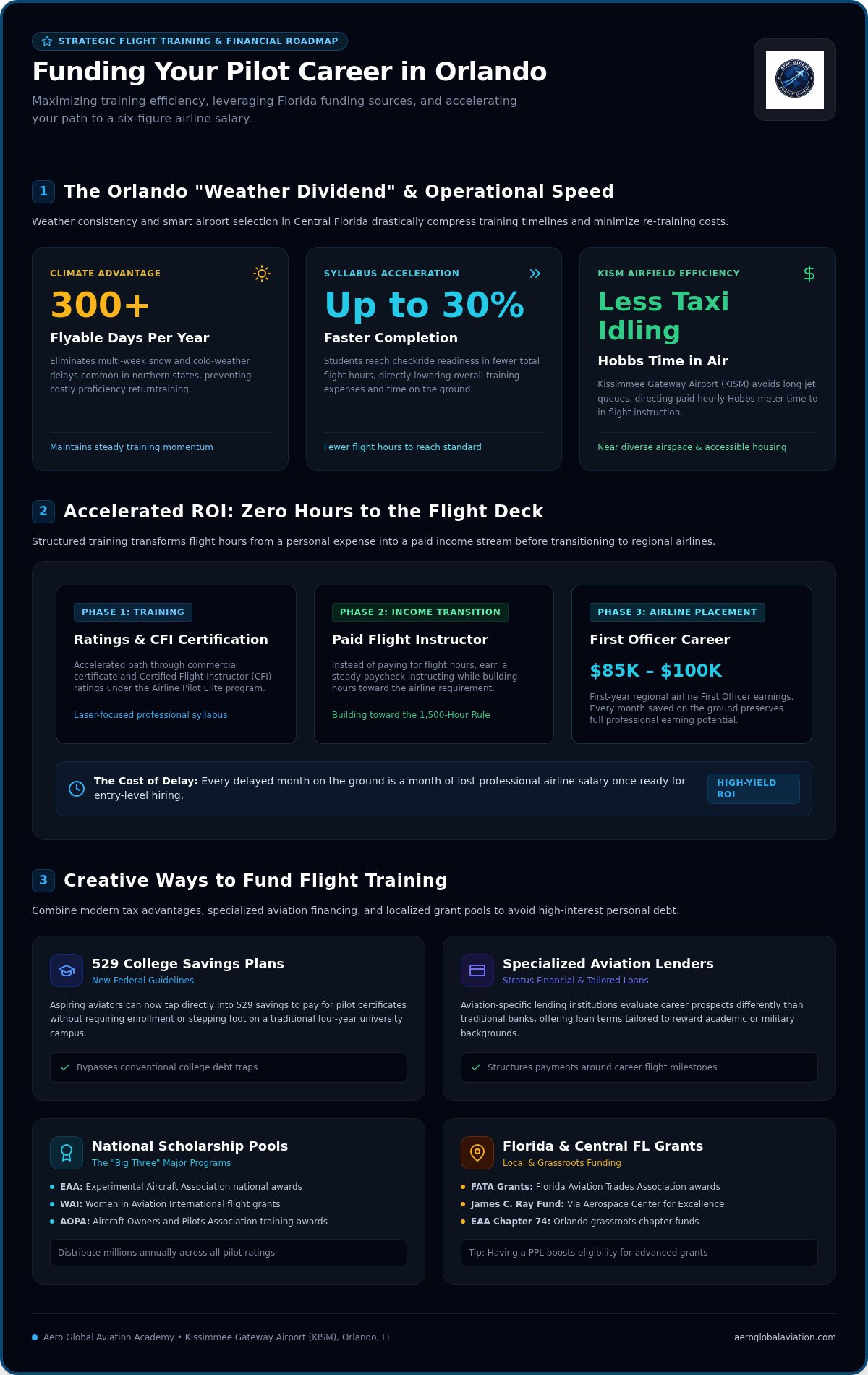
Orlando offers a unique "weather dividend" that directly impacts your wallet. With over 300 flyable days per year, students here avoid the costly "re-training" cycles common in northern states. In colder climates, a two-week snow delay often means paying for extra hours just to regain proficiency. In Central Florida, you maintain momentum, completing your flight training syllabus and certification requirements up to 30% faster. This efficiency effectively lowers your total cost by reducing the number of flight hours needed to reach checkride readiness.
Why Kissimmee is a Strategic Financial Choice
Training at Kissimmee Gateway Airport (KISM) provides a distinct edge over busier hubs like Orlando International. At KISM, you aren't stuck behind a line of commercial jets. Less time idling on the taxiway means more of your paid "Hobbs time" is spent actually learning in the air. The proximity to diverse airspace also allows for efficient cross-country training without wasting fuel on long transitions. Additionally, the local housing market in Kissimmee often offers more accessible options for student pilots compared to the downtown Orlando core, keeping your cost of living manageable while you focus on your ratings.
Calculating the Return on Investment (ROI)
The "cost of delay" is a critical factor for anyone starting their journey in 2026. With entry-level First Officers at regional airlines earning between $85,000 and $100,000 in their first year, every month you spend on the ground is a month of lost professional income. Choosing an accelerated path allows you to reach the 1,500-hour airline requirement significantly sooner.
If you opt for the Airline Pilot Elite program, you aren't just paying for instruction; you're earning the ratings needed to become a Certified Flight Instructor (CFI). This transition is where your investment begins to pay off immediately. Instead of paying for flight hours to reach 1,500, you'll be getting paid to build that time, turning a former expense into a steady stream of income while mentoring the next generation of aviators.
Aviation Scholarships and Local Florida Grants
Securing non-repayable grants is one of the most effective creative ways to fund pilot training Orlando. While many students focus solely on national organizations, the real secret to success lies in combining broad opportunities with local, Florida-specific resources. You should start by exploring the "Big Three" national pools: the Experimental Aircraft Association (EAA), Women in Aviation International, and the AOPA flight training scholarships. These organizations distribute millions of dollars annually, but they are only the beginning of your financial strategy.
Regional pride runs deep in the Florida aviation community, and local organizations want to support home-grown talent. The Florida Aviation Trades Association (FATA) offers grants specifically for students training within the state. Additionally, the James C. Ray Scholarship Fund, often administered through the Aerospace Center for Excellence, provides substantial grants that can cover costs up to your private pilot checkride. Don't overlook the grassroots power of local EAA Chapters, such as Chapter 74 right here in the Orlando area. These smaller groups often have "hidden" scholarship funds that aren't advertised on major job boards, rewarding students who show up and engage with the local pilot community.
Winning the Scholarship 'Numbers Game'
Donors want to invest in students who have already demonstrated commitment. Evidence suggests that having your private pilot license florida makes you significantly more eligible for advanced commercial and instructor grants. It proves you have the aptitude to finish what you start. When writing your essays, emphasize your connection to the Central Florida region and your desire to contribute to our local aviation economy. Keep a close watch on 2026 deadlines. For instance, the Avfuel Pilot-in-Training scholarship application closes on October 31, 2026, while AOPA cycles typically peak in the winter and spring.
Local Orlando Networking as a Funding Strategy
Sometimes, the best funding doesn't come from a formal application but from a handshake. Attending local fly-ins at Kissimmee Gateway Airport allows you to meet private sponsors and industry veterans who may offer mentorship or lead you to "word-of-mouth" grants. Use LinkedIn to connect with alumni from our academy who are now flying for majors; they often know about internal airline bridge programs or local foundations. Even a simple discovery flight serves as a low-cost networking tool, giving you a chance to build rapport with instructors who are deeply connected to the Orlando flight training network. If you're ready to start building these connections, consider visiting us at Aero Global Aviation Academy to see our community in action.
Modern Financing and Specialized Student Loans
While scholarships provide a fantastic foundation, most professional aviators utilize specialized financing to bridge the gap. In the 2026 market, traditional lenders like Sallie Mae offer dedicated airline career training loans with flexible terms. However, looking for creative ways to fund pilot training Orlando often leads students to merit-based platforms like Meritize. These lenders look beyond your credit score, evaluating your academic history or military service to provide more competitive interest rates. If you have a solid track record, your past achievements can literally lower the cost of your future career.
A significant shift in recent years involves the use of 529 plans as a financing tool. Under the latest IRS rules on 529 qualified tuition programs, you can now use these tax-advantaged funds for recognized postsecondary credentials. This includes FAA certificates at approved Part 141 schools without needing to enroll in a four-year college. Utilizing these funds can significantly reduce the amount of high-interest debt you need to carry, making your path to the flight deck much smoother.
Traditional vs. Merit-Based Lending
Choosing between a credit-only loan and a merit-based one depends on your financial profile. Traditional loans often require a cosigner to secure the lowest rates, which can be a hurdle for some. Alternatively, some homeowners explore a Home Equity Line of Credit (HELOC), which might offer lower interest than an unsecured personal loan. In the current 2026 landscape, pay close attention to fixed-rate versus variable-rate options. While variable rates might start lower, fixed rates provide the security of a predictable payment as you transition into your career.
Managing Debt While Building Hours
The biggest fear for many is the "debt gap," which is the time between finishing training and starting an airline job. Most aviation-specific loans offer a grace period, often up to 12 months, allowing you to focus on your commercial pilot training without immediate repayment pressure. You can often choose interest-only payments during this time to keep the principal from growing.
Strategic students use this time to earn their instructor ratings through our Airline Pilot Elite program. By becoming a CFI, you start earning an income immediately after graduation. This allows you to service your loan interest while you build the 1,500 hours required for the airlines. We provide transparent cost breakdowns so you know exactly how much to borrow, ensuring you aren't taking on more debt than necessary to reach your goals.
Creative Funding: Tax Credits, 529 Plans, and Crowd-Sourcing
Beyond traditional loans, several creative ways to fund pilot training Orlando involve tapping into existing assets and employer benefits. If you have a 529 College Savings Plan, 2026 federal guidelines allow you to repurpose those funds for Part 141 flight training certificates without the standard 10% penalty. This is a game-changer for students who have remaining balances from previous studies or family-funded accounts. You should also investigate your current employer's tuition assistance programs. Many non-aviation corporations provide annual stipends for professional development or vocational training that can be applied to ground school costs or your initial pilot ratings.
Maximizing Federal Tax Benefits
The IRS provides specific avenues for recovering training costs, though the rules require careful navigation. While you generally cannot deduct initial flight training as a business expense if it prepares you for a new trade, you can often claim the Lifetime Learning Credit (LLC). The Lifetime Learning Credit is a federal tax incentive that allows you to claim 20% of your first $10,000 in qualified educational expenses, providing a direct reduction of your tax bill by up to $2,000. If you are training through a collegiate partner program, you might also qualify for the American Opportunity Tax Credit (AOTC), which offers even higher potential savings during your first four years of postsecondary education.
The 'Sponsorship' Model
Crowdfunding has evolved into a legitimate milestone-based strategy for modern students. Instead of asking for the total cost of training, many successful aviators use platforms like GoFundMe or GiveSendGo to fund specific, high-cost achievements like a first solo flight or a final checkride. You can also approach local Orlando businesses for community sponsorships. In exchange for branding your flight blog or social media journey, local companies often provide equipment stipends or hourly flight credits.
This "NIL-style" sponsorship model works effectively when you build a transparent, engaging presence that highlights your progress at Kissimmee Gateway Airport. It creates a win-win scenario where local businesses gain visibility while you reduce your out-of-pocket expenses. If you are eager to explore how these funding models can work for you, start your journey today by connecting with our admissions mentors.
Strategic Training at Aero Global Aviation Academy
Finding creative ways to fund pilot training Orlando is only half the battle; the other half is ensuring that every dollar you secure is spent with maximum efficiency. At Aero Global Aviation Academy, we've designed our Career Pilot Program to eliminate the "bloat" often found in traditional flight schools. We don't just teach you to fly; we train you to meet professional standards in the shortest safe timeframe possible. By focusing on a structured progression from your private pilot license through your commercial ratings, we help you avoid the common trap of wandering through your flight hours without a clear objective.
For those who prefer to start smaller, our Wings Foundation offers a low-barrier entry point. This "pay-as-you-go" model for your initial Private Pilot License allows you to fund your early training through personal savings or smaller local grants without committing to a massive loan upfront. Once you've mastered the basics, you can then leverage that experience to secure financing for advanced flight training. This tiered approach keeps your debt manageable and your progress steady.
Efficiency as a Financial Strategy
We utilize a modern fleet equipped with Garmin G1000 glass cockpits. While some schools use older "steam gauge" aircraft to save on rental costs, training on modern avionics actually saves you money in the long run. It reduces the learning curve when you transition to regional jets, meaning you'll spend fewer hours in expensive simulators later. We also place a heavy emphasis on high-quality ground school. Mastering the theory on the ground means you won't waste expensive engine time at Kissimmee Gateway Airport trying to learn concepts that should have been understood before you ever yelled "Clear prop!" Our instructors are focused on checkride readiness from day one, ensuring you don't fly a single unnecessary hour.
Joining the Aero Global Family
The biggest hidden cost in flight training is the "dropout tax." When students feel isolated or overwhelmed, they often pause their training, leading to a loss of proficiency that costs thousands to regain. We pride ourselves on a student-centric culture that acts as a safety net. You'll have access to an internal network of alumni who have successfully navigated the same funding challenges you face today. They provide more than just mentorship; they offer real-world leads on local scholarships and bridge programs that aren't found in a Google search.
As we head into the 2026 training season, the demand for pilots remains at historic highs. The most effective way to audit our efficiency is to see it for yourself. Book a discovery flight with us at Kissimmee Gateway Airport to experience our Garmin-equipped fleet and meet the mentors who will help turn your financial flight plan into a reality. It's time to stop wondering how to pay for your dreams and start flying them.
Take Command of Your Future on the Flight Deck
You have explored the full landscape of creative ways to fund pilot training Orlando, from leveraging 529 savings plans to winning local Florida grants. By combining these smart financial strategies with the weather efficiency of our Kissimmee location, you can significantly reduce your total investment. Our Airline Pilot Elite curriculum is specifically designed to move you quickly from student to instructor. This structured path turns your training into a paying career much sooner than you might have thought possible. Every hour you save in the air is a dollar saved in your pocket.
Our "Practical Mentor" approach ensures you have the expert guidance needed to navigate both the cockpit and your financial flight plan. With over 300 days of sunshine each year, your progress won't be stalled by unpredictable weather patterns. This geographic advantage means you finish your ratings faster and start earning a professional salary earlier. The path to the airlines is structured, logical, and attainable when you have the right local partner by your side. Take the first step toward the cockpit-explore our Orlando Career Pilot Program today! We are ready to help you turn your passion for flight into a rewarding professional destination.
Frequently Asked Questions
Can I use the GI Bill for pilot training in Orlando?
Veterans can often use GI Bill benefits at flight schools that are VA-approved and maintain Part 141 certification. You should verify the current status of any academy through the VA WEAMS database to ensure your specific program qualifies for Post-9/11 benefits. While we focus on professional career paths, we recommend checking if your chosen track meets the requirements for vocational flight training. This is a powerful way to offset the costs of your advanced ratings.
Are there specific scholarships for Florida residents only?
Several scholarship opportunities target Florida residents exclusively to support our local aviation industry. The James C. Ray Scholarship Fund, administered through the Aerospace Center for Excellence in Lakeland, provides substantial grants for young pilots in the Central Florida area. Additionally, the Florida Aviation Trades Association offers annual awards to students training within the state. These regional opportunities are among the most effective creative ways to fund pilot training Orlando because they have a smaller applicant pool.
Is it better to pay for flight school with a credit card or a student loan?
Specialized aviation student loans are typically the superior choice compared to using high-interest credit cards. While credit cards offer immediate convenience, they often carry interest rates that can exceed 20%. In contrast, aviation lenders like Stratus Financial or Meritize offer terms designed for the pilot career path, including lower rates and grace periods. These loans allow you to focus on your training without the immediate pressure of monthly payments while you are still a student.
Can I work a full-time job while attending the Career Pilot Program?
Balancing a full-time job with our Career Pilot Program is challenging due to the intensive nature of the professional curriculum. Most successful students find that a part-time schedule or saving enough to focus entirely on training leads to much better results. Our Kissimmee location offers 300 plus flyable days, which means you'll want to be available to fly whenever the weather is clear. Focusing your energy on training helps you reach a professional salary much faster.
How much money should I save before starting my Private Pilot License?
We recommend saving enough to cover your Private Pilot License (PPL) in full before you begin your first lesson. Having these funds ready prevents training delays that occur when you have to stop flying to wait for your next paycheck. Since the Wings Foundation focuses exclusively on the PPL, it's a great starting point for those who want to pay-as-you-go. Starting with a solid financial cushion ensures that you maintain the momentum needed to pass your checkride.
What happens if I run out of money halfway through my training?
Running out of funds mid-training is a common risk that leads to expensive proficiency loss. If you stop flying for several months, you'll likely need extra hours to regain your skills once you resume. This is why we emphasize building a comprehensive financial plan before your first flight. If you encounter a gap, we suggest focusing on ground school or using flight simulators to keep your knowledge fresh until you can secure additional funding to finish.
Are flight training expenses tax-deductible in 2026?
For most students, initial flight training is not deductible as a business expense because it qualifies you for a new career. However, you can often claim the Lifetime Learning Credit on your federal taxes. This credit allows you to recover 20% of your first $10,000 in tuition and fees, providing a direct reduction of your tax bill. You should consult a tax professional to see how these credits apply as you explore creative ways to fund pilot training Orlando.
Do airlines offer tuition reimbursement after I'm hired?
Many regional airlines in 2026 offer tuition reimbursement or sign-on bonuses once you are hired as a First Officer. Carriers like SkyWest, Envoy, and Piedmont have programs that provide financial assistance after you complete your initial operating experience. While these funds aren't available upfront, they serve as a significant financial tailwind once you reach the flight deck. This reimbursement makes the initial investment in your Airline Pilot Elite training even more rewarding over the long term.


