

You are banking into a steep turn over Central Florida when that first wave of nausea hits. Suddenly, the dream of a professional pilot career feels like it is slipping away. It is a frustrating, often embarrassing moment that many newcomers face, leading to the fear that a sensitive stomach is a permanent disqualifier for the Career Pilot Program. We understand that it is discouraging to feel like you are wasting tuition on lessons cut short, but this physiological hurdle is actually a common rite of passage for many successful aviators. By implementing specific flight training motion sickness tips, you can overcome this challenge and build the resilience necessary for a long career in the cockpit.
In this guide, we provide you with professional, instructor-backed strategies to manage airsickness in real time while developing a long-term plan for habituation. You will discover how to turn those bumpy afternoon flights into productive training sessions without losing your momentum. We are diving into 15 pro tips that cover everything from tactical gaze control to physiological preparation, giving you the confidence to stay in the air and finish your Wings Foundation course with ease.
Key Takeaways
- Understand that airsickness is a temporary "sensory conflict" between your eyes and inner ear, not a permanent barrier to your aviation career.
- Learn how to use the IMSAFE checklist and specific dietary habits to ensure your body is physically ready for the cockpit before you even pre-flight.
- Master real-time flight training motion sickness tips like horizon-based gaze control and airflow management to stop nausea before it takes hold during maneuvers.
- Discover why flying 2-3 times per week is the "sweet spot" for habituating your brain and building the resilience needed for professional advancement.
- Benefit from the support of practical mentors who understand how to navigate the unique heat challenges of Central Florida training environments.
Understanding the 'Sensory Conflict' in the Cockpit
Airsickness isn't a sign of weakness or a lack of talent; it's a natural physiological response to a confusing environment. When you're in the cockpit, your body is subjected to forces and motions it rarely encounters on the ground. This creates a mismatch between what your eyes see and what your inner ear feels. Even legendary pilots who have logged tens of thousands of hours faced this exact hurdle when they first started their journey. While it feels overwhelming in the moment, it's vital to distinguish between temporary habituation challenges and rare chronic conditions. For the vast majority of student pilots, these symptoms are a short-term obstacle that fades as you gain experience and apply proven flight training motion sickness tips.
The Vestibular System vs. Visual Cues
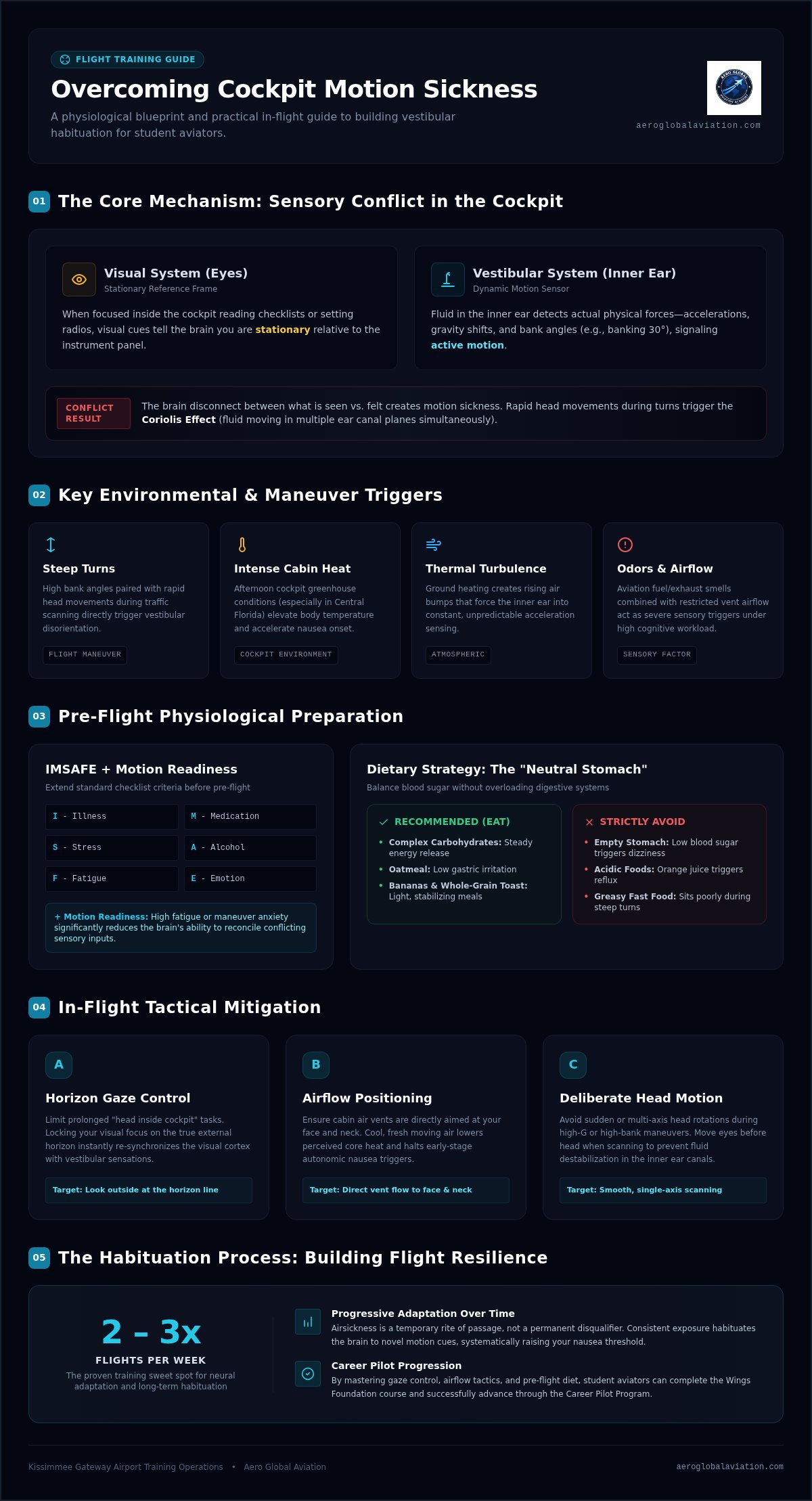
Your vestibular system, located in the inner ear, acts as a sophisticated motion sensor. It detects changes in gravity, acceleration, and bank. The trouble starts when you're focused on tasks inside the cockpit, such as reading a checklist or adjusting the radio. Your eyes tell your brain that you're stationary relative to the instrument panel, but your inner ear is screaming that the aircraft is banking 30 degrees. This discrepancy is the foundation of the sensory conflict theory behind motion sickness. In Central Florida, this conflict often intensifies due to thermal turbulence. As the ground heats up near Kissimmee, rising air creates "bumps" that keep your vestibular system on high alert. If you spend too much time with your "head in the cockpit" during these conditions, the brain disconnect can lead to rapid onset nausea.
Common Triggers for Student Pilots
Certain maneuvers and environmental factors are notorious for triggering symptoms. Steep turns are a primary culprit, particularly when a student moves their head quickly to scan for traffic. This can cause the "Coriolis effect," a disorienting sensation where the fluid in your ear canals moves in multiple planes simultaneously. Beyond the physics of flight, your mental state plays a massive role. High cognitive workload and the natural anxiety of performing a new maneuver can lower your physical threshold for sickness. We often see symptoms exacerbated by specific environmental factors in our training aircraft:
- Intense Cabin Heat: Florida afternoons can turn a cockpit into a greenhouse, making temperature management critical.
- Restricted Airflow: Poorly positioned vents fail to provide the cooling sensation needed to settle the stomach.
- Aviation Odors: The smell of fuel or exhaust can be a powerful sensory trigger when you're already feeling uneasy.
Recognizing these triggers early allows you to take proactive steps. By understanding why your body is reacting this way, you can move past the frustration and focus on the professional milestones of your Career Pilot Program.
Pre-Flight Preparation: Setting the Stage for Success
Success in the cockpit begins long before you start the engine at Kissimmee Gateway Airport. Your body's "nausea threshold" is a moving target influenced by your daily habits. Most students are taught the IMSAFE checklist early on, which covers Illness, Medication, Stress, Alcohol, Fatigue, and Emotion. To effectively manage your symptoms, we suggest adding "Motion Readiness" to this pre-flight self-assessment. If you're feeling particularly fatigued or stressed about a maneuver, your brain's ability to reconcile conflicting sensory signals drops significantly. Integrating these flight training motion sickness tips into your routine can prevent a lesson from being cut short.
Dietary choices are the next pillar of preparation. Many beginners make the mistake of flying on an empty stomach to avoid getting sick, but this often backfires. Low blood sugar can actually make you more susceptible to dizziness and nausea. Aim for a "neutral stomach" by consuming a light, balanced meal. A heavy or greasy breakfast will sit poorly during steep turns, while a completely empty stomach leaves you without the energy needed for high cognitive workloads. These foundational flight training motion sickness tips ensure your body is an ally rather than an obstacle during your training.
What to Eat (and Avoid) Before a Lesson
Stick to complex carbohydrates like oatmeal, bananas, or whole-grain toast. These foods provide a steady release of energy without causing digestive distress. You should strictly avoid acidic or highly processed foods, such as orange juice and greasy fast food, which can trigger reflux in a moving cabin. We recommend finishing your meal at least two hours before your scheduled takeoff. If you need a natural boost, ginger is a scientifically backed ally for aviators. Keeping ginger chews or sipping peppermint tea before a flight can help calm the stomach and improve your overall comfort level.
Hydration and Heat Mitigation in Florida
In the intense humidity of Orlando and Kissimmee, hydration is your primary defense. Dehydration reduces your blood volume, making it much harder for your cardiovascular system to handle the physical demands of flight. By the time you feel thirsty, your tolerance for motion has already decreased. We encourage students to focus on electrolyte balance to maintain sharp focus. Pre-cooling is another essential strategy. Don't spend an hour pre-flighting in the direct Florida sun if you're already feeling sensitive. Stay in the shade as long as possible and keep the cabin ventilated. If you want to learn in an environment that understands these regional challenges, consider the Career Pilot Program at Aero Global, where our mentors help you navigate every aspect of the training environment.
In-Flight Tactics: Real-Time Relief Techniques
Once you're airborne, your focus shifts to immediate management. When that familiar wave of discomfort begins, your tactical choices determine whether you can complete the lesson. It isn't about just "toughing it out." It's about using specific maneuvers to reset your internal equilibrium. These real-time flight training motion sickness tips are designed to keep you functional and focused on your training objectives.
Eyes Outside: The 90/10 Rule
The most effective way to resolve sensory conflict is to provide your brain with a clear, stable reference point. We recommend the 90/10 rule: spend 90% of your time looking outside at the horizon and only 10% scanning your instruments. Instrument fixation is a common trap for students, especially during climbs or turns. Looking down at a static panel while your body feels movement is a recipe for nausea. Instead, pick a distant point on the horizon, like a specific cloud formation or a landmark near Kissimmee, to help your eyes and inner ear align. This simple shift in gaze often provides immediate relief by confirming your physical orientation with visual data.
Active Management mid-Maneuver
If you feel your stomach turning during steep turns or stalls, ask for the controls. There's a reason the pilot flying rarely gets sick compared to the passenger. Taking the controls forces your brain to anticipate the aircraft's motion, which helps synchronize your sensory inputs. While you're flying, focus on these physical adjustments to implement your flight training motion sickness tips effectively:
- Loosen your grip: A "death grip" on the yoke increases physical tension and heightens your stress response.
- Controlled breathing: Slow, deep breaths help calm the vagus nerve and reduce the "fight or flight" response triggered by nausea.
- Direct the airflow: In the Florida heat, ensure all vents are open and pointed directly at your face or wrists to lower your core temperature quickly.
Finally, never underestimate the power of communication. Your instructor is your practical mentor, not a judge. Tell them as soon as you feel a "level one" discomfort. They can level the wings, increase the airflow, or demonstrate a maneuver while you focus on the horizon. Pushing through to the point of "level ten" sickness often results in a longer recovery time and can negatively impact your confidence for the next lesson. By speaking up early, you turn a potential setback into a manageable part of your learning process.
The Habituation Process: Building Your 'Sea Legs'
Habituation is the physiological process where your brain learns to filter out the conflicting signals between your eyes and your inner ear. It isn't a matter of willpower; it's a matter of neuroplasticity. By following structured flight training motion sickness tips, you're essentially teaching your nervous system that the bank and pitch of an aircraft are safe, normal sensations. This adaptation requires consistency. Flying once every two weeks isn't enough to build your 'sea legs' because your brain resets between lessons. We find that students who fly two to three times per week habituate much faster than those with sporadic schedules.
A key part of this journey is mental conditioning. Instead of viewing nausea as an "illness" that makes you unfit to fly, try re-framing it as "information." Your body is simply reporting a new environment it doesn't yet understand. As you gain experience, your brain will stop sounding the alarm. Start with incremental exposure. Focus on straight-and-level flight and gentle turns before moving on to more aggressive maneuvers like power-on stalls or steep spirals. This gradual approach allows your vestibular system to adjust without being overwhelmed.
Structuring Your Early Lessons
Work closely with your instructor to front-load "stable" flight time during your first few hours. We recommend the "Stop Before the Peak" rule: if you feel nausea rising, end the maneuver or the lesson before you actually vomit. Reaching the point of physical illness creates a negative psychological anchor that can make your next flight more stressful. For those in our Wings Foundation course, this pacing is essential for building a solid foundation of confidence. You aren't in a race; you're building a professional skillset that will last a lifetime.
Post-Flight Recovery and Analysis
After every lesson, take five minutes to debrief your physical state with your instructor. Identify exactly which maneuvers triggered the discomfort. Was it the head movement during the checklist? Was it the heat during the taxi? Pinpointing these triggers allows you to create a specific plan for your next flight. While some students turn to ground-based exercises, be cautious with flight simulators. Simulators can sometimes cause "sim sickness" because your eyes see motion that your body doesn't feel, which is the opposite of what happens in an actual cockpit. The light at the end of the tunnel is closer than you think. Most students find that their symptoms significantly diminish or disappear entirely within 5 to 10 hours of flight time. If you're ready to start this rewarding journey with a team that supports your individual needs, apply for our Career Pilot Program today and let our mentors guide you to the flight deck.
The Flight School Advantage: Professional Support at Aero Global
Choosing one of the best flight schools in Florida is about more than just finding the newest aircraft. It's about finding a training environment that prioritizes your wellness and long-term success. At Aero Global Aviation Academy, we recognize that physiological comfort is the foundation of effective learning. Our instructors act as practical mentors who have helped countless students navigate the early stages of their journey. By providing a structured support system, we ensure that your progress into the Career Pilot Program remains steady, regardless of initial sensitivity to motion.
Instructor-Student Communication
We work hard to break the "macho pilot" myth that suggests physical discomfort is a sign of weakness. In reality, professional pilots are highly attuned to their physical limits because safety in the cockpit depends on self-awareness. Our instructors foster a no-judgment environment where you can speak openly about how you're feeling. If you're struggling with nausea, we can adjust the commercial pilot training syllabus to accommodate shorter, more frequent lessons. This tailored approach allows you to implement flight training motion sickness tips in a way that respects your body's pace, ensuring you build confidence without the fear of embarrassment.
Training in Central Florida's Environment
Our location in Kissimmee offers unique strategic advantages for students managing airsickness. Central Florida is famous for its afternoon thermals, but we teach you how to use the early morning "smooth air" window to your advantage. By scheduling your most challenging maneuvers before the ground heats up, you can train in stable conditions that are much easier on the vestibular system. We also employ specific cockpit cooling strategies, such as maximizing airflow during taxi and utilizing sunshades, to keep the environment comfortable. These localized flight training motion sickness tips are part of our commitment to your individual success. If you're ready to see how our supportive environment can help you reach your goals, book a discovery flight today and experience the professional difference firsthand.
Take Control of Your Training Journey
Airsickness is a common physiological milestone that doesn't have to stall your ambitions. By mastering these flight training motion sickness tips, you're doing more than just settling your stomach; you're building the professional resilience required for a lifelong career in the sky. Remember that habituation is a structured process that relies on consistent exposure and open communication with your flight instructor. With the right preparation and a focus on the horizon, those early waves of nausea will soon become a distant memory in your logbook.
At Aero Global Aviation Academy, we're dedicated to helping you reach the flight deck with confidence. Our professional "Practical Mentor" instructors understand the unique challenges of training in the heat of Central Florida and will guide you through every step of our structured Career Pilot Program. Ideally located in Kissimmee, Orlando, we offer the perfect environment for year-round training and rapid progress. Don't let a temporary hurdle keep you grounded. Start your aviation journey with Aero Global Aviation Academy today and turn your passion for flight into a rewarding professional destination.
Frequently Asked Questions
Is it normal to feel motion sick during my first few flight lessons?
Yes, it is perfectly normal and happens to a significant number of new aviators. Your body is simply reacting to the "sensory conflict" of being in a moving three-dimensional environment for the first time. Most students at our Kissimmee facility find that these feelings are temporary. Once your brain learns to synchronize your visual and vestibular inputs, the nausea typically subsides and allows you to focus fully on your flight maneuvers.
Can I still be a commercial pilot if I get airsick?
Absolutely. Many professional pilots who completed our Career Pilot Program started their journey with some level of airsickness. As long as you can habituate and manage the symptoms, it doesn't disqualify you from a commercial career. It is a physiological hurdle to overcome, not a permanent barrier. Our instructors act as practical mentors to help you build the resilience needed to succeed at the highest levels of the aviation industry.
What are the best natural remedies for flight training motion sickness?
Ginger and peppermint are the most effective natural options for settling a sensitive stomach. Many students find that chewing on ginger candies or sipping peppermint tea before a lesson provides significant relief. These flight training motion sickness tips are excellent alternatives to medication. Combining these with a light, neutral meal like oatmeal or a banana will help you maintain your energy levels without triggering the discomfort often caused by greasy or acidic foods.
Should I use Dramamine or other medications before a flight lesson?
No, you should generally avoid taking sedative medications like Dramamine before a flight lesson. The FAA prohibits the use of many over-the-counter motion sickness drugs for pilots because they cause drowsiness and significantly slow your reaction times. Safety is the top priority in the cockpit, especially during your foundational training. Always consult with an Aviation Medical Examiner (AME) or your instructor before considering any medication to ensure it complies with current safety regulations.
How many flight hours does it typically take to get over motion sickness?
Most students habituate within 5 to 10 flight hours of consistent training. Flying 2 to 3 times per week is the most effective way to build your "sea legs" quickly. If you follow these flight training motion sickness tips and maintain a regular schedule, your brain will adapt to the sensory mismatch much faster. Sporadic training can reset your progress, so staying active in the cockpit is essential for long-term comfort and skill development.
Does flight training motion sickness ever come back after I've habituated?
It is possible for symptoms to return if you take a significant break from flying or move into high-intensity maneuvers. Students in our Airline Pilot Elite program sometimes experience a brief period of re-habituation when they start advanced aerobatics. However, because your body has already built the necessary neural pathways, the recovery time is usually much shorter the second time around. Your brain quickly remembers how to process the motion once you return to the cockpit.
What should I do if I feel like I'm going to vomit mid-flight?
If you feel like you are going to vomit, inform your instructor immediately. There is no reason to be embarrassed; our mentors are trained to handle this professionally. They can level the wings, increase the airflow from the vents, and let you focus on the horizon to settle your stomach. If a physical event is unavoidable, use the provided air sickness bag while keeping your eyes outside. Taking a short break often prevents a full setback.
Does the type of aircraft affect how much motion sickness I feel?
Yes, the type of aircraft can influence your comfort level. Smaller training planes are more susceptible to "bumps" from thermal turbulence, which is common in the Orlando climate. These aircraft also have smaller cockpits that can feel warmer than larger jets. However, training in these conditions actually makes you a more resilient pilot. By the time you transition to larger, more stable aircraft, your vestibular system will be highly adapted to almost any flight environment.


