

You're sitting on the taxiway at Kissimmee Gateway Airport, looking up at a sky that feels both infinite and incredibly crowded. Just 500 feet above your standard traffic pattern, the floor of the Orlando Class B airspace begins, while the Disney TFR looms just a few miles to your northwest. It's completely natural to feel a surge of adrenaline when you think about heading out on your own. Building confidence for solo cross-country flights from Kissimmee isn't just about logging hours; it's about mastering the specific local nuances that make Central Florida flying so unique.
We understand that the radio chatter from busy controllers and the unpredictable afternoon sea breeze can feel overwhelming for any student pilot. This guide will walk you through the exact steps to transition from a nervous student to a self-assured pilot who can handle the busiest corridors in the country. You'll learn how to navigate complex airspace, manage Florida's convective weather patterns, and meet every FAA requirement with poise. We're going to break down the pre-flight planning, the communication techniques, and the regional knowledge you need to turn your solo cross-country into a rewarding milestone.
Key Takeaways
- Understand the FAA cross-country requirements as a vital rite of passage that transforms you from a student into a pilot in command.
- Master regional navigation by identifying specific visual landmarks like Lake Tohopekaliga and the Atlantic coast to maintain situational awareness.
- Learn how building confidence for solo cross-country flights from Kissimmee begins on the ground through "chair flying" and the IMSAFE mental checklist.
- Discover why engaging VFR Flight Following early reduces your workload while navigating the complex shelves of Orlando’s Class B airspace.
- Leverage structured mentorship within the Wings Foundation program to gain the regional expertise needed for safe, successful solo operations.
What Is a Solo Cross-Country Flight and Why Does It Build Confidence?
The solo cross-country phase is often the most exhilarating part of your flight training. It represents the first time you leave the familiar sight of your home airport to navigate the complexities of the National Airspace System entirely on your own. At its core, cross-country flying is defined by the FAA as a flight that involves a landing at an airport more than 50 nautical miles from your original departure point. For students at Kissimmee Gateway Airport (KISM), this isn't just a box to check. It is the definitive moment where you prove you can manage an aircraft, communicate with ATC, and navigate shifting weather without an instructor in the right seat.
FAA Requirements for Solo Cross-Country
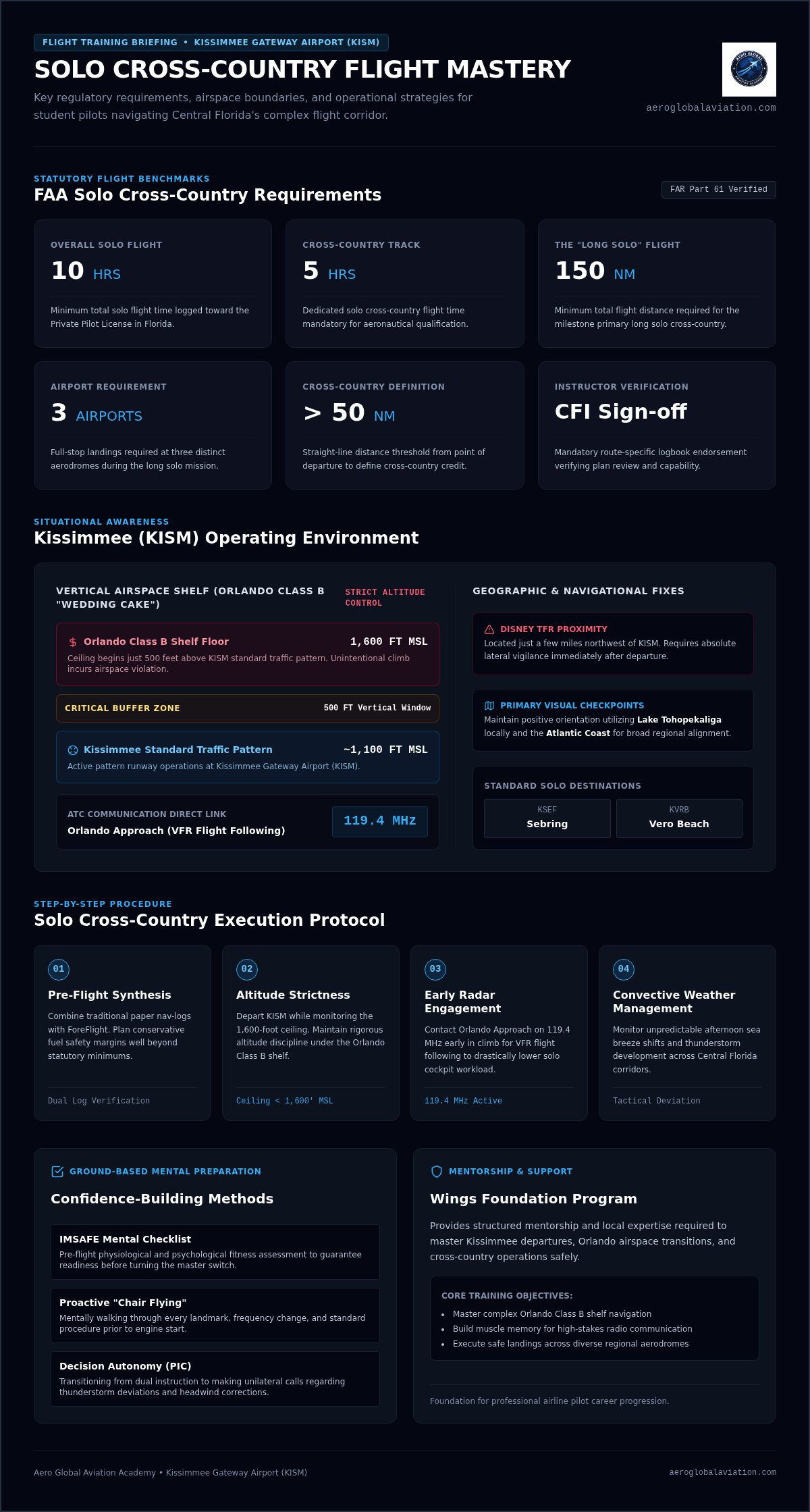
To earn your private pilot license florida, you must log at least 10 hours of solo flight time. This requirement includes 5 hours specifically dedicated to solo cross-country operations. The most significant milestone is the "long solo," which is a flight of at least 150 nautical miles total distance. This journey must include full-stop landings at three different airports, with one segment consisting of a straight-line distance of more than 50 nautical miles. Before you head out, your Certified Flight Instructor (CFI) will provide specific endorsements in your logbook. These endorsements verify they've reviewed your planning for that specific route and are confident in your ability to handle the current conditions.
The Mental Leap to Pilot-in-Command
Building confidence for solo cross-country flights from Kissimmee requires a fundamental shift in how you view your role in the cockpit. You're no longer just a student practicing maneuvers; you're a Pilot-in-Command (PIC) commanding a mission. This independence is the bedrock of a successful airline pilot career path. When you're flying solo, every decision belongs to you. You decide when to deviate for a building thunderstorm or how to adjust your heading for an unexpected headwind.
This autonomy builds a unique kind of muscle memory for complex decision-making. Kissimmee offers a high-stakes environment for this growth. Because KISM sits directly under the Orlando Class B shelf, you must maintain strict altitude discipline from the moment you lift off. Mastering these departures solo proves you have the technical skill and the mental fortitude to operate in any professional environment. By the time you return to Kissimmee and shut down the engine, you'll possess a level of self-assurance that simply can't be taught through dual instruction alone.
Pre-Flight Planning: Key to Confidence in Central Florida
Confidence in the cockpit begins long before you turn the master switch. For student pilots in Central Florida, a successful solo journey is built on a foundation of meticulous preparation. Mastering the FAA solo cross-country flight requirements means becoming an expert in your specific operating area. You should combine traditional paper nav-logs with modern digital tools like ForeFlight to ensure your calculations are precise. Always include a conservative fuel safety margin; don't just plan for the minimums. By the time you reach the run-up area, you should have a clear mental picture of every frequency change and landmark on your route.
Navigating Orlando Airspace
Kissimmee Gateway Airport (KISM) presents a unique challenge because it sits directly beneath the Orlando Class B "wedding cake" structure. When you're flying solo, staying clear of these restricted shelves is your top priority. Building confidence for solo cross-country flights from Kissimmee involves practicing your departures until the 1,600-foot ceiling feels like a familiar boundary rather than a threat. Don't hesitate to engage Orlando Approach on 119.4 MHz for VFR flight following early in your climb. This service provides an extra set of eyes on traffic and helps you navigate toward common destinations like Sebring (KSEF) or Vero Beach (KVRB) with much less stress. If you want to master these routes with a mentor first, our Wings Foundation program provides the local expertise you need.
Managing Florida Weather Patterns
Weather in the Sunshine State is predictable but demanding. You must respect the "2:00 PM rule," which marks the typical start of the afternoon convective cycle. Between May and October, the collision of sea breezes from the Atlantic and the Gulf triggers rapid thunderstorm development. Your pre-flight planning should include a strict Go/No-Go threshold based on these patterns. Use real-time Nexrad data on your tablet to maintain at least 20 nautical miles of separation from any storm cells. Remember that high humidity and soaring temperatures also affect density altitude. A hot Florida afternoon can significantly degrade your Cessna's climb performance, so always verify your takeoff distance during your pre-flight calculations. This level of detail ensures you remain in command of the mission from takeoff to touchdown.
Mental Strategies to Overcome Solo Cross-Country Anxiety
The cockpit can feel surprisingly quiet the moment you level off on your first solo leg. While your training has prepared you for the technical side of flight, building confidence for solo cross-country flights from Kissimmee requires a dedicated mental strategy. Nerves are a natural part of the process, but you can manage them by using the IMSAFE checklist before you even leave the house. By honestly assessing your illness, medication, stress, alcohol, fatigue, and emotion, you ensure that you're starting the mission with a clear head. Once you're sure you're fit to fly, spend time "chair flying" your entire route. Close your eyes and visualize every frequency change, every heading, and the specific sight of the Kissimmee runways as you depart. This mental rehearsal builds a layer of familiarity that keeps anxiety at bay when the workload increases.
Scenario-Based Training (SBT)
Work with your instructor to run through Scenario-Based Training (SBT) before your solo launch. Instead of just practicing maneuvers, you should focus on "what if" scenarios specific to Central Florida. What will you do if you encounter unforecasted clouds near the coast, or how will you handle a lost-communications situation while skirting the Orlando Class B airspace? Developing a standard operating procedure (SOP) for these moments turns a potential crisis into a manageable task. You can find excellent foundational strategies for these situations in the Pilot's Handbook of Aeronautical Knowledge. When you have a pre-planned answer for every scenario, the fear of the unknown disappears, leaving only the professional execution of your flight plan.
The "Fly the Airplane First" Mantra
High-workload environments can lead to mental tunnel vision. If you miss a waypoint or get a complex instruction from a controller, it's easy to feel the pressure mounting. In these moments, you must fall back on the pilot’s golden rule: Aviate, Navigate, Communicate. Fly the airplane first, ensure your course is correct second, and talk to ATC third. Use positive self-talk to regain your composure. Remind yourself that you've practiced these skills dozens of times with your mentor. Keeping your cockpit organized also plays a huge role in reducing mental fatigue. A cluttered lap leads to a cluttered mind, so keep your tablet, logs, and pens in their designated spots. By simplifying your environment and prioritizing your tasks, you'll find that building confidence for solo cross-country flights from Kissimmee becomes a natural byproduct of your professional discipline.
Executing the Flight: Step-by-Step Guidance from Takeoff to Landing
The transition from the planning room to the cockpit is where your preparation turns into professional skill. Building confidence for solo cross-country flights from Kissimmee requires you to stay ahead of the airplane from the moment you call for taxi. Kissimmee Gateway Airport (KISM) is a busy environment with a mix of corporate jets and flight training traffic. As you move toward the runway, keep your taxi diagram visible and maintain a high level of vigilance. Once you're cleared for takeoff, your primary focus is the immediate climb. Remember that the Orlando Class B airspace sits just 500 feet above the standard traffic pattern altitude, so leveling off precisely at 1,500 feet MSL is a non-negotiable step for staying clear of the shelf.
KISM Departure and En Route Radio Comms
Effective communication is your best tool for reducing stress. When you make your initial call to Kissimmee Ground on 121.70, state your tail number followed by the phrase "Student Pilot" to ensure controllers provide the additional spacing and patience you need during your departure. Once you're handed off to Orlando Approach on 119.4, request VFR flight following to your destination, whether it's Sebring (KSEF) or Vero Beach (KVRB). This radar service acts as a safety net, providing traffic advisories and helping you navigate the busy Central Florida corridors. While your GPS provides excellent situational awareness, verify your position using VOR radials or ground-based landmarks like the Florida Turnpike to ensure you aren't over-relying on a single source of data.
The Arrival and Shutdown
Arriving at a non-towered airport like Sebring requires a different mental gear. You must be proactive on the CTAF, announcing your position 10 miles out and again as you enter the 45-degree left downwind. A confident arrival is built on following standard traffic pattern procedures every single time. After you land and clear the runway, take a moment to breathe and acknowledge the achievement. The flight isn't truly over until you've secured the aircraft back at KISM and sat down for a post-flight debrief.
Use your logbook to note what went well and where you felt challenged. This reflection is vital because it shifts your commercial pilot training outlook from that of a student to a future professional. You've proven you can manage a mission independently, which is the exact mindset required for advanced certification. If you're ready to take the next step in your aviation journey, apply for our Career Pilot Program today and turn these milestones into a lifelong career.
How Aero Global Aviation Academy Prepares You for Solo Success
Confidence in the cockpit is a skill that we help you build through structured, expert guidance. Our Wings Foundation program provides the foundational training you need to move from your first lesson to your solo cross-country with total self-assurance. We don't believe in a one-size-fits-all approach. Instead, you'll work with a dedicated instructor who stays with you throughout your private pilot training. This personalized mentorship ensures that you aren't just checking boxes; you're developing the deep regional knowledge required for building confidence for solo cross-country flights from Kissimmee.
You'll train in a modern fleet featuring Cessna 172 Skyhawks equipped with Garmin G1000 glass cockpits. Learning on these advanced systems from the start gives you a significant advantage as you prepare for advanced flight training. The situational awareness provided by modern avionics, combined with our focus on traditional pilotage, ensures you're ready for any scenario. This technical proficiency is the bridge between being a student and becoming a professional pilot who is ready for the Airline Pilot Elite track.
Our Proximity to Professional Airspace
Kissimmee Gateway Airport is the ideal training ground for anyone serious about an aviation career. Because we are located right next to Orlando International, you'll learn to navigate one of the busiest airspace environments in the country from day one. You'll benefit from Central Florida’s 300 plus flyable VFR days, which allows you to maintain a steady training rhythm without long weather delays. Our students often find that the transition from a PPL to a CPL feels like a natural progression because they've already mastered the professional radio work and altitude discipline required in this region.
Your First Step: Book a Discovery Flight
The best way to understand the Aero Global difference is to see it for yourself. We invite you to visit our facilities at KISM, meet our team of practical mentors, and get a feel for the aircraft you'll be commanding. Building confidence for solo cross-country flights from Kissimmee starts with choosing a partner that is invested in your individual success. We're here to guide you through every milestone on your path to the flight deck. Schedule your Discovery Flight at Kissimmee Gateway Airport today! and take control of your future in the skies.
Your Path to the Captain's Seat Starts at KISM
Taking your first solo cross-country flight is more than just a regulatory requirement; it’s the moment you truly become a pilot. By mastering local landmarks and understanding the unique vertical boundaries of the Orlando airspace, you turn potential anxiety into professional competence. We’ve explored how meticulous pre-flight planning and scenario-based mental training are the real secrets to building confidence for solo cross-country flights from Kissimmee. When you combine these strategies with a disciplined approach to radio communications and navigation, the complex Florida skies become your home.
At Aero Global Aviation Academy, we provide a professional training environment at KISM designed to help you thrive. Our expert local flight instructors offer the personalized mentorship you need to succeed, whether you are pursuing a private license or our structured Career Pilot Program. You don't have to navigate this journey alone. Our team is here to ensure you have the skills and the mindset to command any mission with poise. Take the first step toward your professional goals today and experience the transformative power of elite flight training.
Start Your Aviation Journey with the Wings Foundation
Frequently Asked Questions
Is Kissimmee Gateway Airport too busy for a student pilot solo?
Kissimmee Gateway Airport provides a balanced environment that is busy enough to build professional skills but remains accessible for students. While there is a mix of corporate jets and training traffic, the controllers are very experienced with student pilots. Training here is a key part of building confidence for solo cross-country flights from Kissimmee because you learn to handle radio communications and ground movements in a towered environment before you ever leave on your own.
How many solo cross-country hours do I need for my PPL in Florida?
Under FAA regulations, you must log at least 5 hours of solo cross-country flight time to qualify for a Private Pilot Certificate. This is part of a broader requirement for 10 hours of total solo time. Your cross-country hours must include one long flight of at least 150 nautical miles with full-stop landings at three different airports. Our Wings Foundation course ensures you meet these milestones while navigating the specific challenges of Central Florida.
What happens if I get lost during my solo cross-country?
If you become disoriented, you should immediately follow the "Four Cs": Climb, Conserve, Confess, and Communicate. Climbing improves your radio reception and visibility of landmarks like the Atlantic coast or Lake Tohopekaliga. Don't hesitate to tell ATC that you are a student pilot and need assistance. Orlando Approach is a valuable resource that can provide radar vectors to get you back on course safely and quickly while you regain your situational awareness.
Can I use GPS on my solo cross-country flight?
You can certainly use GPS, and our modern fleet at Aero Global is equipped with Garmin G1000 glass cockpits to enhance your situational awareness. However, the FAA Airman Certification Standards require you to demonstrate mastery of pilotage and dead reckoning. You must be able to navigate using visual checkpoints and a paper or digital nav-log as a backup. This dual approach is essential for building confidence for solo cross-country flights from Kissimmee during your training.
How do I handle the Orlando Class B airspace as a student?
Navigating the Orlando Class B airspace requires strict altitude discipline and a clear understanding of the "wedding cake" shelves. At KISM, you must remain below 1,600 feet MSL until you are clear of the overlying shelf unless you have a specific clearance. We teach you to use Flight Following on 119.4 MHz, which allows controllers to monitor your flight and provide guidance as you transit these busy professional corridors near the Disney TFR.
What is the best time of day for a solo cross-country in Florida?
Early morning is the optimal time for solo cross-country flights in Florida, typically with wheels up between 7:00 AM and 8:30 AM. This timing helps you avoid the severe afternoon convective activity and thunderstorms that usually develop after 2:00 PM. Morning air is also much smoother, which reduces your physical workload and allows you to focus entirely on your navigation and communication tasks during the high-stakes environment of a solo mission.
Do I need a special endorsement for every solo cross-country flight?
Yes, the FAA requires two distinct types of endorsements for solo cross-country operations. First, you need a one-time category, make, and model endorsement in your logbook from an authorized instructor. Second, your instructor must review your specific flight planning, weather briefing, and route for every individual cross-country flight you take. This process ensures that a professional has verified your preparation and that the current conditions are safe for your specific skill level.
How do I know if I am truly ready for my first solo cross-country?
You are ready when your instructor provides the required endorsements, which signifies they have full confidence in your abilities. Beyond the legal requirements, you'll know you're ready when you can consistently manage the aircraft, navigate Orlando's complex airspace, and handle radio calls without prompting. Our personalized mentorship at Aero Global ensures you have the foundational skills and mental strategies to transition from a student to a confident pilot in command.


