Did you know that the pilot shortage is projected to peak at 24,000 vacancies in 2026, while median salaries for airline pilots have climbed to an impressive $226,600? It's a gold rush in the skies, yet many aspiring aviators feel grounded by the complex airline pilot career path. You might feel anxious about the 1,500-hour flight time requirement or wonder if the significant investment in flight school will truly deliver the lifestyle you've dreamed of. We know these hurdles feel high, but they're much easier to clear when you have a clear, professional plan in place.
We've created this expert-driven roadmap to help you navigate the journey from your very first student pilot certificate to the flight deck of a major airline. This guide breaks down every milestone; it clarifies the transition from a private pilot to a commercial professional. You'll learn how to leverage efficient training environments to build your hours and see exactly how your dedication transforms into a rewarding, high-paying career. Let's explore the practical, step-by-step sequence that makes your dream of flight an attainable reality this year.
Key Takeaways
- Understand why the 2026 pilot shortfall creates an unprecedented opportunity to secure your place in the cockpit with record-breaking salary potential.
- Follow our expert-driven roadmap to master the airline pilot career path, ensuring you hit every FAA certification milestone with precision and confidence.
- Learn how to transform the 1,500-hour flight time requirement from a hurdle into a period of professional refinement that prepares you for airline operations.
- Discover how the seniority system works at major carriers to dictate your schedule, salary, and the timeline for your promotion to captain.
- Identify the key advantages of a structured training environment and how a career-focused academy like 2FLY Airborne accelerates your transition into a professional aviation role.
Navigating the Airline Pilot Career Path in 2026
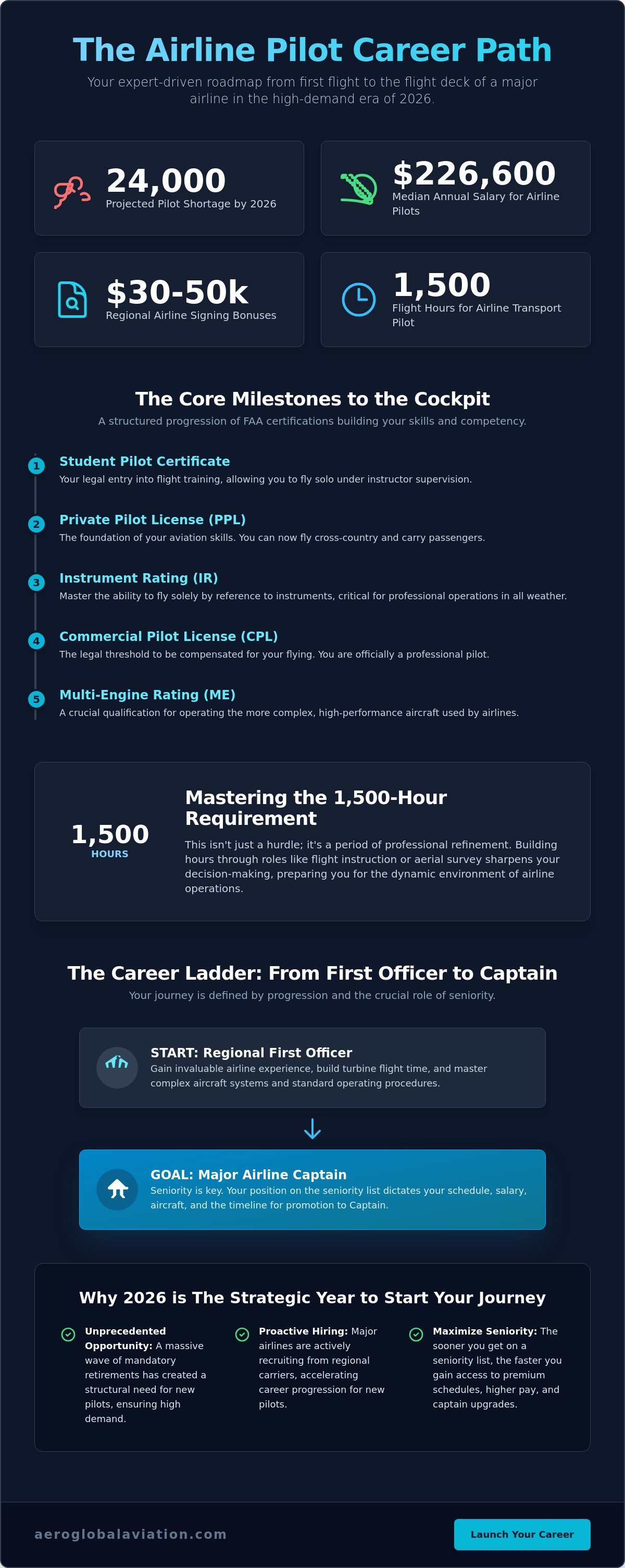
The modern airline pilot career path is far more than just learning to fly. It's a carefully choreographed sequence of FAA certifications, each designed to build the technical mastery and decision-making skills required for the pilot profession. In 2026, this journey has become a strategic race. With the U.S. pilot shortfall expected to reach 24,000 this year, the industry is moving at a record pace to fill seats left vacant by a massive wave of mandatory retirements. You aren't just joining a workforce; you're entering a high-demand field where your progression is backed by structural necessity.
Transitioning from a student pilot to a professional aviator requires a shift in mindset. You'll move from viewing flight as a hobby to treating every hour in the cockpit as a step toward a commercial destination. To facilitate this, many students choose an accelerated track like our Career Pilot Program. These "zero to hero" frameworks are designed to take you from your first discovery flight to commercial certification with maximum efficiency, ensuring you hit the job market while the hiring window is wide open.
Current Industry Trends and Pilot Demand
Hiring cycles in 2026 have shifted from "selective" to "proactive." Major airlines are no longer waiting for pilots to knock on their doors; they are reaching deep into the regional levels to secure talent. This has created a ripple effect where regional carriers are offering signing bonuses between $30,000 and $50,000 just to attract new First Officers. Additionally, the integration of new aircraft technologies means that modern training focuses heavily on automation management and systems proficiency. This evolution ensures that today's graduates are ready for the high-tech cockpits of the next decade.
Why 2026 is the Strategic Year to Start
If you're weighing the options between a traditional four-year degree and flight training, the return on investment in 2026 is undeniable. While a college degree often leads to entry-level roles with significant debt, flight training puts you on a fast track toward a median annual wage of $226,600. You can explore the latest commercial pilot salary trends to see how these earnings stack up against other high-stakes professions. Starting your training now is a strategic move because seniority is everything in aviation. The sooner you get your number on a seniority list, the faster you'll enjoy the premier schedules and captain's pay that define the peak of the airline pilot career path.
The Core Milestones: From First Solo to Commercial Certification
The airline pilot career path is a structured progression designed to ensure safety and competency at every altitude. It's not just about logging hours; it's about mastering specific skill sets that build upon one another in a logical, rewarding sequence. Each stage concludes with a checkride. This is a high-stakes practical test where an FAA examiner validates your skills and knowledge. Passing these exams isn't just about getting a new piece of plastic for your wallet; it's about proving you're ready for the immense responsibility of the cockpit. Starting with a dedicated program like the Wings Foundation ensures you don't just pass your initial tests, but that you internalize the professional habits required for a lifelong career.
To reach the flight deck of a major carrier, you'll navigate through these essential milestones:
- Student Pilot Certificate: Your legal entry into flight training.
- Private Pilot License (PPL): The foundation of all your aviation skills.
- Instrument Rating (IR): The ability to fly solely by reference to instruments.
- Commercial Pilot License (CPL): The legal threshold to fly for compensation.
- Multi-Engine Rating (ME): A requirement for operating sophisticated airline aircraft.
Foundation Licenses: PPL and Instrument Rating
Think of the Private Pilot License as your "driver's license" of the air. It grants you the freedom to fly cross-country and carry passengers, but its primary purpose is to cement your fundamental stick-and-rudder skills. Once you've mastered the basics, the Instrument Rating (IR) introduces the technical precision required for professional flight. You'll learn to trust your dials over your physical senses, a shift that is critical for safety when visibility drops. By following the official FAA pilot certification standards, you ensure that your training meets the highest regulatory benchmarks from day one. Mastering these fundamentals early is vital because it prevents the training plateaus that often stall students later in their journey.
The Professional Leap: Commercial and Multi-Engine Ratings
Earning your Commercial Pilot License (CPL) is the moment your hobby officially becomes a career. This certification requires a higher level of precision and a much deeper knowledge of aircraft systems and federal regulations. It's the point where you transition from "learning to fly" to "flying for a living." However, a single-engine commercial license is rarely enough for the airlines. You must also obtain a Multi-Engine Rating. Flying an aircraft with two engines requires specialized training in aerodynamics and emergency procedures, particularly during "engine-out" scenarios. This rating is a non-negotiable prerequisite for any pilot aiming for a regional or major carrier. For a deeper look at how these specialized skills prepare you for the industry, check out our guide on Advanced Flight Training.
If you want to see how these steps fit into a comprehensive timeline, review our Career Pilot Program to begin planning your ascent into the professional ranks.
Bridging the Gap: Mastering the 1,500-Hour Requirement
After you earn your commercial license, you'll face the most significant numerical milestone in aviation: the 1,500-hour rule. This FAA requirement for the Airline Transport Pilot (ATP) certificate often feels like a daunting gap, but successful aviators view it as a period of professional refinement. It's the stage where you transition from a certified pilot to a seasoned captain. While some see this as a "grind," it's actually an apprenticeship that builds the muscle memory and decision-making skills needed for heavy jet operations. According to the Bureau of Labor Statistics pilot career outlook, the demand for qualified pilots remains high, making this "time-building" phase a strategic investment in your future.
The environment where you train matters. Part 141 schools offer a highly structured syllabus that can lead to hour reductions for a Restricted ATP (R-ATP) if you meet specific collegiate or military requirements. In contrast, Part 61 provides the flexibility to build hours on your own terms. For those looking for a clear, mentorship-driven route, the Airline Pilot Elite Program provides a direct path to becoming a flight instructor. This role is widely considered the most effective way to bridge the gap while staying sharp in the cockpit.
The Flight Instructor (CFI) Route
Teaching others is the gold standard for reaching 1,500 hours. When you instruct, you're forced to master every nuance of aerodynamics and federal regulations to explain them clearly to a student. This mastery is exactly what airline recruiters look for during the interview process. Typically, a busy full-time CFI can log between 60 and 100 hours per month. At this rate, you can bridge the gap from your initial commercial license to the 1,500-hour mark in roughly 12 to 18 months, all while earning a paycheck and building a professional network.
Alternative Time-Building Strategies
If instructing isn't your primary interest, there are other entry-level roles that help you advance along the airline pilot career path. These jobs provide unique challenges that diversify your logbook:
- Aerial Photography: Precision flying that builds excellent spatial awareness and technical discipline.
- Pipeline or Powerline Patrol: Low-altitude work that sharpens your navigation and real-world weather-reading skills.
- Banner Towing: High-repetition takeoff and landing practice that builds superior stick-and-rudder coordination.
Some pilots choose to buy a small, economical aircraft to build hours independently. While this offers total freedom, it lacks the professional oversight and "soft skill" development found in commercial roles. Regardless of your method, maintaining a meticulous logbook is non-negotiable. Ensure every entry is legible and cross-referenced, as this document is the primary evidence of your readiness for the airlines.
From Regional First Officer to Major Airline Captain
The regional airline phase is where the technical training you've accumulated finally meets the reality of scheduled commercial service. As a First Officer, you're no longer just flying an airplane; you're managing a complex operation within a massive, fast-moving network. Your daily life is governed by seniority, which is the heartbeat of the airline pilot career path. This system determines whether you fly a Tuesday morning trip to Chicago or spend your weekends at home. In 2026, many regional pilots find that their time in the "right seat" is shorter than ever due to rapid Captain upgrades. Before you apply, make sure you've ticked every box on the Regional Airline Pilot Requirements list to ensure you're ready for day one of indoctrination.
Life as a Regional First Officer involves a steep learning curve. You'll likely start on "reserve," meaning you're on call to cover trips when other pilots are unavailable. As your seniority grows, you'll become a "line holder," allowing you to bid for specific schedules and routes. This phase is about more than just logging hours. It's about learning the "soft skills" of crew resource management and understanding the nuances of Part 121 regulations in real-world scenarios.
Regional Airlines and Flow-Through Agreements
Flow-through agreements are a unique and valuable feature of the 2026 aviation market. These contracts offer a guaranteed seat at a major carrier like American or United without a second interview. While this provides immense peace of mind, the current "direct hire" market is so aggressive that many pilots choose to interview with multiple majors to reach their destination faster. Regional experience serves as the ultimate proving ground. It is where you learn to handle high-density airspace and adverse weather in a jet environment, proving you have the discipline required for the major leagues.
Life at the Majors: Career Longevity and Benefits
Moving to a major airline represents the pinnacle of the profession. Here, you transition from regional jets to wide-body "heavy" aircraft that cross oceans and time zones. The benefits at this level are transformative. Major carriers in 2026 often provide 401k contributions exceeding 15 percent and travel perks that allow you and your family to explore the world. With the mandatory retirement age still set at 65, a pilot entering a major carrier today can look forward to decades of high-earning potential and a stable work-life balance. If you're ready to start your journey toward these major airline benefits, apply for our flight training programs today and secure your future in the cockpit.
Launching Your Career at Aero Global Aviation Academy
Choosing where to train is the most critical decision you'll make at the start of your journey. While casual flight schools offer a relaxed pace, a structured, career-oriented academy provides the professional rigor necessary to succeed on the airline pilot career path. At Aero Global Aviation Academy, we act as your practical mentor. We ensure you aren't just a number in a database but a future captain with a personalized roadmap. Our Career Pilot Program serves as our flagship training track, designed to move you through your ratings with the efficiency required to meet the 2026 hiring surge.
We also recognize that many aspiring aviators are transitioning from other professional fields. If you're considering a mid-life shift, our guide on Is 40 Too Old to Become a Pilot? provides the clarity you need to make an informed choice. Whether you're 18 or 45, the goal remains the same: reaching the flight deck with the skills and confidence to command a commercial jet.
The Airline Pilot Elite Advantage
Our Airline Pilot Elite program is specifically engineered for those who want to go all the way. It takes you from zero experience through your advanced instructor certifications, providing a seamless transition into a paid role where you can build your 1,500 hours. We maintain a modern fleet at our Kissimmee facility, ensuring you train on reliable equipment that mirrors the technology found in regional cockpits. By enforcing airline-ready standards from day one, we help you develop the professional discipline, checklist usage, and crew coordination skills that major carriers demand during their interview and simulator evaluations.
Kissimmee: The Ultimate Training Environment
Location is a strategic asset that many students overlook. While pilots in other regions lose weeks to winter storms and low ceilings, our students in Kissimmee benefit from over 300 days of flyable weather each year. This favorable climate means you can fly more often, retain your skills better, and finish your training months ahead of schedule. Furthermore, our proximity to Orlando International (MCO) means you'll train in complex, high-density airspace from the very beginning. This exposure to professional radio work and heavy jet traffic is the best possible preparation for your future career. We invite you to visit our Kissimmee facility for a discovery flight to see why Central Florida is the premier destination for flight training.
Take Command of Your Aviation Future
The journey to the flight deck is a series of strategic milestones that require both dedication and the right partnership. You've seen how the airline pilot career path transforms from a student's first solo into a rewarding career at a major carrier. By following our FAA-approved curriculum, you gain the technical mastery and professional habits that define today's elite aviators. Training in the optimal climate of Kissimmee allows you to maximize your progress with over 300 flyable days each year, ensuring you stay ahead of the curve.
We provide the structured mentorship you need to bridge the gap to 1,500 hours through advanced instructor ratings. This path isn't just about logging time; it's about refining your skills so you're ready for the responsibility of a commercial cockpit. The opportunities in 2026 are unprecedented, and your seat in the sky is waiting.
Start Your Journey with Aero Global’s Career Pilot Program and take the first step toward your new office at 35,000 feet. We're ready to help you reach your destination.
Frequently Asked Questions
What is the fastest airline pilot career path in 2026?
An accelerated, full-time training program followed immediately by working as a Certified Flight Instructor is the quickest way to navigate the airline pilot career path. By training in a high-weather-availability location like Kissimmee, you can complete your initial ratings in months rather than years. This consistent momentum allows you to start building your 1,500 hours while the industry hiring surge is at its peak, moving you into a regional jet as quickly as possible.
Do I need a college degree to become an airline pilot?
You don't need a college degree to earn your FAA licenses or to fly for regional airlines. While many major carriers still prefer a four-year degree for their applicants, the current pilot shortfall has led some to relax these requirements for highly experienced candidates. If you choose to skip the degree initially, focusing on high-quality flight training and logging turbine time can still lead to a successful career at the highest levels of the industry.
How much does it cost to go from zero to a commercial pilot license?
The financial investment required to reach a commercial pilot license varies based on how frequently you fly and how quickly you master the technical curriculum. While it is a significant upfront commitment, the return on investment in 2026 is exceptionally high given the record-level salaries for airline captains. Most students view this as a strategic career investment rather than a simple expense, often utilizing various funding options to manage the transition effectively.
Can I become an airline pilot if I wear glasses or have 20/20 corrected vision?
You can absolutely become an airline pilot if you wear glasses, provided your vision is correctable to 20/20. The FAA requires a First-Class Medical Certificate for airline operations, which tests for distance vision, near vision, and color perception. As long as your corrective lenses allow you to meet these specific safety standards, your path to the cockpit remains wide open. Don't let corrective lenses discourage you from pursuing your professional goals.
What is the 1,500-hour rule and does it apply to everyone?
The 1,500-hour rule is a mandatory requirement for the Airline Transport Pilot (ATP) certificate, which is necessary to fly for a Part 121 airline. While this applies to most civilian pilots, the FAA allows for specific reductions. Military pilots can qualify with 750 hours. Graduates of approved collegiate aviation programs may qualify with 1,000 or 1,250 hours depending on their specific degree type, making it a vital factor to consider when planning your training.
Is there an age limit for starting flight training in the United States?
There is no upper age limit for starting flight training in the United States. You can begin logging hours as early as age 14 for gliders or 16 for powered aircraft, but you must be 17 to earn a private license and 23 to earn your full ATP certificate. While the mandatory retirement age for airline pilots is currently 65, many pilots enjoy long second careers in corporate aviation or flight instruction well beyond that age.
How do I finance my flight training at an aviation academy?
Most students finance their training through a combination of specialized aviation loans, personal savings, and merit-based scholarships. Many regional airlines also offer tuition reimbursement programs or signing bonuses that help offset the cost of training once you reach their hiring minimums. We recommend exploring all available financial aid options early to ensure your training remains consistent, as staying in the cockpit regularly is the best way to maintain your skills.
What is the difference between Part 61 and Part 141 flight schools?
The primary difference lies in structure and FAA oversight. Part 141 schools follow a rigid, FAA-approved syllabus that is ideal for students aiming for a professional career on a strict, predictable timeline. Part 61 offers more flexibility, allowing you to tailor your training schedule around other life commitments. For most career-focused aviators, the structured environment of a Part 141 program provides a more efficient and professional path to the major airlines.


