
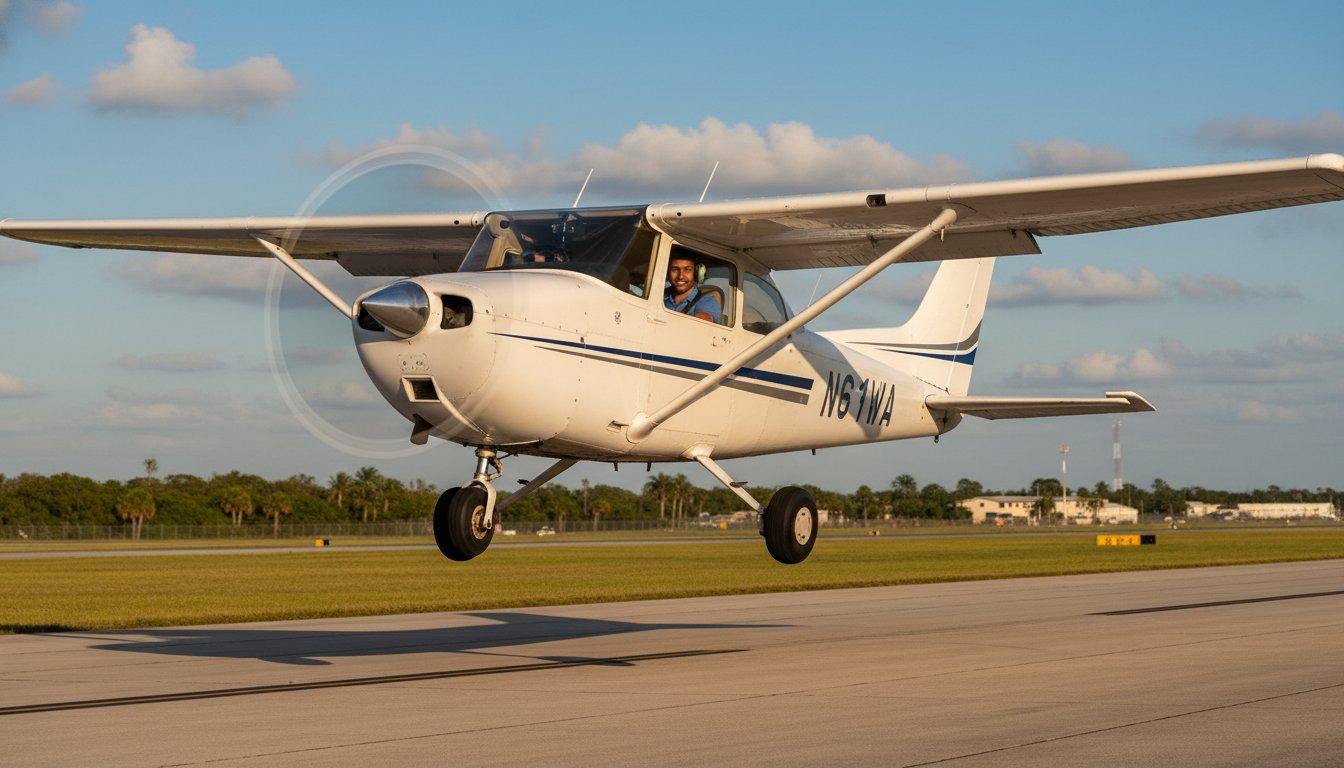
Imagine the silence of the cockpit as your instructor steps out, closes the door, and gives you a thumbs up from the tarmac. That sudden realization that you are the sole Pilot-in-Command is both exhilarating and intimidating, especially if you are worried about busy radio frequencies or engine reliability. It is completely normal to feel a rush of nerves before your first solo flight, but those feelings are simply a sign that you respect the high-stakes nature of aviation.
While many pilots follow the FAA path, there are alternative certifications available globally that focus on recreational flying. You can explore Recreational Pilot Licence (RPL) Training options to understand how different training frameworks can help you achieve your goals in the cockpit.
We are here to help you turn that anxiety into professional confidence. This guide provides the practical roadmap you need to prepare for, survive, and celebrate this historic milestone in your training. You will discover the specific FAA legal requirements, including the pre-solo knowledge test and medical certification, while learning the step-by-step procedures for your first three landings. We will also cover the mental strategies that help you transition from a student into a capable pilot who is ready for our Wings Foundation or Career Pilot Program. By the time you finish reading, you will understand exactly what it takes to fly alone and return to the ramp with a new sense of achievement.
Key Takeaways
- Understand why taking off and landing as the sole occupant is the most significant milestone in your pilot training journey.
- Master the legal prerequisites under FAR Part 61, including age limits and the necessity of a Student Pilot Certificate.
- Learn exactly what to expect on the day of your first solo flight, from the instructor's surprise exit to completing your three full-stop landings.
- Discover mental preparation techniques like "chair flying" to manage anxiety and build the confidence required for solo operations.
- See how our Wings Foundation program leverages the unique Orlando airspace to prepare you for a successful career in the skies.
What is a First Solo Flight? Defining the Student Pilot Milestone
The moment arrives without much fanfare. Your instructor asks you to taxi to the ramp, hops out, and tells you to do three laps in the pattern. A first solo flight is formally defined as the period when a student pilot operates an aircraft as the sole occupant, taking off and landing without an instructor's assistance. While the technical definition is straightforward, the psychological reality is much larger. You are no longer a passenger with a headset; you've transitioned into the role of Pilot-in-Command (PIC). This means you hold the final authority and responsibility for the safety and operation of the flight.
This milestone represents the greatest leap in a pilot's training journey. It's the point where your theoretical knowledge and physical muscle memory must align perfectly. You'll notice the aircraft climbs faster and feels more responsive without the extra weight of an instructor in the right seat. Every decision, from adjusting the mixture to managing the descent rate, rests entirely on your shoulders. It is the definitive proof that you possess the skills and judgment to handle the aircraft safely in a real-world environment.
Within the timeline of earning your private pilot license florida, the solo typically occurs after you've mastered basic maneuvers, stalls, and consistent landings. Most students reach this stage between 10 and 20 hours of dual instruction. In the busy airspace around Orlando and Kissimmee, reaching your solo means you've demonstrated the ability to stay ahead of the airplane while maintaining situational awareness and clear radio communication.
The History and Tradition of Soloing
A First solo flight is steeped in traditions that date back to the early days of aviation. Since the Wright brothers first took to the skies, the act of flying alone has been the ultimate rite of passage. One of the most famous traditions involves your instructor cutting off the back of your shirt. This practice originated in the days of tandem trainers where the instructor sat behind the student. Since there were no radios, the instructor would tug on the student's shirttail to give directions. Cutting the shirt symbolizes that the instructor no longer needs to pull your strings; you're ready to fly on your own. This tradition builds a unique sense of camaraderie and confidence that stays with you as you pursue advanced ratings.
Solo Flight vs. Solo Time: Understanding the Difference
It's helpful to distinguish between the "event" of soloing and the "logbook entry" of solo time. Solo time refers to any flight time where you are the only person on board the aircraft. While your first solo is a specific, celebrated event, you'll continue to accumulate solo time throughout your training to meet FAA requirements. Your first solo is typically limited to the airport traffic pattern. Later, you'll conduct cross-country solo flights that take you to distant airports. All of these hours count toward the 40-hour minimum required for certification, but they serve different purposes. The first solo proves you can land; the subsequent solo hours prove you can navigate and manage complex flight environments independently.
FAA Requirements: What You Need Before You Can Solo
While the excitement of your first solo flight is what keeps you motivated, the FAA ensures you are legally and technically prepared before you ever leave the ground alone. Compliance with Federal Aviation Regulations (FAR) Part 61 is not just a formality; it is a safety framework designed to protect you and other pilots in the sky. By meeting these standards, you bridge the gap between being a student and becoming a responsible operator of an aircraft.
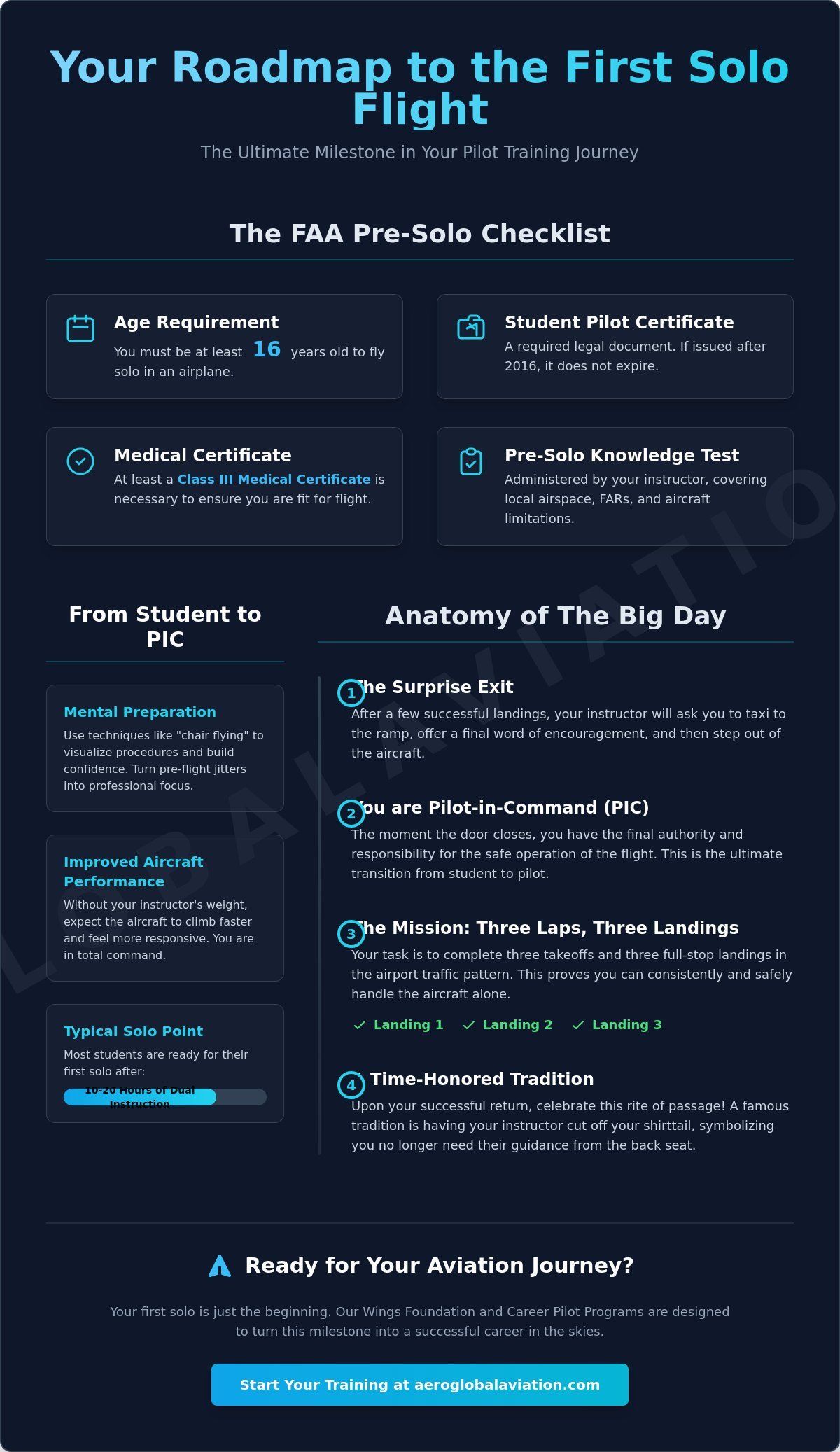
To begin, you must be at least 16 years old to solo an airplane. You also need a Student Pilot Certificate, which is a modern document that no longer expires if issued after 2016. Alongside this, you must secure at least a Class III Medical Certificate. This exam ensures you are physically fit for the demands of flight, covering vision, hearing, and general health. Securing your medical early in your training is a smart move to ensure there are no surprises that could delay your progress.
Before your instructor signs you off, you must pass a pre-solo aeronautical knowledge test. This is not a generic exam. It is a specific test administered by your instructor that covers FAR Parts 61 and 91, local airspace rules for your airport, and the specific operating limitations of your training aircraft. Mastering these details is a vital part of Preparing for your first solo. This test transforms your nervous energy into technical certainty, ensuring you know exactly how to handle the aircraft and the environment around you.
Endorsements and the Logbook
Your logbook is your legal passport in the aviation world. Your Certified Flight Instructor (CFI) must provide a specific endorsement for the make and model of aircraft you intend to fly. As of 2026, digital logbooks are the industry standard, and these endorsements must be updated every 90 days. If your endorsement expires, you cannot fly solo again until your instructor conducts a proficiency flight and re-signs your logbook. Always double check your dates before heading to the airport.
Aeronautical Knowledge and Proficiency
There is no "magic number" of hours required for a first solo flight in the United States. The FAA uses a competency-based model, meaning you solo when you are ready, not when you hit a certain hour mark. You must demonstrate consistent proficiency in maneuvers like power-off stalls, steep turns, and emergency engine-out procedures. Most importantly, you must show you can manage the traffic pattern and land safely every single time. Our private pilot license florida guide outlines how we structure this training to help you reach this milestone with total confidence.
The Anatomy of the Solo: What Happens on the Big Day
The transition from a dual instructional flight to your first solo flight often happens when you least expect it. After a series of successful landings during a normal lesson, your instructor will likely ask you to taxi to a safe spot on the ramp or a taxiway turnout. They will gather their gear, offer a few final words of encouragement, and step out of the aircraft. Suddenly, the cockpit feels remarkably spacious. Your primary task is now to complete the standard solo profile, which typically consists of three full-stop landings in the airport traffic pattern. This structure ensures you prove your ability to take off, navigate the pattern, and bring the aircraft to a complete halt three separate times.
One of the first things you will notice as you add full power for your first solo takeoff is the aircraft's increased performance. Without the weight of an instructor in the right seat, the plane will accelerate faster and climb much more aggressively than you are used to. You might reach your pattern altitude before you even turn crosswind. It is essential to stay ahead of the airplane by monitoring your airspeed and pitch closely. On the radio, you should identify yourself to Air Traffic Control as a "student pilot." This simple suffix alerts controllers to your status, and they will often provide you with extra space or clearer instructions to help you manage the environment safely.
A First solo flight is a test of your ability to maintain focus when the cabin is quiet. Without an instructor to catch small errors, you must rely on your checklists and the procedures you have practiced for weeks. Every movement must be intentional and precise as you work through the stages of the flight. Whether you are flying at a quiet rural strip or a busy regional hub, the fundamentals of stick-and-rudder flying remain your best tools for success.
The Traffic Pattern: Your Solo Office
The traffic pattern is a rectangular circuit that organizes the flow of aircraft around the runway. You will begin with the upwind leg, climbing to a safe altitude before turning 90 degrees into the crosswind leg. Next is the downwind leg, where you fly parallel to the runway in the opposite direction of your landing. Here, you perform your pre-landing checks and reduce power. The base leg is your penultimate turn, followed by the final approach where you align with the runway centerline. A stabilized approach is a flight path where you maintain a constant glide path, airspeed, and landing configuration toward a specific aiming point on the runway.
Traditions: Why We Cut the Shirt Tail
Once you taxi back to the hangar and shut down the engine, the celebration begins. The most famous aviation tradition is cutting the tail off the student's shirt. This practice dates back to the era of tandem-seat trainers where instructors sat behind students and tugged on their shirttails to give directions. Cutting the shirt symbolizes that the instructor no longer needs to "pull your strings" to keep you safe. At Aero Global Aviation Academy, we proudly display these signed shirttails as trophies of student success. While some international schools favor dousing the pilot with a bucket of cold water, we find the shirt-cutting ceremony to be a more permanent and meaningful way to welcome you into the community of pilots.
Overcoming Solo Jitters: Mental Preparation Tips
Feeling a rush of adrenaline before your first solo flight is a sign of a healthy pilot mindset. This "solo anxiety" isn't a lack of skill; it's a profound respect for the aircraft and the environment. You're acknowledging the high-stakes nature of aviation, which is the first step toward building a professional safety culture. To manage these nerves, you must transition from a reactive student to a proactive Pilot-in-Command through deliberate mental conditioning.
One of the most effective tools in your arsenal is "chair flying." This technique involves sitting in a quiet space and visualizing every movement of the flight, from engine start to the final shutdown. Close your eyes and see the airspeed indicator climb, feel the pressure on the rudder pedals, and hear your voice making the radio calls. By the time you actually step into the cockpit, your brain has already "flown" the mission multiple times. This reduces the cognitive load during the real event, allowing you to focus on precision rather than just survival.
You must also trust the professional judgment of your instructor. A Certified Flight Instructor (CFI) will never sign your logbook for a first solo flight unless they are 100% certain of your ability to handle any situation. Their reputation and certificate are tied to your success. When you feel the urge to look at the empty right seat for guidance, remember that your instructor's voice is already in your head through the hours of training you've logged. Silence the "ghost instructor" by focusing on your checklists and the view outside the windscreen.
Decision Making and the 'Go/No-Go' Mindset
Safety starts before you ever turn the key. You have the ultimate authority to cancel a solo if the weather, the aircraft, or your own mental state isn't perfect. Being a pilot means having the ego to control the plane but the humility to stay on the ground when conditions aren't right. If an approach doesn't feel stabilized, perform a go-around immediately. Executing a go-around is the mark of a superior pilot who prioritizes safety over pride. This level of maturity is exactly what we look for in students entering our private pilot license florida program.
Radio Communication Confidence
Radio anxiety is common, but you can simplify your communications to stay focused. Always use the phrase "Student Pilot" after your tail number. This tells Air Traffic Control (ATC) that you might need a little more time or clearer instructions. Controllers are your teammates; they want you to succeed and will often give you extra space in the pattern if they know you're soloing. Keep your calls brief and functional. If you get overwhelmed, fly the airplane first and talk second. Aviate, navigate, and then communicate.
If you're ready to start building this level of professional confidence, explore our flight training courses to begin your journey toward the flight deck.
Starting Your Journey at Aero Global Aviation Academy
Your first solo flight is more than just a box to check; it is the foundation of your entire professional life in the cockpit. At Aero Global Aviation Academy, we designed our Wings Foundation program specifically to guide you through this high-stakes milestone with precision and poise. We don't just teach you to fly; we mentor you to think like a captain from your very first hour of dual instruction. This personalized approach ensures that when the day comes for your instructor to step out of the plane, you feel fully prepared to command the aircraft on your own.
Once you've conquered the traffic pattern, you'll be ready to expand your horizons and take on greater challenges. Many of our students use the momentum from their solo to transition into our comprehensive career pilot program. This structured path takes you from your initial private pilot training all the way to commercial certification, turning your passion into a tangible professional destination. Our commitment to safety and modern training techniques provides a reliable framework for your advancement through every rating.
Why Kissimmee is the Perfect Place to Solo
Location is a strategic asset in flight training. Training at Kissimmee Gateway Airport (KISM) offers a unique advantage because you learn to operate in a professional environment from day one. The consistent Florida weather provides more flyable days per year, which means you can maintain the frequency needed for rapid skill retention. Dealing with professional Air Traffic Control in the busy Orlando airspace builds a level of radio confidence that students at quieter, uncontrolled fields often lack. This exposure to real-world complexity makes you a more capable and versatile pilot before your first solo flight even takes place.
Next Steps After the Solo
After you've celebrated your solo, your training shifts toward more complex operations that build your endurance and navigation skills. You will begin planning solo cross-country flights and meeting the specific requirements for night flying. As you look ahead, it's helpful to review the private pilot license Orlando cost to understand the financial roadmap for the remainder of your certification. This transparency helps you plan your training frequency and budget effectively. If you're ready to start, book a discovery flight today to experience our mentorship firsthand and take your first step toward the flight deck.
Take Command of Your Aviation Future
Completing your first solo flight is the moment your identity shifts from a student to a pilot. You've navigated the FAA legal requirements, mastered the traffic pattern at our Kissimmee-based training facility, and conquered the mental hurdles of flying alone. This milestone isn't just an end point; it's the essential gateway to advanced ratings and a lifelong career in the skies. With our professional CFI mentorship and a structured path to Commercial Pilot ratings, you have the support system needed to turn this achievement into a professional destination.
Our team is dedicated to your individual success, providing the personalized attention that makes complex technical training feel attainable and rewarding. The foundation you build today determines your safety and proficiency for years to come. Don't let uncertainty hold you back from reaching the flight deck and experiencing the freedom of the skies. Start your journey to solo flight with the Wings Foundation today! We look forward to seeing you clear the runway and head for the horizon with confidence.
Frequently Asked Questions
How many hours of flight time do I need before my first solo?
There is no fixed minimum hour requirement set by the FAA for your solo. Instead, you'll reach this milestone once you demonstrate consistent proficiency in basic maneuvers and landings. While the national average to earn a license is 60 to 70 hours, most students are ready to solo between 10 and 20 hours of dual instruction. Your instructor will ensure you're fully prepared before signing your logbook.
Can I fail my first solo flight?
You don't "fail" a solo in the traditional sense of a graded test. The goal is to complete your three landings safely and return the aircraft to the ramp. If you decide to perform a go-around because an approach doesn't feel right, that's actually a sign of success in pilot judgment. Your instructor only sends you up when they're certain you have the skills to handle the flight.
What happens if the engine fails during my solo?
You'll rely on the emergency procedures you've practiced repeatedly during your dual instruction. Before your first solo flight, you must prove you can maintain aircraft control and execute an emergency landing without help. You'll follow your checklists, maintain your best glide speed, and select a suitable landing site. Your training is designed to make these life saving actions feel like second nature.
Do I need a special license to fly solo?
You must hold a Student Pilot Certificate and a valid FAA medical certificate before you can fly alone. These documents, along with a specific logbook endorsement from your instructor, serve as your legal authorization. The endorsement is specific to the make and model of the aircraft you're flying. It's also important to remember that these certificates issued after 2016 do not expire.
What is the tradition of cutting the shirt tail after a solo?
Cutting the shirttail is a historic rite of passage that marks your transition to an independent pilot. In the early days of aviation, instructors sat behind students in tandem trainers and tugged on their shirts to give directions. By cutting the tail of your shirt, the instructor is signaling that you no longer need their guidance. We proudly display these signed trophies at our facility to celebrate your achievement.
Can I take a passenger with me on my first solo flight?
No, you cannot carry any passengers while operating as a student pilot. FAA regulations under Part 61 are very clear that you must be the sole occupant of the aircraft during your solo phases. You'll be able to share the joy of flight with friends and family once you successfully pass your private pilot checkride. For now, your focus remains entirely on mastering the aircraft.
Is there an age limit for a first solo flight?
You must be at least 16 years old to perform a first solo flight in a powered airplane. While you can start taking lessons at any age, the legal requirement for soloing ensures you have the maturity and judgment required for independent flight. There is no upper age limit as long as you can pass the required FAA medical exam to prove you're physically fit for flight duties.
What should I bring with me in the cockpit for my solo?
You'll need your Student Pilot Certificate, medical certificate, and your endorsed logbook to be legally compliant. Beyond the paperwork, bring your headset, a well organized kneeboard, and the aircraft's physical checklists. It's helpful to have a bottle of water and your navigation charts ready, even if you're just staying in the traffic pattern. Keeping your cockpit tidy helps you maintain focus on the task at hand.


