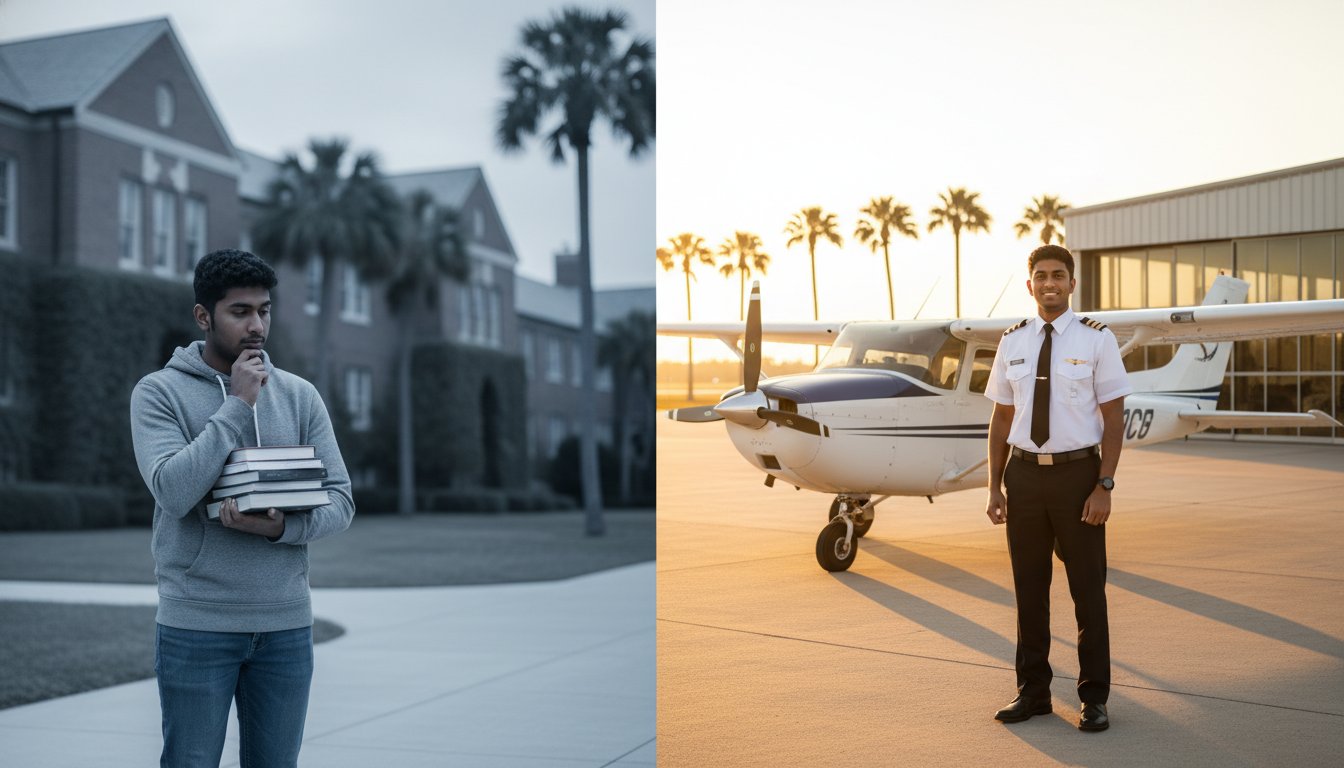
With a projected shortfall of 24,000 pilots across the industry this year, major carriers like Delta and United have officially shifted the four-year degree from a strict requirement to a preferred qualification. Choosing a specialized aviation academy over a traditional university is now a tactical move for those who want to reach the cockpit sooner. You're likely weighing the excitement of flight against the fear of wasting years on a degree that isn't mandatory for your success. It's a high-stakes decision, and feeling anxious about the 1,500-hour rule or the differences between training regulations is completely understandable.
By reading this guide, you'll discover the critical differences between these paths to choose the most cost-effective route for your goals. We'll break down the practical timeline to reaching the airlines, compare the job security offered by each route, and provide a roadmap tailored to 2026 hiring trends. From understanding how Part 141 programs can streamline your training to identifying which path offers the best return on investment, you'll gain the clarity needed to launch your professional pilot career with confidence. It's time to turn your passion for the skies into a tangible destination.
Key Takeaways
- Accelerate your timeline to the cockpit by choosing a focused 10 to 18-month training path instead of a traditional four-year university commitment.
- Understand why major carriers have shifted degree requirements to preferred, positioning a career-focused aviation academy as the most efficient route to your 2026 hiring goals.
- Evaluate the technical differences between Part 141 and Part 61 schools to select the training structure that fits your personal learning style and professional ambitions.
- Learn how to audit a flight school's fleet and maintenance logs to ensure you're training on modern, reliable equipment that meets industry standards.
- Explore how structured programs like the Wings Foundation build a solid private pilot base before you transition into elite commercial training tracks.
What is an Aviation Academy? Defining the Tactical Path
An aviation academy serves as a high-intensity launchpad for your professional career. It's a structured environment where the objective isn't just to earn a license, but to master the specific skill sets required by major airlines. In 2026, this tactical focus is more valuable than ever. As the industry grapples with a shortfall of 24,000 pilots, the demand for airline-ready candidates has reached a fever pitch. You aren't just learning to fly; you're adopting the discipline and technical proficiency of a commercial first officer through immersive tracks like the Career Pilot Program.
This immersion experience goes beyond the basics. It includes rigorous ground school, standardized flight hours, and a commitment to professional standards that mimics a corporate flight department. To grasp the full scope of this journey, it's helpful to review what is flight training at a professional level. You'll move from your first solo to advanced instrument ratings with a focus on precision and safety. This structured approach ensures that when you step into an airline interview, you're speaking their language from the first minute. Earning your Commercial Pilot License (CPL) isn't just a technical achievement; it's the specific milestone that transforms you from a student into a professional eligible for a $90,000 starting salary.
The Role of FAA Part 141 Certification
Airlines prefer candidates from Part 141 schools because they follow a strict, FAA-approved syllabus. This structure provides a predictable training quality that casual, local schools often lack. Because the curriculum is so rigorous, the FAA allows students to qualify for certain certificates with fewer total flight hours compared to less structured programs. This efficiency means you reach your goals faster and with a higher level of technical competency. It's about training smarter, not just longer. When you follow a standardized syllabus, you develop the muscle memory and procedural habits that major carriers expect from their flight crews.
Academy vs. Local Flight Club
Choosing a dedicated aviation academy over a casual flight club is a decision about your professional future. While clubs are great for weekend hobbyists, they often struggle with instructor availability and inconsistent fleets. A professional academy provides a uniform fleet of modern aircraft, often featuring glass cockpits that reflect what you'll see in a regional jet. This consistency allows you to focus on your skills rather than learning the quirks of a different airplane every week. You're treated like a professional from your very first day on the ramp, surrounding yourself with mentors and peers who share your drive for the cockpit.
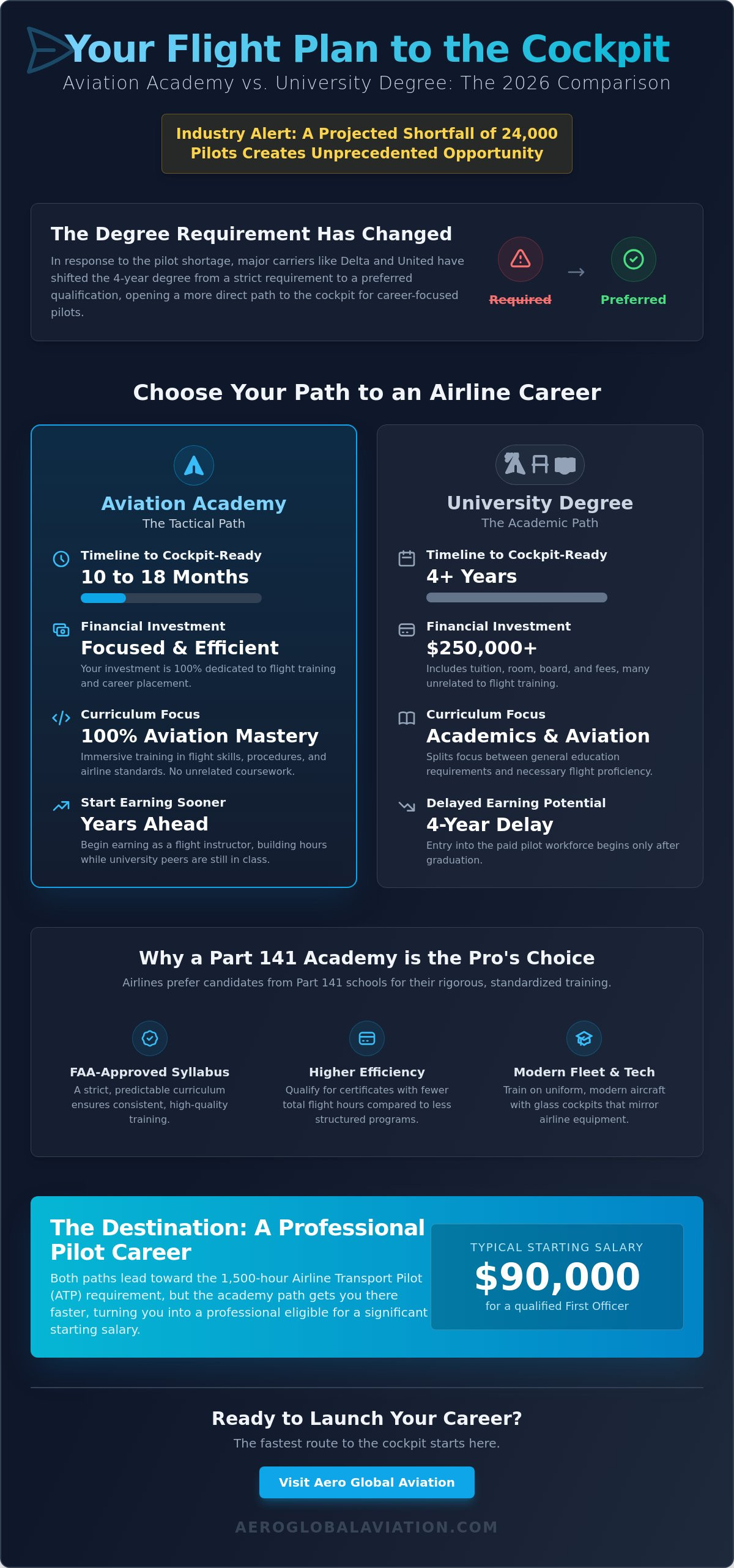
Aviation Academy vs. University Degree: The 2026 Comparison
Deciding between a four-year university and a dedicated aviation academy comes down to your personal timeline and financial goals. In 2026, the contrast is stark. A university degree requires four years of full-time study. In contrast, an academy program can guide you through your ratings in 10 to 18 months. This difference isn't just about the calendar. It's about the heavy financial burden of academic credits, room, and board that don't directly contribute to your flight hours. While a university degree might cost over $250,000 at some institutions, the academy route focuses your investment entirely on the cockpit.
The FAA Commercial Pilot Certificate Requirements focus strictly on aeronautical knowledge and flight proficiency. A university path forces you to split your attention between these critical skills and general education requirements. An academy allows you to live and breathe aviation every day. Both paths eventually lead toward the 1,500-hour Airline Transport Pilot requirement. However, academy graduates typically start earning money as flight instructors years before their university peers even finish their senior year. This head start is vital in a year where the industry faces a shortfall of 24,000 pilots.
The Academic vs. Technical Split
You don't need a semester of College Algebra or World History to safely command a modern jet. While a degree offers a broad educational base, an aviation academy focuses 100% on the technical mastery of the aircraft and the regulations governing the skies. This specialized training ensures you're fully prepared for the high-stakes environment of a professional cockpit from day one. A degree might still make sense if you're pursuing a military commission or want a non-aviation backup career. For those purely focused on the flight deck, the technical route is the most direct path to success.
ROI and Speed-to-Market
The true cost of a four-year degree is the opportunity cost. If you graduate from an academy two years earlier, you gain two extra years of seniority at an airline. In an industry where seniority dictates your schedule, your aircraft type, and your pay, starting early is worth millions over a thirty-year career. Programs like our career pilot program are designed to maximize this speed-to-market. With regional airlines offering starting salaries around $90,000, every month you spend in a traditional classroom is a month of lost professional income. If you're ready to accelerate your journey, you can begin your professional training with a mentor who prioritizes your timeline.
The Degree Myth: Do Major Airlines Still Require a 4-Year Diploma?
For decades, a four-year bachelor's degree was the unofficial ticket to a major airline cockpit. It served as a screening tool during times when applicants far outnumbered available seats. Today, the landscape has shifted entirely. As of May 2026, major carriers like Delta Air Lines and United Airlines have officially reclassified the four-year degree from "required" to "preferred." This change reflects a pragmatic response to the peak of the pilot shortage, which currently faces an estimated shortfall of 24,000 pilots. Airlines now prioritize your technical proficiency and flight hours over your academic GPA.
Recruiters are looking for a professional portfolio that demonstrates mastery of the skies. This includes a clean checkride record, diverse flight experience, and advanced ratings. Choosing an aviation academy allows you to build this portfolio quickly. Instead of spending four years in a lecture hall, you're spending that time in the air, logging the specific hours that make you a valuable asset to any flight department. Job security in 2026 isn't found in a diploma; it's found in the seat of a modern aircraft where your skills are in high demand.
The 1,500-Hour Rule as the Great Equalizer
The FAA mandates a minimum of 1,500 total flight hours for an Airline Transport Pilot (ATP) certificate. This requirement is the true gatekeeper of your professional career. Because of this, the most important metric for any aspiring pilot is the speed at which they reach their Commercial Pilot License (CPL) and Certified Flight Instructor (CFI) ratings. A dedicated aviation academy streamlines this process, often graduating students in less than half the time of a university program. Once you're an instructor, you're getting paid to build the hours you need for the airlines. Recruiters are far more interested in your performance during commercial pilot training than your choice of college minor. They want to see that you can handle the responsibility of a multi-million dollar aircraft with precision and safety.
Future-Proofing Your Career
You might worry that skipping a degree now could limit your advancement later. In reality, many pilots choose to complete their bachelor's degree online once they've reached a regional or major airline. This strategy allows you to earn a professional salary, with median annual pay for airline pilots now around $226,600, while finishing your education on your own schedule. While university graduates may qualify for a Restricted ATP at 1,000 hours, the four years they spend in a classroom often negates that advantage. An academy student is usually already flying for a regional carrier by the time a university student tosses their graduation cap. Your ultimate job security comes from your technical proficiency and your seniority number. By focusing on high-quality training at an aviation academy, you ensure that your career trajectory remains steep and your earning potential starts as early as possible.
How to Evaluate an Aviation Academy: A Check-List for Success
Choosing the right aviation academy requires more than a quick look at a brochure. You need a rigorous checklist to ensure your investment translates into a seat at a major airline. Start by verifying the school's FAA status. While Part 61 training offers flexibility, a Part 141 certificate indicates a structured syllabus that airlines often prefer for its consistency and oversight. Next, inspect the fleet. You should look for aircraft equipped with modern glass cockpits, such as the Garmin G1000. Training on the same technology used in regional jets reduces your learning curve during airline transition training.
Personalized mentorship is the heartbeat of a successful training experience. Ask about the instructor-to-student ratio to ensure you won't be fighting for schedule blocks or simulator time. An academy that prioritizes career placement support and maintains active airline pathways provides a clear bridge to your first professional job. Finally, evaluate the geographic location. A school located in a region with complex airspace and reliable weather will maximize your training efficiency and prepare you for the realities of commercial flying.
The Kissimmee and Orlando Advantage
Training in Central Florida offers a strategic advantage that few other regions can match. With more flyable days per year than almost any other part of the country, you'll avoid the long seasonal delays that plague northern schools. Operating out of Kissimmee puts you adjacent to the complex Class B airspace of Orlando International (MCO). Navigating this busy environment from day one builds the radio proficiency and situational awareness that recruiters look for. The local aviation community here is a networking goldmine, filled with professional pilots and mentors who are deeply invested in the next generation of talent.
Red Flags to Avoid
Be cautious of schools that function primarily as aircraft rental businesses. A true career-track academy focuses on student outcomes, not just keeping planes in the air. Watch out for hidden costs that aren't included in the initial quote. You should specifically ask about fuel surcharges, examiner fees, and mandatory supplies to avoid financial surprises mid-training. Low instructor retention is another major warning sign. If instructors are leaving frequently, it often signals a lack of professional standards or poor maintenance, both of which can stall your progress. When you're ready to see our fleet and meet your future mentors, visit our flight deck to start your journey.
Aero Global Aviation Academy: Your Practical Mentor to the Skies
Choosing your flight training provider is the final, most critical step in your 2026 career plan. At our aviation academy, we don't just process students through a factory line; we cultivate future captains through a deeply personal mentorship model. We understand that the transition from a dreamer to a professional pilot requires more than just hours in a logbook. It requires a dedicated partner who understands the local Kissimmee environment and uses that knowledge to sharpen your skills. Our approach balances the high-stakes reality of technical training with the warm encouragement you need to succeed.
We believe every successful career starts with a rock-solid base. This is the core of our Wings Foundation philosophy. By focusing on a comprehensive Private Pilot License (PPL) course first, we ensure you master the fundamentals of flight before moving into complex professional maneuvers. This deliberate pace prevents the burnout often seen in high-volume programs and builds the confidence necessary for a lifetime of safety. Once you've secured your foundation, our advanced flight training bridges the gap between being a student and becoming a professional, preparing you for the rigorous standards of the modern airline industry.
The Airline Pilot Elite Program
Our most comprehensive career track is the Airline Pilot Elite program. This path is specifically designed to take you from your very first flight all the way to advanced instructor certification. We integrate instructor ratings because they're the most reliable way to reach the 1,500-hour ATP milestone while earning a professional income. You won't just be flying; you'll be teaching, which is the ultimate way to master aeronautical knowledge. Throughout this journey, we provide personalized career coaching and resume preparation to ensure your applications stand out to major airline recruiters.
Start Your Journey Today
The best way to feel the difference of a mentor-led environment is to step onto the ramp yourself. We invite you to visit our hangar in Kissimmee to meet our instructors and see our modern fleet in action. Our "Practical Mentor" approach has led to higher checkride pass rates because we prioritize your individual readiness over corporate quotas. You'll train in the heart of Florida's complex airspace, gaining the radio proficiency and situational awareness that airlines demand. When you're ready to stop dreaming and start flying, it's time to launch your career with Aero Global Aviation Academy. Your seat in the cockpit is waiting.
Take Command of Your Aviation Future
Selecting the right path to the flight deck is the most significant decision you'll make for your professional life. Prioritizing speed-to-market and technical mastery allows you to capitalize on the historic pilot shortage while maximizing your long-term seniority. A dedicated aviation academy offers the most direct route to these goals by focusing your energy entirely on the skills airlines value most. By training under FAA Part 141 standards at our Kissimmee-based facility, you'll benefit from consistent flying weather and a curriculum built for professional excellence.
Our mentorship-driven Career Pilot Programs ensure you aren't just another number in a corporate system. You'll receive the personalized attention needed to master complex airspace and excel during your checkrides. The transition from student to professional is a structured, attainable process when you have the right guide by your side. It's time to stop weighing the options and start building your legacy in the skies. Begin Your Professional Pilot Journey at Aero Global Aviation Academy. We look forward to seeing you on the flight deck soon.
Frequently Asked Questions
Is an aviation academy better than a university degree?
An aviation academy is the tactical choice for pilots who prioritize speed and cost-efficiency. While a university offers a broad academic background, an academy focuses entirely on technical flight proficiency and career readiness. This specialized environment allows you to reach the airlines years sooner than a traditional four-year program, maximizing your lifetime earning potential and seniority.
Do I need a 4-year degree to fly for major airlines in 2026?
No, a four-year degree is no longer a mandatory requirement for many major U.S. airlines as of 2026. Carriers like Delta and United have reclassified the degree as a preferred qualification rather than a requirement. Due to the projected shortfall of 24,000 pilots this year, airlines are prioritizing flight experience, professional certifications, and clean checkride records over academic diplomas.
How long does it take to graduate from an aviation academy?
Most students complete their professional pilot ratings at an aviation academy within 10 to 18 months. This accelerated timeline is possible because the curriculum is focused 100% on flight training and ground school. You don't have to navigate semester breaks or general education requirements, allowing you to transition from a beginner to a commercial pilot with high efficiency.
What is the average cost of an aviation academy vs. a university?
An aviation academy typically requires a lower total financial investment than a four-year university program. University costs are often doubled by four years of academic tuition, room, board, and fees that don't directly contribute to your flight hours. By choosing a dedicated flight school, you focus your entire budget on the cockpit and start earning a professional salary much earlier.
Can I get financial aid for an aviation academy?
Many students secure funding through private student loans or specialized aviation lenders who understand the industry's high earning potential. While academies don't usually offer federal FAFSA aid, they often partner with financial institutions to provide competitive options for their Career Pilot Program. You should check with each school's admissions office to see which lending partners they currently accept.
What is the 1,500-hour rule and how does it affect my choice?
The 1,500-hour rule is an FAA mandate requiring pilots to log 1,500 total flight hours before they can fly for a commercial airline. This rule makes your "time-to-instructor" critical. An academy helps you earn your instructor ratings faster so you can get paid to build those hours. This path allows you to reach the 1,500-hour milestone while gaining valuable professional teaching experience.
Will an aviation academy help me get a job at the airlines?
Yes, reputable academies provide career placement support and maintain active networking pathways with regional carriers. These schools often host recruiter events and provide resume coaching to ensure your professional portfolio stands out. Training in a professional, mentorship-driven environment from day one helps you develop the situational awareness and technical discipline that airline recruiters demand in 2026.
Why is Florida considered the best place for an aviation academy?
Florida is the premier training location because it offers over 300 flyable days per year and highly complex airspace. Training in Central Florida minimizes weather delays, allowing you to finish your ratings on schedule. Navigating the busy airspace near major hubs also prepares you for the high-density radio work and professional procedures you'll encounter every day as an airline pilot.


