

The most successful airline pilots of 2028 aren't the ones who quit their day jobs today; they're the ones who mastered the art of the "Sunrise Sortie" at Kissimmee Gateway. If you feel caught between the financial security of your current career and the pull of the cockpit, you're not alone. The reality is that balancing a job while in flight school Kissimmee isn't just a survival tactic; it's a strategic move to enter the aviation industry with minimal debt and maximum focus.
We know the weight of a mortgage and the exhaustion of Orlando traffic can make a career change feel out of reach. However, your dream of flying doesn't have to wait for a perfect moment that may never come. This guide shows you how to integrate professional training into your existing life through flexible 2026 training models and smart scheduling. You'll discover a realistic path to transition into a commercial pilot seat by 2027 or 2028 without sacrificing your financial stability. We will explore how to leverage local advantages and mentor-led programs to ensure you stay on track for your FAA exams while keeping your current professional life thriving.
Key Takeaways
- Learn why Part 61 training is the preferred choice for working professionals, offering the flexibility to tailor your flight hours around your career commitments.
- Master the art of balancing a job while in flight school Kissimmee by leveraging early morning "Sunrise Sorties" at Kissimmee Gateway Airport to beat the Orlando traffic.
- Explore the "Pay-As-You-Go" model to achieve a debt-free transition into the cockpit while calculating your future return on investment in the 2026 pilot market.
- Boost your study efficiency with modern AI-driven tools and home-based simulators that build critical muscle memory without the cost of fuel.
- Discover how the "Practical Mentor" approach at Aero Global Aviation Academy guides you from the Wings Foundation through to the Airline Pilot Elite certification.
Can You Balance a Job and Flight School in Kissimmee?
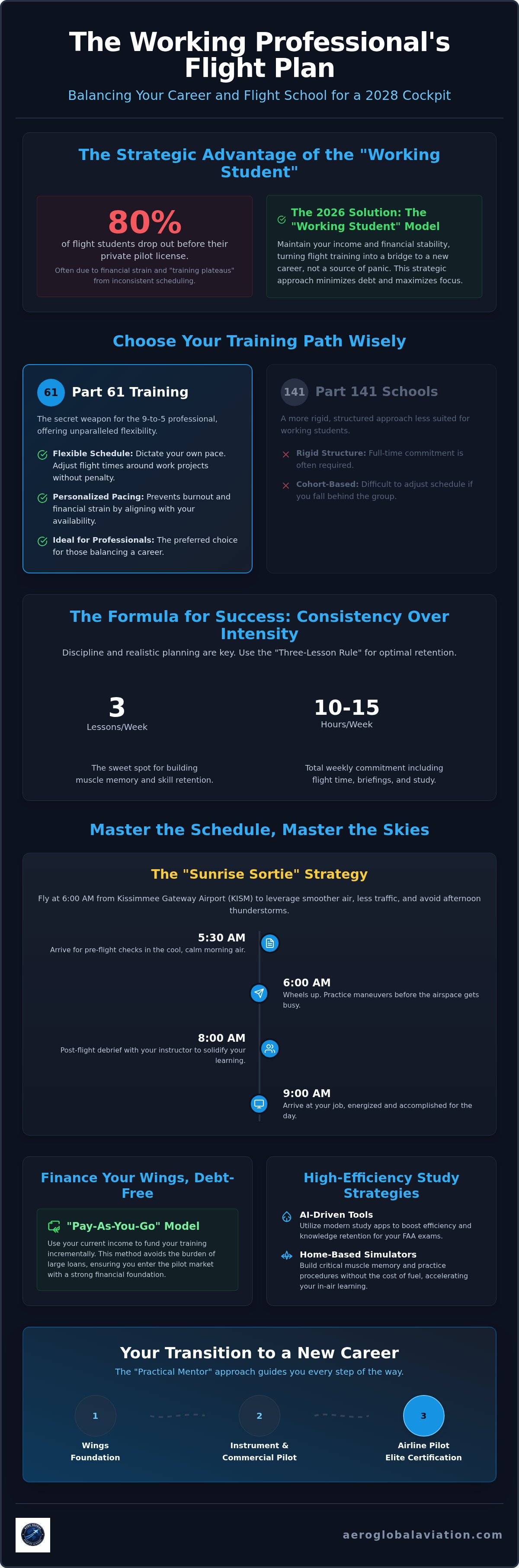
In 2026, the "Working Student" model has evolved from a difficult struggle into a strategic advantage for aspiring aviators. You aren't just a hobbyist; you're a professional-in-training who recognizes that financial stability is the foundation of a successful career transition. This shift in mindset is the first step in successfully balancing a job while in flight school Kissimmee. By maintaining your current income, you ensure that flight training remains a bridge to a better future rather than a source of financial panic.
Many prospective pilots are haunted by the statistic that 80% of students drop out before earning their private pilot license. This failure rarely stems from a lack of ability or the complexity of what flight school entails. Instead, it's often caused by "training plateaus" where students stop for weeks at a time, lose their proficiency, and then spend more money relearning old skills. You can avoid this trap by committing to a schedule that fits your life, rather than forcing your life to fit a rigid program.
The Flexibility of Part 61 Training
Part 61 training is the secret weapon for the 9-to-5 professional. Unlike the rigid, full-time requirements often found in Part 141 schools, Part 61 allows you to dictate your own pace. If a work project demands extra hours one week, you can adjust your flight schedule without falling behind a cohort of other students. Aero Global Aviation Academy specializes in this tailored approach, ensuring your training milestones align with your professional availability. This personalized pacing prevents both academic burnout and the financial strain that comes from forced, full-time enrollment.
Setting Realistic Expectations for 2026
Success requires a disciplined look at your calendar. We recommend the "Three-Lesson Rule" for working professionals. Flying three times a week is the sweet spot for retention; it's enough to build muscle memory but spread out enough to allow for rest and work duties. You should plan for about 10 to 15 hours of total commitment each week, which includes flight time, pre-flight briefings, and ground school study. Transitioning careers requires social and personal sacrifices. You might spend Saturday mornings in the cockpit instead of on the golf course, but by 2027, that investment will put you in a professional cockpit. Consistency always beats intensity when you're balancing a job while in flight school Kissimmee.
Mastering the Kissimmee Schedule: Weather, Commutes, and Timing
Kissimmee Gateway Airport (KISM) stands as a strategic sanctuary for the working pilot. Unlike the sprawling complexity of Orlando International (MCO), KISM offers a streamlined environment where you spend less time idling on the taxiway and more time building hours. This efficiency is paramount when you're balancing a job while in flight school Kissimmee. Every minute saved on the ground is a minute you can dedicate to your professional responsibilities or your flight training goals. By choosing a hub that caters to general aviation rather than massive commercial airliners, you ensure your training remains the priority.
The Sunrise Sortie: Beating the Heat and the Office
Florida's 2026 climate remains a pilot's best friend, provided you know how to time your flights. The "Sunrise Sortie" involves booking your slot for 6:00 AM. By the time the typical 3:00 PM thunderstorms roll across Central Florida, you've already completed your maneuvers and are safely back at your desk. This strategy allows you to fly in smooth, stable air that makes mastering landings much easier while avoiding the midday heat that can lead to fatigue.
A typical morning routine for a professional student looks like this:
- 5:30 AM: Arrive at the academy for pre-flight checks while the air is still cool.
- 6:00 AM: Wheels up. Practice your maneuvers before the airspace becomes crowded.
- 8:00 AM: Post-flight debrief with your instructor to review your progress.
- 9:00 AM: Log into your remote workspace or arrive at the office, energized by the morning's achievements.
Navigating the Orlando-Kissimmee Commute
Traffic in 2026 requires a tactical approach to keep your stress levels low. To avoid the worst of the congestion on I-4 and Florida’s Turnpike, schedule your lessons outside the 7:30 AM to 9:30 AM and 4:30 PM to 6:30 PM windows. KISM's location allows you to bypass the heaviest tourist traffic surrounding the theme parks, giving you a more predictable commute. While driving, you can turn transit time into study time by using audio-based ground school reviews or practicing your radio communications.
If you're also researching financing your flight training, these quiet moments during your commute are perfect for planning your long-term budget. Balancing a job while in flight school Kissimmee becomes much simpler when you treat your commute as a productive part of your training day. Central Florida offers over 300 days of flyable weather annually, making it one of the most efficient places globally to fast-track your ratings. If you're ready to see how a professional schedule fits into the cockpit, you can evaluate local training options to find a rhythm that works for your unique career path.
Financing Your Wings: Pay-As-You-Go vs. Traditional Loans
Deciding how to fund your aviation journey is just as critical as choosing your flight instructor. For many professionals, the choice between high-interest debt and steady self-funding is the biggest hurdle to overcome. When you're balancing a job while in flight school Kissimmee, your current paycheck becomes your most valuable tool for risk management. Instead of taking on a massive loan that requires immediate repayment, you can pay for each flight as you complete it. This "Pay-As-You-Go" model ensures you never owe money for hours you haven't flown yet, protecting you if a work deadline or family emergency forces a temporary pause in your training.
The return on investment for a pilot career in 2026 is exceptionally strong. With median annual salaries for airline pilots reaching $232,140 in 2025, according to the Bureau of Labor Statistics, the training investment is one that pays for itself quickly. Even commercial pilots in non-airline roles saw median salaries of $123,220. By working while you train, you maintain a safety net that covers your daily living expenses, allowing your future pilot earnings to go toward wealth building rather than just debt servicing.
Pros and Cons of the Debt-Free Path
The debt-free path offers a psychological freedom that shouldn't be underestimated. You can focus entirely on the cockpit without the shadow of a monthly loan statement hanging over you. Our Wings Foundation program is designed specifically to help students reach that first milestone, the Private Pilot License, without the burden of massive upfront costs. While this path may take slightly longer, you own every hour of progress. In contrast, traditional loans can carry high interest rates that compound if you hit training delays, making the pay-as-you-go approach a safer bet for the professional student.
Leveraging Your Current Income
To keep your skills sharp, you should budget for at least two to three lessons per week. This frequency is the minimum required to balance a job and flight training effectively without losing proficiency. Your steady income also makes you a better candidate for specialized financing later on. Many students choose to self-fund their Private Pilot and Instrument ratings, then use a small, strategic loan for the final push into Commercial and Multi-Engine certifications. This hybrid approach minimizes total interest while maximizing your speed to the first paycheck in the cockpit. Don't forget to consult with a tax professional about potential education credits or deductions available for career transitions in 2026. If you are also maintaining professional credentials or board roles during this time, you can learn more about Education Pathways, LLC for state-approved continuing education.
Efficiency isn't just a buzzword; it's the difference between finishing your ratings in months rather than years. When you're balancing a job while in flight school Kissimmee, your study time is your most precious resource. This need for streamlined learning is a hallmark of modern vocational education, where global providers like Apeiro Institute set a high standard for delivering flexible, high-quality training that respects a student's professional commitments. By 2026, the traditional method of lugging around heavy textbooks has been replaced by high-tech, streamlined solutions that fit into the gaps of a busy workday. You don't need hours of uninterrupted silence to make progress; you need a system that works with your professional life.
Modern Tools for the Busy Student
AI-driven tutors now provide personalized feedback on FAA written exam question banks, identifying exactly where your knowledge gaps are so you don't waste time on topics you've already mastered. VR headsets have become a game-changer for cockpit familiarization. Instead of paying for aircraft rental time just to sit and learn the instrument panel, you can practice your "flow" in a virtual cockpit from your living room. Cloud-based flight planning tools allow you to prepare for your next lesson during a lunch break, ensuring you arrive at the airport ready to fly immediately. These tools allow you to build muscle memory for free before you ever turn the key in an actual airplane.
Mastering FAA Written Exams While Working
One of the most effective strategies is the "Batching" method. Instead of trying to learn everything at once, focus exclusively on the ground school for one rating at a time. Many successful students choose to finish their entire ground school and pass the FAA written exam before they even step into the cockpit for intensive flight hours. This approach allows you to focus purely on the physical skill of flying without the stress of an upcoming test. Early exposure to Commercial Pilot Training materials can also give you a broader perspective on how foundational concepts apply to professional flight certification.
Incorporating a "15-Minute Ground School" habit into your daily routine keeps the information fresh. Whether it's reviewing flashcards during your commute or watching a quick video on weather patterns before bed, these micro-sessions maintain academic momentum between flight lessons. This steady progress is vital for balancing a job while in flight school Kissimmee. If you're ready to start your journey with a structured plan, explore our student-led training models to find the right fit for your schedule.
Transitioning to Your New Career with Aero Global Aviation Academy
The journey from a desk to a flight deck is a transformation that requires more than just flight hours; it requires a partnership. At Aero Global, we don't just see you as a student pilot. We see you as a future colleague. Our "Practical Mentor" approach is designed specifically for those balancing a job while in flight school Kissimmee. Many of our instructors have walked this exact path themselves, navigating professional responsibilities while building their hours. This shared experience means we understand that your time is valuable and your training must be efficient, structured, and results-oriented.
The Career Pilot Program for Professionals
Our training roadmap is built to scale with your ambition. You might start with the Wings Foundation to secure your Private Pilot License, but the ultimate destination for most is the Career Pilot Program. This comprehensive track takes you through your Instrument Rating and Commercial Pilot License, providing the milestones needed to enter the industry. For those looking to reach the pinnacle of training, the Airline Pilot Elite program offers the advanced instructor certifications required to bridge the gap to the major airlines.
We know that professional life in 2026 can be unpredictable. If a last-minute work emergency arises, our academy handles scheduling changes with the flexibility that only a dedicated local partner can provide. Beyond the cockpit, training at KISM allows you to network with a community of aviators in the Orlando area. These connections are vital; the person you share a coffee with in the hangar today could be the one who recommends you for your first commercial seat in 2027.
Your 2026 Launchpad at KISM
Choosing a local academy over a massive "pilot factory" gives you a distinct advantage. You receive personalized attention and a training schedule that respects your existing career. Your current job isn't a distraction from your aviation goals; it's the fuel that funds your future. It provides the stability and financial independence that allow you to focus on mastering the aircraft without the weight of mounting debt. For those managing family life alongside their career change, ensuring a strong educational start for their children at an institution like Jumpstart Learning Academy is a key part of that long-term success.
The first step is often the most revealing. We recommend a Discovery Flight as a career litmus test. It's a chance to get behind the controls, feel the aircraft's response, and confirm that the cockpit is where you belong. If you're ready to stop dreaming and start flying, book a consultation with us today. We'll work together to build a custom part-time schedule that ensures you're balancing a job while in flight school Kissimmee effectively, keeping you on track for a successful career transition by 2028.
Your Flight Deck Career Starts in Kissimmee
Transitioning into aviation in 2026 doesn't require you to abandon the financial security you've worked hard to build. By leveraging the flexibility of Part 61 training and the strategic advantages of Kissimmee Gateway Airport, you can maintain your current income while fast-tracking your pilot ratings. We've explored how "Sunrise Sorties" and modern study aids allow you to master the skies without burning out or sacrificing your professional performance.
Success in balancing a job while in flight school Kissimmee comes down to having the right partner by your side. At Aero Global Aviation Academy, our mentor-led programs are specifically designed for career-switchers who need a realistic roadmap from their first flight to a professional cockpit. Our proven track record from PPL to CPL shows that with a disciplined schedule and professional support, your transition to the flight deck is an attainable destination rather than just a distant dream.
Take the next step toward your future today. Build your custom part-time flight schedule with Aero Global Aviation Academy and see how our flexible training models fit your life. The horizon is waiting, and we're here to help you reach it.
Frequently Asked Questions
Is it possible to become a commercial pilot while working 40 hours a week?
Yes, it's entirely possible to achieve your commercial pilot goals while maintaining a full-time career. Many of our students use the flexibility of Part 61 training to schedule flights around their 40-hour work weeks. By enrolling in a structured path like the Career Pilot Program, you can build hours consistently without resigning from your current position. This approach allows you to fund your training while gaining the necessary experience for a professional cockpit seat.
How many times a week should I fly to maintain my progress?
To maintain steady progress and retain muscle memory, we recommend flying at least two to three times per week. This frequency ensures that you aren't spending valuable lesson time relearning skills from previous sessions. While some students fly more during weekends, consistency is the most important factor. Balancing a job while in flight school Kissimmee becomes much easier when you establish a predictable rhythm that keeps your skills sharp and your momentum high.
What is the "Sunrise Sortie" and how does it help student pilots in Florida?
The "Sunrise Sortie" is an early morning flight lesson, typically starting around 6:00 AM at Kissimmee Gateway Airport. This strategy is highly effective in Florida because it allows you to fly in the coolest, most stable air of the day. You'll avoid the common afternoon thunderstorms that often disrupt training schedules. Plus, finishing your flight before 9:00 AM means you can head to the office energized and ready for your workday.
Can I use my current salary to pay for flight school without taking loans?
You can certainly use your current income to fund your training through a "pay-as-you-go" model. This debt-free approach is a popular choice for working professionals who want to avoid high-interest loans. By paying for each lesson as you complete it, you maintain total control over your finances. Many students start with our Wings Foundation course to secure their Private Pilot License while using their salary to cover costs at a manageable, sustainable pace.
Does Aero Global Aviation Academy offer weekend or evening flight lessons?
Aero Global Aviation Academy specializes in supporting career-oriented students with flexible scheduling options, including weekends and evenings. We understand that your professional commitments don't always follow a standard pattern. Our instructors work closely with you to find time slots that fit your unique life, whether that means early morning sessions or weekend intensives. This personalized attention ensures that your path to becoming a pilot remains both attainable and rewarding without compromising your current professional role.
How long does it take to get a PPL while working full-time in Kissimmee?
Obtaining a Private Pilot License (PPL) while working full-time typically takes between six to twelve months. The exact timeline depends on how frequently you can fly and your dedication to ground school study. Students who commit to two or three lessons per week often see the most efficient progress. Leveraging the favorable Kissimmee weather and our Wings Foundation curriculum helps you reach this first major milestone as quickly and safely as possible.
What are the best study tools for student pilots with limited time in 2026?
In 2026, the best tools for busy students include AI-driven study aids that identify knowledge gaps and VR headsets for home-based cockpit familiarization. Cloud-based flight planning apps allow you to prepare for lessons during your lunch break or commute. These digital resources maximize your efficiency, allowing you to master complex FAA written exam material in short, focused sessions. Using these modern tools helps you stay academically prepared even when your schedule is packed with professional duties.
What happens if my work schedule changes during my flight training?
If your work schedule changes, our academy offers the flexibility needed to adjust your training plan accordingly. Because we utilize a Part 61 framework, you aren't locked into a rigid cohort schedule. We act as a practical mentor, helping you pause or accelerate your training based on your professional availability. This collaborative spirit ensures that balancing a job while in flight school Kissimmee remains a stress-free process that adapts to the realities of your career.


