
Did you know that the top 10% of airline pilot earners are now bringing home more than $239,200 a year? If you're looking at the flight deck from the ground, you probably find yourself asking: is becoming a pilot a good investment 2026? It's a valid concern when you consider the commitment required for professional training and the noise surrounding economic shifts. You want to ensure that your time in the cockpit translates into a stable, high-paying career rather than just an uncertain future.
We understand that the initial investment in your education can feel daunting, especially when you're trying to choose between various training pathways. This article provides a clear look at the financial and professional return on investment you can expect right now. You'll discover exactly when you can start earning a professional salary and why the mandatory retirement age of 65 continues to create a massive opening for new talent. We'll also explore how choosing a structured environment like our Airline Pilot Elite program in Kissimmee can minimize training delays and get you to your 1,500-hour milestone faster than you thought possible.
Key Takeaways
- Uncover why the mandatory retirement age of 65 is creating a massive hiring vacuum that supports high entry-level wages for new pilots through the end of the decade.
- Compare training costs against major airline salary projections to see why becoming a pilot is a good investment 2026 for those targeting the top 10% of earners.
- Learn how training in the favorable climate of Kissimmee acts as a strategic asset, protecting your budget from the hidden costs of weather-related delays.
- Discover the step-by-step roadmap from the Wings Foundation to the Airline Pilot Elite track, turning your passion into a tangible career destination.
- See how personalized mentoring at a dedicated career academy provides the competitive edge needed to navigate modern airline hiring requirements.
Evaluating the Professional Aviation Landscape in 2026
The aviation industry has reached a pivotal moment where the demand for skilled aviators is no longer just a projection; it's a daily operational reality for airlines. As you look at the current market, you might wonder if becoming a pilot a good investment 2026. The answer lies in the structural shifts within the global fleet. According to the 2026 Boeing Pilot and Technician Outlook, the industry requires a massive influx of new personnel to support long-term fleet growth and replace departing veterans. This isn't a temporary spike. It's a fundamental change in how airlines source their talent.
Aviation is increasingly viewed as a recession-resistant trade skill. While other sectors face uncertainty from automation or economic shifts, the mandatory retirement age of 65 for commercial pilots creates a predictable and non-negotiable hiring vacuum. For those seeking a broad Overview of the pilot profession, it's clear that the path from a student to a high-earning captain is more structured and secure than it was a decade ago. You aren't just learning to fly; you're acquiring a technical certification that the global economy cannot function without.
The 2026 Pilot Shortage: Myth vs. Reality
The shortage is very real, but it has evolved into a strategic competition for talent. Regional airlines are working harder than ever to attract new pilots, often offering signing bonuses that can reach up to $50,000 in 2026 to secure commitments. These carriers act as the primary engine for the "flow-through" agreements that eventually move you into the cockpit of a major airline. This system creates a clear, reliable path for advancement. The pilot shortage has effectively shifted the power into your hands, forcing airlines to offer record-breaking starting pay and better quality of life to keep their planes in the air.
Aviation Technology and Training Standards
To succeed in this environment, your training must match the technology you'll find in a modern jet. The industry now expects new hires to be proficient with glass cockpit systems like the Garmin G1000. Training in this digital environment from day one makes your transition to heavy aircraft much smoother. Modern simulation is also playing a huge role in your ROI. It's reducing the cost of instrument rating proficiency by allowing you to master complex procedures on the ground before you ever burn a drop of fuel. Choosing a career-oriented academy ensures you're learning the specific standards that major airlines demand, rather than just flying for recreation.
The Financial Math: Training Costs vs. Pilot Salaries
When you analyze the numbers, the most important metric isn't the hourly rental rate of a Cessna; it's the "Total Investment" required to reach your first paycheck. While you can discover Fun Flying Aviation Ltd for structured microlight training, many students get caught up in finding the cheapest hourly rate for commercial paths and overlook the hidden costs of a drawn out timeline. A four year aviation degree can be a fulfilling path, but the tuition and time away from the workforce often pale in comparison to an accelerated flight academy. By choosing a focused environment, you're not just saving on interest; you're entering the high earning phase of your career years earlier. If you're asking if becoming a pilot a good investment 2026, the answer is found in the speed of your progression.
Entry-Level Earnings: The CFI and Regional Phase
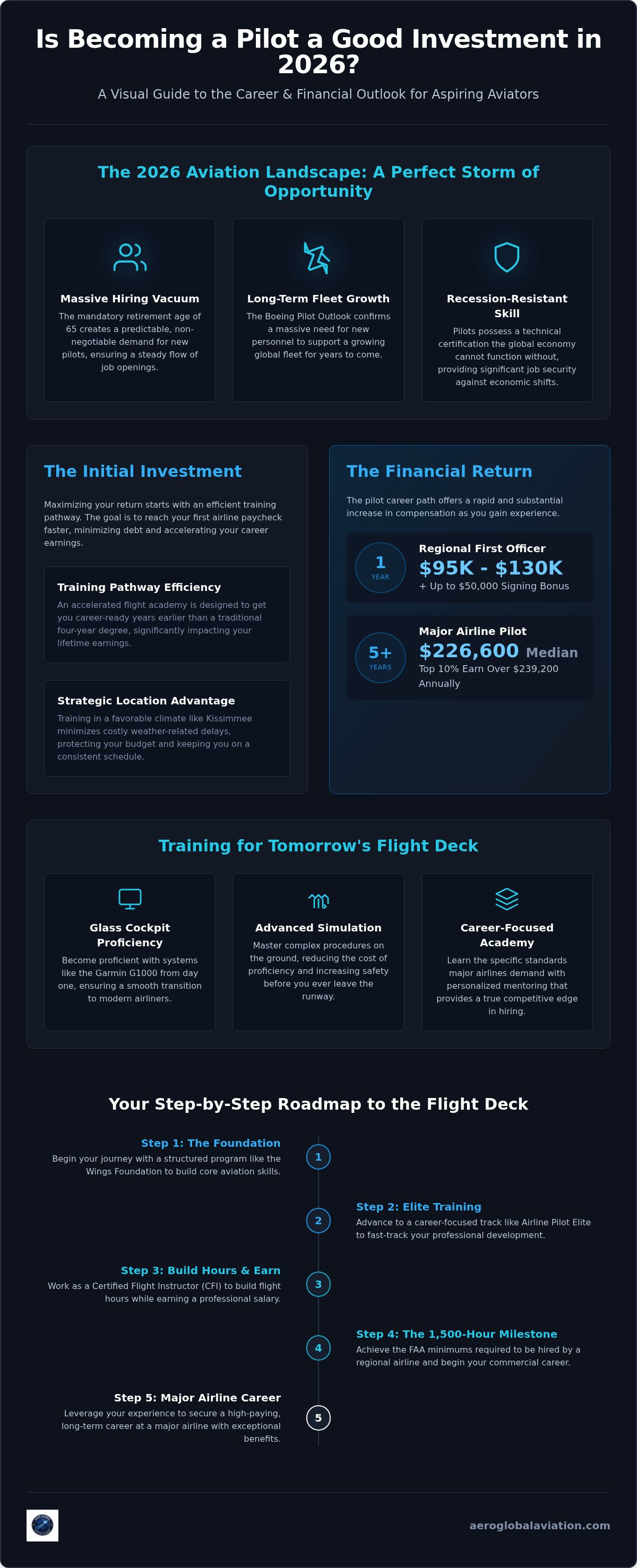
The path to 1,500 hours is often paved by working as a Certified Flight Instructor (CFI). This phase is a strategic move that allows you to earn a living while building the precision required for airline operations. Once you hit those FAA minimums, the financial transition is rapid. In 2026, first year regional First Officers are seeing compensation packages between $95,000 and $130,000. These figures often include signing bonuses of up to $50,000, which act as a powerful tool to offset your initial training debt. This immediate cash flow provides a level of financial stability that few other entry level professions can match.
The Long-Term Payoff: Major Airline Compensation
The real wealth in aviation is built through seniority at a major carrier. According to recent Pilot career outlook and salary data, the median annual wage for airline pilots has reached $226,600. For those who reach the top 10% of the profession, annual earnings exceed $239,200. Beyond the base pay, the retirement benefits are exceptional. Most major airlines provide direct 401k contributions that far exceed the matching programs found in standard corporate roles. When you factor in the lifestyle flexibility that comes with high seniority, the return on your initial training becomes exponential over a thirty year career.
- Seniority Logic: Higher seniority equals better route choices, more days off, and significantly higher pay scales.
- Retention Bonuses: Airlines are increasingly using mid career bonuses to keep experienced captains in their seats.
- Global Mobility: A commercial license is a portable asset that is in demand across every continent.
If you're ready to start calculating your own career trajectory, you can explore our Career Pilot Program to see how we help students bridge the gap from beginner to professional.
Beyond the Sticker Price: Why Training Efficiency Matters
When you calculate your potential returns, don't just look at the quote on the brochure. The true cost of flight school includes the salary you lose every month you spend on the ground instead of in the air. This is why training efficiency is the secret variable in deciding if becoming a pilot a good investment 2026. If a program takes two years due to weather delays when it could have taken 14 months, you've effectively "paid" an extra $100,000 in lost regional airline wages. Understanding the Pilot Career Outlook means realizing that getting to your 1,500-hour milestone as quickly as possible is your primary financial objective.
The Orlando Weather Advantage
Central Florida offers a strategic advantage that most northern schools simply cannot match. With over 300 flyable days per year, our students in Kissimmee avoid the seasonal "groundings" that plague the Northeast and Midwest. This consistent access to the cockpit significantly shortens the PPL to CPL timeline. Finishing your ratings just six months earlier doesn't just save on living expenses; it places you in the hiring queue half a year sooner. This allows you to start accruing seniority and retirement benefits while others are still waiting for the clouds to clear.
Fleet Availability and Maintenance
Nothing stalls your momentum like a "maintenance" sign on the aircraft you were supposed to fly for your cross-country solo. High fleet uptime is a non-negotiable factor when deciding if becoming a pilot a good investment 2026, as every canceled flight represents a delay in your career trajectory. We prioritize high-density training by maintaining an on-site mechanical team that keeps our fleet in peak condition. This reliability is essential for skill retention. When you fly four times a week instead of once every ten days, your muscle memory develops faster and you require fewer review hours.
Our modern fleet, equipped with glass cockpit technology, prepares you for advanced flight training and ensures you are comfortable with industry-standard avionics from your very first hour. Before you commit, use our checklist for the Best Flight Schools in Florida to ensure your chosen academy has the infrastructure to support your pace. Skill retention and rapid progression are the hallmarks of a smart aviation investment.
Choosing Your Training Track: Wings Foundation to Airline Pilot Elite
Deciding which path to take is just as important as the decision to fly. When you evaluate if becoming a pilot a good investment 2026, you'll see that a structured, cohesive track beats a piecemeal approach every time. You need a roadmap that doesn't just teach you to handle an aircraft, but prepares you for the specific demands of a multi-crew flight deck. By choosing a program that aligns with your ultimate career destination, you eliminate the risk of redundant training and wasted hours. We've designed our tracks to move you from the ground to the cockpit with professional precision.
The Wings Foundation: Building Your Base
Every successful aviation career starts with the Private Pilot License Florida course, which we call the Wings Foundation. This initial phase is where you master the fundamentals of flight, navigation, and FAA regulations. Many students view the PPL as just a hobbyist's certificate, but in the context of professional ROI, it's the most critical hurdle in the investment. A shaky start here leads to expensive re-training costs later when you're trying to master complex commercial maneuvers. We focus on building a rock-solid foundation so that your transition to advanced ratings is a natural, efficient progression.
Airline Pilot Elite: Accelerating the Instructor Path
For those who want to reach the 1,500-hour requirement as quickly as possible, the Airline Pilot Elite program is the definitive choice. This track takes you beyond the Commercial Pilot License (CPL) to earn your Certified Flight Instructor (CFI), CFII, and Multi-Engine Instructor (MEI) ratings. This is the "CFI bridge" that many competitors ignore. By becoming an instructor within our academy, you transform from a student paying for flight time into a professional getting paid to build it. This program is meticulously designed to prepare you for the Airline Pilot Career Path by immersing you in an airline-oriented environment from day one. When considering if becoming a pilot a good investment 2026, the Airline Pilot Elite track offers the clearest math for a rapid career launch.
The transition from a beginner to a regional first officer is a structured journey. Our Career Pilot Program streamlines the move from PPL to CPL, ensuring that every hour you spend in the air is a direct investment in your future. If you're ready to see which track fits your timeline, you can apply for the Airline Pilot Elite program today to secure your spot in our next intake.
Maximizing Your Return at Aero Global Aviation Academy
Choosing the right environment is the final piece of the puzzle. While the industry demand is clear, your personal success depends on the quality of your mentorship. At Aero Global Aviation Academy, we've structured our operations to mirror the professional standards of major carriers. This ensures that when you step into a regional jet, the procedures and discipline feel like second nature. Training at Kissimmee Gateway Airport (KISM) places you in a strategic corridor of Florida's airspace, offering the perfect blend of complex traffic and efficient turnarounds. When you consider if becoming a pilot a good investment 2026, the efficiency of your training ground becomes your greatest competitive advantage.
The "Practical Mentor" Advantage
Next Steps: Securing Your Future in the Cockpit
The best way to test your aptitude and feel the academy's culture is to book a discovery flight. This hands-on experience at KISM allows you to get behind the controls and see the Orlando skyline from your new office. Once you've felt the excitement of that first takeoff, our admissions counselors can help you build a custom career roadmap tailored to your specific goals. Don't let another hiring cycle pass you by. Reach out to our team to discuss your finances and schedule, and let's turn your aspiration into a tangible professional destination.
Your Path to a Professional Cockpit
The data is clear: the aviation industry is hungry for new talent and prepared to reward it well. With major airline salaries reaching record highs and a predictable hiring vacuum created by mandatory retirements, the timing for your entry into flight training is ideal. You've seen that the real return on investment comes from efficiency. By choosing a location like Kissimmee with 300 plus flyable days per year, you protect your budget from weather delays and reach your earning years much faster.
When you ask is becoming a pilot a good investment 2026, the answer lies in choosing a structured path that leads to a real destination. From the Wings Foundation to our Airline Pilot Elite program, our tracks are designed specifically for airline placement. You'll benefit from professional mentorship and a curriculum that mirrors the standards of the world's leading carriers. Don't let another year pass you by on the ground. Launch your career with the Airline Pilot Elite program at Aero Global Aviation Academy and secure your future in the sky. We look forward to seeing you on the flight deck.
Frequently Asked Questions
Is becoming a pilot a good career in 2026 given the current economy?
Yes, aviation remains one of the most stable high earning paths available today. The mandatory retirement age of 65 ensures a steady stream of job openings regardless of short term economic fluctuations. With regional airlines offering significant signing bonuses, the initial return on investment is stronger than in previous decades. It's a technical skill that is globally portable and resistant to automation for the foreseeable future.
How much does it cost to become a commercial pilot in Florida in 2026?
While costs vary based on the specific training track, industry averages for zero to commercial training typically range between $70,000 and $100,000. Choosing an academy in Kissimmee can actually lower your total expenditure by reducing the time spent on the ground due to weather. Our students benefit from consistent flight schedules, which prevents the financial drain caused by extended training timelines and skill degradation.
What is the average starting salary for a pilot in 2026?
First year regional First Officers are currently earning between $95,000 and $130,000, which often includes signing bonuses to attract top talent. This high starting point is a direct result of the ongoing pilot shortage. As you gain experience and move to a major carrier, the median annual wage jumps significantly. Many senior captains earn well over $226,600 according to current labor statistics.
Can I get financing for flight school at Aero Global Aviation Academy?
Prospective students should check with our admissions team for the most current information regarding payment structures and external financing partners. While the academy doesn't provide direct loans, we work with various lenders who specialize in aviation education. Securing your financing early is a vital step in ensuring your training remains intensive and uninterrupted, which is key to maximizing your long term career return on investment.
How long does it take to go from zero hours to an airline job?
Most students can complete their commercial ratings in 12 to 18 months, but reaching a major airline job typically requires hitting the 1,500 hour flight time milestone. Many of our graduates choose the Airline Pilot Elite track to become instructors, allowing them to build those hours professionally. Depending on how often you fly, you could transition from a beginner to a regional airline cockpit in approximately two to three years.
Is flight school a better investment than a university degree for pilots?
For many, an accelerated flight academy offers a faster path to a high salary than a four year degree. While some major airlines once required a bachelor's degree, many have shifted their focus to flight hours and technical proficiency. By starting your career three years earlier, you gain seniority and earn airline wages sooner. This often outweighs the benefits of a traditional degree when evaluating if becoming a pilot a good investment 2026.
What are the medical requirements to become a commercial pilot in 2026?
To fly for a commercial airline, you must obtain and maintain an FAA First Class Medical Certificate. This examination covers vision, hearing, equilibrium, and general cardiovascular health. We strongly recommend that all students secure their medical certificate before beginning the Wings Foundation or Career Pilot Program. Ensuring you meet these physical standards early protects your investment and confirms you're cleared for a professional career in the sky.
Does Aero Global Aviation Academy help with job placement after graduation?
We provide professional mentorship and career guidance to help our graduates navigate the airline hiring landscape. Our Airline Pilot Elite program is specifically designed to transition students into instructor roles, which is the most reliable way to build the hours required for airline placement. By training in a professional environment that mirrors airline operations, our students are better prepared for the rigorous interview and simulator evaluations used by major carriers.


