The biggest flight academy in the country isn't always the right place for your training. Often, the largest "pilot mills" sacrifice the individual mentorship you need to truly master the skies. You're likely feeling the pressure of rising tuition costs and the confusing choice between Part 61 and Part 141 programs while searching for the best flight schools in florida. It's a high-stakes investment, and it's natural to feel uncertain about which environment will actually prepare you for a professional cockpit.
This guide provides the clarity you need to choose a training partner with total confidence. You'll learn how to identify a top-tier academy that leverages Florida's 350 annual flying days to help you meet the global demand for 660,000 new pilots projected by Boeing. We will preview a 2026 evaluation checklist that covers everything from modern glass cockpits to the career timeline of our Career Pilot Program, ensuring you move from your first solo to a commercial rating with a clear and rewarding sense of purpose.
Key Takeaways
- Learn why Florida’s consistent VFR conditions allow you to complete your training hours more efficiently than almost anywhere else in the world.
- Master a 10-point vetting checklist to help you identify the best flight schools in florida by prioritizing safety records and fleet transparency.
- Discover the strategic benefits of training at Kissimmee Gateway (KISM), where you’ll gain essential experience navigating complex airspace near major hubs like Orlando.
- Map out a realistic 2026 timeline for transitioning from your Private Pilot License to a professional cockpit through our structured Career Pilot Program.
- Explore how the Wings Foundation course provides the perfect starting point for those looking to secure their PPL before committing to a full career track.
Why Florida is the Global Hub for Pilot Training in 2026
Florida has earned its reputation as the "Aviation Capital" for reasons that go far beyond its famous coastlines. For decades, the state has served as the primary training ground for the next generation of aviators, a legacy deeply rooted in Florida's aviation history. The region’s geography and infrastructure make it an ideal environment for those looking to transition from a student to a professional pilot. When you search for the best flight schools in florida, you aren't just looking for an instructor; you're looking for a strategic advantage that only this unique climate and ecosystem can provide.
The state offers an unparalleled density of airports, ranging from quiet rural strips to high-traffic international hubs. This variety allows students to gain diverse airspace experience early in their training. Navigating the complex skies around major cities while building cross-country hours prepares you for the realities of commercial flight. This exposure is a core component of a successful career pilot program, ensuring that by the time you reach your Commercial Pilot License (CPL), you're already comfortable in high-pressure environments. You'll graduate with a logbook that reflects real-world mastery rather than just minimum requirements.
The Economic and Climate Advantage
Choosing a training location with approximately 350 flying days per year isn't a luxury; it's a financial strategy. In many parts of the country, winter weather can ground students for weeks at a time. These delays don't just slow your progress; they erode muscle memory and force you to spend extra hours relearning skills you've already practiced. In Florida, consistent flying days mean you stay sharp and retain your training more effectively. This reliability lowers the total duration of your training, helping you reach the 1,500-hour mark and start your airline career sooner. The state's robust aviation infrastructure also provides a lower barrier to entry, with more available aircraft and maintenance support than almost anywhere else.
Career Networking in the Sunshine State
Florida is a massive hub for major airline operations and regional carriers, placing you right in the center of the industry. The high concentration of Designated Pilot Examiners (DPEs) means you won't be waiting months for a checkride, which is a common bottleneck in other regions. When recruiters look at a logbook filled with Florida hours, they see a pilot who has handled busy radio frequencies and varied weather patterns. This professional recognition is why the best flight schools in florida continue to attract students from every corner of the globe. You aren't just earning a certificate; you're building a professional network in the heart of the aviation world, turning your training into a tangible career destination.
The Ultimate Checklist for Evaluating Florida Flight Schools
Choosing a flight school is a life-altering decision. You aren't just paying for a seat in a cockpit; you're investing in a professional partnership that will define your safety and skill for decades to come. While many search for the best flight schools in florida based on price alone, the most successful students look for a balance of mentorship, transparency, and operational excellence. To help you filter through the noise, we recommend using a structured checklist for evaluating flight schools before you commit your time and resources.
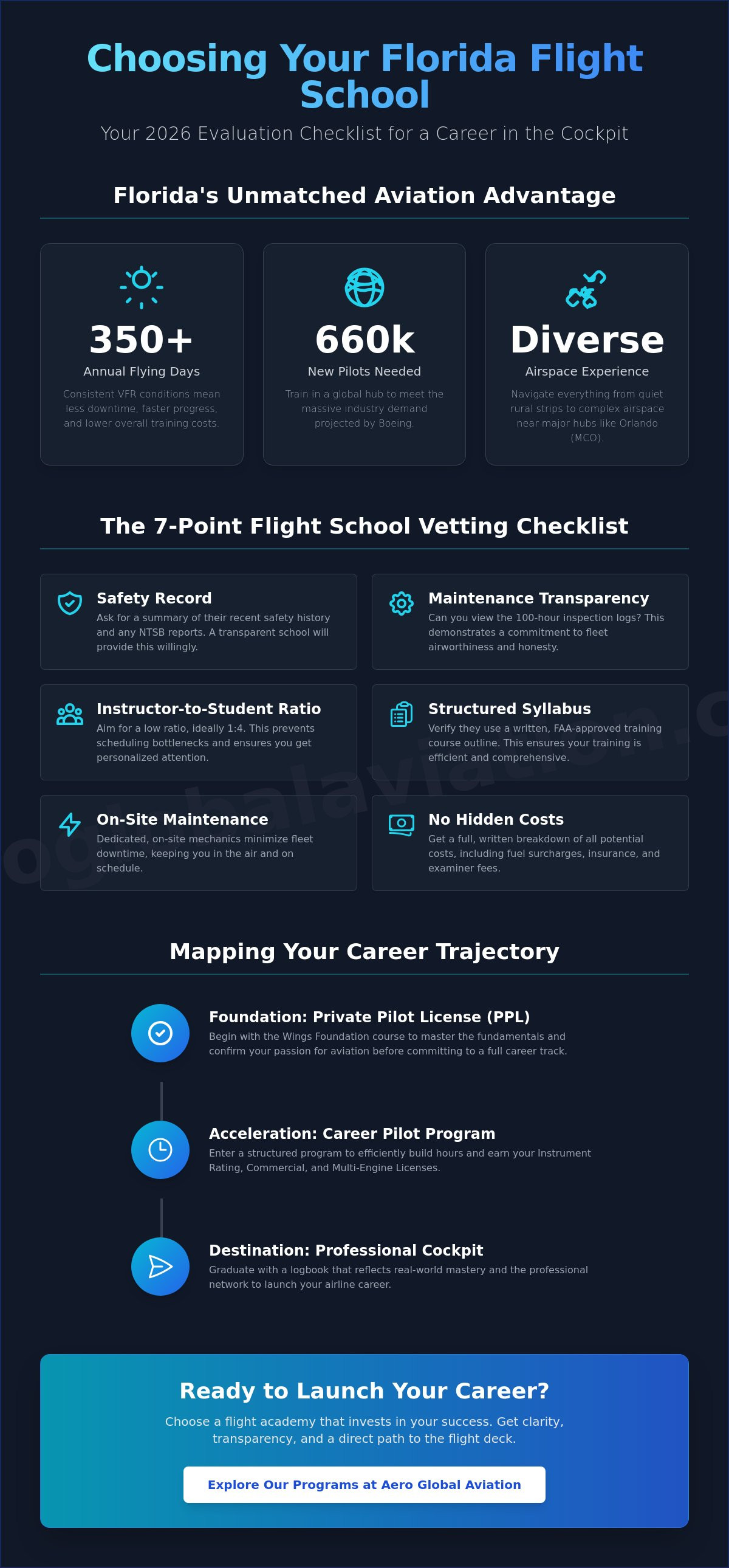
A top-tier academy should welcome your questions and provide clear, documented answers. Use the following 10 points to vet your potential training home:
- Safety Record: Request a summary of their recent safety history and NTSB reports.
- Maintenance Transparency: Ask if you can view the 100-hour inspection logs for the primary training fleet.
- Instructor-to-Student Ratio: Ensure the school maintains a ratio (ideally 1:4) that prevents scheduling bottlenecks.
- Structured Syllabus: Verify they use a written, FAA-approved training course outline for every lesson.
- On-site Maintenance: Confirm they have dedicated mechanics to keep the fleet airworthy without long delays.
- Hidden Costs: Get a full breakdown of fuel surcharges, insurance deductibles, and examiner fees.
- Checkride Availability: Ask about their relationship with local Designated Pilot Examiners (DPEs) and current wait times.
- Airspace Complexity: Ensure the school operates in an environment that offers both tower-controlled and uncontrolled experience.
- Fleet Modernity: Look for aircraft equipped with Garmin G1000 avionics to prepare for modern airline cockpits.
- Career Pathing: Verify they offer a clear progression from your first solo to your commercial ratings.
Fleet Management and Technology Standards
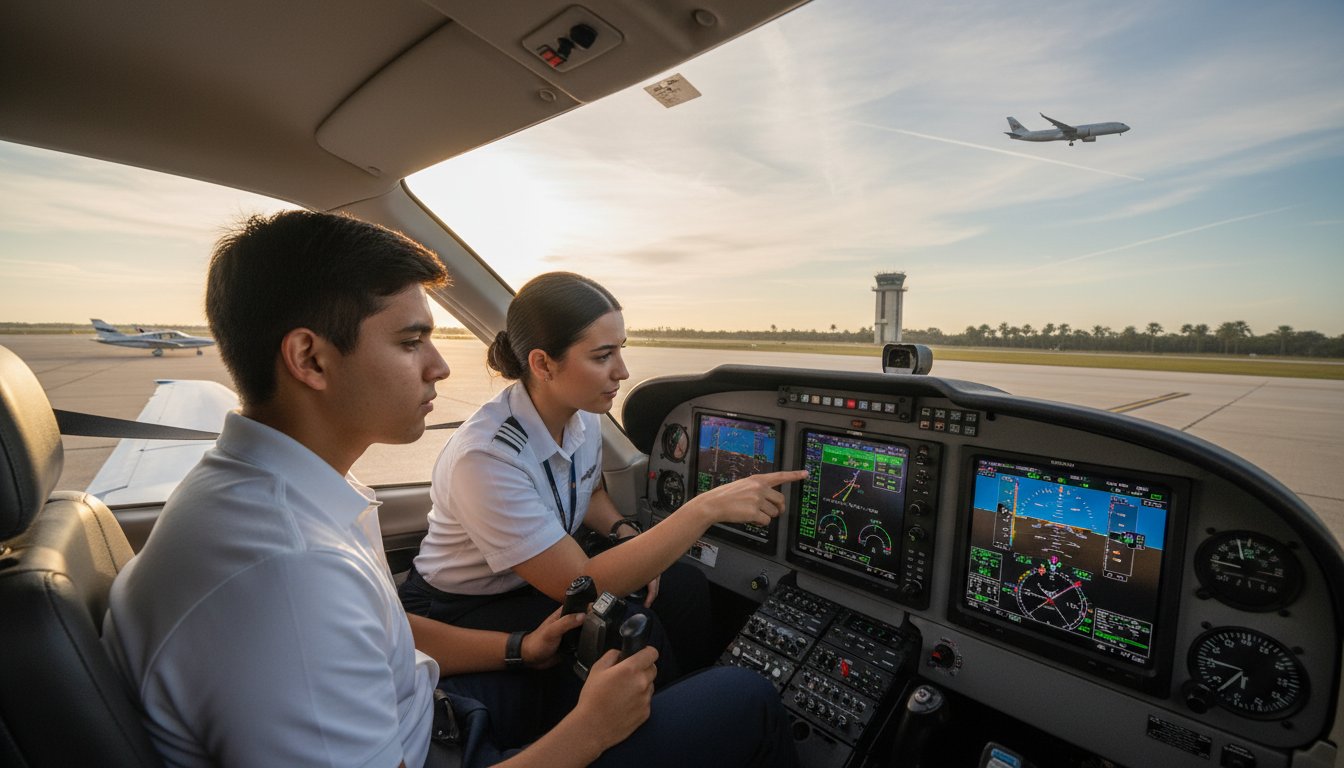
In 2026, training in an aircraft with a "glass cockpit" is no longer optional for career-minded pilots. Mastering the G1000 system early ensures a smoother transition to the advanced flight decks found in regional jets. You should also evaluate the diversity of the fleet. A healthy school maintains a strong ratio of single-engine trainers to multi-engine aircraft, which is vital for advanced flight training. If you're ready to see how a professional fleet operates, you can schedule a tour of our facilities to inspect our aircraft firsthand.
Curriculum Depth and Instructor Quality
The best flight schools in florida prioritize mentorship over simple hour-building. You need to know if your instructor is truly invested in your success or if they're simply waiting for their own 1,500-hour milestone. A quality curriculum integrates ground school directly with flight lessons, ensuring that the theory you learn on the ground is immediately applied in the air. This holistic approach leads to better retention and higher checkride pass rates, moving you toward your professional goals with confidence.
Central Florida Advantage: Why Kissimmee and Orlando Lead the State
The geography of your training airport determines how much time you spend flying versus taxiing. While the entire state is known for aviation, Central Florida offers a unique operational rhythm that sets it apart from the congested corridors of the south. When you look for the best flight schools in florida, Central Florida stands out as the most balanced region for aspiring professionals. It provides a pilot friendly atmosphere where the local community and infrastructure are built to support your growth from a student to a captain.
Kissimmee Gateway Airport (KISM) serves as the primary hub for this advantage. With multiple runways and full tower support, it offers the complexity required for professional development without the exhausting wait times found at major international hubs. Training here means you spend your tuition dollars in the air, not idling on a taxiway waiting for a gap in airline traffic. This efficiency is why the region has become a magnet for high quality instruction and ambitious students alike.
Kissimmee: The Perfect Training "Sweet Spot"
KISM provides the ideal environment for commercial pilot training because it sits at the intersection of diverse airspaces. You'll gain the confidence to communicate with air traffic control while being just minutes away from quiet practice areas. Its strategic location also simplifies your cross-country requirements. From Kissimmee, you can easily plan flights to both the Atlantic and Gulf coasts, giving you experience with varied coastal weather patterns and airport layouts in a single afternoon. This variety ensures that the best flight schools in florida located in this area produce well rounded, adaptable pilots.
Lifestyle and Logistics for Students
Beyond the cockpit, the logistics of living in Central Florida are significantly more student-friendly than in Miami or Fort Lauderdale. The cost of living in the Orlando and Kissimmee areas remains more manageable, allowing you to dedicate more of your budget to your flight hours. Because the region is a global tourism leader, the infrastructure for housing and amenities is robust and accessible. You'll also find yourself in a networking goldmine; the proximity to major airline training centers like SimCom and Pan Am creates natural opportunities to connect with industry veterans. This ecosystem makes the transition from a learner to a professional feel like a logical, supported progression rather than a solo struggle.
Choosing Central Florida means choosing an environment that respects your time and your investment. You'll train in the same airspace used by major carriers at Orlando International (KMCO), gaining real-world exposure that is invaluable for your future career. It's a place where the infrastructure, the economy, and the aviation community all align to help you reach your destination faster.
Navigating the Career Path: Program Specifics You Must Verify
The journey from your first discovery flight to a professional flight deck is a structured ascent, not a random collection of hours. When you research the best flight schools in florida, you'll often see "Zero to Hero" timelines promised in six to nine months. While accelerated paths are possible in Florida's consistent weather, a realistic 2026 schedule must account for the rigorous transition from the Private Pilot License (PPL) to the Commercial Pilot License (CPL). This middle phase is where the technical difficulty spikes, requiring you to move from basic aircraft control to the precision required for instrument and multi-engine operations.
One of the most significant hurdles for students is the "sticker shock" of hidden costs. You can spot a high-quality academy by how they present their fee structure. Be wary of quotes that only list FAA minimum hours; as noted by national averages, most students take 60 to 70 hours to earn a PPL despite the 40-hour minimum. Always ask if the quote includes fuel surcharges, insurance deductibles, and the fees for Designated Pilot Examiners (DPEs). Identifying these costs upfront allows you to focus on your training rather than your bank balance.
The Professional Rating Stack
The core of your training is the rating stack. The Instrument Rating (IR) is often considered the most challenging phase because it requires you to fly solely by reference to instruments. It's the "brain" of your pilot education. Following this, the Multi-Engine (ME) rating provides the power and complexity needed to secure a regional airline interview. For those aiming for the very top, our Airline Pilot Elite program is designed to take you through these ratings and into advanced instructor certifications. This allows you to build the 1,500 hours required for an Airline Transport Pilot (ATP) certificate while earning a living as a mentor to new students.
Financing and ROI in 2026
The high cost of training is an investment in a career with massive projected demand. The 2025 Boeing Pilot and Technician Outlook projects a global need for 660,000 new pilots by 2044, meaning the return on investment for a Florida-based education has never been clearer. However, you must consider the "opportunity cost" of slow training. Every month you aren't at an airline is a month of lost senior-level salary. Finishing your ratings efficiently at a school with high aircraft availability isn't just about convenience; it's a calculated financial move. If you're ready to start this journey, you can explore our professional training tracks to see how we prioritize your timeline and career goals.
Launching Your Career at Aero Global Aviation Academy
After you've used our checklist to evaluate the landscape, the next step is choosing a partner that treats your career goals as a tangible destination. Aero Global Aviation Academy stands out among the best flight schools in florida because we operate as your "Practical Mentor" rather than an impersonal training factory. We understand that every student enters the cockpit with a unique vision, and our programs are designed to turn that vision into a professional reality through structured, high-quality instruction at our Kissimmee facility.
If you're just beginning to explore the world of aviation, our Wings Foundation course offers the perfect entry point. This program focuses exclusively on the Private Pilot License (PPL), allowing you to master the fundamentals of flight and secure your initial certification without the pressure of a full commercial commitment. It's an ideal choice for those who want to build a solid base of stick-and-rudder skills before deciding on their long-term career trajectory. For those with their sights set on the flight deck of a major carrier, our Airline Pilot Elite track provides a comprehensive journey. This program guides you from zero experience all the way through your advanced instructor certifications, creating a clear path to build the hours you need for airline eligibility.
Personalized Mentorship vs. Pilot Mills
The primary difference you'll experience at Aero Global is our commitment to a student-centric approach. In a high-demand market where many "pilot mills" prioritize volume over value, we focus on the quality of the individual learning experience. You'll train with instructors who aren't just building their own time; they're invested in your success as a future colleague in the industry. This mentorship is backed by our commitment to fleet excellence. We maintain a fleet of modern aircraft equipped with Garmin G1000 avionics, ensuring that the technology you learn on today is the same standard you'll find in professional cockpits tomorrow. This consistency builds the deep confidence required to handle complex airspaces and challenging weather conditions.
Next Steps: From Discovery to Flight Deck
Your journey toward a professional pilot career begins with a single, decisive action. We invite you to experience the "Kissimmee Advantage" firsthand by booking a discovery flight at our Orlando/Kissimmee facility. This introductory session allows you to take the controls under the guidance of one of our expert mentors and get a feel for our training environment. Once you've felt the thrill of takeoff, our team will guide you through the enrollment process for our 2026 Career Pilot Program. We'll help you map out your training milestones and ensure you're prepared for the medical and regulatory requirements of the field. Don't let your ambitions remain on the ground. Join the ranks of elite Florida-trained pilots and start building your future with a team that is as dedicated to your success as you are.
Take Command of Your Aviation Future
The path to a professional cockpit is now within your reach. You've learned how to look past the marketing and use a rigorous checklist to identify the best flight schools in florida. By prioritizing a modern G1000 training fleet and a strategic training environment like the Kissimmee Gateway Airport, you're setting yourself up for a safer and more efficient journey. Choosing a school that offers structured PPL to CPL career tracks ensures that every hour you spend in the air is a direct investment in your future airline career.
Don't let the complexity of the industry hold you back from your goals. With the right mentorship and a clear evaluation of your options, you can navigate the transition from a student to a commercial pilot with total confidence. The global demand for pilots is growing, and there's no better time to start your training in the aviation capital of the world. Begin your professional pilot journey with Aero Global Aviation Academy today. Your destination is waiting, and we're ready to help you reach it.
Frequently Asked Questions
What is the average cost of flight school in Florida for 2026?
Industry averages for professional pilot training in 2026 typically range from $65,000 at local FBOs to over $180,000 for four-year university degree programs. These figures represent the total investment for certifications from your first solo through your commercial ratings. You should always verify if a quoted price includes essential extras like fuel surcharges, insurance, and FAA examiner fees to ensure your budget remains accurate.
How long does it take to become a commercial pilot in Florida?
You can expect to reach your commercial pilot milestones in approximately 7 to 10 months when enrolled in an accelerated program. Florida’s reliable climate provides roughly 350 flying days per year, which significantly reduces the time lost to weather cancellations. This consistency helps you maintain sharp muscle memory and progress through the syllabus much faster than in regions with harsh winters.
Is Florida better than Arizona for flight training?
Florida is often preferred over Arizona because its sea-level elevation provides better engine performance and more efficient cooling for training aircraft during the summer months. While both states offer excellent flying weather, the best flight schools in florida provide access to a more diverse range of coastal and high-traffic airspace. This variety better prepares you for the complex environments you'll encounter as a professional airline pilot.
What are the FAA requirements for a Commercial Pilot License (CPL)?
The FAA requires a minimum of 250 total flight hours under Part 61 regulations or 190 hours if you're training under a structured Part 141 curriculum. You must also be at least 18 years old and hold a valid second-class medical certificate to exercise commercial privileges. This license is the professional standard that allows you to fly for compensation or hire in the aviation industry.
Can international students train at Florida flight schools?
Yes, international students can train in Florida by obtaining an M-1 or F-1 visa through an FAA-approved flight academy. Florida is a premier global destination because its training standards are highly respected by international civil aviation authorities. You'll need to pass a TSA background check and demonstrate English language proficiency as part of the standard enrollment process for vocational flight training.
What is the difference between Part 61 and Part 141 flight schools?
Part 141 schools use a highly structured, FAA-approved syllabus that often allows for lower minimum hour requirements due to increased government oversight. Part 61 training offers more flexibility, allowing you and your instructor to adjust the lesson sequence based on your personal schedule and learning pace. Both paths lead to the same FAA certificates, so your choice should depend on whether you prefer a rigid academic environment or a more adaptable one.
Do I need a college degree to become an airline pilot in 2026?
Most major airlines in 2026 no longer require a four-year college degree for employment, though it can still serve as a competitive advantage during the hiring process. Regional airlines and low-cost carriers prioritize your flight hours, technical skills, and safety record over a traditional degree. Choosing a professional flight academy allows you to enter the workforce sooner, which is a strategic move to maximize your lifetime earnings and seniority.
How do I build the 1,500 flight hours required for the airlines?
The most common way to build the 1,500 hours required for an Airline Transport Pilot (ATP) certificate is by working as a Certified Flight Instructor (CFI). This role allows you to earn a salary while gaining valuable experience and mastering your own flying skills through teaching others. Other popular options include flying for aerial photography companies, pipeline patrol, or skydiving operations, all of which help you reach the airline experience requirements.


