

What if the most rewarding seat in the cockpit isn't at the controls of a massive commercial airliner? Many pilots feel stuck in the regional airline pipeline, facing years of long reserve times and a lack of control over their schedules. You might think the only way to earn a six-figure salary is by wearing a major airline uniform, but the market for non-airline pilot jobs Orlando offers in 2026 proves otherwise. With local corporate Hawker 800XP Captain positions currently reaching up to $170,000 per year, the Central Florida landscape is full of high-value opportunities that don't require the traditional airline grind.
You deserve a career that matches your lifestyle goals while keeping your skills sharp. This guide reveals the diverse, high-paying aviation paths available right here in our backyard, from Part 91 corporate roles to advanced flight instruction. We will break down the specific ratings you need to qualify for these specialized positions and provide a practical plan to build your flight hours outside the regional system. Discover how to turn your passion for flight into a premium career without ever leaving the Orlando area.
Key Takeaways
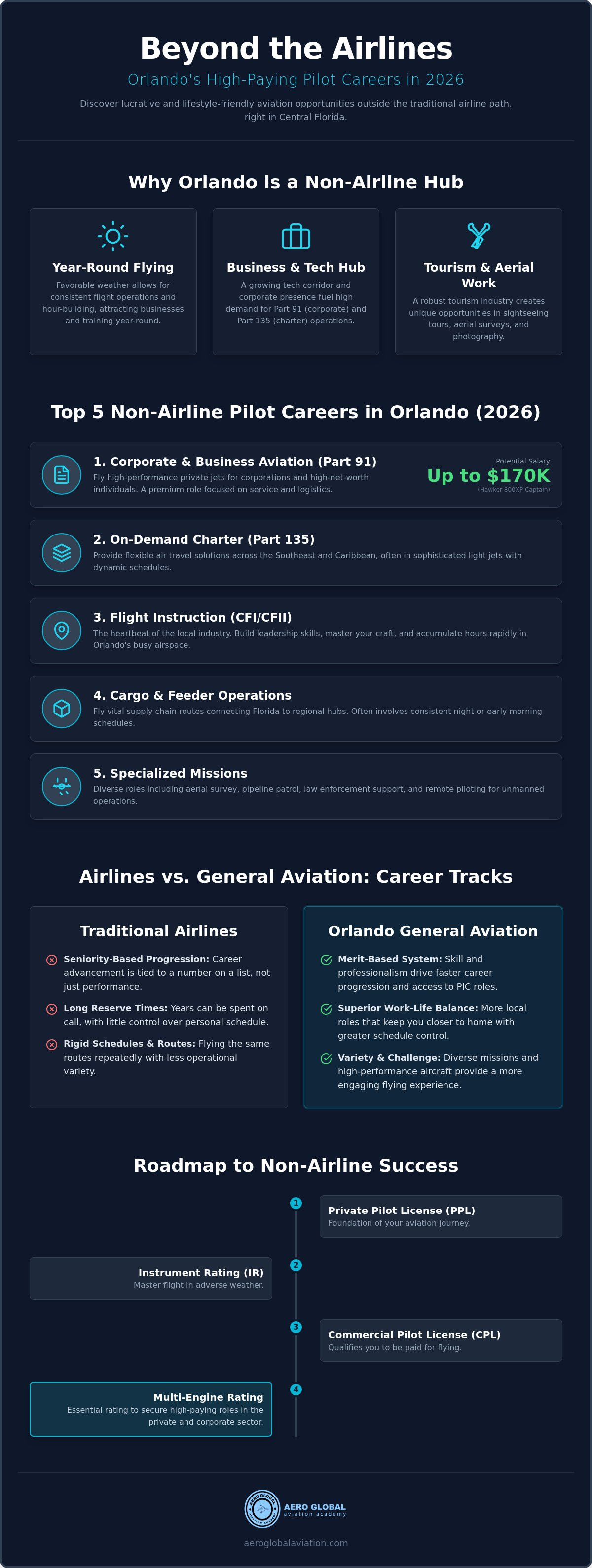
- Explore how Orlando’s unique mix of tourism and business hubs creates a high demand for Part 91 and Part 135 operations.
- Discover the top five non-airline pilot jobs Orlando offers in 2026, ranging from elite corporate flight decks to professional flight instruction roles.
- Learn how the merit-based system of general aviation offers superior work-life balance and faster career progression compared to traditional airline seniority tracks.
- Identify the essential ratings, including the Multi-Engine certification, required to secure high-paying roles in the private sector.
- Map out your professional transition with a structured training path like the Career Pilot Program, designed to move you from student to commercial professional efficiently.
The 'Hidden' Aviation Job Market: Why Orlando is a Non-Airline Hub
Orlando is famous for its theme parks and the massive terminals at MCO, but for many pilots, the most exciting opportunities happen away from the commercial gates. When we discuss General Aviation, we are looking at a massive sector that includes everything from private corporate jets to emergency medical services. In 2026, the demand for non-airline pilot jobs Orlando offers has surged because pilots are looking for more than just a number on a seniority list. They want variety, local stability, and the chance to fly high-performance aircraft without the rigid constraints of a major carrier.
Professional roles in this sector typically fall under Part 135 (charter) or Part 91 (corporate) regulations. These positions allow you to operate as a Pilot in Command (PIC) with significant authority over flight safety and operations. Central Florida is a unique hub for these roles because our weather allows for year-round flight operations. This means businesses can rely on their flight departments without the seasonal interruptions found in northern states. We've seen a clear shift in 2026 where pilots prioritize "lifestyle" careers that keep them closer to home while still providing the professional challenge of a complex flight deck.
The Rise of Private Aviation in Central Florida
Kissimmee Gateway Airport (KISM) and Orlando Executive have become epicenters for luxury charter services. As the Florida tech corridor expands, more corporations are moving their flight departments to the region to stay connected with global markets. A corporate pilot in the 2026 economy is more than just a flyer; they are a high-level service provider who manages complex logistics and provides personalized attention for executives. This growth means more opportunities for those who have completed advanced training like our Airline Pilot Elite program, which prepares you for the high standards of corporate flight decks.
Tourism and Aerial Operations: The Orlando Advantage
The local economy provides a steady stream of specialized work that keeps your logbook growing. Florida's booming real estate market creates a constant need for aerial survey and photography pilots to document new developments. Additionally, the tourism industry fuels a robust sightseeing and tour sector that operates daily. Perhaps most importantly, flight instruction remains a premier way to build a stable, local career. By serving as a Certified Flight Instructor, you aren't just building hours; you're becoming a mentor in the local aviation community and mastering your craft in one of the busiest airspaces in the country.
Top 5 Non-Airline Pilot Career Paths in Orlando for 2026
Orlando's aviation landscape is far more diverse than just the major carriers at MCO. If you're searching for non-airline pilot jobs Orlando provides, you'll find a market that rewards skill, flexibility, and specialized training. In 2026, several high-growth sectors offer competitive pay and unique mission profiles that keep your flying career exciting. These roles often provide a faster route to the captain's seat and a more personal connection to the mission than a standard airline track.
- Flight Instruction (CFI/CFII): This remains the heartbeat of the local industry. It is the primary way to build leadership skills and master your craft while helping others reach their goals.
- Corporate and Business Aviation: Flying for private companies or high-net-worth individuals out of airports like Orlando Executive gives you access to a high-end professional network.
- On-Demand Charter (Part 135): These roles involve providing flexible travel solutions across the Southeast and Caribbean, often flying sophisticated light jets.
- Cargo and Feeder Operations: These are vital supply chain roles that connect Florida's commerce to larger regional hubs, often operating on consistent night or early morning schedules.
- Specialized Missions: This category includes aerial survey, pipeline patrol, and even law enforcement support. To increase your versatility in this tech-driven market, many pilots now secure an FAA remote pilot certificate to manage unmanned survey operations.
Becoming a Professional Flight Instructor (CFI)
CFI roles in Orlando are highly coveted because our year-round VFR weather allows for rapid flight hour accumulation. You can often fly more hours in a month here than in a whole season elsewhere. At academies like Aero Global, you'll experience the professional satisfaction of mentoring the next generation. This path isn't just a stepping stone; it's a career where you can transition into Chief Pilot roles, managing entire training departments and shaping school safety culture. If you're ready to start this journey, our Career Pilot Program offers a direct path to these professional ratings.
The Corporate Pilot Lifestyle: Part 91 vs. Part 135
Understanding the difference between Part 91 and Part 135 is key to finding your fit. Part 91 corporate flying typically offers more schedule predictability and the chance to fly for the same group of executives. Part 135 charter work is more dynamic, with changing destinations and on-demand requests. In Orlando's corporate sector, you'll commonly operate versatile aircraft like King Airs or Citation jets. The networking benefits are immense. You aren't just a pilot; you're a trusted partner for Orlando’s business elite, often leading to long-term career stability. Leveraging executive education from ClickAcademy Asia can help you master the communication skills needed to thrive in these unique professional opportunities.
Airlines vs. General Aviation: Comparing the Career Tracks
Choosing between an airline career and general aviation is more than just picking an airplane; it's about selecting a lifestyle that fits your personal goals. While airlines operate on a rigid seniority system where your schedule and pay depend entirely on your hire date, Embry-Riddle flight careers and industry data show that general aviation thrives on a merit-based model. In the world of non-airline pilot jobs Orlando offers, your reputation, specialized ratings, and professional relationships often dictate your career speed. If you prove yourself as a skilled and reliable pilot, you can bypass the decades-long wait for a captain's seat often found at major carriers.
The variety of flying also differs significantly between these two paths. Airline pilots often fly the same repetitive routes between major hubs, following strict company procedures and automated systems. In contrast, corporate and charter pilots handle hands-on mission planning for unique destinations across the Caribbean and the Southeast. This requires a higher level of engagement and decision-making authority. While a regional pilot might spend years on reserve waiting for a call, a pilot in a specialized Orlando flight department often manages the entire operation, from fuel planning to passenger coordination with luxury ground transport like PDA Limo.
Schedule and Quality of Life
Quality of life is where the gap becomes most visible for pilots living in Central Florida. A Kissimmee-based flight instructor typically enjoys a predictable duty cycle and sleeps in their own bed every night. Contrast this with the grueling 4-day trips and unpredictable reserve status common at regional airlines. Commuter stress is a real burden for airline pilots who don't live in their base city, whereas Orlando general aviation jobs offer the ease of a local commute. You don't have to sacrifice your family life or personal time to maintain a professional flight schedule.
Total Compensation and Benefits
While airline starting pay has increased, specialized corporate roles are highly competitive. In July 2026, we see Hawker 800XP Captain positions in Orlando advertised with salaries between $150,000 and $170,000. These roles often include bonuses and perks that offset a lower base salary compared to legacy airlines. Many established Florida flight departments provide comprehensive health and retirement plans that rival any commercial carrier. Smaller charter operations also offer a fast-track to the left seat, allowing you to reach peak earnings much sooner than the traditional airline ladder allows. If you are looking for the ultimate preparation for these elite roles, our Airline Pilot Elite program is designed to get you there.
The Training Roadmap: Ratings Needed for Non-Airline Success
Every professional journey begins with a solid foundation. While a Private Pilot License gets you in the air, the Commercial Pilot License (CPL) is your true "license to learn" for any professional role. In the competitive market for non-airline pilot jobs Orlando offers, simply having a CPL isn't enough. You need a strategic stack of ratings that make you an asset to corporate flight departments and charter operators. These certifications prove to employers that you possess the technical discipline and safety mindset required for high-stakes operations.
Don't overlook the importance of your Instrument Rating. In Central Florida, our weather is generally excellent, but the afternoon thunderstorms during the rainy season are legendary. Having a sharp instrument skill set ensures year-round employability. It provides the safety margin required for Part 135 operations where you don't always have the luxury of waiting for a clear VFR day. Mastering the clouds is a non-negotiable step for anyone serious about a career in the local business aviation sector.
Mastering Multi-Engine Operations
Most high-paying non-airline roles require you to handle more than one engine. In fact, a Multi-Engine Rating is non-negotiable for roughly 90% of these positions. Corporate departments prioritize pilots who demonstrate the technical proficiency to manage engine-out scenarios and complex system failures. This training provides a massive safety benefit and proves you can handle the sophisticated aircraft typically used in executive transport. For a deeper look at how these ratings impact your career, explore our guide on Advanced Flight Training.
The Power of the CFI and CFII Ratings
If you want to reach the 1,500-hour milestone while staying local, becoming an instructor is your best bridge. Earning your Certified Flight Instructor (CFI) and CFII ratings forces you to master the FAA's "Fundamentals of Instructing." Teaching a student how to recover from a stall or navigate a complex approach reinforces your own knowledge in a way that solo flying never can. It turns you into a subject matter expert on aircraft systems and federal regulations. Our Airline Pilot Elite track is a comprehensive way to gain these credentials while building the leadership skills corporate flight departments value most. If you're ready to build a resume that stands out to Orlando's top aviation employers, start your professional training with us today.
Launching Your Orlando Aviation Career with Aero Global
Aero Global Aviation Academy isn't just a flight school; it's your dedicated partner in navigating the diverse world of aviation. Our mission is to provide professional-grade training that prepares you for the specific demands of the 2026 market. Whether you're aiming for high-end corporate flight decks or specialized aerial missions, we focus on the skills that local employers value most. By choosing a path tailored to your specific goals, you can secure the best non-airline pilot jobs Orlando has to offer without getting lost in a massive, impersonal training factory. We believe in your potential and provide the structured environment needed to turn that potential into a professional reality.
Our approach is built on the foundation of practical mentorship. We understand that every student has a unique vision for their career, and we take the time to offer personalized attention that larger institutions often overlook. This commitment to your individual success ensures that you aren't just another number on a roster. You are a future colleague in the local aviation community. We invite you to visit our Kissimmee facility to experience this culture firsthand, whether you're ready for a discovery flight or a detailed career consultation.
Why Train in Kissimmee (KISM)?
Training at Kissimmee Gateway Airport (KISM) provides a massive strategic advantage for any aspiring professional. You'll operate in a busy, controlled airspace that sharpens your communication and situational awareness from day one. This environment perfectly mirrors the professional world you'll enter as a charter or corporate pilot. Being so close to Orlando’s major aviation hubs means you're just minutes away from key networking events and industry resources. Most importantly, we leverage our local climate to offer 360+ days of flyable weather, ensuring your training stays on schedule and your momentum never fades.
Your Path from Zero to Professional Pilot
The transition from a beginner to a seasoned professional is a structured and attainable process with our support. Our Career Pilot Program takes you from your first solo flight all the way to your Commercial Pilot License. We don't stop at certification. Our academy actively assists with hour-building strategies and professional development, helping you bridge the gap between training and your first professional cockpit. We provide the technical expertise and the career guidance needed to navigate the 2026 job market with confidence. Start your journey toward a professional pilot career today and discover the freedom of flying on your own terms.
Take Command of Your Aviation Future in Central Florida
Orlando's aviation ecosystem provides a wealth of opportunities for pilots who value variety and local stability over the rigid airline track. By focusing on merit and specialized skills, you can access the most rewarding non-airline pilot jobs Orlando offers in 2026. This market rewards those who master multi-engine operations and take pride in professional mentorship. Whether you are aiming for a corporate jet or a chief pilot role, the path to a high-paying career is clear and attainable right here in Central Florida.
At Aero Global Aviation Academy, we provide the structured PPL to CPL career tracks you need to succeed in this dynamic industry. Our Kissimmee-based expert flight instructors are dedicated to your individual progress, ensuring you train in a supportive environment with top-tier aircraft maintenance and safety standards. Don't wait for a seniority number to dictate your life when you can build a professional reputation today. Explore Our Professional Pilot Training Programs in Orlando and take the first step toward a career that fits your lifestyle. Your future in the flight deck is closer than you think, and we are ready to help you launch it.
Frequently Asked Questions
Can I get a pilot job in Orlando with just a Commercial Pilot License?
Yes, you can secure entry-level positions with a Commercial Pilot License, which serves as your professional "license to learn." Many pilots find initial non-airline pilot jobs Orlando offers in sectors like aerial sightseeing, banner towing, or basic aerial survey work. While these roles are excellent for building foundational experience, adding a Multi-Engine or CFI rating is often necessary to qualify for the high-paying corporate and charter positions in the region.
How much do non-airline pilots make in Florida in 2026?
Salaries in the private sector vary significantly based on your experience and specific ratings. As of July 2026, the average annual pay for a Non-Commercial Pilot in Florida is $35,499, but the median for a Non-ATP Pilot is $105,200. For those in elite roles, such as a Hawker 800XP Captain in Orlando, advertised salaries currently range between $147,000 and $183,000 per year.
Is it better to build hours as a CFI or in a Part 135 operation?
Both paths offer unique advantages depending on your long-term goals. Serving as a Certified Flight Instructor (CFI) is often the fastest way to build hours because Orlando’s year-round VFR weather allows for consistent daily flying. Part 135 charter operations provide valuable multi-engine experience and professional networking opportunities, though they often require higher insurance minimums before you can act as Pilot in Command.
What are the requirements for flying corporate jets in Orlando?
Most corporate flight departments require a Commercial Pilot License with Multi-Engine and Instrument ratings as a baseline. For larger or more complex jets, employers often look for an Airline Transport Pilot (ATP) certificate and a specific type rating for the aircraft. Beyond technical skills, corporate operators value a service-oriented mindset and the ability to manage complex logistics for high-priority passengers.
Do I need a college degree for non-airline pilot jobs?
A college degree is not strictly required for many non-airline roles in the private sector. While major airlines have traditionally preferred a four-year degree, many corporate and charter operators prioritize your flight hours, specific aircraft experience, and safety record. In general aviation, your professional reputation and technical proficiency often carry more weight than a formal academic background.
How long does it take to go from zero to a professional pilot job?
It typically takes between 12 and 24 months to transition from a beginner to a professional pilot. A structured track like our Career Pilot Program is designed to move you through your ratings efficiently. Once you reach approximately 250 hours and earn your Commercial Pilot License, you can begin applying for entry-level commercial roles and start earning a paycheck while you continue to build experience.
Are there many entry-level pilot jobs available at Kissimmee Gateway Airport?
Kissimmee Gateway Airport (KISM) is a major hub for entry-level aviation activity in Central Florida. The airport hosts numerous flight schools, maintenance facilities, and aerial tour operators that frequently hire new commercial pilots. Many of our students transition directly into instructor roles or find work with local survey and photography companies that benefit from the airport's strategic location.
What is the difference between flying under Part 91 and Part 135?
Part 91 regulations govern private, non-commercial flights, such as a company flying its own employees in its own aircraft. These rules offer more operational flexibility for the pilot. Part 135 covers on-demand charter operations where the public pays for transportation. Part 135 involves stricter FAA oversight regarding pilot training, maintenance standards, and required rest periods to ensure a higher level of safety for paying passengers.


