
What if the most exclusive office in Central Florida isn't a luxury suite in Orlando, but a flight deck cruising at 41,000 feet? While many aspiring aviators fixate on the airlines, the world of business aviation offers a unique blend of high-end service and professional autonomy. You might feel overwhelmed by the different requirements for charter operations versus commercial carriers. However, learning how to become a corporate pilot Kissimmee training hubs facilitate is a structured and rewarding process when you have the right local guidance.
It's natural to feel uncertain about which flight school understands the nuances of executive travel or how to build a network in such a tight-knit industry. We're here to clear the clouds and provide a direct roadmap from your first solo flight to landing a position in a corporate jet. This guide explores the specific certification path you need, the strategic advantages of training at Kissimmee Gateway Airport, and the local programs designed to maximize your career momentum as the industry faces an estimated shortfall of 24,000 pilots this year.
Key Takeaways
- Master the step-by-step certification path, including the Private Pilot License and Instrument Rating, necessary to move into the left seat of a business jet.
- Discover how to become a corporate pilot Kissimmee flight departments prioritize by training in a high-activity hub of private aviation.
- Gain a competitive edge by learning in Central Florida's complex airspace, where year-round flying weather ensures you hit your hour requirements without seasonal delays.
- Learn why "white glove" service and logistics management are just as critical as your technical flight skills in the world of executive travel.
- Explore how structured local programs, such as the Career Pilot Program, provide the professional-grade training needed to transition from student to corporate aviator.
Understanding the Corporate Pilot Landscape in Central Florida (2026)
Florida's aviation sector is thriving as we move through 2026. The state has solidified its position as the primary engine for business travel growth in the Southeast. If you are investigating how to become a corporate pilot Kissimmee is the ideal place to begin because it sits at the heart of this expansion. Unlike the rigid, schedule-driven world of commercial airlines, corporate aviation focuses on personalized service and mission flexibility. You aren't just a pilot; you're often the face of the operation for high-net-worth individuals and executive teams.
The role requires a unique blend of technical mastery and logistical coordination. Whether you work as a salaried employee or a Corporate contract pilot, you will manage everything from flight planning to passenger logistics. Corporate flight departments value pilots who can think on their feet and handle the pressures of a high-traffic environment. When you research how to become a corporate pilot Kissimmee training programs often highlight the tactical advantage of learning in such a busy, professional environment where the standards are exceptionally high.
Corporate vs. Airline: Which Path Fits Your Goals?
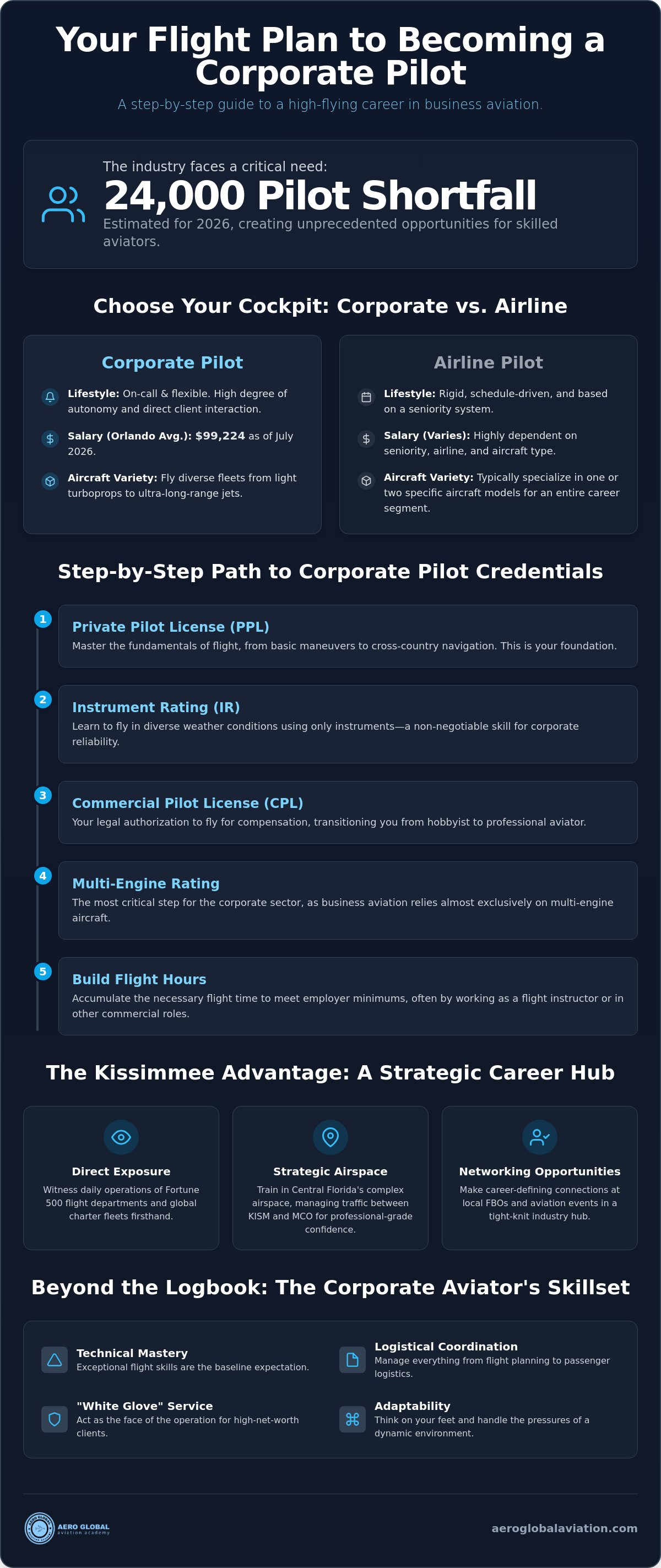
Choosing between these paths depends on your personal priorities. Airline pilots live by a seniority list, but corporate pilots live by the needs of the client. It's often an "on-call" lifestyle that requires you to be ready for a mission at short notice. However, the rewards are significant. In Orlando, the average corporate pilot salary has reached $99,224 as of July 2026. You'll also fly a wider variety of aircraft, ranging from nimble light turboprops to ultra-long-range jets that can cross oceans. This variety keeps the job exciting and builds a diverse set of skills that the airlines simply can't match.
The Kissimmee-Orlando Business Aviation Hub
Kissimmee Gateway Airport (KISM) acts as the essential reliever for Orlando International (MCO). It handles a massive volume of private jet traffic, placing you directly in the middle of the action. Training here provides invaluable experience in complex airspace. You'll frequently share the ramp with Fortune 500 flight departments and global charter fleets. This proximity makes networking at local Fixed Base Operators (FBOs) a natural part of your daily routine. Here are a few reasons why this hub is unique:
- Direct Exposure: You'll see the daily operations of major corporate flight departments firsthand.
- Strategic Airspace: Learning to manage the traffic between KISM and MCO builds professional-grade confidence.
- Networking: Casual introductions at the terminal often lead to career-defining job offers.
With an estimated shortfall of 24,000 pilots expected across the industry in 2026, the demand for skilled aviators is at an all-time high. Starting your journey in a hub like Kissimmee gives you a front-row seat to the best opportunities in the business.
Step-by-Step Path to Your Corporate Pilot Credentials
Transforming your passion for aviation into a professional career in a corporate jet cockpit requires a disciplined, milestone-driven approach. If you are mapping out how to become a corporate pilot Kissimmee offers a strategic advantage by providing access to high-traffic environments that mirror the real-world demands of business aviation. Your journey is more than just logging hours; it's about mastering the specific certifications that corporate flight departments prioritize.
Your journey begins with the Private Pilot License (PPL). This initial phase is about mastering the fundamentals of flight, from basic maneuvers to cross-country navigation, ensuring you have a rock-solid foundation. Next, you'll earn an Instrument Rating (IR), which allows you to fly in diverse weather conditions using only your instruments. This certification is essential for the reliability that corporate clients expect, and you can review the official FAA pilot requirements to understand the rigorous standards involved in this professional upgrade.
The Commercial Pilot License (CPL) is your legal authorization to fly for compensation, moving you from the world of hobbyist to professional. Following your CPL, adding a Multi-Engine Rating is often the most critical step for those targeting the corporate sector. Business aviation relies almost exclusively on multi-engine aircraft for safety and performance. Finally, you'll focus on building flight hours. Many pilots choose to work as flight instructors or in specialized entry-level roles to reach the hourly requirements often mandated by insurance companies for jet operations.
The Importance of a Structured Career Pilot Program
A structured path prevents the common "training plateau" where progress stalls between ratings. By enrolling in a comprehensive program, you ensure a seamless transition from one certification to the next, keeping your skills sharp and your momentum high. This streamlined timeline is often the fastest way to move from zero hours to a professional cockpit. For a deeper look at the specifics of professional-grade certification, explore our guide on commercial pilot training.
Multi-Engine and Instrument Ratings: The Corporate Edge
Corporate aviation demands a higher level of precision and all-weather capability than general aviation. Mastering Instrument Flight Rules (IFR) ensures you can navigate complex airspace and maintain schedules regardless of visibility. The Multi-Engine Rating is the passport to corporate cockpits, opening the door to the sophisticated twin-engine jets that define modern business travel. Choosing a program like the Career Pilot Program ensures you're training on the equipment and systems you'll actually use in the field.
Why Training in Kissimmee Is a Strategic Career Move
Geography is destiny when it comes to professional flight training. If you are researching how to become a corporate pilot Kissimmee stands out as a premier destination because it offers a unique combination of environmental and industrial advantages. Central Florida provides year-round flying weather, which means you'll face fewer cancellations due to seasonal storms compared to training hubs in the north. This consistency allows you to complete your ratings faster, helping you reach the cockpit of a business jet while the hiring market remains exceptionally strong in 2026.
Beyond the weather, the environment at Kissimmee Gateway Airport (KISM) is tailored for the aspiring professional. You aren't just flying in a vacuum; you are training on the same ramps where high-end business jets operate daily. Seeing a Gulfstream G650 or a Bombardier Global 7500 taxi past your training aircraft builds a sense of professional familiarity. It demystifies the world of executive travel and allows you to observe the standards of dress, communication, and aircraft care that define the industry. This localized exposure is a critical part of how to become a corporate pilot Kissimmee flight departments actually want to hire.
Mastering Complex Airspace in Central Florida
Navigating the skies over Orlando isn't for the faint of heart, and that's exactly why it's valuable. You'll learn to manage the corridor between KISM and Orlando International (MCO), communicating with air traffic controllers who handle everything from small trainers to massive international airliners. This complex airspace experience prepares you for high-stakes corporate missions where precision is non-negotiable. When evaluating the best flight schools in florida, look for programs that leverage this high-traffic environment to build your confidence and radio proficiency early in your training.
Kissimmee Gateway Airport (KISM) as Your Home Base
KISM serves as a primary reliever for MCO, making it a hub for private aviation without the restrictive delays of a major international terminal. This makes it incredibly accessible for students living in nearby communities like St. Cloud, Celebration, or Lake Nona. Training here places you in a community of "Practical Mentors" who understand the local landscape. You'll also gain insights into various business aviation career paths simply by interacting with the crews and staff at local Fixed Base Operators. This organic networking is often the secret ingredient that turns a newly minted commercial pilot into a competitive candidate for a corporate flight department.
Building the 'Corporate Resume': Beyond the Logbook
In the world of business aviation, your logbook is only half the story. While technical proficiency is non-negotiable, corporate flight departments search for individuals who can provide "white glove" service to their passengers. This means you must be a customer service expert, a logistics manager, and a poised professional all at once; some even explore The Ultimate Face Painting Course to offer unique value during family-oriented charters. When you are learning how to become a corporate pilot Kissimmee training environments allow you to observe these traits in action every day at the airport terminal.
Professionalism and grooming are vital components of your resume. High-net-worth clients and executive teams expect their pilots to reflect the standards of their own organizations. This includes everything from a crisp uniform to carrying professional, aerospace-grade luggage from ALEON that matches the high-end aesthetic of the flight deck. These soft skills often determine whether you get the job after you meet the minimum flight hour requirements. Success in this field requires a "practical mentor" mindset where you are always looking for ways to improve the passenger experience.
Building Hours with a Purpose
Most aspiring pilots reach the required flight hours by working as a Certified Flight Instructor (CFI). This path is particularly effective for corporate tracks because it builds leadership and critical decision-making skills. When you're responsible for a student's safety, you develop the maturity needed for single-pilot or small-crew operations. To explore how to reach these advanced milestones, you can find detailed information on advanced flight training and instructor rating paths.
Networking in the Kissimmee Aviation Community
Landing your first role often happens on the ramp or in the FBO lobby. Attending local safety seminars and aviation events at KISM is a great way to meet current crews. Networking at a Fixed Base Operator (FBO) requires a mix of respect and initiative. When you see a crew waiting for their passengers, a polite introduction can go a long way. Many pilots started their careers because they were in the right place at the right time with the right attitude.
It's important to understand the different types of operations you might join. Part 91 refers to private corporate flight departments that fly specifically for their own company's business, while Part 135 operations are commercial charter companies that fly passengers for hire. Leveraging the connections made during your training is a proven strategy for finding these opportunities. If you're ready to start building your professional reputation, apply for our Airline Pilot Elite program today to begin your instructor certification path and start leading the next generation of aviators.
Launch Your Career with Aero Global Aviation Academy
Aero Global Aviation Academy serves as your dedicated local partner in the journey toward the corporate jet cockpit. We understand that the path to a high-end aviation career can feel complex, especially when you are balancing technical requirements with professional aspirations. That's why we apply our "Practical Mentor" philosophy to every student. We provide the personalized attention and industry insight that larger, impersonal corporations often overlook. If you're researching how to become a corporate pilot Kissimmee offers no better home base than our facility at KISM, where your success is our primary mission.
Our training programs are structured to meet you exactly where you are in your journey. The Wings Foundation course provides a solid Private Pilot base for those who want to master the fundamentals before committing to a professional track. For those with their sights set on a professional paycheck, the career pilot program offers a direct, streamlined path from zero hours to Commercial certification. If you want to maximize your leadership skills and reach the most elite corporate departments, our Airline Pilot Elite program takes you all the way through advanced instructor ratings, preparing you to lead and fly at the highest levels.
Personalized Training for Professional Results
Our location at Kissimmee Gateway Airport is a strategic asset for your training timeline. Because we operate in Central Florida, we leverage the year-round flying weather to keep your training on schedule. You'll spend more time in the air and less time waiting for the clouds to clear, which is essential for hitting your 2026 career milestones. We tailor our instruction to meet the specific demands of corporate aviation, focusing on the precision, radio proficiency, and professional poise required by top-tier flight departments.
Your Next Steps: From Discovery Flight to Career
Taking the first step toward your new career is a simple and exciting process. You can book a discovery flight at our Kissimmee facility to experience the thrill of the flight deck firsthand and see our fleet in action. During your visit, you'll have the opportunity to consult with our instructors to build a personalized corporate career roadmap. We'll help you understand the specific ratings you need and how to leverage the local aviation community to your advantage. Start your journey in the heart of Florida aviation today and turn your professional goals into a tangible destination.
Your Flight Path to Executive Aviation Starts Today
The journey to the left seat of a business jet is a precise blend of technical skill and professional networking. By focusing on the strategic advantages of training at the Kissimmee Gateway Airport, you've already identified the most efficient way to build your hours in a high-traffic, professional environment. You now understand that mastering the comprehensive PPL to CPL curriculum and adding a Multi-Engine Rating are the non-negotiable steps to entering the corporate world. When you choose our Professional Pilot Track, you aren't just earning certificates; you're joining a community of expert instructors with real-world aviation experience who are dedicated to your individual success.
Deciding how to become a corporate pilot Kissimmee flight departments respect starts with choosing a partner that treats your goals as their own. With the projected industry pilot shortfall reaching 24,000 this year, there's never been a better time to transition from a student to a professional aviator. Don't let uncertainty hold you back from the lifestyle and career you've always envisioned. Ready to fly? Explore the Career Pilot Program at Aero Global Aviation Academy today! We're here to guide you through every milestone, from your first discovery flight to your first corporate mission. The sky is waiting for you.
Frequently Asked Questions
Do I need a college degree to become a corporate pilot in 2026?
You don't strictly need a four-year college degree to obtain your pilot certificates or secure many corporate positions in 2026. While some major corporations prefer a degree for their flight departments, the current pilot shortage means that your ratings, flight hours, and professional reputation carry more weight. Focus on mastering your craft and building a strong local network to stand out to recruiters.
How many flight hours are typically required for a corporate pilot job?
Most corporate flight departments require between 1,000 and 1,500 total flight hours for first officer positions on business jets. While you can earn your Commercial Pilot License at 250 hours, insurance requirements for sophisticated turbine aircraft typically demand higher experience levels. Many students bridge this gap by working as flight instructors after completing their initial professional training.
What is the difference between a corporate pilot and a charter pilot?
A corporate pilot typically flies for a single company's private flight department under Part 91 regulations, serving the company's employees and guests. In contrast, a charter pilot works for a company that "rents" the aircraft and crew to various clients under Part 135 rules. Both roles require high levels of professionalism, but corporate flying often offers more predictable schedules and a closer relationship with the passengers.
Can I train for a corporate career while working another job in Kissimmee?
Yes, you can absolutely train for your certificates while maintaining another job in the local area. Our programs offer the flexibility needed to balance your current professional life with your flight schedule. Learning how to become a corporate pilot Kissimmee flight schools facilitate is often a matter of consistent dedication and smart scheduling rather than full-time immersion.
What aircraft will I learn to fly at Aero Global Aviation Academy?
You will train in a variety of modern single-engine and multi-engine aircraft designed to prepare you for professional-grade certification. These trainers are selected specifically for their reliability and their ability to help you master the complex flight systems you'll encounter in business jets. This diverse fleet ensures you're ready for the eventual step up to turbine-powered equipment in the corporate sector.
Is corporate pilot pay comparable to major airlines in Florida?
Corporate pilot pay in Florida is very competitive, with Orlando-based pilots averaging $99,224 annually as of July 2026. While major airlines might offer higher top-tier salaries for senior captains, corporate aviation often provides a faster route to a high-paying seat and a more varied flying experience. The lifestyle benefits and unique destinations also add significant value to the total compensation package.
How long does the Career Pilot Program take to complete?
When investigating how to become a corporate pilot Kissimmee students often find that the Career Pilot Program takes between 6 and 12 months to complete. Your personal pace and lesson frequency play a large role in this timeline. Florida's consistent sunshine allows for a steady training rhythm that helps you reach your professional goals much faster than in other regions.
Are there financing options for flight training in Kissimmee?
Several financing options are available to help you manage the investment in your future, including specialized aviation loans and private scholarships. If you're a veteran, you may also be eligible for the Post-9/11 GI Bill, which has an annual cap for vocational flight training of $17,662 effective August 1, 2026. We recommend consulting with our team to explore which roadmap fits your financial situation best.


