
What if your most profitable and fulfilling professional decade hasn't even begun? Many professionals believe that reaching fifty means the window for a radical shift has slammed shut, particularly in the demanding world of aviation. You might worry that age discrimination or the rigors of an FAA First Class Medical exam will block your path. However, embarking on a career change to pilot at 50 Kissimmee is a calculated, high-reward mission that leverages your life experience as a primary asset. The current pilot shortage means airlines are looking for the maturity and discipline that only comes with decades of professional life.
In this article, you will discover the realistic path to the flight deck and why Central Florida’s year-round flying weather is your secret weapon for an efficient transition. We'll explore the financial ROI of professional training and provide a clear timeline for your certifications. You'll gain a deep understanding of the local Kissimmee aviation market and the confidence to see your age as a strength rather than a liability. From the first flight in the Career Pilot Program to securing a commercial seat, we provide the roadmap for your fifteen-year second act in the skies.
Key Takeaways
- Understand why the 15-year window before the mandatory FAA retirement age of 65 remains a highly profitable timeframe for new commercial pilots in 2026.
- Learn how pursuing a career change to pilot at 50 Kissimmee allows you to leverage over 300 days of annual flying weather to significantly accelerate your certification timeline.
- Evaluate the financial return on investment by comparing modern training costs with the surging median salaries and signing bonuses currently offered by regional airlines.
- Discover the structured progression from the low-risk Wings Foundation course to the comprehensive Airline Pilot Elite program designed for professional transitions.
- Identify how your existing professional maturity and life experience serve as a competitive advantage in an industry facing a peak pilot shortage.
Is 50 Too Late to Become a Pilot in Florida? The 2026 Reality
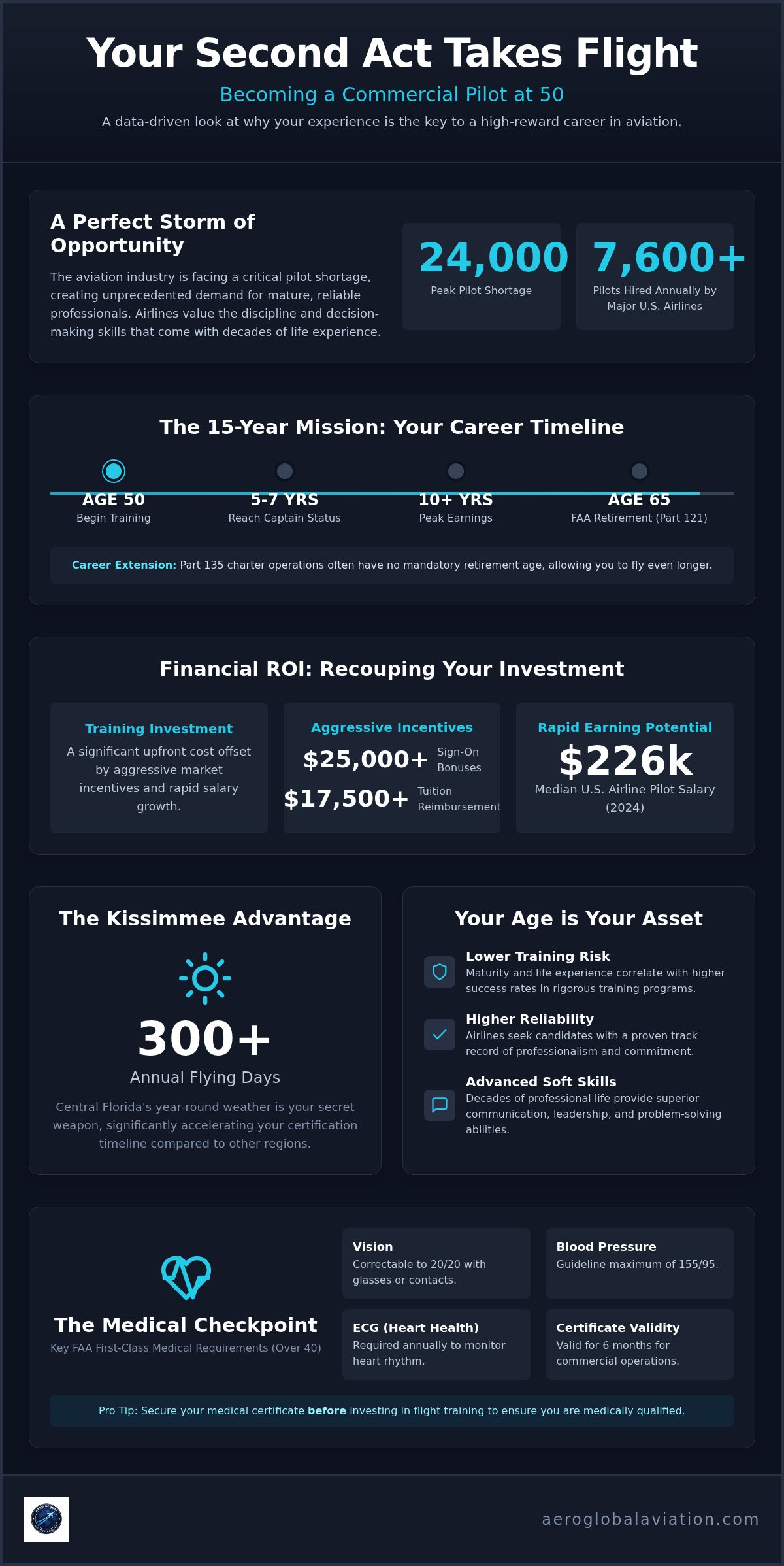
The idea that fifty is the finish line for a new career is an outdated myth. In 2026, the aviation industry faces a peak shortage of 24,000 pilots, making your age a strategic advantage rather than a hurdle. Airlines are actively seeking the stability and professional discipline that a career change to pilot at 50 Kissimmee brings to the flight deck. While younger candidates might have more years ahead, your maturity translates to lower training risk and higher reliability for recruiters who need experienced decision-makers.
The "Age 50 Rule" reveals that a fifteen-year career window is not just viable; it's highly lucrative. With major U.S. airlines projected to hire over 7,600 pilots this year, the demand for qualified crew members has never been higher. Your previous professional life has likely equipped you with a "soft skill" set that younger students are still developing. These traits are essential when meeting FAA pilot certification requirements and advancing through the rigorous training environments required for commercial flight.
The Mandatory Retirement Age and Your Career Window
Understanding the regulatory landscape is vital for your planning. For commercial airlines operating under Part 121, the FAA mandatory retirement age is currently 65. This creates a clear "15-year mission" where you can realistically reach Captain status at a regional carrier and enjoy several years of peak earnings. If you prefer more flexibility, Part 135 charter operations often have no mandatory retirement age. This allows you to fly professionally as long as you maintain your health, potentially extending your second career well into your late sixties or seventies.
Medical Certification for Pilots Over 50
Your health is the true gatekeeper of your aviation career, not the date on your birth certificate. To fly commercially, you must pass an FAA First-Class Medical exam. For pilots over 40, this certificate is valid for six months and requires an annual ECG to monitor heart health. Don't let common myths about blood pressure or vision deter you. The current guideline maximum for blood pressure is 155/95, and distant vision only needs to be correctable to 20/20 with glasses or contacts. We always recommend securing this medical certificate before you spend a single dollar on flight training. This ensures you're medically qualified for the long-term professional return you expect from your investment.
Financial ROI: Can You Recoup Your Training Costs in 15 Years?
Embarking on a career change to pilot at 50 Kissimmee requires a clear-eyed look at the numbers. While the upfront investment for professional flight training is significant, the market conditions in 2026 provide a faster payback period than any previous decade. With a mandatory retirement age of 65 for commercial airline pilots, you have a focused fifteen-year window to maximize your earnings and secure your retirement. The math is simple: even with a later start, the high salary ceiling in aviation makes this one of the most profitable second-career moves available.
Most career-shifters find that the initial training costs are offset quickly once they reach the flight deck of a regional carrier. In the current landscape, airlines are offering aggressive incentives to secure reliable crew members. For example, some regional carriers provide sign-on bonuses reaching $25,000, while others offer tuition reimbursement packages up to $17,500. When you combine these incentives with the rapid seniority movement seen in 2026, the path to a positive return on investment becomes very clear. If you're ready to map out your specific financial path, our team can help you choose the right Career Pilot Program to meet your goals.
Projected Earnings and Career Progression
The journey from student to a high-earning professional typically involves a two-year period of building the 1,500 flight hours required for an Airline Transport Pilot certificate. Once you join a regional airline, your earning potential scales rapidly. Median U.S. airline pilot salaries reached $226,600 in 2024, more than double the figures from just a few years prior. By reaching the "Left Seat" as a Captain within five to seven years, you can spend the final decade of your career in the highest pay brackets, often recouping your entire training investment within the first three years of airline employment.
Corporate and Private Aviation: The Age-Friendly Alternative
If the rigid structure of major airlines doesn't appeal to you, corporate and private aviation under Part 135 regulations offers a compelling alternative. These flight departments often prefer mature pilots because of the professional polish and life experience they bring when interacting with high-net-worth clients. A major advantage of this path is the lack of a mandatory retirement age, allowing you to fly professionally as long as you maintain your health. Corporate flight departments value your previous business background, often viewing your career change to pilot at 50 Kissimmee as a sign of dedication and superior decision-making skills.
Why Training in Kissimmee is a Strategic Move for Older Students
When time is your most precious resource, where you train becomes as important as how you train. A career change to pilot at 50 Kissimmee allows you to bypass the seasonal delays that often plague flight schools in northern climates. In Central Florida, we don't deal with "winter stalls" or weeks of grounded aircraft due to snow and ice. Instead, you benefit from a consistent schedule that keeps your skills sharp and your progress steady. For a professional with a fifteen-year career horizon, every week saved in training is a week gained in a high-paying cockpit.
The efficiency of the local environment isn't just about convenience. It's about protecting your investment. By choosing a location that supports daily flight operations, you ensure that your transition from a beginner to a professional is as compressed and effective as possible. This strategic choice allows you to maximize your remaining years in the industry while training in a region that truly understands the needs of second-career aviators.
Weather as a Training Catalyst
The math of a second career demands speed. Orlando’s climate offers over 300 days of Visual Flight Rules (VFR) weather annually, meaning you can fly nearly every day. This consistency is vital for older learners because frequent repetition builds muscle memory faster and more reliably than sporadic training sessions. Research into a midlife career change to the airlines highlights that minimizing training gaps is a primary driver of student success. If you can finish your certifications three to six months earlier by training in Florida, you're not just saving on living expenses; you're gaining months of airline seniority and earnings.
The Kissimmee Aviation Ecosystem
Kissimmee Gateway Airport (KISM) provides the ideal environment for a professional transition. It strikes a perfect balance between a focused training environment and a high-stakes professional airspace. As a towered airport, KISM requires you to interact with Air Traffic Control from your very first flight, building the communication confidence you'll need in a commercial environment. You'll share the runways with a diverse mix of traffic, from light trainers to sophisticated corporate jets. This exposure is invaluable for those pursuing a career change to pilot at 50 Kissimmee, as it forces you to acclimate to the pace of professional aviation quickly.
Location also drives your networking potential. Being in the backyard of Orlando International (MCO) puts you at the center of a massive aviation hub. Central Florida is home to numerous flight departments, cargo operations, and regional carriers. Training here means you are building relationships in the very market where you might seek your first professional seat. To understand more about these local advantages, you should explore Why Train in Kissimmee? Orlando Aviation Weather Perks to see how our environment supports your specific timeline.
The Accelerated Path: From Zero to Commercial Pilot at 50
Speed is your greatest ally when launching a second career in the cockpit. While younger students might take a casual approach, your career change to pilot at 50 Kissimmee demands a structured, high-efficiency roadmap. We focus on "stacking" your certifications to ensure you move from the classroom to a professional flight deck as quickly as possible. This isn't about cutting corners; it's about utilizing a professional training environment that respects your timeline and your previous life experience.
Your journey follows a logical progression of four critical milestones. You begin with the Private Pilot License (PPL), move into the Instrument Rating (IR), achieve your Commercial Pilot License (CPL), and finally secure your Certified Flight Instructor (CFI) rating. This path is designed to transition you from a beginner to a paid professional in a matter of months rather than years. If you're ready to start the engine on your new career, explore our full training curriculum and see how we mentor students through every stage of the process.
Phase 1: Building the Foundation
Every professional aviator starts with the Wings Foundation. During your first 40 to 60 hours of flight, you'll master the fundamental mechanics of aircraft control, takeoffs, and landings. For mature students, a highly structured ground school is essential. You'll find that your ability to study and synthesize complex information is a major asset during this phase. We focus on getting you solo-ready quickly while ensuring you have a deep understanding of the regulations and safety protocols. To see the specific requirements for this first step, check out our guide on How to Get Your Private Pilot License in Florida.
Phase 2: The Professional Track
Once you have your PPL, you'll transition into the Career Pilot Program to earn your Instrument and Commercial ratings. The Instrument Rating is where you learn to fly solely by reference to your cockpit displays, a skill that is non-negotiable for airline operations. Managing the intensity of full-time training at age 50 requires focus, but your disciplined work ethic will help you stay ahead of the curve.
The final hurdle for many is building the 1,500 flight hours required for the airlines. The most efficient strategy is becoming a flight instructor. By teaching others, you stay sharp, gain hours rapidly, and actually get paid to fly while you wait for your airline class date. This instructor phase turns your career change to pilot at 50 Kissimmee into a self-sustaining professional endeavor, allowing you to reach the regional airlines with the experience and confidence that recruiters value.
Aero Global Aviation Academy: Your Partner in the Second Act
Aero Global Aviation Academy isn't just a flight school; we're a dedicated partner for professionals ready to redefine their professional future. Choosing a career change to pilot at 50 Kissimmee requires a training environment that respects your background and values your time. We avoid the impersonal, factory-style approach of larger institutions. Instead, we provide a mentor-led experience that prioritizes your individual success. Our team understands that at fifty, you aren't just looking for a hobby; you're executing a strategic professional pivot.
The Airline Pilot Elite Advantage
Our Airline Pilot Elite program is the most comprehensive path we offer, designed to take you from a Private Pilot all the way to advanced instructor certifications. Our Airline Pilot Elite curriculum is meticulously engineered to align with 2026 airline hiring standards, ensuring you graduate with the technical proficiency and leadership skills required by major regional carriers. You'll train in a modern fleet equipped with G1000 glass cockpits, which are the industry standard for 2026. This technology mirrors what you'll find in modern airline flight decks, making your transition from our academy to a professional cockpit seamless and intuitive.
We also recognize that a career change at this stage often involves balancing existing life responsibilities. We offer personalized scheduling to ensure your training fits into your life transition without sacrificing the intensity required for professional certification. This flexibility, combined with our strategic location at Kissimmee Gateway, allows you to maximize every hour of training. It's about working smarter to protect your fifteen-year career window.
Take the First Step: The Discovery Flight
The best way to silence doubt is to get in the cockpit. A discovery flight at Kissimmee Gateway Airport allows you to experience the sensation of flight and test your aptitude firsthand. You'll meet our instructors, evaluate our academy culture, and see why our approach resonates so deeply with older students. This initial flight is more than just a tour; it's the beginning of your professional evaluation. You'll see the quality of our aircraft and the professionalism of our staff, confirming that you're in the right place for your second act.
Following your flight, we invite you to a consultation to map out your 15-year career plan. We'll look at the certification timeline, the current market demand in Central Florida, and the financial milestones of your new journey. Pursuing a career change to pilot at 50 Kissimmee is a bold move that deserves a clear, actionable roadmap. Let us be the practical mentors who guide you toward that final professional destination. Your experience is your advantage, and we're here to help you use it.
Your Fifteen-Year Flight Plan Starts Now
Aviation isn't just for the young; it's for the disciplined and the prepared. By leveraging the 2026 pilot shortage and the strategic advantages of Central Florida, you can turn the next fifteen years into the most rewarding phase of your professional life. You now understand how the mandatory retirement age of 65 provides a clear window for peak earnings. Executing a career change to pilot at 50 Kissimmee is a bold, calculated move that transforms your decades of life experience into a competitive asset in the cockpit.
Aero Global Aviation Academy serves as your practical mentor, offering a Professional Pilot Track designed for career changers and a strategic location at Kissimmee Gateway Airport. Our expert mentorship guides you from your first hour to your commercial certification with precision and care. Don't let another year pass on the ground. Book Your Discovery Flight in Kissimmee Today to experience our culture firsthand and meet the team dedicated to your success. Your second act is ready for takeoff, and we're here to help you clear the runway.
Frequently Asked Questions
Is 50 too old to get hired by a regional airline?
No, 50 is not too old. Regional airlines are currently facing a massive shortage of qualified crew members and actively hire mature candidates. They value the stability and life experience you bring to the flight deck. Since the mandatory retirement age is 65, you still have a fifteen-year professional window to maximize your earnings. This makes a career change to pilot at 50 Kissimmee a strategic and profitable move for those ready to commit.
How long does it take to go from zero experience to a commercial pilot at 50?
Transitioning from zero experience to a commercial pilot usually takes between six and twelve months of intensive training. Reaching the 1,500-hour requirement for airlines typically takes about two years in total. By following a structured path like our Airline Pilot Elite program, you can stack your ratings efficiently. This accelerated timeline ensures you spend the maximum amount of time earning a professional salary before reaching the mandatory retirement age.
What happens when I reach the mandatory retirement age of 65?
Upon reaching the mandatory retirement age of 65, you are legally required to step down from flying for Part 121 commercial airlines. This regulation is strictly enforced by the FAA to ensure safety standards. However, this doesn't mean your flying career is over. You can transition your skills into other high-paying sectors of the industry that don't have the same age restrictions, allowing you to continue your professional journey as long as you remain medically fit.
Can I still fly professionally after 65 in other aviation sectors?
Yes, you can absolutely continue flying professionally after age 65. Part 135 charter operations, corporate flight departments, and flight instruction roles do not have a mandatory retirement age. Many pilots find these second-act careers highly rewarding as they offer more flexible schedules and personalized service environments. Your experience remains a valuable asset to private companies and training academies that prioritize safety and mature decision-making over a specific age limit.
How much does it cost to change careers to a pilot at 50?
The total investment for a full career transition generally ranges between $80,000 and $130,000 across the aviation industry. This includes everything from your initial Private Pilot License to your Commercial Pilot License and instructor ratings. While costs vary based on your pace and the specific aircraft used, many students utilize tuition reimbursement programs from airlines to offset the expense. Investing in professional training is a calculated step toward a high-earning and fulfilling second career.
What is the FAA First Class Medical, and can I pass it at 50?
The FAA First-Class Medical is a comprehensive health examination required for all commercial airline pilots. For pilots over age 40, this certificate is valid for six months and includes an annual ECG to monitor heart health. Most healthy individuals pass this exam easily. The standards focus on vision correctable to 20/20 and blood pressure within a maximum of 155/95. We recommend securing this certificate before starting your career change to pilot at 50 Kissimmee.
Do I need a college degree to become a pilot at 50?
You don't necessarily need a college degree to fly for regional airlines or corporate flight departments. While some major legacy carriers historically preferred a four-year degree, the current pilot shortage has led many to prioritize flight hours and experience instead. Your previous professional background and life experience often carry significant weight with aviation recruiters. Focusing on high-quality training and building your flight hours is the most effective way to secure a position.
Why is Kissimmee, Florida considered a top location for flight training?
Kissimmee is a premier training hub because it offers over 300 days of favorable flying weather every year. This prevents the seasonal delays common in northern states, allowing you to finish your certifications months faster. Kissimmee Gateway Airport provides a professional, towered environment that prepares you for complex airspace. Its proximity to Orlando International also means you are training in the heart of a major aviation network with excellent local industry connections.


