
At age 30, you aren't starting behind the curve; you're actually entering the cockpit with the maturity and life experience that airlines desperately crave in the 2026 hiring market. Making a career change to pilot at 30 Orlando isn't just a bold move, it's a calculated one. With the mandatory retirement age remaining at 65, you have a potential 35-year career ahead of you. That's longer than most people spend in their entire first professional field.
It's understandable to worry about balancing intensive training with family life or the financial pressure of leaving a stable salary. You've built a life, and the thought of hitting the reset button can feel daunting. However, your professional history gives you a discipline that younger students are often still developing. This guide will show you how to leverage that maturity into a successful second act in the sky.
You'll discover why Central Florida's year-round flying weather makes it the most efficient place to earn your ratings. We'll outline a clear timeline from your first flight to the moment you qualify for a commercial seat. From the foundational Wings Foundation course to the comprehensive Airline Pilot Elite track, you'll see exactly how to navigate this transformation with confidence.
Key Takeaways
- Discover how your existing professional maturity serves as a major competitive advantage during airline interviews, where recruiters prioritize leadership and reliability.
- Learn how to execute a career change to pilot at 30 Orlando by utilizing Central Florida's 300+ days of annual sunshine to maximize your flight hours and minimize weather delays.
- Master the roadmap from your first solo flight in the Wings Foundation course to the advanced professional certifications offered in the Airline Pilot Elite program.
- Evaluate the long-term ROI of transitioning to the flight deck and explore the specialized financing strategies that make a mid-career shift financially viable for your family.
- Identify the strategic benefits of training at Kissimmee Gateway Airport, a professional hub that offers the ideal environment for adult learners to focus on their new career.
Is 30 Too Late to Become a Pilot? The 2026 Reality Check
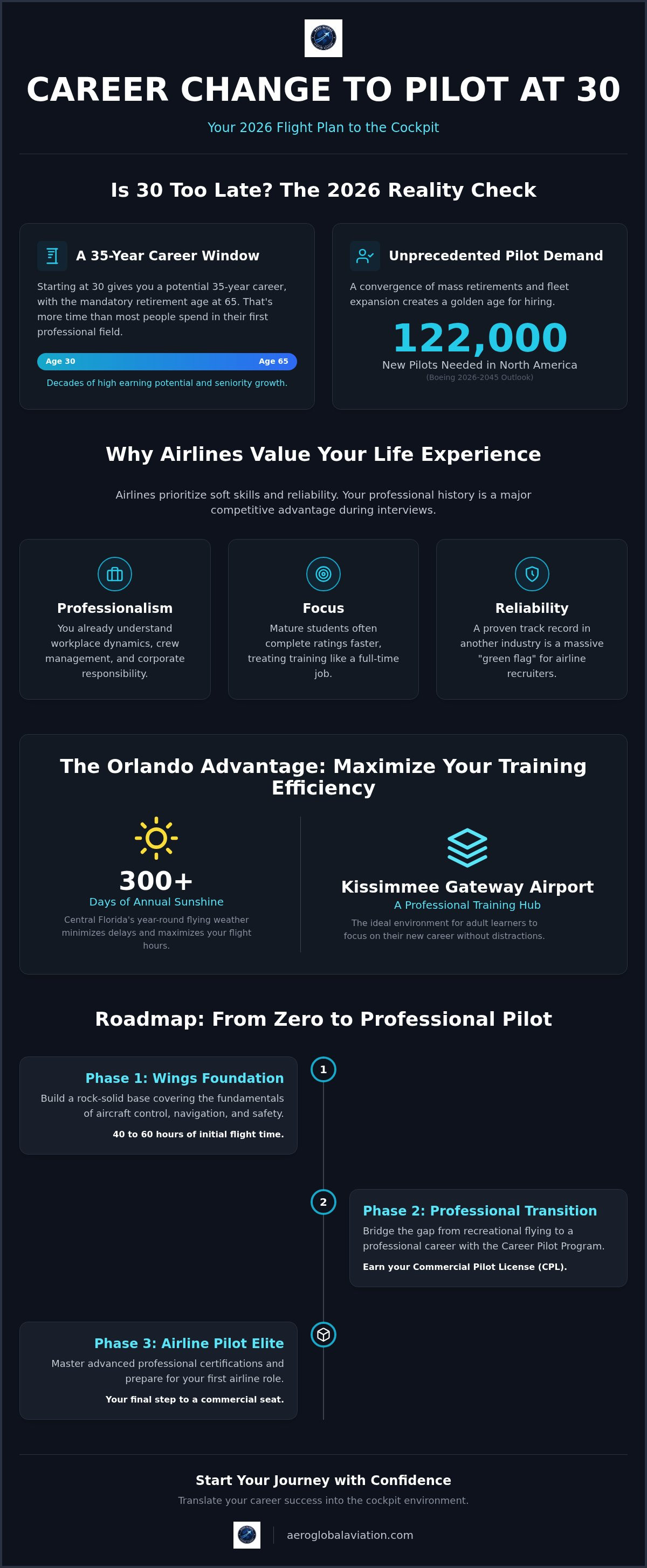
The idea that you must start flight training in your teens is a lingering myth from a different era of aviation. In the 2026 market, starting at 30 isn't just viable; it's often preferred by major carriers. If you are considering a career change to pilot at 30 Orlando, you are entering the industry with a significant advantage: a 35-year career window. With the FAA mandatory retirement age for airline pilots holding steady at 65, you have three and a half decades of earning potential ahead of you. This is more than enough time to reach the left seat of a wide-body jet and maximize your lifetime earnings.
The Math of a Career Pivot at 30
Airlines are currently facing a massive wave of retirements. Approximately 4,300 U.S. pilots reach the mandatory retirement age every year, and Boeing's 2026-2045 outlook projects a need for 122,000 new pilots in North America alone. When you look at the numbers, starting at 30 allows you to reach a major airline by 35 or 36. Even with a later start, you will still enjoy nearly 30 years at the highest pay scales in the industry. The convergence of mass retirements and fleet expansion has turned 2026 into the definitive golden age of hiring for those ready to commit to the flight deck. While your younger peers might have more years, your 35-year window is more than sufficient to reach the top of the seniority list at a legacy carrier.
Why Airlines Value Adult Learners
Airlines have shifted their focus toward "soft skills" and professional reliability. Adult learners bring a level of discipline, communication, and decision-making that 18-year-olds often lack. Understanding the requirements for pilot certification in the United States is just the technical side; the ability to manage a crew and handle high-pressure situations comes from life experience. This makes the career change to pilot at 30 Orlando a highly strategic move for those coming from fields like law enforcement, management, or education.
- Professionalism: You already understand workplace dynamics and corporate responsibility.
- Focus: Mature students typically complete their ratings faster because they treat training like a full-time job.
- Reliability: A proven track record in another industry is a massive "green flag" for airline recruiters.
At Aero Global Aviation Academy, we use a "Practical Mentor" approach specifically designed for this demographic. We don't just teach you how to fly; we help you translate your previous career successes into the cockpit environment, ensuring your transition is as efficient as possible.
The Step-by-Step Roadmap: From Zero to Professional Pilot in Orlando
Transitioning into the cockpit requires a clear, professional flight plan. If you are pursuing a career change to pilot at 30 Orlando, you need a roadmap that respects your time and your previous professional commitments. At Aero Global, we break this journey into logical phases that move you from your first takeoff at Kissimmee Gateway Airport to your final interview with a major airline. This structured approach ensures you build the right habits from day one.
Phase 1: Building Your Wings in Kissimmee
Your journey begins with the Wings Foundation. This initial phase covers your first 40 to 60 hours of flight time and focuses on the fundamentals of aircraft control, navigation, and safety. Most adult learners find that our structured ground school allows them to master the technical knowledge while maintaining their current professional responsibilities. It is about building a rock-solid base before moving to more complex operations. For a deeper look at the specific requirements, read our guide on How to Get Your Private Pilot License in Florida.
Phase 2: The Professional Transition
Once you have earned your Private Pilot License, the focus shifts to our Career Pilot Program. This phase bridges the gap between flying for fun and flying for a paycheck. You will move from basic maneuvers to the precision required for a Commercial Pilot License (CPL). Executing a career change to pilot at 30 Orlando requires a focus on efficiency. Under Part 61 regulations, a total of 250 flight hours are required to earn your commercial certificate, which must include 100 hours of pilot-in-command time and 50 hours of cross-country flight. Following the official FAA steps to Become a Pilot ensures you meet all regulatory standards while training in a professional environment.
Phase 3: Airline Pilot Elite Track
The final stage of your transition is the Airline Pilot Elite track. This is where you earn your Instrument (IFR) and Multi-Engine ratings, which are essential for flying in complex weather and operating larger aircraft. To reach the 1,500-hour requirement for major airlines, most pilots choose to become a Certified Flight Instructor (CFI). This allows you to get paid to fly while sharing your knowledge with new students, turning your training into a job. You can explore the full spectrum of professional certifications in our Commercial Pilot Training Guide. If you are ready to see how these phases fit your specific goals, our team can help you map out your Career Pilot Program timeline today.
The Orlando Advantage: Why Central Florida is the Best Place to Pivot
Training near Orlando International (MCO) puts you in the heart of some of the busiest airspace in the country. This isn't just about the scenery; it's about professional preparation. Navigating complex traffic patterns and communicating with busy Air Traffic Control (ATC) units prepares you for the "big leagues" of commercial aviation from day one. This high-density environment ensures that when you transition to a regional jet, the pace of professional operations feels familiar rather than overwhelming. According to the Airline and Commercial Pilots Occupational Outlook Handbook, the demand for skilled aviators remains high, and training in challenging airspace gives you a competitive edge. Local efficiency also translates to lower overall costs, as you spend less time waiting for clear weather and more time mastering the aircraft.
The Kissimmee Connection
Kissimmee Gateway Airport (KISM) serves as our strategic base, offering a perfect balance of professional infrastructure and accessible training. It's located just minutes from the major theme parks and residential hubs, making it an ideal location for adult students who need to balance flight hours with family life. The region is also home to several regional airline bases and maintenance hubs, providing unparalleled networking opportunities. You aren't just learning to fly in a vacuum; you're immersing yourself in a massive aviation ecosystem. You can explore how we leverage this local advantage in our guide to The Ultimate Career Pilot Program in Kissimmee. This proximity to industry leaders means you're often training alongside the very people who will eventually be your colleagues.
Financing Your Career Change: Managing the Risk at 30
Entering flight school at 30 means you likely have financial obligations that an 18-year-old does not. Managing the risk of a career change to pilot at 30 Orlando requires a transition from viewing flight training as a cost to viewing it as a capital investment. For the 2026-2027 academic cycle, federal Direct Unsubsidized Loans for professional students carry a fixed rate of 8.07 percent. Private lenders offer a broader range of options, with fixed rates starting as low as 2.39 percent for those with strong credit or professional history. This is where your decade of work experience becomes a literal asset, as lenders often favor mature career changers with proven financial reliability.
You must decide between full-time immersion and part-time training. Full-time training at Aero Global Aviation Academy allows you to reach the flight deck faster, which means you start earning a professional salary sooner. Part-time training, however, allows you to maintain your current income while building your foundational hours in the Wings Foundation program. Many students find that a hybrid approach works best, where they stay employed during ground school and transition to full-time flying once they reach the commercial phase.
Budgeting for the Transition
Building a "flight fund" while working your current 9-to-5 is a smart way to reduce your eventual loan burden. When comparing schools, it's vital to understand "wet" versus "dry" rates. A wet rate includes the cost of fuel, while a dry rate does not; always verify which one a school is quoting to avoid unexpected expenses. Most dedicated students transition from zero experience to a paying flight instructor position within 12 to 24 months of consistent training. You should also consult with a tax professional regarding 2026 incentives for professional education, as some flight training expenses may be deductible if they improve skills required in your current professional sphere.
ROI and Future Earnings
The return on investment for a pilot career remains exceptionally strong. According to May 2024 data, the median annual wage for airline pilots, copilots, and flight engineers reached $226,600. Even commercial pilots in non-airline roles see a median wage of $122,670. While the initial investment is significant, many regional airlines offer signing bonuses and tuition reimbursement programs that can help you pay back training loans much faster than in other industries. You can explore the long-term financial trajectory in The Airline Pilot Career Path Guide. If you want to discuss specific payment plans and how to structure your career change to pilot at 30 Orlando, contact us at Aero Global Aviation Academy to speak with a mentor.
Starting Your Journey with Aero Global Aviation Academy
At 30, you aren't just looking for a flight school; you're looking for a professional partner that respects your background and your timeline. Aero Global Aviation Academy understands that a career change to pilot at 30 Orlando requires a different level of communication and support than a teenager might need. Our academy is built on a philosophy of personalized mentorship. We recognize that you bring valuable life experience to the table, and we use that maturity as a foundation for your technical training. Whether you're starting with the Wings Foundation for your PPL or aiming for the full spectrum of ratings in our Airline Pilot Elite program, we provide the structured environment necessary for a professional pivot.
Mentorship and Community
You won't be training in isolation. Our community in Kissimmee is filled with fellow career changers who share your focus and drive. This network provides a unique support system where you can learn from peers who have successfully transitioned from corporate roles to the flight deck. Our instructors act as practical mentors, guiding you through the complexities of FAA requirements while preparing you for the specific demands of airline interviews. We support you from that first nervous solo flight all the way to your final certification as a flight instructor or commercial pilot. This collaborative spirit ensures that your transition feels like a shared mission rather than a solitary struggle.
Take the First Step
The most effective way to confirm your passion is to get into the air. We invite you to schedule a tour of our Kissimmee facilities and book a discovery flight. This initial experience allows you to handle the controls and feel the reality of your new career path while speaking directly with an instructor who understands your goals. Before you commit to the full Career Pilot Program, we also recommend securing your FAA First-Class Medical Certificate. This is a vital first check to ensure you meet the physical requirements for professional flying at the major airline level.
The aviation industry in 2026 offers a rare window of opportunity for those with the discipline to pursue it. Our Kissimmee location, situated in the heart of Florida's aviation corridor, provides the ideal hub for your new career. Don't let another year pass wondering "what if" while you're stuck in a 9-to-5 that no longer fulfills you. Take the controls and begin your journey to the flight deck today. The sky is waiting, and at 30, you're in the perfect position to claim your seat.
Take Command of Your Future in the Sky
A career change to pilot at 30 Orlando is a powerful, calculated decision that positions you for decades of professional fulfillment. You aren't just catching up; you're arriving at the flight deck with the maturity and focus that modern airlines prioritize. By leveraging Orlando's 300+ annual flying days and our strategic Kissimmee location, you can move through your ratings with maximum efficiency. Your 35-year career window is wide open, and the sustained demand for skilled aviators in 2026 makes this the definitive moment to pivot.
At Aero Global Aviation Academy, we provide the expert mentorship and structured Career Pilot Program specifically tailored for adult learners. We understand the high stakes of a mid-career shift and are dedicated to guiding you from your first solo to your final airline interview. Stop wondering if it's too late and start building your legacy in the cockpit.
Are you ready to see the world from a new perspective? Book Your Discovery Flight and Start Your Career Pivot Today. Your second act begins at the end of the runway, and we're here to help you take flight with confidence.
Frequently Asked Questions
Am I too old to become an airline pilot if I start at 30?
You are absolutely not too old. Starting a career change to pilot at 30 Orlando gives you a 35-year professional window before the mandatory retirement age of 65. Airlines actually value the life experience and reliability that 30-year-old candidates bring to the cockpit. Many of our most successful students at Aero Global Aviation Academy are adult learners who have transitioned from other high-stakes industries with great success and focus.
How long does it take to go from zero to airline pilot in Orlando?
The timeline typically ranges from 12 to 24 months to complete your professional ratings. After earning your Commercial Pilot License through our Career Pilot Program, you'll likely spend another 12 to 18 months building the 1,500 flight hours required for major airlines. Orlando's consistent weather allows for a much faster training pace compared to other regions, helping you reach the flight deck as quickly as possible.
Can I keep my current job while attending flight school at 30?
Yes, many students maintain their current employment while completing the Wings Foundation course for their Private Pilot License. This stage requires significant study but offers the flexibility to fly on a part-time schedule. As you transition into more intensive phases like the Career Pilot Program, you may find that a full-time commitment accelerates your progress and allows you to start your new career and professional salary much sooner.
What is the mandatory retirement age for commercial pilots in 2026?
As of 2026, the mandatory retirement age for pilots operating under FAA Part 121 regulations remains 65 years old. This regulation applies to pilots flying for major commercial airlines. For those starting at 30, this ensures a long and lucrative career path. It's important to remember that other commercial flying opportunities, such as corporate aviation or flight instruction, don't have the same strict age limitations as the major airlines.
How much does it cost to change careers to a pilot in Orlando?
While costs vary based on your previous experience and the pace of your training, a total career transition typically involves a significant investment. This includes the cost of your Private Pilot License, Instrument Rating, and Commercial Pilot License milestones. Many students at our Kissimmee facility utilize specialized aviation financing or personal savings to cover these professional certifications. The long-term ROI is substantial, with major airline salaries often exceeding the initial training investment.
What are the medical requirements for a commercial pilot license?
To fly for a major airline, you must obtain an FAA First-Class Medical Certificate. This examination, performed by an Aviation Medical Examiner, checks your vision, hearing, and overall cardiovascular health. For those pursuing a career change to pilot at 30 Orlando, we recommend securing this certificate before beginning your training. It confirms that you meet the physical standards required for a professional career and prevents any future surprises regarding your medical eligibility.
Is Orlando a good place for flight training during hurricane season?
Orlando remains one of the best training environments in the world, even during the summer months. While hurricane season is a factor in Florida, major storms are relatively infrequent and typically only affect flight operations for a few days at a time. The region still boasts over 300 days of flyable weather annually. Our location at Kissimmee Gateway Airport allows students to maintain a consistent training schedule that's more reliable than schools in colder climates.
What is the difference between Part 61 and Part 141 training for career changers?
Part 61 training offers more flexibility, which is often ideal for adult career changers who need to balance training with existing life responsibilities. It allows for a more personalized pace based on your individual progress. Part 141 schools follow a more rigid, FAA-approved syllabus and are often associated with university programs. At Aero Global Aviation Academy, we focus on a structured yet adaptable approach that ensures you meet all professional standards while respecting your personal timeline.


