What if the most rewarding fifteen years of your professional life haven't even started yet? Many professionals reaching their fiftieth birthday assume the flight deck is a closed door, but the reality is that the aviation industry is more welcoming to mature pilots than ever before. You might feel a bit of anxiety about the 1,500-hour rule or wonder if your health will meet the FAA First Class Medical standards after five decades. It's completely normal to question the return on investment when you're looking at a career window that closes at the mandatory retirement age of 65. However, your maturity and life experience are actually significant assets in a high-stakes environment.
In this guide, you'll discover the tactical roadmap for how to become an airline pilot in Florida while staying right here in Kissimmee. We will validate your path by showing you how to navigate regulatory requirements and maximize your time in the air. You'll learn about the specific timeline for a second-act career and why the local Central Florida climate offers the most efficient training ground in the country. From understanding medical screenings to mapping out your path to the cockpit, we're here to help you turn your late-start concerns into a strategic professional advantage.
Key Takeaways
- Understand the "Age 65 Rule" and why starting at 50 provides a viable, lucrative 15-year window in the cockpit.
- Discover how to become an airline pilot in Florida by leveraging Kissimmee’s 300+ days of flyable weather for accelerated, year-round training.
- Learn why securing your FAA First Class Medical certificate is the most critical first step to ensure your long-term career viability.
- Explore structured training paths like the Career Pilot Program and the Airline Pilot Elite track to transition from zero experience to a professional flight instructor.
- Identify high-demand career alternatives beyond major airlines, such as corporate aviation and private jet charters, that value mature, experienced pilots.
Can You Start a Pilot Career at 50? (The Reality of the 15-Year Window)
Stepping into a cockpit at age 50 isn't just possible; it's a strategic move that many professionals are making to escape the corporate grind. While the industry often highlights young cadets, the reality of the current market is that airlines are hungry for the stability and focus that mature pilots bring to the table. You aren't just starting a job; you're launching a 15-year career that can lead to the captain's seat of a major aircraft. If you're researching how to become an airline pilot in Florida, your first step is understanding exactly how much time you have to fly.
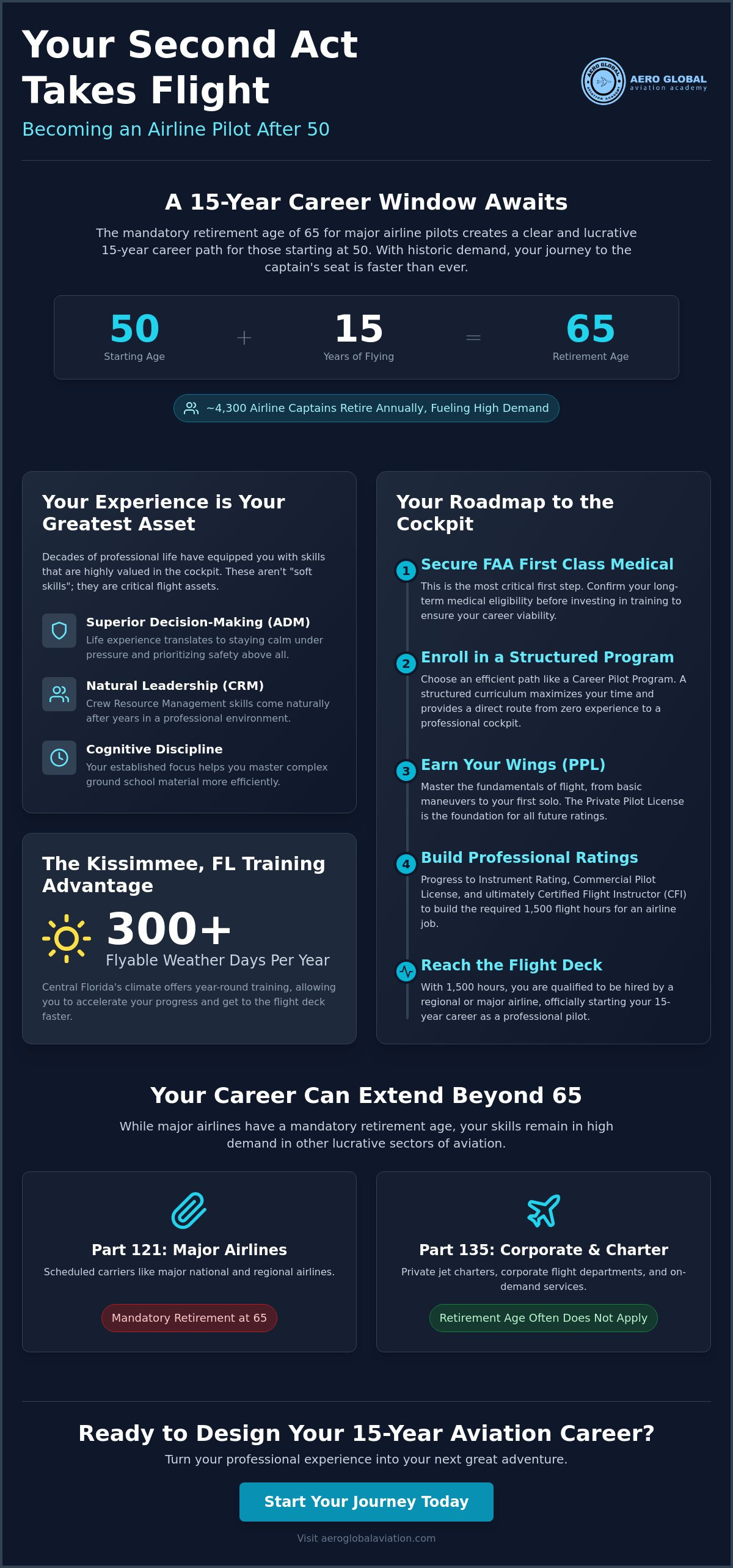
As of 2026, the mandatory retirement age for commercial airline pilots in the United States is 65. This provides a clear, 15-year window for anyone starting at 50. With approximately 4,300 airline captains retiring annually, the demand for new pilots remains at historic highs. This shortage means that your progression through the ranks can happen much faster than it did twenty years ago, making those 15 years both lucrative and professionally fulfilling.
The FAA Mandatory Retirement Age and What It Means for You
The age 65 limit specifically applies to Part 121 operations, which are the major scheduled airlines. If you choose to fly for Part 135 operators, such as private jet charters or corporate flight departments, that mandatory retirement age often doesn't apply. This means your career could actually extend well past 65 if your health remains strong. For those focused on the airlines, 15 years is plenty of time to reach the captain's seat at a regional carrier, where pay scales have risen significantly to meet the pilot shortage. When you compare the earning potential of a senior pilot to a standard corporate salary, the financial case for this career change becomes very clear.
Why Your Professional Background Is a Training Asset
Your decades of work experience aren't lost when you enter flight school. You've already developed the cognitive discipline required for intensive ground school and the complex process of pilot certification in the United States. Airlines value "soft skills" like Crew Resource Management (CRM) and leadership, which take years to master in other industries but come naturally to a 50-year-old professional. Your life experience also leads to superior Aeronautical Decision-Making (ADM). You've learned how to stay calm under pressure and prioritize safety; these are the exact traits flight examiners look for. When you're learning how to become an airline pilot in Florida, these transferable skills often help you progress through training more efficiently than a student half your age.
Navigating the Career Pilot Program: From Zero to Commercial Certification
When time is your most valuable asset, a haphazard approach to training won't work. For a professional starting at 50, a structured career pilot program is the engine that drives your transition. This isn't just about learning to fly; it's about following a proven sequence designed to move you from the ground to the flight deck with maximum efficiency. You need a path that respects your 15-year career window while ensuring you meet every rigorous safety standard. By following a condensed schedule, you can complete the necessary how to become an airline pilot in Florida milestones in a fraction of the time it takes traditional students.
The Wings Foundation: Securing Your Private Pilot License
Your journey begins with the Wings Foundation, where you'll spend your first 40 to 60 hours of flight time. Operating out of Kissimmee Gateway Airport, you'll master basic maneuvers, takeoffs, and landings in a professional environment. For many mature students, this is the most significant psychological hurdle. It requires shifting from being an expert in your current field to being a novice in a cockpit. However, once you complete your first solo flight, that initial anxiety transforms into a deep sense of accomplishment. Mastering these fundamentals is the bedrock of all steps to a professional pilot career.
Transitioning to Professional Ratings for Career Advancement
After your private license, the pace accelerates. You'll move into the commercial pilot training phase, where the goal is precision and professional-grade skill. This involves obtaining an Instrument Rating, which allows you to fly in low-visibility conditions, and a Multi-Engine Rating to handle larger, faster aircraft. These certifications are non-negotiable for anyone looking at how to become an airline pilot in Florida. By following a dedicated timeline, it's possible to reach commercial certification in just 12 to 18 months.
Once you hold a Commercial Pilot License (CPL), you can legally be compensated for flying. From there, your focus shifts to building the 1,500 hours required for your Airline Transport Pilot (ATP) certificate. Many pilots choose to work as flight instructors or in regional charter roles to reach this milestone. This phase is where your maturity shines, as you'll be managing passengers or students with a level of professionalism that younger pilots are still developing. If you're ready to see how your specific background fits this timeline, you can explore our program options to find your best starting point.
The Health and Medical Hurdles for Pilots Over 50
Before you commit to a single hour of flight training, you must clear the most important hurdle in your new career: the FAA First Class Medical certificate. This is the gold standard for professional flight and is required for anyone who intends to fly for a major airline. While many prospective pilots fear that age-related health issues will grounded them before they start, the FAA focuses on management and stability rather than perfection. Understanding the FAA Medical Certification Age Requirements is vital because it confirms there is no upper age limit for certification; if you are healthy, you can fly.
Securing this certificate early protects your investment. It would be a mistake to spend thousands on flight hours only to discover a disqualifying heart condition or vision issue later. By visiting an Aviation Medical Examiner (AME) first, you gain a clear picture of your long-term viability in the cockpit. Your AME isn't just a gatekeeper; they're a partner in your career longevity who helps you navigate the specific health standards required for pilots over 50.
Securing Your FAA First Class Medical Certificate
There are three classes of medical certificates, but the First Class is the only one that permits you to exercise Airline Transport Pilot privileges. For pilots age 40 and older, this certificate requires renewal every six months. The exam is thorough, covering hearing, vision (which must be 20/20 corrected), and blood pressure, which generally must stay below 155/95. Because you are over 40, you'll also undergo an annual electrocardiogram (ECG) to monitor heart health. Preparing for your first visit means having your medical history organized and ensuring any managed conditions, such as treated hypertension, meet FAA documentation standards.
Understanding the 1,500-Hour Rule for Mature Career Changers
Clearing the medical hurdle is a major win, but you must also plan for the 1,500-hour rule. This regulation requires pilots to log 1,500 total flight hours before they can fly for a Part 121 airline. When you're looking at how to become an airline pilot in Florida at age 50, you need a strategy to build these hours quickly. The most common and effective route is becoming a Certified Flight Instructor (CFI). This allows you to earn a living while logging the hours necessary to reach the airline flight deck. Balancing this hour-building phase with your financial responsibilities is easier in a high-activity hub like Kissimmee, where the constant demand for training keeps you in the air and moving toward your 1,500-hour goal. This structured approach is a fundamental part of how to become an airline pilot in Florida for those on a 15-year career timeline.
Why Kissimmee and Central Florida Are Ideal for Accelerated Training
Location is the most underrated variable in flight training success. For a professional starting a second act at age 50, every week spent on the ground is a week of lost seniority and earnings. When you research how to become an airline pilot in Florida, you'll quickly see that Central Florida is the global epicenter for efficient, high-quality aviation education. The density of airports, maintenance facilities, and flight schools in the Orlando corridor creates a robust ecosystem that supports your rapid progression. Choosing a training hub like Kissimmee Gateway Airport (KISM) allows you to immerse yourself in a professional environment that mirrors the complexity of airline operations from day one.
Maximizing Your Flight Hours with Florida Weather
Florida offers over 300 days of VFR (Visual Flight Rules) weather annually, which is the highest concentration of flyable days in the United States. This statistic is vital for mature students who cannot afford the "training rust" caused by seasonal breaks. In northern climates, a student might lose three weeks to snow and ice; when they finally return to the cockpit, they often spend several hours just regaining their previous proficiency. Here, you maintain constant momentum. You'll also learn to navigate diverse weather patterns, including the quick-moving convective activity and humidity unique to the region. Just as pilots manage these elements in the air, many local professionals rely on Expert Air Florida to handle the intense heat and humidity on the ground through expert seasonal maintenance. These conditions build superior weather-management skills that will serve you well throughout your 15-year career.
The Kissimmee Advantage: Airspace and Infrastructure
Training at Kissimmee Gateway Airport provides a unique strategic benefit. You are situated in complex Central Florida airspace, just miles from Orlando International (MCO), yet you avoid the extreme congestion and long taxi times of a major commercial hub. This means you spend more of your lesson time actually flying rather than waiting for clearance on a crowded tarmac. The proximity to dozens of diverse satellite airports also makes it easy to meet cross-country flight requirements without long, unproductive transit times. You aren't just learning in a vacuum; you're training in the same airspace you'll eventually navigate as a professional.
Beyond the technical advantages, Kissimmee has become a destination for mature career changers. You'll find a community of like-minded professionals who bring the same level of focus and maturity to their training that you do. This local network provides invaluable support and professional connections that extend far beyond the flight school. If you're ready to leverage these regional advantages to fast-track your new career, you can begin your training at Kissimmee Gateway Airport with a team that understands your goals. Mastering how to become an airline pilot in Florida is significantly easier when you have the right environment and the right mentors behind you.
Designing Your 15-Year Aviation Career Path at Aero Global Aviation
Your journey doesn't end with a license; it begins with a roadmap that leads directly to a professional flight deck. At Aero Global Aviation Academy, we've refined the Airline Pilot Elite track to serve as a comprehensive path from your first hour to your final instructor certification. This program is specifically designed to minimize downtime, allowing you to move through your ratings with the precision that a second-act career requires. When you're researching how to become an airline pilot in Florida, having a clear destination for every stage of your training is the key to maintaining momentum and maximizing your career window.
The CFI Route: Building Hours While Getting Paid
Becoming a Certified Flight Instructor (CFI) is the most reliable way to bridge the gap between your commercial license and an airline job. Teaching isn't just about building time; it's about deep mastery. When you explain complex maneuvers to a student, you're cementing your own understanding of aerodynamics and safety protocols. This educational phase is where many pilots truly find their rhythm and confidence. We support our CFI candidates by providing a professional environment where you can work and learn simultaneously, ensuring you reach the 1,500-hour threshold as quickly as possible.
Corporate and Charter Opportunities for Pilots 50+
While many focus exclusively on major airlines, the world of Part 135 operations offers a compelling alternative for pilots over 50. Corporate flight departments and private jet charters often prioritize the maturity and professional history that older pilots possess. These roles frequently offer more flexible schedules and personalized service environments—similar to the bespoke vacation experiences curated by Ares Elite Journeys—that differ from the high-volume nature of regional airlines. Because Part 135 operations do not have a mandatory retirement age, they provide a much longer career tail that can extend well beyond your sixty-fifth birthday.
Even after you reach the age 65 threshold for the airlines, your skills remain in high demand. Transitioning into ferry piloting or returning to flight instruction allows you to stay in the air as long as your health permits. Your fifteen-year career can easily become a twenty-year legacy in aviation. The best way to start is to see the view from the cockpit for yourself. Booking a discovery flight at Aero Global Aviation Academy is the most practical first step to confirm that this path is right for you. We'll pair you with a mentor who understands the unique needs of a 50-year-old student, ensuring your first experience in the air is both informative and inspiring. Mastering how to become an airline pilot in Florida starts with that first takeoff, and we're ready to help you clear the runway for your second act.
Clear Skies for Your Second Act
Transitioning to the flight deck at age 50 isn't just a dream; it's a calculated and rewarding professional pivot. You have a solid 15-year window to command the skies, supported by a global pilot shortage that values your maturity and leadership. By understanding the medical requirements and embracing the accelerated pace of a structured Career Pilot Program, you can secure your future in an industry that never stops growing. The path is clear, and the demand for experienced professionals has never been higher.
Kissimmee Gateway Airport provides the perfect backdrop for this journey. With expert instructors and a proven track record of helping mature students succeed, we ensure your transition is as smooth as possible. You now have the roadmap for how to become an airline pilot in Florida, from clearing your first medical exam to logging those final commercial hours. The view from the cockpit is waiting for you.
Start your second act, book a Discovery Flight at Aero Global Aviation Academy today!
Your life experience is your greatest asset in the cockpit. We're here to help you turn that experience into a successful aviation career that lasts for years to come.
Frequently Asked Questions
Is 50 too old to become a commercial pilot in 2026?
No, age 50 is an excellent time to start because you still have a 15-year career window before the mandatory retirement age of 65. Airlines value the maturity and decision-making skills that older professionals bring to the flight deck. Many second-career pilots find that their focus allows them to complete training milestones efficiently, making the transition both viable and professionally rewarding.
How long does it take to go from zero experience to a commercial pilot job?
You can typically reach your commercial pilot certification in 12 to 18 months through a structured program. After achieving your Commercial Pilot License (CPL), you will spend additional time building the 1,500 flight hours required for major airline roles. Many students choose the flight instructor route to build these hours while earning a paycheck, which accelerates the path to the airlines.
What is the mandatory retirement age for pilots in the United States?
The mandatory retirement age for Part 121 airline pilots in the United States is currently 65. While there have been legislative proposals to increase this age to 67, those changes haven't been passed into law as of 2026. It's important to remember that Part 135 charter and corporate operations often don't have the same age restrictions, allowing for a longer career tail.
Can I pass the FAA First Class Medical exam if I have high blood pressure?
Yes, you can pass the exam as long as your blood pressure is well-managed and stays within the FAA guideline maximum of 155/95. The Aviation Medical Examiner (AME) will look for stability and proper documentation of any medications you use. Since pilots over 40 require an annual ECG, staying proactive about your cardiovascular health is a key part of maintaining your certification.
How much does it cost to change careers to a pilot at age 50?
Changing careers involves a significant financial commitment that covers everything from ground school and flight hours to exam fees. While costs vary based on how quickly you progress and the specific ratings you pursue, you should budget for a comprehensive path from your private license to commercial certification. Many students find that the high starting salaries at regional airlines provide a strong return on this initial investment.
Are airlines actually hiring pilots who start their training at 50?
Airlines are actively hiring mature pilots to help address the ongoing global pilot shortage. Recruiters often prefer the reliability and life experience of second-career pilots who demonstrate strong aeronautical decision-making. Learning how to become an airline pilot in Florida gives you access to a massive hiring hub where regional carriers are eager to fill seats with dedicated, focused professionals.
What are the best flight schools in Kissimmee for mature students?
The best schools for mature students offer structured tracks like the Career Pilot Program or the Airline Pilot Elite program. These courses provide a clear roadmap from zero experience to advanced instructor ratings. Schools based at Kissimmee Gateway Airport are particularly advantageous because they offer professional training environments without the delays found at larger international hubs, allowing you to maximize your time in the air.
Can I build my 1,500 hours while working another job?
It's possible to build hours part-time, but most career changers find that working as a flight instructor is the fastest way to reach 1,500 hours. This role allows you to stay immersed in the aviation environment while earning an income. If you're serious about how to become an airline pilot in Florida, dedicating yourself to full-time hour building will help you reach the airline flight deck much sooner.


