

You are holding short of Runway 15 at Kissimmee Gateway, the DPE is silent in the right seat, and suddenly the radio chatter from KISM tower sounds like a blur of noise. Your hands are slick on the yoke, and the thought of that $1,200 examiner fee feels like a heavy weight pressing down on your performance. Dealing with checkride anxiety Kissimmee is a challenge every student faces, but it does not have to ground your career before it starts.
We understand that the fear of a "pink slip" and the pressure of a high-stakes oral exam can cause even the most skilled aviators to freeze up. It is a feeling every pilot knows, the paralyzing worry that a single mistake will lead to a failure. You have worked hard for this moment, and you deserve to showcase your skills without a mental block getting in the way. Our team is here to act as your practical mentor through this final hurdle.
This article promises to equip you with proven physiological and psychological techniques to neutralize nerves and fly with Pilot-in-Command authority. We will break down how to master KISM radio work under pressure, maintain confidence during the oral exam, and use professional mock checkrides to ensure you pass on your first attempt.
Key Takeaways
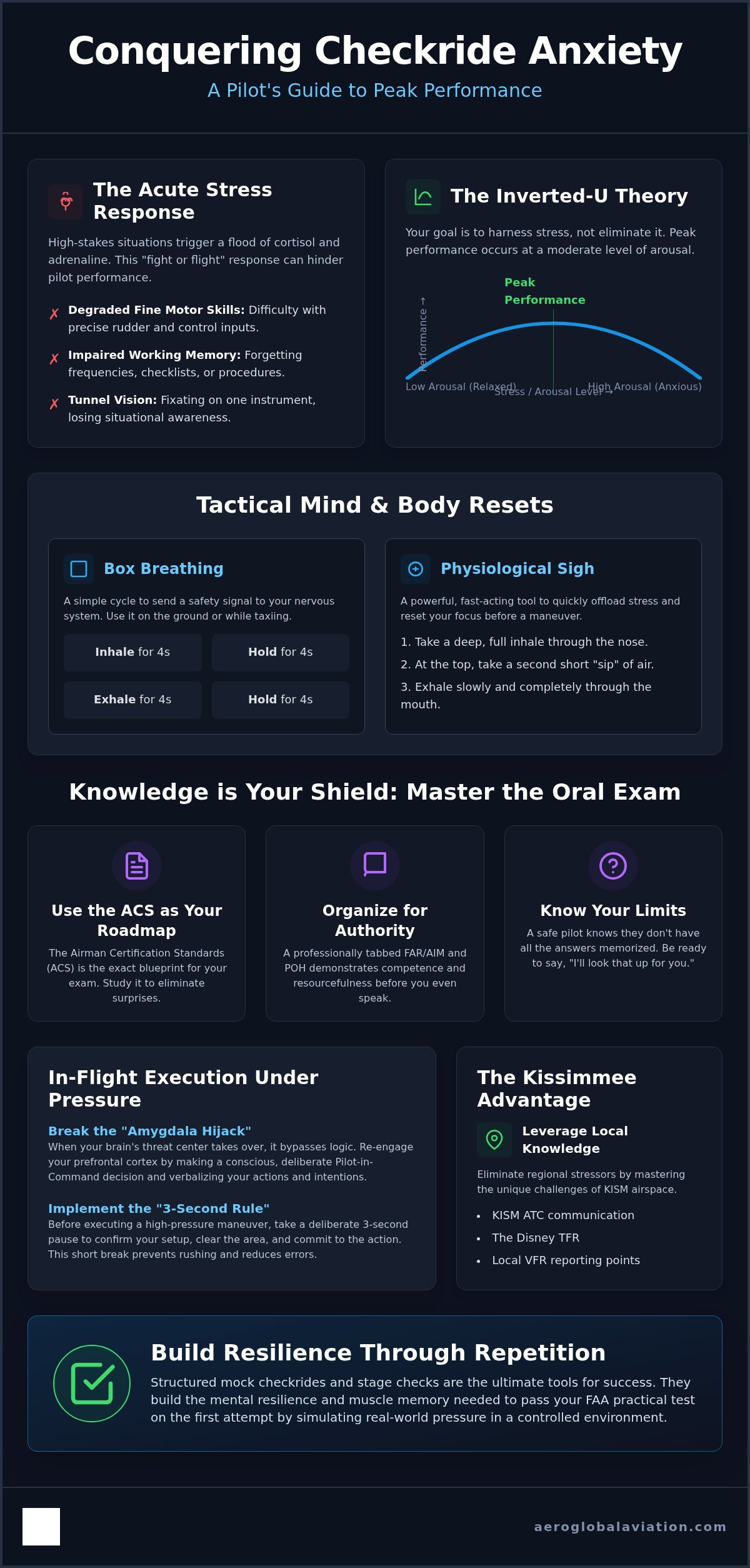
- Learn how the acute stress response affects your working memory and how to harness the Inverted-U Theory to turn nervous energy into peak performance.
- Use the psychological power of over-preparation to defeat oral exam dread and project professional authority through an organized NavLog and flight bag.
- Implement tactical in-flight techniques like the "3-second rule" and verbalized thoughts to maintain deliberate control during high-pressure maneuvers.
- Simplify dealing with checkride anxiety Kissimmee by leveraging local knowledge of KISM air traffic control and the Disney TFR to eliminate regional stressors.
- Discover how structured mock checkrides and stage checks build the mental resilience needed to pass your FAA practical test on the first attempt.
The Physiology of Flight Test Nerves: Why Your Brain Freezes
Checkride anxiety is a natural physiological response to a high-stakes professional transition. It is not a sign of poor training or a lack of skill; rather, it is your body’s way of preparing for a significant challenge. When dealing with checkride anxiety Kissimmee pilots often find that while they know the maneuvers perfectly, their bodies react as if they are facing a physical threat. This is the Acute Stress Response. This biological process floods your system with cortisol and adrenaline, which can sharpen your reflexes but frequently degrades fine motor skills and working memory. In the cockpit, this might manifest as struggling with precise rudder coordination or momentarily forgetting a radio frequency you have used a hundred times at KISM.
Understanding the Inverted-U Theory helps reframe this experience into something manageable. This psychological principle suggests that peak performance occurs at a moderate level of arousal. Without any stress, you might be too relaxed to catch small errors. However, when stress levels become too high, your performance drops off a cliff. The goal is to stay at the top of that curve. Common physical triggers like a racing heart, shallow breathing, or "tunnel vision" are signals that you are sliding past your peak performance zone. Recognizing these signs early allows you to intervene before your brain hits a total "freeze" state.
The Amygdala Hijack in the Cockpit
When a maneuver does not go exactly as planned, the amygdala, your brain's threat center, can take over. It bypasses the prefrontal cortex, which is the area responsible for complex decision-making and your years of flight training. This "hijack" is why a pilot might fixate on a single instrument while their situational awareness decays. You must learn to recognize the difference between healthy nerves, which keep you alert, and performance-inhibiting anxiety, which shuts down your logic. Adopting a firm Pilot in Command mindset acts as a biological circuit breaker. By making a conscious, deliberate command decision, you re-engage your logical brain and regain control of the aircraft.
Tactical Breathing for Immediate Reset
Military pilots use specific techniques to stay calm during high-stress missions, and you can apply these same tools during your practical test. Box breathing is a highly effective reset that you can use even while taxiing. Simply inhale for four seconds, hold for four, exhale for four, and hold for four. This cycle sends a physical signal to your nervous system that you are safe. Another powerful tool is the physiological sigh, which involves a deep inhale followed by a short second "sip" of air and a very long exhale. Practicing this during your pre-flight walkaround at Kissimmee Gateway Airport sets a calm baseline before you even climb into the cockpit. These few seconds of controlled breath can be the difference between a shaky maneuver and a precise execution that meets every ACS requirement.
Defeating the 'Oral Exam' Dread: Knowledge as a Shield
Knowledge is the most effective antidote to fear. When you understand the "why" behind a regulation or a system, the "what if" scenarios that fuel anxiety begin to fade. Dealing with checkride anxiety Kissimmee requires you to treat the oral exam as an open-book exercise in professional competence. The FAA does not expect you to memorize every word of the FAR/AIM; they expect you to know where to find the answers. Using the 2026 Airman Certification Standards (ACS) as your personal study guide ensures you are exactly aligned with what the Designated Pilot Examiner (DPE) is required to test. By using the ACS as a checklist, you eliminate the mystery of the exam and replace it with a structured plan for success.
Tab Your FAR/AIM and POH Like a Pro
A messy flight bag suggests a messy pilot. Your organization level communicates professional authority before you even answer the first question. Use color-coded tabs to mark critical sections in your FAR/AIM and Pilot’s Operating Handbook (POH). For Kissimmee pilots, focus on tabbing local airspace requirements, weather minimums, and emergency procedures. When a DPE asks a tough question, you won't fumble through pages. You'll calmly flip to the exact tab, demonstrating that you are a prepared and resourceful pilot. This visual clarity often lowers the examiner's overall scrutiny level because you have already proven your diligence and respect for the regulations.
During the oral, you might hit an "I don't know" moment. Don't panic. A safe pilot knows their limits. If you are unsure, tell the DPE: "I don't have that memorized, but I know exactly where to find it." Then, use your tabbed resources. This honesty builds trust and shows you prioritize accuracy over guessing. Learning in-flight stress management starts here, on the ground, by maintaining your composure when your knowledge is challenged.
The 'DPE is a Human' Perspective
It is easy to view the examiner as a gatekeeper whose sole job is to find a reason to fail you. In reality, the DPE wants to see that you are a safe, prudent applicant ready for your private pilot license florida. They are looking for a future colleague, not a student to interrogate. Treat the oral exam as a professional briefing rather than a trial. Build rapport through clear, concise, and honest communication. If you approach the session with the confidence of a pilot delivering a mission report, the atmosphere shifts from an exam to a professional exchange. If you want to refine this professional presence, our Career Pilot Program offers specialized mentoring to help you master these essential soft skills.
Managing In-Flight Stress: Execution Under Pressure
Once you leave the briefing room and head to the ramp at Kissimmee Gateway Airport, the nature of the challenge changes. Dealing with checkride anxiety Kissimmee shifts from mental recall to physical execution. The cockpit is a dynamic environment where stress can quickly compound if not managed with tactical precision. To stay ahead of the airplane, you must implement a deliberate pace. The "3-Second Rule" is your primary tool for this. When the DPE prompts you for a maneuver, such as a power-off stall, don't react instantly. Take three seconds to breathe, verify your clearing turns, and confirm your configuration. This brief pause demonstrates to the examiner that you are a deliberate Pilot in Command rather than a reactive student.
Another powerful technique is the "Flight Instructor" method of verbalizing your thoughts. By narrating your actions out loud, you create a feedback loop that keeps your brain engaged with the task at hand. Say your targets: "I am maintaining 3,000 feet, clearing the left, and starting my steep turn now." This narration helps you catch small deviations before they become major errors. If you do notice a minor slip, such as a 50-foot altitude gain, acknowledge it out loud to reset the DPE’s expectation. Simply saying, "I see I'm slightly high; I am correcting back to 3,000 now," shows the examiner you are aware of the standards and are actively managing the flight. This prevents a "Chain of Errors" where one small mistake leads to a mental collapse during the next maneuver.
Chair Flying for Muscle Memory
Mental rehearsal is a scientific way to build resilience before you even pre-flight. Your brain cannot easily distinguish between a real landing and a vivid, imagined one. Spend time visualizing the specific environment of KISM. Imagine the sight of the Disney TFR to your north and the sound of the tower controller's voice. Script your radio calls and emergency flows until they are automatic. When you have practiced the sequence a hundred times in your mind, your hands will move with confidence even when your heart rate spikes. This level of preparation ensures that your motor skills remain sharp when the pressure of the practical test begins.
The Power of the 'Positive Exchange of Controls'
Use standard operating procedures as psychological anchors. The "positive exchange of flight controls" is more than a safety requirement; it is a mental reset that forces you to focus on the immediate transition. Maintaining strict cockpit management also reduces your mental load. Keep your iPad organized and your charts tucked away when not in use. A cluttered cockpit leads to a cluttered mind. Remember that the first 10 minutes of the flight often set the tone for the entire session. If you remain ahead of the airplane during the taxi and departure, you will carry that professional momentum into the more demanding maneuvers that follow.
The Kissimmee Advantage: Leveraging Local Knowledge
One of the most effective ways of dealing with checkride anxiety Kissimmee pilots can utilize is mastering the "home-field advantage" at Gateway. When you fly out of KISM, you aren't just navigating an airport; you are operating within a familiar ecosystem. Dealing with checkride anxiety Kissimmee becomes much easier when you view the local environment as an asset rather than a hurdle. Building confidence with the local controllers is a massive stress reducer. These professionals are used to training traffic, and knowing their cadence can make a complex clearance feel like a routine conversation. This familiarity allows you to focus on your Pilot in Command duties rather than decoding radio transmissions.
Navigating the "Disney TFR" and the Orlando Class B shelf requires zero hesitation during a checkride. A DPE will watch closely to see how you handle these boundaries. By using local landmarks like Lake Toho and I-4 as visual anchors, you can maintain situational awareness without constantly burying your head in the iPad. Making a confident "Go/No-Go" decision based on the predictable Central Florida afternoon thunderstorms is also a point of PIC pride. It shows the examiner you respect the environment and prioritize safety over the pressure to finish the test. This level of environmental mastery signals that you are ready for the responsibilities of a certified pilot.
Handling the Florida Heat and Thermals
Hydration and physical comfort are often overlooked in stress management. The Florida heat can quickly lead to fatigue, which degrades your decision-making and increases irritability. We recommend timing your checkride for the smooth morning air to maximize your maneuver precision and stay cool. Anticipate thermals and "bumpy" air when flying over the Kissimmee swamps or Lake Toho; knowing they are coming prevents you from over-controlling the aircraft when the wings dip. Staying calm and collected in the cockpit heat shows the DPE you have the physical stamina required for a professional aviation career.
KISM Departure and Arrival Mastery Mastery
Impress your examiner by demonstrating mastery of specific KISM radio procedures and taxiway layouts. Knowing every "hot spot" at Gateway reduces the uncertainty that leads to runway incursions and nervous fumbling with the airport diagram. DPEs often use the local practice area to initiate "diversion" scenarios. If you already know the nearby airports and landmarks, these diversions become simple navigation exercises rather than high-stress emergencies. Our Career Pilot Program includes deep-dive sessions on these local nuances to ensure you feel like an expert in your own backyard.
The Aero Global Approach: Mock Checkrides and Mentorship
At Aero Global Aviation Academy, we believe that the most effective way of dealing with checkride anxiety Kissimmee students can find is through exposure and structured mentorship. We don't just teach you how to fly; we prepare you for the specific environment of a practical test from your very first hour. Our Career Pilot Program integrates stress-testing into every phase of training. This ensures that the pressure of an examiner's presence feels like a familiar challenge rather than a shock to your system. By building "test-taking muscles" through regular stage checks, you arrive at your checkride with the confidence of a pilot who has already succeeded in similar high-stakes scenarios.
Every stage check at our academy concludes with a personalized debrief. We don't simply list errors; we turn perceived weaknesses into actionable confidence-builders. This approach is central to our "Practical Mentor" philosophy. We aim to create pilots who are fully prepared for the rigors of commercial pilot training. By the time you meet your DPE, you will feel like a professional peer delivering a briefing rather than a student under a microscope. Dealing with checkride anxiety Kissimmee becomes a manageable part of your professional development when you have a team that treats your success as their own.
The Wings Foundation: Building a Calm Base
For those just beginning their aviation journey, our Wings Foundation course focuses on building a calm, rock-solid base of fundamentals. We recognize that your first checkride is often the most intimidating hurdle you will face. We provide a supportive, student-centric environment where you can master the basics without fear. Transitioning from your Private Pilot License to advanced professional ratings is a seamless process when you have a consistent support team that understands your individual flying style and your specific stressors.
Airline Pilot Elite: Professional-Grade Preparation
As you progress into our Airline Pilot Elite program, we introduce professional-grade preparation techniques used by major carriers. We implement airline-style Standard Operating Procedures (SOPs) to eliminate guesswork in the cockpit. When every action is part of a standardized flow, anxiety has no room to take root. For students pursuing advanced instructor ratings like CFI or CFII, you will learn to master checkride psychology by seeing the process from the other seat. Evaluating others often provides the final perspective shift needed to neutralize your own nerves. If you're ready to see our "PIC-First" training in action, book your discovery flight and meet your future mentors at Kissimmee Gateway Airport today.
Take the Left Seat with Confidence
Mastering your nerves is as much a part of being a pilot as mastering your crosswind landings. By understanding your body’s physiological response and leaning into the home-field advantage at Kissimmee Gateway Airport, you transform fear into focus. Dealing with checkride anxiety Kissimmee is about more than just surviving the day; it is about performing with the authority of a Pilot in Command. You have the skills and the knowledge. Now, you simply need the tactical mindset to showcase them to your examiner.
At Aero Global Aviation Academy, we provide the professional training and structured PPL to CPL curriculum you need to succeed. Our expert mentors are dedicated to your first-pass success, offering mock checkrides that ensure you are truly ready for the real thing. You don't have to face this milestone alone. We are here to guide you every step of the way, from your first discovery flight to your final certification. Our student-centric approach ensures you feel supported and prepared for every challenge the industry provides.
Take command of your aviation future, join the Aero Global Career Pilot Program today. Your journey to the flight deck starts with a single, confident step. We can't wait to see you in the skies over Central Florida.
Frequently Asked Questions
What happens if I fail my checkride in Kissimmee?
If you don't meet the standards, you'll receive a Notice of Disapproval, often called a "pink slip." This document outlines the specific areas where you need improvement. It isn't a career-ender; it's a roadmap for retraining. You'll work with your instructor to master those specific tasks and then schedule a re-evaluation. In the Kissimmee area, retest fees typically range from $500 to $800 depending on how much of the test needs repeating.
How do I deal with a 'tough' DPE reputation?
Focus on the Airman Certification Standards (ACS) rather than the examiner's personality. Every DPE must follow these objective criteria. If you perform to the standard, they cannot fail you. Dealing with checkride anxiety Kissimmee involves realizing the examiner is a professional checking boxes, not an adversary. Prepare to be the most organized applicant they've seen all month. Professionalism and precise execution are the best ways to win over any "tough" examiner.
Is it normal to feel like I've forgotten everything the night before?
Yes, this is a common psychological response to high stress. Your brain is processing a massive amount of information, and cortisol can make recall feel sluggish. Trust in the endorsements your instructor provided. They wouldn't sign you off if you weren't ready for the challenge. Get plenty of rest and stay hydrated. Once you begin your familiar pre-flight routine at KISM, your training and knowledge will naturally click back into place.
How much does a checkride cost in Florida in 2026?
In 2026, Designated Pilot Examiner (DPE) fees in the Orlando and Kissimmee regions are approximately $1,200 for an initial practical test. This fee is paid directly to the independent examiner and is separate from aircraft rental costs. Retest fees vary but generally fall between $500 for a flight-only check and $800 if ground portions are repeated. Always confirm the exact fee and payment method with your chosen examiner when scheduling your date.
Can I reschedule my checkride if I'm too anxious to fly?
You can reschedule, but you should evaluate if the anxiety is a temporary hurdle or a lack of proficiency. A "No-Go" decision is a valid exercise of PIC authority if you truly feel unsafe. However, some nerves are expected. We recommend discussing your feelings with a mentor. At our academy, we use structured mock checkrides to help students determine if they are ready for the pressure before they commit to the official examiner's fee.
Should I tell my friends and family my checkride date?
Many pilots find that keeping the date quiet reduces external pressure. You don't want to worry about "letting people down" if the weather doesn't cooperate or if you need a retest. Telling only your instructor and a few close mentors allows you to focus entirely on the flight. Once you have that temporary certificate in your hand, the celebration with everyone else will feel even better without the added weight of their expectations.
How do I handle a 'mental block' during the oral exam?
Take a breath and use your resources. If you hit a block, tell the DPE you want to look up the specific reference in your tabbed FAR/AIM or POH. The examiner wants to see that you are a resourceful pilot who prioritizes accuracy over guessing. Dealing with checkride anxiety Kissimmee is easier when you remember that the oral is a professional conversation, not a memory contest. Use your tabbed books as your roadmap to stay on track.
What is the best way to practice for the checkride at KISM?
The most effective method is participating in structured mock checkrides that simulate the exact environment of Kissimmee Gateway Airport. Practice your radio calls with KISM tower and navigate the local practice areas until they feel like your own backyard. Our academy integrates these simulations into the curriculum to build your mental resilience. Chair flying while visualizing local landmarks like Lake Toho ensures your flows and procedures are automatic even when you are under pressure.


