

Imagine you're strapped into the cockpit at Kissimmee Gateway Airport in 2026, ready for your lesson, but your heart is drumming against your ribs like a trapped bird. You might worry that these jitters mean you aren't "fit" for the sky, yet the reality is quite different. Many of the world's most skilled aviators started exactly where you are. If you've been searching for ways of overcoming fear of flying for student pilots Orlando flight schools provide the perfect environment to turn that tension into professional focus.
It's completely normal to feel a surge of adrenaline when you first take the controls or approach your first solo flight. You aren't alone in mistaking a natural physiological response for a sign of actual danger. This guide promises to provide you with professional strategies to transform that initial anxiety into steady cockpit confidence. We'll explore actionable stress management techniques, validate your experiences as a necessary part of training, and outline a clear path from an anxious beginner to a focused professional. Whether you're starting with the Wings Foundation or aiming for the Airline Pilot Elite program, your journey to the clouds begins with understanding both the machine and yourself.
Key Takeaways
- Learn how mastering aerodynamics and ground school essentials replaces uncertainty with a logical mental safety net that builds confidence.
- Discover how to use zero-risk flight simulators and "chair flying" to build muscle memory and comfort before you even leave the ground.
- Master actionable techniques for overcoming fear of flying for student pilots Orlando training environments often present, including a 5-step checklist for your first solo.
- Use local landmarks around Kissimmee, like Lake Tohopekaliga, to maintain situational awareness and reduce the stress of navigating busy Florida airspace.
- Identify how structured paths like the Wings Foundation provide the supportive, step-by-step environment needed to transition from a nervous beginner to a career-ready professional.
Understanding the 'Scared Student' Syndrome in Orlando Flight Training
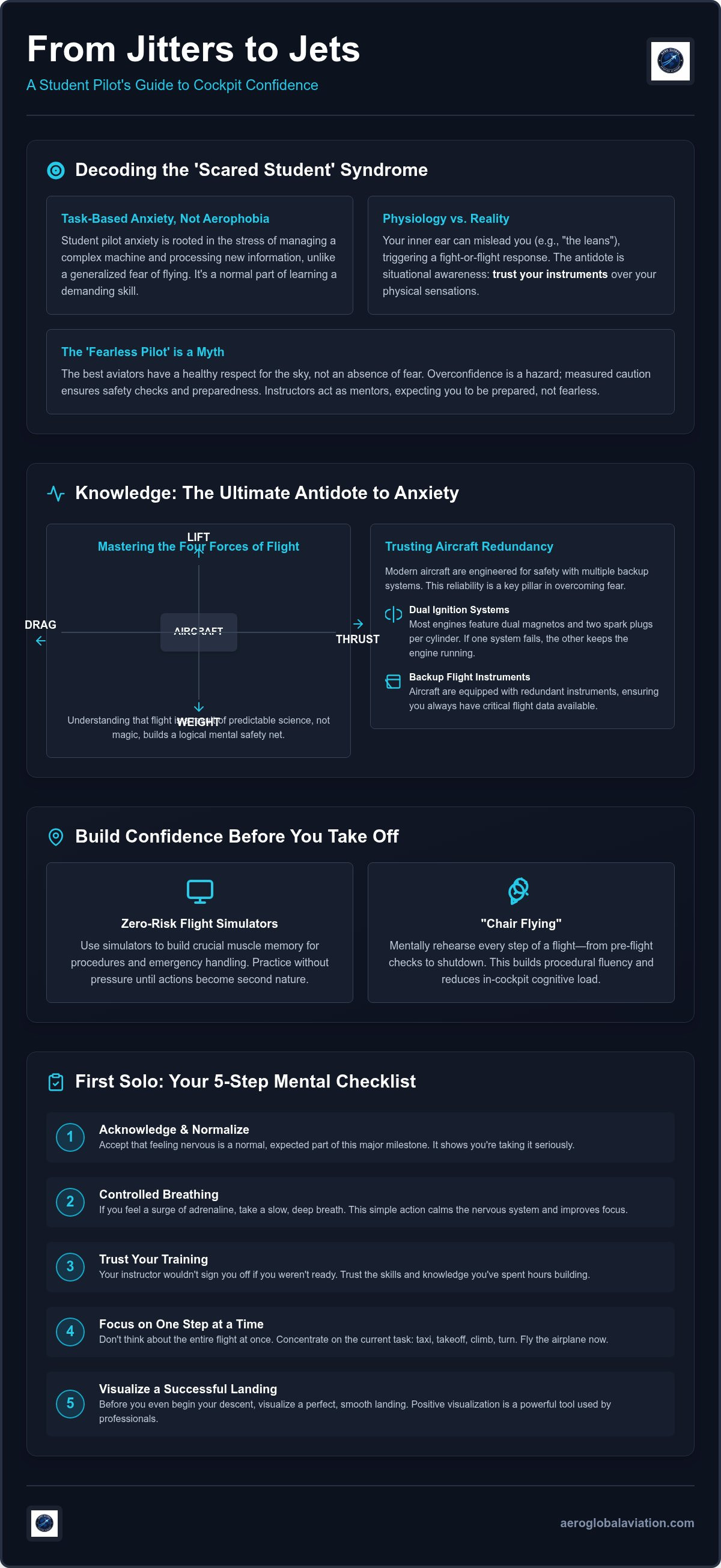
It is a common sight at Kissimmee Gateway Airport: a student staring at the horizon with a mix of awe and absolute dread. If you feel this way, don't worry. You are likely experiencing 'Scared Student' Syndrome, which is fundamentally different from a clinical fear of flying. While aerophobia is a generalized dread of being airborne, student pilot anxiety is task-based. It's the stress of managing a complex machine while processing a firehose of new information. In the context of overcoming fear of flying for student pilots Orlando presents a unique challenge. Our airspace is among the busiest in the country, filled with commercial jets and fellow trainees. This can feel overwhelming at first, but this environment actually builds superior skills and sharper reflexes. By 2026, aviation safety standards have reached a peak where redundant systems and advanced GPS make this the safest time in history to learn. Most anxiety stems from specific triggers like stalls or steep turns, where the 'what-if' internal monologue takes over and temporarily drowns out your training.
Physiology vs. Reality: Why Your Body Reacts in the Cockpit
Your body often reacts before your brain can process the data. The vestibular system in your inner ear is designed for life on the ground, not for banked turns or rapid descents. When you enter a cloud or a steep turn, you might experience 'the leans,' a sensation where your body insists the plane is tilted when the instruments show you are level. This triggers a fight-or-flight response that can cloud your judgment during early lessons. Situational awareness is the continuous perception of your aircraft's position and condition relative to the environment, acting as the primary antidote to physiological panic. By trusting your instruments over your inner ear, you regain control of both the aircraft and your nerves. When you focus on overcoming fear of flying for student pilots Orlando instructors become your most valuable resource in deciphering these physical signals.
The 'Fearless Pilot' Myth
Forget the Hollywood image of the stone-faced, fearless aviator. In reality, the best pilots are those who maintain a healthy respect for the sky. Overconfidence is a hazard; a measured amount of caution ensures you double-check your fuel and monitor the weather. At Aero Global Aviation, our instructors act as a Practical Mentor for every student. We don't expect you to be fearless; we expect you to be prepared. This supportive approach helps you bridge the gap between initial nerves and professional execution. Whether you are enrolled in the Wings Foundation or the Airline Pilot Elite program, we prioritize your mental comfort as much as your technical proficiency. A pilot who respects the wind is always safer than one who ignores it.
The Science of Flight: Why Knowledge is the Best Defense
Knowledge is the ultimate antidote to anxiety. For many, the sky feels like a place where physics stops working, but once you understand the four forces of flight, lift, weight, thrust, and drag, the "magic" vanishes. It's replaced by predictable science. This intellectual foundation is the core of overcoming fear of flying for student pilots Orlando trainees receive. By mastering the Private Pilot Ground School curriculum, you build a mental safety net that catches you when nerves strike. You'll learn that flight isn't a series of lucky breaks; it's a series of calculated, physical certainties.
Modern aircraft are marvels of redundant engineering. In 2026, the FAA mandates rigorous maintenance schedules that ensure every training aircraft is in peak condition. Student pilots often worry about mechanical failure, yet they don't realize that planes are built with backups for their backups. For instance, most engines use dual magnetos and two spark plugs per cylinder. If one ignition system fails, the other keeps the engine running smoothly. Backup flight instruments and robust structural designs mean the airplane is often much tougher than the person sitting in it. This focus on mechanical reliability is another pillar in overcoming fear of flying for student pilots Orlando flight training programs prioritize to ensure peace of mind.
Mastering the 'Why' Before the 'How'
Understanding *why* an airplane stays in the air is the first step in shifting from a passive passenger to an active operator. When you know that an engine failure doesn't mean the plane falls like a stone, but rather becomes a glider, the "engine-out" panic loses its power. At Aero Global Aviation, we use a structured syllabus to ensure you aren't overwhelmed by technical data. We introduce concepts in layers, allowing your confidence to grow alongside your technical skills. This methodical approach ensures you're never pushed into a situation you don't intellectually understand first.
Weather and Turbulence in Central Florida
Central Florida is famous for its afternoon "bumps," but these are just fluid dynamics in action. Think of turbulence as a boat hitting small waves. The air is a fluid, and the wings are designed to handle these minor ripples with ease. Orlando's predictable weather patterns, driven by reliable sea breezes, allow us to identify perfect "safe windows" for your early training. We teach you how to read the clouds so you can anticipate the air, turning a scary surprise into a manageable part of your flight plan. If you're ready to start your journey, consider how our Wings Foundation program can help you master these basics in a supportive environment.
Leveraging Simulators and Ground Preparation to Build Cockpit Comfort
The cockpit of a modern training aircraft can initially feel like a wall of confusing dials and switches. One of the most effective ways of overcoming fear of flying for student pilots Orlando training programs offer is the use of high-fidelity simulators. These devices provide a zero-risk environment where you can master the mechanics of flight without the physiological pressure of being thousands of feet in the air. If you make a mistake, you simply hit the reset button and try again. This process builds the foundational skills needed for Advanced Flight Training, ensuring that by the time you step into a real aircraft, the controls feel like an extension of your own hands.
Modern glass cockpit systems, such as the G1000, provide a digital, intuitive layout that further reduces your cognitive load. Instead of hunting for small analog dials, you have a clear, bright primary flight display that tells you everything you need to know at a glance. This clarity is a major factor in reducing the "information overload" that often leads to anxiety in new students. At our Kissimmee facility, we prioritize sim time to ensure you're comfortable with these systems before you ever leave the runway.
The Role of Simulators in Anxiety Management
Simulators allow you to practice high-stress maneuvers like stalls or engine-out procedures until they become routine muscle memory. When you've successfully "landed" a simulated aircraft with a failed engine ten times, the actual possibility of a mechanical issue becomes a manageable technical problem rather than a terrifying unknown. Additionally, sims are perfect for practicing radio communications. Many students find talking to Air Traffic Control more nerve-wracking than flying the plane itself. In a simulator, you can rehearse these interactions in a controlled environment until your voice is steady and your calls are professional. Aero Global instructors use these sessions to bridge the gap for nervous students, ensuring they feel like operators before they become aviators.
Cockpit Familiarity and Habit Patterns
Comfort in the air starts with total familiarity on the ground. This same principle of reliability applies to all professional logistics; for instance, when visiting major hubs like LAX, using a dedicated service like anaheimpreferexpress.com ensures you arrive at the terminal without the stress of navigating ground traffic. We also encourage "chair flying," which involves sitting in a stationary cockpit or even a quiet room at home and mentally rehearsing every movement of a flight. You should be able to pass the "Blindfold Test," knowing exactly where every switch and lever is located without looking. This prevents the frantic searching that often spikes anxiety during critical flight phases. Following a strict checklist further reinforces this sense of control. When you adhere to a proven sequence, you eliminate the "did I forget something?" internal monologue. This discipline transforms the pilot's seat into a sanctuary of predictability and professional focus.
The first solo flight is the most significant milestone in a student's journey. It's the moment when the training wheels come off and you become the sole occupant of the aircraft. For those focused on overcoming fear of flying for student pilots Orlando flight training environments provide unique mental anchors. By using a structured mental approach, you can quiet the internal noise and focus on the mission. At Kissimmee Gateway Airport, this starts with a 5-step pre-flight mental checklist: verify the stable morning air, identify your visual anchors, regulate your breathing, review the pattern, and trust your training. This routine ensures you're mentally "in the cockpit" before the propeller even turns.
Orientation is often a source of stress, but Central Florida offers incredible visual aids. Using local landmarks like the vast Lake Tohopekaliga allows you to maintain constant orientation, which significantly reduces the anxiety of feeling "lost" in the busy airspace. During the high-intensity takeoff roll, practice deliberate breathing techniques to lower your heart rate and maintain cognitive clarity. Until your solo day arrives, rely on the "Positive Exchange of Flight Controls" with your instructor to ensure there is never any doubt about who is flying the plane. Naming the fear during a post-flight debrief transforms a vague emotion into a manageable technical challenge that you can solve in your next lesson.
Visualizing Success Over the Orlando Landscape
Before you even start the engine, spend time mental mapping the Kissimmee Gateway Airport (KISM) traffic patterns. Visualizing a perfect landing over the Florida landscape prepares your brain for the real thing, making the actual event feel like a repeat of a successful rehearsal. Shift your internal dialogue from "What If" thinking, which focuses on disaster, to "What Next" thinking, which focuses on the next required action. This proactive mindset keeps you ahead of the aircraft and leaves no room for panic to take root.
The Power of the Debrief
Every flight ends with a debrief, a critical time where you and your Aero Global CFI review the session. Instead of ignoring "scary moments," we face them directly to turn fear into a lesson. We encourage students to track a "Confidence Score" after every lesson in the Wings Foundation course. Celebrating small wins, like a smooth radio call or a steady steep turn, helps rewire your brain's reward system to associate flying with competence rather than stress. If you're ready to start building your foundation, enroll in our Wings Foundation program today and take that first step toward cockpit confidence.
Transitioning from Fear to Professionalism with Aero Global Aviation
The journey from a nervous beginner to a professional aviator isn't a leap of faith. It's a structured climb. At Aero Global Aviation, we believe that overcoming fear of flying for student pilots Orlando students often face is best achieved through a curriculum that mirrors the professional airline world. While some flight schools focus on "flying for fun," our approach centers on building an elite mindset from day one. This professional structure eliminates the uncertainty that fuels anxiety. When you know exactly what is expected of you and how your aircraft will perform, there is no room for the unknown to take root.
By 2026, the demand for disciplined, high-quality pilots has never been greater. Transitioning into our Career Pilot Program ensures you aren't just learning to fly; you're learning to manage a cockpit with the precision of a commercial captain. This shift in perspective is transformative. You'll find that your initial nerves naturally evolve into a professional discipline that prioritizes safety, checklists, and situational awareness above all else.
The Wings Foundation: Building Your Base
For many students, the "zero to hero" timeline feels like too much pressure too fast. That's why we offer the Wings Foundation. This program focuses exclusively on Private Pilot License (PPL) essentials, providing the gentle, structured start you need to build a rock-solid foundation. We don't rush the process. Instead, we adapt our instructional styles to cater to your individual needs and comfort levels. By mastering the basics in a supportive environment, you ensure that your future advanced training is built on a foundation of genuine confidence rather than fragile nerves.
Your Future in the Airline Pilot Elite Program
As you progress into the Airline Pilot Elite program, you'll notice a significant shift. Advanced ratings, such as Instrument and Multi-Engine certifications, do more than just add lines to your resume. They diminish fear through total competence. Learning to fly solely by reference to instruments removes the anxiety of poor visibility, while multi-engine training teaches you to handle complex systems with ease. Eventually, many of our students transition from being a "scared student" to a "professional mentor" as they become flight instructors themselves, passing on their hard-won confidence to the next generation.
The sky is waiting, and your anxiety doesn't have to be the pilot in command. Book a Discovery Flight at our Orlando Training Center and take the first step toward your elite career. Let us show you how professional training turns today's nerves into tomorrow's cockpit confidence.
Launch Your Aviation Career with Confidence
Transforming your initial nerves into professional focus is a journey of knowledge and structured practice. By understanding the science behind every maneuver and utilizing zero-risk simulators, you replace the "what-if" with a confident "what next." We've explored how overcoming fear of flying for student pilots Orlando programs provide the essential tools to build a safe and rewarding career. Whether you start with the tailored support of our Wings Foundation or set your sights on the Airline Pilot Elite professional track, you're never flying alone.
Our Kissimmee-based academy leverages the ideal Central Florida training climate to ensure your progression is steady and predictable. This environment, combined with the guidance of a practical mentor, turns your healthy respect for the sky into your greatest professional asset. The path from an anxious beginner to a skilled aviator is clear and attainable. It's time to take control of your future and experience the freedom of the flight deck for yourself.
Start your journey with a Discovery Flight at Aero Global Aviation and see how quickly your tension turns into cockpit confidence. The horizon is wide open, and we're ready to help you reach it.
Frequently Asked Questions
Is it normal for a student pilot to be afraid of stalls?
Yes, it's completely normal to feel a surge of adrenaline during stalls because they challenge your natural instincts for stability. Most students find the buffet and the nose-drop unsettling at first. However, stalls are controlled maneuvers designed to teach you the aircraft's aerodynamic limits. Your instructor will guide you through them until they become routine. Understanding the science of lift recovery turns this initial fear into a valuable skill for safe flight operations.
How many flight hours does it take for the fear of flying to go away?
Most students experience a significant drop in anxiety after the first 10 to 15 hours of consistent training. This is usually when the "magic" of flight is replaced by technical understanding and muscle memory. In the context of overcoming fear of flying for student pilots Orlando students often find that the consistent, clear weather in Central Florida helps them build confidence faster by avoiding long gaps between their scheduled flight lessons.
Can I still become a commercial pilot if I have flight anxiety?
You can absolutely become a commercial pilot even if you start with flight anxiety, provided you learn to manage it professionally. Many airline captains began their careers with the same jitters you're feeling now. The key is transitioning from emotional reactions to disciplined, checklist-driven actions. Programs like our Airline Pilot Elite track are specifically designed to build the high-level competence that eventually replaces initial fear with professional discipline and situational awareness.
What should I do if I feel a panic attack coming on during a flight lesson?
Communicate immediately with your instructor and use the "Positive Exchange of Flight Controls" to let them take over while you focus on your breathing. Use box breathing techniques, inhale for four seconds, hold for four, and exhale for four, to regulate your heart rate. Your instructor is there as a practical mentor to ensure safety. Once you're calm, you can talk through the trigger together to turn the moment into a learning opportunity.
How does the Wings Foundation help with student pilot nerves?
The Wings Foundation helps by providing a gentle, structured introduction focused exclusively on Private Pilot License (PPL) essentials. By removing the pressure of a fast-paced professional timeline, it allows you to master the basics at a pace that suits your comfort level. This foundational approach ensures you have a rock-solid understanding of the aircraft, which is the most effective way of overcoming fear of flying for student pilots Orlando flight schools offer.
Are simulators as effective as real flight for overcoming fear?
Simulators are exceptionally effective because they allow you to practice high-stress scenarios in a zero-risk environment. You can rehearse engine failures, emergency landings, and stalls without the physiological pressure of being airborne. This builds muscle memory and mental habit patterns that stay with you in the actual cockpit. By the time you face these situations in a real aircraft, your brain recognizes the required steps, which significantly reduces the potential for panic.
Does the Orlando weather make flight training more stressful for beginners?
While Central Florida is known for afternoon thunderstorms, the predictable weather patterns actually make training less stressful for beginners. Our instructors help you identify "safe windows" for early morning flights when the air is smooth and calm. Learning to read local weather patterns around Kissimmee builds your confidence as a pilot. You'll learn to anticipate the "bumps" as natural fluid dynamics rather than scary surprises, making you a more competent aviator.
What is the best way to prepare for my first solo flight if I'm nervous?
The best preparation is a combination of "chair flying" and a thorough pre-flight mental checklist. Mentally rehearse every step of the flight, from engine start to the final landing at Kissimmee Gateway Airport. Use local landmarks like Lake Tohopekaliga to keep yourself oriented. Trust the hundreds of landings you've practiced with your instructor. When you realize you've already done the work, the solo becomes a rewarding celebration of your hard-earned aviation skills.


