Did you know that the aviation industry projects a shortage of 24,000 pilots by the end of 2026? This massive demand has made finding a high-quality fast track pilot program florida a top priority for aspiring aviators who want to swap a desk for a cockpit. You're likely feeling the pressure of choosing the right path while worrying about hidden costs or whether you can truly handle the intensity of an accelerated timeline. It's completely normal to feel overwhelmed by the technical differences between Part 61 and Part 141 regulations or the stress of a condensed curriculum.
We're here to show you that with the right mentorship and a strategic location, you can earn your Commercial Pilot License in less than a year without sacrificing the quality of your education. This guide breaks down how to leverage Florida's unique flying environment to build hours quickly, secure a path toward becoming a flight instructor, and prepare for a career where the average airline pilot in the state earns $161,701 annually. You'll discover how training in high-density airspace like Orlando provides the professional edge you need to transition from zero experience to a professional flight deck in record time.
Key Takeaways
- Learn why a full-time, immersive curriculum is the most reliable way to transition from the ground to the cockpit without the common delays of traditional programs.
- Discover how a fast track pilot program florida utilizes the region's constant sunshine to help you reach your commercial milestones in record time.
- Master the radio skills needed for professional flying by training at Kissimmee Gateway Airport, right in the heart of Central Florida's complex airspace.
- Identify the key fleet requirements, including G1000 glass cockpits, that prepare you for the technical demands of a modern airline career.
- Explore how the Airline Pilot Elite program provides a clear route to becoming a flight instructor, allowing you to build the hours required for the major airlines.
The Mechanics of a Fast Track Pilot Program in Florida
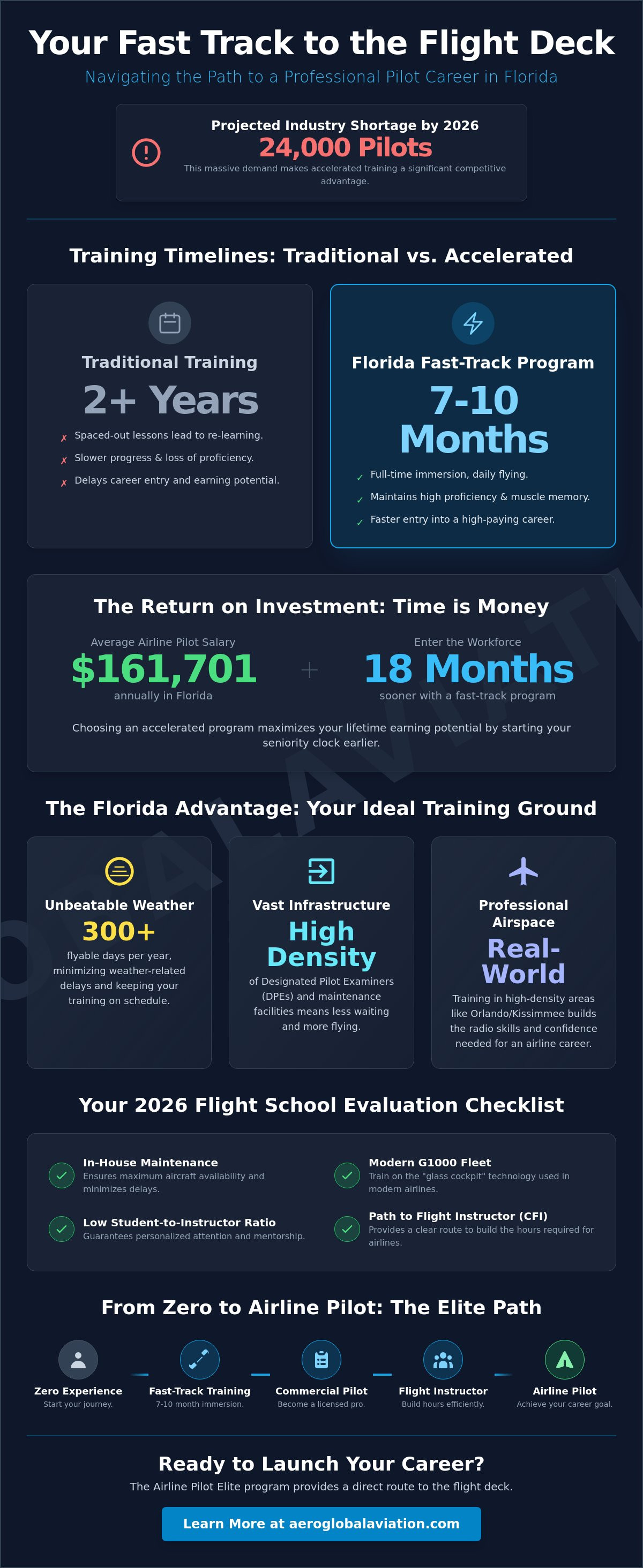
A fast track pilot program florida is more than just a condensed calendar; it's a full-time professional commitment designed to move you from the ground to the flight deck with maximum efficiency. Unlike traditional training where lessons might be spaced weeks apart, these programs utilize a structured, daily curriculum that treats flight training like a full-time job. This immersion model is a strategic response to the massive industry shifts we're seeing in 2026. With a projected global shortage of 24,000 pilots this year, the ability to reach your career milestones quickly isn't just a convenience; it's a competitive advantage that puts you in line for high-paying airline roles sooner.
Transitioning from zero experience to a professional level requires a deep understanding of Pilot certification in the United States. While a traditional "pay-as-you-go" approach often takes two years or more, the "Zero to Hero" model used in Florida streamlines this process into a timeline as short as seven to ten months. By flying almost every day, you maintain a high level of proficiency and muscle memory, which significantly reduces the time spent reviewing previous lessons. This allows you to focus on mastering complex maneuvers and advanced navigation without the "two steps forward, one step back" pattern common in casual training.
Why Florida is the Global Hub for Accelerated Training
Florida's reputation as a flight training powerhouse is built on its unique environmental and economic assets. The state offers over 300 flyable days per year, which is a critical factor when you're on a tight schedule. In other regions, a week of bad weather can derail your progress for a month. Here, you can plan your checkride with confidence, knowing the climate supports your goals. Additionally, Florida has a high concentration of Designated Pilot Examiners (DPEs) and a massive aviation infrastructure. This means less time waiting for exam dates and better access to maintenance facilities, keeping you in the air instead of stuck on the ramp.
Immersion vs. Traditional Training: The ROI Factor
The return on investment for an accelerated track is found in the time you save. Immersion training is a total-focus pedagogical approach where students live and breathe aviation for the duration of their course. When you condense two years of training into seven months, you're not just saving on tuition inflation; you're entering the workforce eighteen months earlier. In a state where the average airline pilot salary is $161,701 per year, those extra months of seniority and earnings represent a significant financial gain. By choosing a fast track pilot program florida, you minimize re-learning time and maximize your career's earning potential from day one.
Evaluating Accelerated Flight Training: What to Look For in 2026
Choosing a fast track pilot program florida is a major investment in your future, but speed shouldn't come at the cost of safety or depth. You need a training environment that helps you meet all FAA requirements for pilots while preparing you for the high-tech cockpits of 2026. Look beyond the marketing brochures and evaluate the actual infrastructure. A school that manages its own maintenance and maintains a low student-to-instructor ratio will always outperform a "pilot factory" where you're just a number on a schedule. This personalized attention is vital for managing the emotional intensity of a five-month curriculum. You can use our guide on the best flight schools in florida to help narrow down your choices based on these critical metrics.
Aircraft Availability and Maintenance Reliability
In an accelerated track, every day counts. If a plane goes down for maintenance and there isn't a backup available, your timeline slips. This is why having an in-house maintenance team is a non-negotiable requirement for any fast track pilot program florida. You should also prioritize schools that offer G1000 glass cockpit technology. Modern regional jets don't use "steam gauges," so training on advanced avionics from day one makes your transition to the airlines much smoother. Whether you're flying a Piper Archer or a Cessna 172, the reliability of the fleet ensures you stay on track for your checkride. A diverse fleet allows you to gain experience in different airframes, which builds a well-rounded skill set for your future employer. If you're ready to see how a professional fleet operates, explore our training aircraft options today.
The Mentor Factor: Instructor Consistency in Fast-Track Programs
Your relationship with your instructor is the single most important factor in your success. In many large programs, students are passed between different instructors, which leads to frustrating progress plateaus and a lack of personalized guidance. You want a dedicated primary instructor who acts as a practical mentor rather than someone just trying to build hours for their own career. Ask about instructor availability during your discovery flight to ensure you won't be competing for time. A consistent mentor understands your specific learning style and pushes you through the intensive curriculum without letting you fall behind. This collaborative spirit turns a stressful training schedule into a logical, rewarding journey toward your wings, ensuring you feel supported every step of the way.
Comparing Fast-Track Paths: Zero Experience to Commercial Pilot
The journey from a discovery flight to a professional cockpit is a series of structured milestones that require both precision and dedication. In a fast track pilot program florida, these milestones are organized into a tight sequence that eliminates the "dead time" found in traditional training. You'll start with your Private Pilot License (PPL), where you master the fundamentals of flight and earn your first solo. From there, you'll move immediately into the Instrument Rating (IR), learning to fly solely by reference to instruments, which is a critical skill for any professional aviator. For a deep dive into the technical details of this progression, you can review our full breakdown of PPL to CPL requirements.
Once you've mastered instrument flight, the focus shifts to the Commercial Pilot License (CPL) and the necessary "time-building" phase. Traditional students often struggle to find reasons to fly during this period, but accelerated programs use this time strategically. You'll engage in complex cross-country flights and night operations that don't just build hours but build real-world proficiency. This phase is designed to transform you from a student into a pilot who can handle the responsibilities of a commercial flight deck with confidence and poise.
The 250-Hour Milestone: Timeline Breakdown
Reaching the commercial checkride requires a disciplined approach to your flight schedule. In a full-time Florida program, you can expect to reach the 250-hour mark in about seven to nine months, depending on your pace and weather. The first three months focus on PPL and IR, while the remaining time is dedicated to building the experience necessary for commercial maneuvers. Under FAA Part 61 regulations, you must log at least 250 hours of flight time to qualify for your Commercial Pilot Certificate. Accelerated tracks optimize this by scheduling high-utilization flight blocks, ensuring you're never waiting for an aircraft or an instructor to clear your next milestone.
The Airline Pilot Elite Track: Beyond the Basics
For those looking at the long-term career outlook for airline and commercial pilots, the Airline Pilot Elite track offers a comprehensive solution. This path doesn't stop at the Commercial License; it integrates advanced instructor ratings like CFI, CFII, and MEI into your initial training. Becoming a Certified Flight Instructor is the most efficient way to bridge the gap between 250 hours and the 1,500 hours required by major airlines. By teaching others, you refine your own knowledge and get paid to build the flight time you need. This airline-oriented environment ensures you aren't just learning to fly; you're learning to lead in a professional aviation setting.
The Central Florida Advantage: Why Kissimmee is the Hub for Speed
Location is the silent engine behind every successful fast track pilot program florida. While many schools promise speed, the actual training density depends on how many quality hours you can log each day. Kissimmee Gateway Airport (KISM) serves as the perfect launchpad for this intensity. Unlike coastal airports that often struggle with morning sea fog, Kissimmee enjoys clear inland conditions that keep the flight line moving. This geographic advantage means you spend less time waiting for the weather to clear and more time mastering the maneuvers required for your next rating.
Training in Central Florida also places you within a 100-mile radius of diverse aviation hubs like Tampa, Daytona Beach, and Melbourne. This proximity creates a playground for cross-country requirements, offering a variety of approach types and runway configurations. You aren't just flying in circles; you're gaining exposure to real-world environments that prepare you for the professional life of a commercial pilot. This variety accelerates your maturity and ensures that by the time you reach your checkride, you've seen more than just your home base.
Airspace Complexity as a Training Tool
Proximity to Orlando's Class B airspace is a major strategic benefit for students. Managing the transition between KISM tower and Orlando Approach requires sharp radio work and precise situational awareness. While some might find complex airspace intimidating, a practical mentor uses it as a tool to build elite proficiency early in your career. You'll learn to communicate with controllers in high-traffic environments, a skill that sets you apart during airline interviews. This constant exposure to diverse airport types, from quiet uncontrolled strips to busy international corridors, ensures your skills stay sharp and professional.
Logistics and Lifestyle for the Fast-Track Student
Success in an intensive program requires a supportive environment outside the cockpit. Kissimmee offers a range of student housing options and local amenities that cater to a full-time training lifestyle. Being located near major airline hubs like Orlando International (MCO) provides unique networking opportunities and the chance to observe professional operations firsthand. Training in a world-class vacation hub also helps balance the high-stakes nature of your studies. When you're not in the air, you have access to a vibrant community that makes the transition to your new career feel like an exciting adventure. If you're ready to experience the Central Florida advantage, apply for our Airline Pilot Elite program and start your journey today.
Launching Your Career with Aero Global’s Airline Pilot Elite
Choosing the right fast track pilot program florida is about more than just finding the quickest path to a license; it's about selecting a partner that invests in your long-term success. The Airline Pilot Elite program at Aero Global is our definitive solution for those who want to transition from zero experience to a professional flight deck with confidence. Unlike large-scale operations where you might feel like a number, our program focuses on a personalized approach that prepares you for the high standards of the major airlines. You can explore the specific milestones and training modules in our comprehensive career pilot program guide to see exactly how we map your journey to the flight deck.
A key advantage of our Elite track is the built-in pathway to employment. We don't just graduate students; we mentor future colleagues. High-performing graduates often transition directly into flight instructor roles right here in Kissimmee. This allows you to earn a living while building the 1,500 hours required for your Airline Transport Pilot certificate. You'll gain these hours in the same high-density airspace where you trained, ensuring your proficiency remains at a professional peak until the day you're hired by a regional or major carrier.
Aero Global’s Mentorship Philosophy
We reject the "pilot factory" model in favor of a "Practical Mentor" philosophy. This means you have direct access to school leadership and small class sizes that allow for individual progress tracking. Our instructors don't just focus on passing checkrides; they focus on "Destination Readiness." This approach ensures you understand the systems, professionalism, and decision-making skills required in a Part 121 airline environment. We've seen our students reach regional airlines in record time because they weren't just taught to fly; they were taught to lead. This collaborative spirit creates an environment where your success is our primary objective.
Your Next Steps: Discovery Flights and Enrollment
The best way to start your journey is to see the Central Florida advantage for yourself. Booking a discovery flight at KISM allows you to experience our fleet and the complex Orlando-area airspace firsthand. Before you begin the enrollment process for the 2026 intake, you'll need to handle a few essential prerequisites. Ensure you can obtain at least a second-class FAA medical certificate and meet all TSA requirements if you are an international student. We also recommend researching your financing options early to ensure your training remains uninterrupted. The demand for pilots is at an all-time high, and there's never been a better time to take that first step toward your wings. Reach out to our team today to schedule your visit and join the next generation of professional aviators.
Claim Your Seat in the Professional Cockpit
The path to becoming a commercial pilot in 2026 is faster and more accessible than ever before. By choosing a fast track pilot program florida, you leverage the state's unique climate and complex airspace to build elite proficiency in months rather than years. You've seen how immersion training eliminates re-learning time and how training in high-density areas like Orlando prepares you for the technical demands of modern airlines. Success in this field isn't just about logging hours; it's about the quality of the mentorship and the equipment you use during those critical training phases.
We provide the tools you need to succeed, including an advanced Garmin G1000 equipped fleet and a strategic Kissimmee Gateway Airport location. Our mentorship-driven Career Pilot tracks ensure you aren't just another student in a factory, but a future professional with a clear destination. It's time to turn your aspirations into a tangible career path. Start your journey today with Aero Global's Career Pilot Program in Kissimmee and take command of your future. The sky is waiting for you, and we're ready to help you reach it.
Frequently Asked Questions
How long does a fast track pilot program in Florida actually take?
A typical fast track pilot program florida takes between seven and ten months to move from zero experience to a Commercial Pilot License. This timeline is significantly shorter than the two or more years often required by traditional part-time training. By flying almost every day, you maintain high proficiency levels and complete your checkrides in rapid succession without the usual delays.
Is an accelerated flight program harder than traditional training?
Accelerated programs are more intense because they require a full-time commitment similar to a professional job. While the daily pace is demanding, many students find it easier to retain information because there are no long gaps between flight lessons. This total immersion helps you master complex maneuvers and technical knowledge more efficiently than sporadic training schedules allow.
What is the cost of a fast track pilot program in Florida for 2026?
The cost of a fast track pilot program florida in 2026 depends on several factors, including the type of aircraft used and the specific ratings included in the curriculum. Industry estimates for professional tracks can vary widely depending on the school's fleet and instructor ratios. You should always request a detailed cost breakdown from your chosen school to understand what is included in their professional training packages.
Do airlines prefer pilots from accelerated programs or traditional universities?
Major airlines generally focus on your total flight hours, your checkride performance, and your professional attitude rather than whether you attended a university or an accelerated school. The goal is to reach the 1,500-hour requirement with high-quality experience. Accelerated tracks are highly respected because they demonstrate a pilot's ability to handle the fast-paced training environments found at regional and major carriers.
Can I get financing for a fast track pilot program in Orlando?
Many flight schools in the Orlando area partner with specialized third-party lenders to help students manage the investment of professional training. These lenders often offer loan structures designed specifically for the aviation industry. You should check with individual schools to see which financial partners they work with to support your transition into a professional pilot career and determine your eligibility.
What are the medical requirements for a career pilot program?
You must obtain an FAA medical certificate from an Aviation Medical Examiner to begin a career pilot program. While a Second Class Medical is sufficient for commercial operations, most aspiring airline pilots aim for a First Class Medical Certificate. This ensures you meet the rigorous health standards required to fly for major airlines before you invest in your full training curriculum and career path.
Is Florida weather really the best for flight training speed?
Florida's climate is a primary reason it remains the world's top destination for flight training speed. With over 300 flyable days per year, you avoid the seasonal delays that plague schools in northern states. This consistent weather allows for a steady training rhythm, which is the most critical factor in completing an accelerated program on your target schedule without losing momentum.
What is the difference between Part 61 and Part 141 for fast-track students?
Part 141 schools follow a rigid, FAA-approved curriculum that often allows for lower minimum flight hour requirements for certain ratings. Part 61 programs offer more flexibility, allowing instructors to tailor the training to your individual progress and learning style. Both pathways lead to the same FAA certifications, so the choice depends on whether you prefer a highly structured environment or a more personalized approach.


