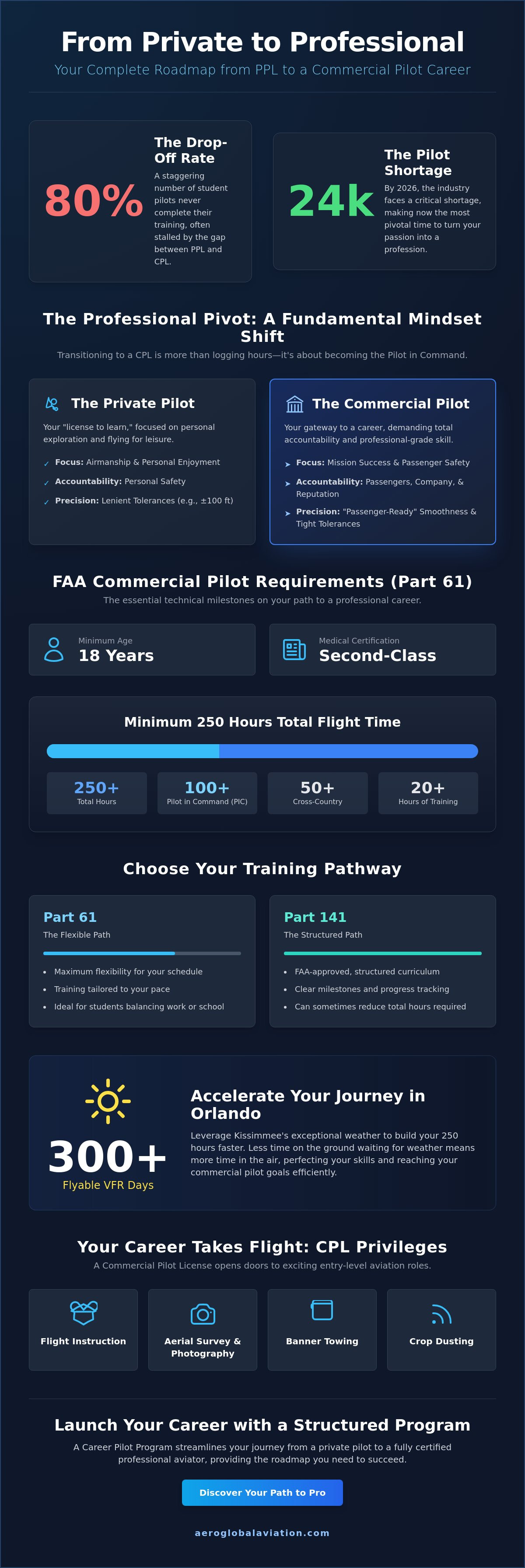
Approximately 80% of student pilots never actually finish their training. It's a staggering statistic that often points to one major hurdle: the daunting gap between earning a private license and finally mastering the PPL to CPL requirements. You've already proven you can fly, but transitioning from a hobbyist to a professional pilot requires a serious shift in precision, mindset, and endurance.
We understand that the 250 hour total time requirement feels like a long road, especially when you're balancing financial planning with the need for consistent progress. You deserve a clear path that turns that long gap into a series of rewarding professional milestones. This guide provides the exact FAA requirements and strategic roadmap you need to bridge the distance between your Private Pilot License and a paid commercial career.
We'll explore the specific differences between Part 61 and Part 141 pathways while highlighting how Orlando's 300 plus flyable days can accelerate your journey. From mastering commercial maneuvers to building a solid plan for your flight hours, you're about to discover how to turn your passion into a professional destination.
Key Takeaways
- Transition from a recreational mindset to a professional one by understanding the high-stakes precision required to fly for compensation or hire.
- Navigate the technical PPL to CPL requirements with a clear roadmap covering age eligibility and the essential Second-Class Medical certification.
- Maximize your training efficiency by leveraging Kissimmee’s unique geography and over 300 days of VFR weather to build your 250 hours rapidly.
- Refine your technical skills to meet the Commercial Standard for precision maneuvers like Chandelles, ensuring you're ready to impress on your checkride.
- Discover how a structured Career Pilot Program can streamline your journey from private pilot to a fully certified professional aviator.
The Professional Pivot: Understanding the Shift from PPL to CPL
Stepping into the cockpit as a commercial student is about much more than just logging extra time in your book. It represents a fundamental transformation in how you view your role on the flight deck. While your Private Pilot License (PPL) was your ticket to learn and explore the skies at your leisure, meeting the PPL to CPL requirements is your gateway to a legitimate, high stakes career. In 2026, the aviation industry continues to face a significant pilot shortage, with some reports suggesting a gap of 24,000 pilots. This makes right now the most pivotal time to transition from an enthusiast to a professional aviator.
Mastering the Pilot in Command (PIC) authority during this transition means moving beyond simply handling the aircraft. It involves taking total accountability for the flight's outcome and the safety of your future passengers. You aren't just flying for yourself anymore; you're flying for a mission, a company, and a professional reputation. This mindset shift is what truly defines a "pro" before they even sit for the checkride.
Privileges and Limitations of the CPL
The primary distinction of the commercial certificate is the legal ability to fly for compensation or hire. Under the FAA pilot certification framework, a Commercial Pilot License (CPL) allows you to be paid for your skills. This opens doors to several rewarding entry-level roles:
- Flight Instruction: Helping the next generation of pilots find their wings.
- Aerial Survey and Photography: Capturing data and imagery for commercial use.
- Banner Towing: Building valuable tailwheel and low-level experience.
- Crop Dusting: Providing essential agricultural support through precision flying.
However, you must understand the "holding out" rule. Even with a CPL, you cannot simply start your own airline or offer flight services directly to the general public. This requires an air carrier certificate. Your CPL allows you to work for an established operator, but it does not make you a one-person airline.
The Skill Gap: What Changes in the Cockpit?
The technical shift from private to commercial flying is marked by a demand for extreme precision. As a private pilot, you likely aimed for altitude tolerances of plus or minus 100 feet. For a commercial student, those margins shrink significantly. You're now training for "passenger-ready" flying, where every movement is smooth, intentional, and coordinated. Meeting the PPL to CPL requirements means proving you can handle complex maneuvers while maintaining total situational awareness. Your pre-flight planning and decision-making must evolve into a professional-grade process that leaves nothing to chance, ensuring you are ready for the rigors of the Career Pilot Program and beyond.
FAA Commercial Pilot Requirements: The Technical Roadmap
Turning your passion into a paycheck begins with understanding the specific technical benchmarks set by the FAA. While your private certificate focused on basic airmanship, the PPL to CPL requirements are designed to ensure you possess the stamina and skill for professional operations. You must be at least 18 years old to hold a commercial certificate, making this an ideal path for young aviators looking to launch a lifelong career. Beyond age, you'll need to upgrade your medical status. While a Third-Class Medical suffices for private flying, exercising commercial privileges requires at least a Second-Class Medical certificate to ensure you meet the physical standards for professional duty.
Choosing between Part 61 and Part 141 training structures is one of the most important decisions you'll make. Part 61 offers maximum flexibility for students with busy schedules, while Part 141 follows a highly structured, FAA-approved curriculum that can sometimes reduce the total hours required for certification. Integrating the Official FAA Pilot Information into your daily study routine will help you stay compliant with these regulations as they evolve. If you're looking for a structured environment to tackle these milestones, exploring a Career Pilot Program can provide the consistency you need to succeed.
Total Flight Time Requirements
Under the standard Part 61 pathway, you must accumulate a minimum of 250 total flight hours. This isn't just about "boring holes in the sky" but rather meeting specific experience milestones. You'll need at least 100 hours of Pilot-in-Command (PIC) time and 50 hours of cross-country flight time. Additionally, the FAA mandates 10 hours of instrument training and 10 hours of training in a complex aircraft or a Technically Advanced Aircraft (TAA). These hours ensure you're comfortable in the high-performance environments common in professional aviation.
The Commercial Knowledge Test
Before you can take your checkride, you must pass the Commercial Pilot Knowledge Test (CAX). This exam moves beyond basic private pilot theory to cover advanced aerodynamics, complex FAA regulations, and high-level navigation. Most students find success using modern ground school software and dedicated study blocks to master these topics. Remember that your written exam results are valid for 24 calendar months. It's often best to knock this out early in your 250-hour journey so you can focus entirely on your flight maneuvers as the checkride approaches.
Strategy for Success: Bridging the 250-Hour Gap Efficiently
Reaching the 250-hour flight time mark is often the most significant endurance test in a pilot's early career. It's the "time building" phase where many students lose momentum, but a strategic approach ensures you arrive at your checkride sharp and ready for hire. Navigating the PPL to CPL requirements efficiently requires choosing a location that works for you, not against you. This is why Kissimmee and the greater Orlando area have become the world's premier hubs for rapid professional development.
Success during this phase isn't just about the quantity of hours in your logbook; it's about the quality of the experience you gain. By treating every flight as a professional mission, you'll develop the habits required for a long-term career. Using your Instrument Rating to fly in "the system" during your cross-country hours is a great way to stay sharp while meeting the PPL to CPL requirements.
The Florida Advantage for Student Pilots
Central Florida offers a unique strategic asset: over 300 days of VFR weather every year. This consistency is vital because it prevents "training rust," the phenomenon where skills degrade during long breaks caused by poor weather. When you can fly almost every day, you save money by finishing faster and requiring fewer review lessons. Beyond the weather, the complex airspace surrounding Orlando and Tampa provides a high-intensity environment that builds professional-grade confidence. You'll learn to navigate busy traffic patterns and communicate with air traffic controllers in a high-density environment, making you a much more attractive candidate for future employers.
Building Quality Hours, Not Just Quantity
Don't fall into the trap of simply "boring holes in the sky." Use your cross-country time to master advanced navigation and IFR procedures. According to the AOPA Commercial Certificate Guide, the transition to commercial flying requires a mastery of precision that can only be developed through intentional practice. This is also the ideal time to look ahead at Advanced Flight Training to see how your current hours will support future instructor or airline ratings. While splitting time as a safety pilot is a popular way to reduce costs, use it wisely. Ensure you're still acting as the primary decision-maker during your PIC legs to keep your leadership skills sharp.
Mastering Commercial Maneuvers for Your Checkride
The final hurdle in satisfying PPL to CPL requirements is the practical test, where you must prove your mastery of the aircraft. Unlike the private pilot checkride, the commercial standard demands a level of finesse that suggests you are ready to fly passengers for hire. This means your maneuvers must be smooth, coordinated, and executed with high situational awareness. You aren't just trying to stay within the lines; you're demonstrating that you can manage the airplane's energy and performance at the edge of its envelope.
Chandelles and Lazy Eights are the "artistic" highlights of this stage. A Chandelle is a maximum performance climbing turn that requires you to trade airspeed for altitude while maintaining a constant rate of turn. Lazy Eights are perhaps the most challenging, as they require you to constantly vary pitch and bank through a 180 degree arc. There is never a moment in a Lazy Eight where your control inputs are static. You must also master Steep Spirals, which test your ability to maintain a constant radius around a point while gliding from high altitude, and the Power-Off 180 degree landing, which is the ultimate test of energy management.
The Commercial Maneuver Checklist
Preparation for maneuvers like Eights on Pylons starts on the ground. You must understand pivotal altitude and how groundspeed affects your position relative to your pylons. During the checkride, briefing your examiner is a critical professional skill. Explain what you are doing, why you are doing it, and what safety precautions you are taking. This demonstrates the professional mindset discussed in earlier sections. Common mistakes that lead to an unsatisfactory result often include:
- Failure to clear the area properly before starting maneuvers.
- Losing track of the wind direction during ground reference maneuvers.
- Fixating on the instruments instead of looking outside.
- Allowing altitude or airspeed to drift beyond ACS tolerances without correction.
The Oral Exam: Proving Your Professional Knowledge
The ground portion of the checkride is just as rigorous as the flight. Your examiner will probe your understanding of aircraft systems, performance limitations, and complex weight and balance calculations. You should be prepared for scenario based questions that test your judgment. For example, how would you handle a mechanical issue while flying a paying passenger? Referencing a comprehensive Commercial Pilot Training guide can help you master the deep theory required to speak with authority during this exam.
Ready to perfect these maneuvers under the guidance of expert mentors? Explore our professional training tracks and take the next step toward your commercial certificate.
Launch Your Career with Aero Global’s Professional Pilot Tracks
You've mastered the maneuvers and understood the technical benchmarks. Now, it's time to choose the environment where you will complete your PPL to CPL requirements. Aero Global Aviation Academy provides a structured, professional ecosystem at our Kissimmee campus, designed to move you through the milestones with purpose. Our Career Pilot Program is specifically built for those ready to bridge the gap between private flying and a commercial paycheck. By training at Kissimmee Gateway Airport, you're placing yourself in a vibrant aviation community that mirrors the professional world you're about to enter.
For those aiming for the flight deck of a major airline, the journey doesn't stop at the commercial certificate. Our Airline Pilot Elite track takes you through to advanced instructor certifications. This is a critical step, as becoming a Certified Flight Instructor (CFI) is widely recognized as the most efficient way to reach the 1,500-hour requirement for airline employment. You'll gain experience, build hours, and sharpen your own skills while getting paid to teach others. It's a transformative process that turns a skilled pilot into a true aviation leader.
From Student to Professional Mentor
Transitioning from a student to a mentor is a significant career milestone. The Career Pilot Program focuses on developing your leadership and instructional abilities alongside your technical flying. By training in the high-traffic environment of Central Florida, you're preparing for the realities of the modern aviation industry. Our team is dedicated to supporting your growth, helping you prepare for that first professional job search once you meet all your PPL to CPL requirements. Instructor opportunities within the academy often provide the fastest, most reliable path to building the time needed for regional and major carriers.
Your Next Step in Kissimmee
Deciding how to invest in your future is a big step. Many aspiring pilots weigh the pros and cons of an Aviation Academy vs. University degree. While universities offer a traditional academic path, our academy focuses on accelerated, hands-on flight training that gets you into the workforce faster. We invite you to book a tour of our facilities at Kissimmee Gateway Airport to see our fleet and meet our instructors in person. Contact an admissions counselor today to build a personalized roadmap and discuss the various financial planning options available to help you reach your professional destination in 2026.
Take Command of Your Aviation Future
Satisfying the PPL to CPL requirements is the definitive bridge between flying for fun and flying for a living. You now have a clear roadmap for transitioning to a professional mindset, leveraging Florida’s favorable weather for efficient time-building, and mastering the precision maneuvers required for your checkride. By choosing to train in Kissimmee, you gain the advantage of over 300 flyable days a year and a curriculum led by expert instructors who bring real airline experience to every lesson.
Our professional pilot tracks are designed to turn your long-term aspirations into a tangible reality. We don't just teach you how to fly; we prepare you for the lifestyle and high stakes responsibilities of a commercial aviator. The industry is actively seeking skilled pilots to fill the current shortage, and there has never been a better time to invest in your own success.
Start Your Journey to the Flight Deck - Join Our Career Pilot Program
Your transition from private pilot to professional starts with a single, decisive step. We are ready to help you take it. Let’s get you into the cockpit and moving toward the career you’ve always wanted.
Frequently Asked Questions
Can I get my Commercial Pilot License without an Instrument Rating?
Yes, you can technically earn a CPL without an Instrument Rating, but it comes with significant operational limitations. The FAA restricts commercial pilots without an instrument rating from carrying passengers for hire on cross country flights longer than 50 nautical miles or at night. Since most professional flying involves these conditions, we strongly encourage students to secure their rating during the Career Pilot Program to ensure they are fully employable.
How many hours do I really need to move from PPL to CPL?
The total flight time depends on the training pathway you choose. Under Part 61, the FAA mandates a minimum of 250 total flight hours. If you train under a structured Part 141 curriculum, you may be eligible for certification with as few as 190 hours. Both paths require specific milestones, including 100 hours of pilot in command time and 50 hours of cross country flight to meet the PPL to CPL requirements.
What is the difference between a First, Second, and Third-Class Medical?
Each medical class serves a specific professional level. A Third-Class Medical is sufficient for private pilots flying for recreation. To exercise the privileges of a commercial certificate, you must hold at least a Second-Class Medical. If your ultimate goal is to fly for a major airline, you will eventually need a First-Class Medical, which involves the most rigorous physical standards and frequent renewals to ensure peak pilot health.
How much does it cost to bridge the gap from PPL to CPL in 2026?
Total investment varies based on how frequently you fly and the type of aircraft you use for training. Beyond flight hours and instructor fees, you should budget for "hidden" costs like the FAA written exam fee, which is approximately $175, and Designated Pilot Examiner fees for your checkride. We recommend speaking with an admissions counselor at our Kissimmee campus to receive a detailed breakdown of current training costs and professional equipment needs.
Can I fly for an airline immediately after getting my CPL?
Not yet. While a CPL allows you to fly for compensation, most airlines in the United States require an Airline Transport Pilot (ATP) certificate, which necessitates 1,500 total flight hours. After meeting your PPL to CPL requirements, the most common next step is joining our Airline Pilot Elite track to become a flight instructor. This allows you to earn a paycheck while building the remaining hours needed for the airlines.
What are the most difficult maneuvers on the Commercial checkride?
Many students find Lazy Eights and the Power-Off 180 degree landing to be the most challenging. Lazy Eights require constant, fluid coordination across the entire flight envelope, while the Power-Off 180 is a "spot landing" that tests your ability to manage energy perfectly without engine power. Mastery of these maneuvers demonstrates the high level of precision and situational awareness that defines a professional aviator ready for hire.
Is it better to train under Part 61 or Part 141 for a CPL?
The best choice depends on your personal schedule and learning style. Part 61 offers maximum flexibility, which is great for students who need to balance training with other commitments. Part 141 is a highly structured, FAA approved curriculum that is often preferred by those seeking an accelerated, school-like environment. Both paths lead to the same commercial certificate, provided you meet the rigorous standards required for the professional pilot career.
How long does the transition from PPL to CPL typically take?
Your timeline is largely determined by your flight frequency. Full time students in an accelerated program often bridge the gap in 3 to 6 months. If you are training part time, it may take a year or longer to accumulate the necessary 250 hours. Training in Orlando helps speed up this process because our 300 plus flyable days per year mean you rarely have to cancel a lesson due to poor weather.


