Florida boasts over 300 days of clear, flyable weather every year, making it the most reliable training ground in the United States. If you're looking for the fastest way to get commercial pilot license Florida, you've already found the right geography to beat the clock. We know you're eager to swap the classroom for the clouds. However, the fear of weather delays or confusion over training regulations can feel like a heavy anchor when you're ready to start your career.
You aren't alone in feeling anxious about the 250-hour flight time requirement or the technical differences between Part 61 and Part 141 schools. Our goal is to replace that uncertainty with a concrete plan of action. We'll show you how to leverage Florida's unique aviation advantages to streamline your journey from student to professional.
In this 2026 guide, you'll discover an efficient month-by-month roadmap designed to maximize your time in the air. We'll break down the specific benefits of accelerated programs like our Career Pilot Program and explain how a structured curriculum can shave months off your timeline. By the end of this article, you'll have the confidence to choose a path that prioritizes your career goals and gets you to the flight deck faster than you thought possible.
Key Takeaways
- Leverage Florida's 300+ annual days of VFR weather to eliminate grounding delays and maintain consistent training momentum.
- Understand why a structured Career Pilot Program offers the fastest way to get commercial pilot license Florida compared to self-paced, casual training.
- Navigate the 250-hour FAA requirement with purposeful time-building strategies that prepare you for the professional flight deck.
- Follow a realistic 2026 roadmap that takes you from zero experience to a commercial certificate through total immersion.
- Discover how professional mentorship and high-density training environments accelerate both knowledge retention and checkride readiness.
Why Florida is the Premier Destination for Accelerated Pilot Training
Speed in flight training is rarely about how fast the aircraft flies; it's about how often it leaves the ground. Florida offers over 300 Visual Flight Rules (VFR) flying days every year, which is the highest count in the contiguous United States. When you are looking for the fastest way to get commercial pilot license Florida, this environmental reliability is your most powerful tool. While students in northern states are grounded by winter ice and snow, you'll be logging hours and mastering maneuvers in the sunshine.
The "fastest way" is actually a mathematical formula: consistent weather multiplied by high-density airspace exposure. This combination ensures you don't just hit your hours quickly, but you gain the high-level skills needed for a professional career. Northern training programs often suffer from "skill fade" during long winter pauses, which can force you to repeat lessons and spend more money. In Florida, the momentum never stops. You'll move through the U.S. pilot certification process with a level of continuity that significantly improves knowledge retention.
The Kissimmee Advantage: Training at KISM
Training at Kissimmee Gateway Airport (KISM) provides a strategic edge that generic Florida schools can't match. You are positioned right next to Orlando International (MCO), giving you immediate access to complex Class B airspace. You'll learn to interact with professional controllers and diverse traffic from your very first flights. Unlike larger hubs, KISM offers shorter taxi times and multiple practice areas just minutes away. This means more of your paid hour is spent learning in the air rather than idling on the tarmac. Additionally, the region's robust aviation infrastructure ensures aircraft maintenance is handled swiftly, keeping our fleet ready for your next milestone.
Weather Patterns and Training Efficiency
New pilots often worry about Florida's famous afternoon thunderstorms. In reality, these brief showers are a training benefit. They teach you how to read weather charts and make smart "go or no-go" decisions, which are critical skills for a commercial pilot. You'll also benefit from consistent sea breezes that help you master crosswind landings much earlier in your curriculum. 2026 climate trends show that Central Florida continues to offer the most stable conditions for year-round flight operations. By following a structured schedule, you can easily fly around the rain and maintain a pace that gets you to your checkride months ahead of your peers.
Comparing Accelerated vs. Traditional Flight Training Paths
Choosing between a casual training pace and an accelerated track is the single most important decision you'll make on your journey to the flight deck. Many students start with a "pay-as-you-go" approach, flying once or twice a week. While this feels flexible, it often leads to training plateaus where you spend more time relearning old maneuvers than mastering new ones. The fastest way to get commercial pilot license Florida is through a total immersion model that treats your training like a full-time profession rather than a part-time hobby.
Total immersion creates a cycle of constant reinforcement. When you fly daily, your brain and body stay in "aviation mode," which dramatically increases your checkride readiness. This structured approach prevents the skill fade that adds unnecessary hours and costs to your journey. You'll find that meeting the FAA commercial pilot requirements becomes a logical progression of milestones rather than a daunting hurdle. If you're ready to commit, our Career Pilot Program is designed to turn that commitment into a professional certificate with maximum efficiency.
The Total Immersion Model
Flying four to five times per week is the gold standard for rapid progress. This frequency builds muscle memory at an exponential rate. Instead of spending the first twenty minutes of a flight "shaking off the rust," you'll start every session ready to advance. We integrate ground school theory directly with your flight schedule, so the aerodynamics you study in the morning are the same principles you feel in the yoke that afternoon. This synergy between theory and practice is a hallmark of the fastest way to get commercial pilot license Florida, as it ensures you understand the "why" behind every "how."
Part 141 vs. Part 61 for Speed
The debate between Part 141 and Part 61 training often centers on flight hour requirements. While Part 141 schools can technically graduate commercial pilots at 190 hours compared to the 250 hours required under Part 61, the "fastest" path isn't always the one with fewer hours. Part 141 programs are often bound by rigid, bureaucratic syllabi that don't allow for much deviation. If you master a skill quickly, you may still be forced to fly redundant lessons.
A structured Part 61 environment provides the flexibility to move at your personal learning pace. You can fly multiple times a day when the weather is perfect or focus intensely on a specific maneuver until it's flawless. This adaptability often results in finishing the program in fewer calendar days, even if the total flight time is higher. It's about choosing the path that respects your timeline and your individual talent.
Navigating FAA Requirements: Strategies to Hit 250 Hours Faster
Hitting the 250-hour mark is often the most daunting part of the journey toward a professional career. If you want the fastest way to get commercial pilot license Florida, you can't afford to fly aimlessly. Many students fall into the trap of "boring holes in the sky" just to see the numbers on their logbook go up. Instead, we advocate for a structured approach where every flight serves a specific purpose toward your end goal. You aren't just logging time; you're building a professional foundation.
The commercial pilot training process is broken down into clear milestones. By following a strategic cross-country plan, you can satisfy multiple FAA requirements in a single flight. For instance, planning a long-distance trip that includes night landings and controlled airspace interactions saves you from having to schedule separate sessions for each. Consulting an AOPA commercial certificate guide can help you visualize these requirements, but having a mentor to map them out on a calendar is what truly accelerates the process.
Purposeful Time Building
Time building should be treated as a rehearsal for your professional life. We encourage students to use these hours to master advanced flight training maneuvers like steep spirals and eights-on-pylons until they become second nature. Florida's unique geography allows you to fly from the Atlantic coast to the Gulf of Mexico in a single afternoon, providing exposure to varying wind patterns and terrain that makes you a more versatile pilot.
Leveraging modern technology is another way to speed up your progress. Training in aircraft equipped with G1000 glass cockpit technology prepares you for the high-tech environments of regional airlines. It's not just about the hours; it's about the quality of those hours. Mastering these systems early means you won't struggle with technical transitions later in your career, effectively shortening your overall training timeline.
The Instrument Rating Shortcut
The Instrument Rating (IFR) is the bridge between your private certificate and your commercial goals. It's arguably the most critical phase for anyone seeking the fastest way to get commercial pilot license Florida. Without an IFR, a single layer of clouds can ground your training for days. Once you're instrument-rated, you gain the legal and technical ability to fly in a wider range of weather conditions, keeping your schedule moving regardless of the ceiling.
Florida is famous for its "Actual IMC" (Instrument Meteorological Conditions). Training here allows you to experience real clouds and rain under the guidance of an instructor, building a level of confidence that simulators simply can't replicate. This proficiency makes the subsequent transition to commercial maneuvers much more intuitive. You'll already be comfortable with precise aircraft control, allowing you to focus entirely on the higher standards required for your professional checkride.
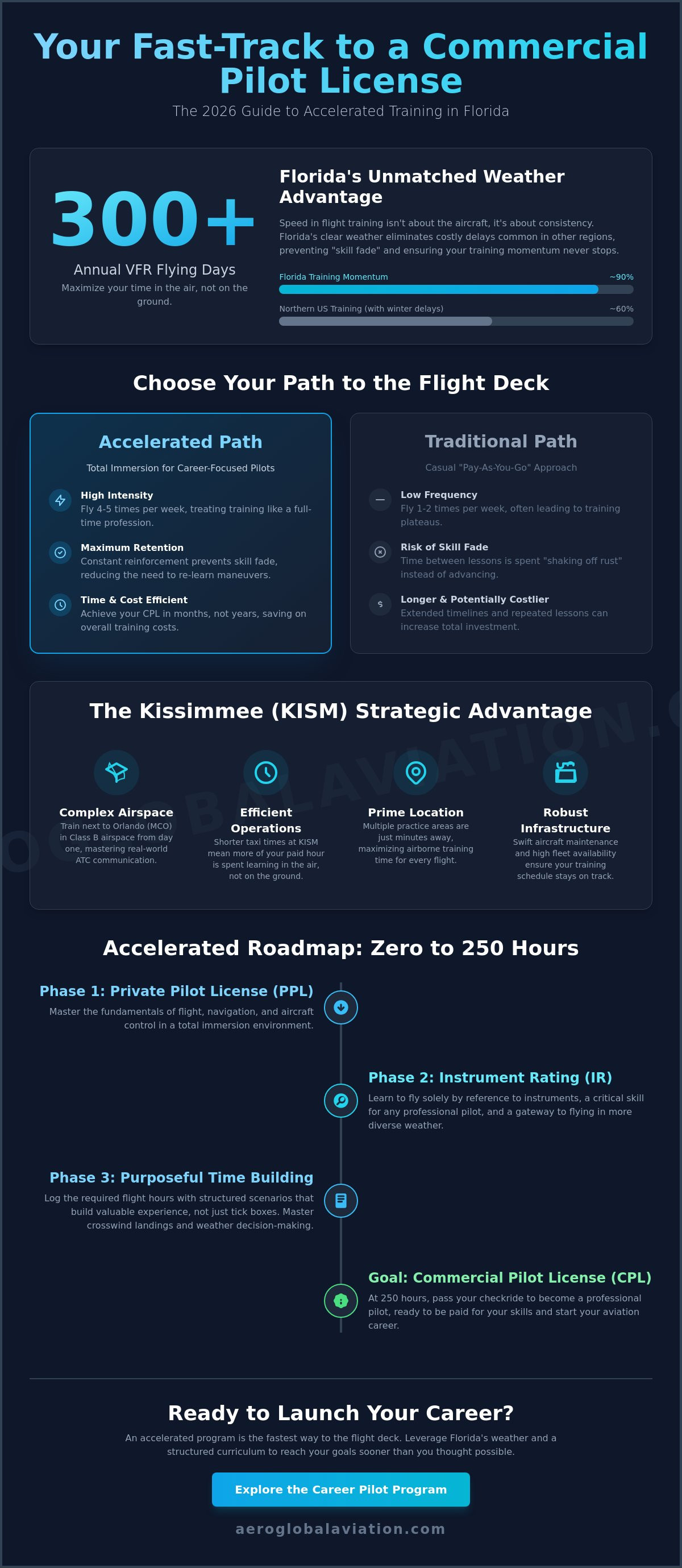
Your Fast-Track Timeline: From Zero to Commercial Pilot in 2026
The 2026 aviation landscape is defined by an urgent need for professionals. With projections indicating a global demand for 674,000 new pilots over the next two decades, there has never been a better time to accelerate your training. While the journey requires dedication, the fastest way to get commercial pilot license Florida is to follow a high-intensity, structured timeline. This roadmap isn't just about logging hours; it's about transforming your mindset from a student to a career professional in ten months or less.
Success in this timeline depends on your commitment to a full-time schedule. By immersing yourself in flight operations daily, you avoid the common pitfalls of stop-and-start training. You'll move through the curriculum with the same momentum as the regional airlines you aim to join. If you're ready to start this journey, visit our main site to see how we can align our resources with your career goals.
Month 1–3: Building the Foundation
Your first 90 days focus on earning your private pilot license florida. This is the bedrock of your career. During Month 1, you'll master basic aircraft control and aim for your first solo flight. By Month 2, you should complete your FAA written exam to keep the path clear for practical training. We recommend leveraging our Wings Foundation curriculum during this phase. It's designed to provide the rigorous academic and practical support needed to reach "checkride ready" status without the delays often found in less structured programs. Proactive communication with your mentor ensures you stay on track for your Phase 1 checkride by the end of Month 3.
Month 4–10: The Professional Pivot
Once you have your private certificate, the focus shifts toward the "Professional Pivot." Months 4 through 6 are dedicated to your Instrument Rating. This is where you transition from "learning to fly" by sight to "flying for hire" using precision instruments. You'll spend these months mastering the IFR environment, which is essential for maintaining a fast schedule in any weather condition. This phase is critical because it builds the discipline required for commercial standards.
Months 7 through 10 represent the final sprint toward the 250-hour finish line. You'll focus on commercial maneuvers that require high levels of precision and advanced decision-making. This is also the ideal time to integrate multi-engine ratings. Adding a multi-engine rating during your final time-building phase is a strategic move that significantly increases your career speed. By the time you reach your commercial checkride in Month 10, you won't just be a licensed pilot; you'll be a highly skilled candidate ready for the next step in the industry.
Start Your Career with Aero Global’s Career Pilot Program
Finding the fastest way to get commercial pilot license Florida requires more than just a sunny location; it requires a dedicated partner. While large "pilot factories" may offer high-volume training, they often struggle with the personal bottlenecks that can stall your progress. At Aero Global, we position ourselves as your Practical Mentor. We combine the professional authority of a top-tier academy with the warm encouragement of a boutique flight school. This ensures you get the individual attention necessary to master complex maneuvers without getting lost in a corporate shuffle.
Our career pilot program is meticulously structured to maximize every hour you spend at the airport. We've designed a curriculum that flows logically from your first solo to your final commercial checkride. By maintaining a high instructor-to-student ratio and a well-maintained fleet, we ensure that your schedule is the priority. You won't find yourself grounded due to administrative delays or lack of aircraft availability. Instead, you'll experience a training environment that moves at your speed.
The Aero Global Elite Difference
For those who have their sights set on the major airlines, our Airline Pilot Elite track provides a comprehensive path from zero experience to advanced instructor certifications. This program doesn't just stop at the commercial license; it prepares you for the long-term goal of reaching the 1,500-hour milestone. We offer personalized scheduling that adapts to your learning pace. If you're excelling, we push you forward. If you hit a challenge, our instructors dedicate the time needed to fix the bottleneck quickly. Our commitment to aircraft availability means you can fly when you're ready, which is the true secret to maintaining a fast-track timeline.
Taking the First Step in Kissimmee
The best way to understand the Aero Global difference is to visit our facility in Kissimmee. Booking a discovery flight allows you to experience the KISM airspace firsthand and meet the mentors who will guide your journey. During your first 30 days in the Career Pilot Program, you will typically hit these milestones:
- Complete your initial orientation and safety briefings to align with academy standards.
- Begin daily flight sessions to master basic aircraft control and build muscle memory.
- Engage in structured ground school sessions to prepare for the FAA written exam.
We'll also help you with financial planning to ensure your training remains uninterrupted. This proactive approach is the fastest way to get commercial pilot license Florida because it removes the uncertainty that often slows down aspiring aviators. Don't let your dreams stay on the ground. Contact Aero Global Aviation Academy to start your fast-track journey today.
Take Command of Your Aviation Future Today
You've explored the strategic advantages of the Florida climate and the efficiency of a structured, immersive curriculum. Achieving your professional goals doesn't have to be a multi-year struggle filled with uncertainty. When you choose the fastest way to get commercial pilot license Florida, you aren't just saving time; you're launching your career with the momentum necessary to succeed in a competitive hiring market. The transition from a student to a professional pilot is a significant milestone, and having a clear roadmap makes that journey both attainable and rewarding.
Our team is ready to help you move from the ground to the flight deck. By training at our strategic Kissimmee Gateway Airport location with a tailored PPL to CPL curriculum, you'll develop the airline-ready proficiency that sets you apart from the crowd. Apply for the Career Pilot Program at Aero Global Aviation Academy and take the first step toward your new life in the sky. We're dedicated to your success and look forward to seeing you in the cockpit.
Frequently Asked Questions
How long does it realistically take to get a CPL in Florida?
A full-time student can realistically obtain a Commercial Pilot License in 6 to 10 months. This aggressive timeline assumes you're flying four to five days per week and staying consistent with your ground school studies. While individual progress varies, the fastest way to get commercial pilot license Florida involves this total immersion approach to avoid the skill regression that happens with infrequent flying.
Is an accelerated flight program too difficult for beginners?
Accelerated programs are intense, but they're specifically structured to help beginners succeed through constant reinforcement. The fast pace actually helps build muscle memory more effectively because you don't have long gaps between your flight lessons. With a dedicated mentor guiding you, the learning curve feels like a steady, manageable climb rather than an insurmountable wall.
Can I work a full-time job while doing an accelerated pilot program?
Working a full-time job is generally not compatible with an accelerated training schedule. These programs require a commitment similar to a 40-hour work week to maintain the necessary momentum for rapid certification. If you need to work while training, a flexible Part 61 program allows you to adjust your pace, though it will naturally extend your total timeline to reach the 250-hour mark.
Why is Florida considered the best place for fast flight training?
Florida is the premier choice because it offers over 300 Visual Flight Rules flying days per year, which is the highest in the contiguous U.S. This minimizes weather-related groundings that often delay students in other regions. The state's high density of airports and complex airspace also provides a superior training environment for building professional-grade skills in a shorter calendar window.
What are the FAA medical requirements for a commercial pilot license?
You must hold at least a current second-class FAA medical certificate to exercise the privileges of a commercial pilot. This exam evaluates your vision, hearing, and general physical health to ensure you can safely operate aircraft in a professional capacity. It's a smart move to secure this medical clearance before you invest in training to confirm you meet the health standards for the career.
How much does the fastest commercial pilot program in Florida cost?
Industry data for 2026 shows that a full "zero to airline" track typically ranges between $80,000 and $130,000 depending on the school and aircraft type. For students who already hold a private certificate, the standalone commercial training phase often falls between $20,000 and $35,000. These figures represent broad industry averages, so you should always review a specific school's enrollment documents for their current rates.
What happens if I fail a checkride during an accelerated program?
Failing a checkride is a temporary setback, but it isn't the end of your professional journey. Your instructor will provide targeted remedial training on the specific areas that need improvement before you schedule a re-examination. The goal is to ensure you meet the high safety standards required for professional flight, and many successful airline pilots have a checkride re-test in their training history.
Do I need a college degree to be a commercial pilot in 2026?
The FAA does not require a college degree to earn a Commercial Pilot License or work as a professional pilot. However, most major U.S. airlines still either require or strongly prefer candidates who hold a four-year bachelor's degree. You can begin your flight training and start earning a living as a pilot while completing a degree online to make yourself more competitive for major airline hiring.


