The cockpit seat you've been dreaming about is closer than you think, and the cost of getting there doesn't have to ground your ambitions before you ever leave the runway. Thousands of aspiring pilots assume that scholarships for flight training Florida are reserved for a lucky few, but the truth is that most qualified candidates simply don't know where to look or how to apply strategically.
That frustration is real. Hourly flight instruction adds up fast, eligibility requirements can feel like a maze, and the last thing you want is to start your aviation career buried in debt. You deserve a clearer path forward.
This guide gives you exactly that. You'll walk away with a curated list of scholarships worth pursuing in 2026, a practical strategy for building an application that stands out, and a roadmap toward earning your Commercial Pilot License without the financial weight that stops so many candidates cold. Florida's training environment offers genuine advantages for stretching every scholarship dollar further, and we'll show you how to make the most of them. Let's get started.
Key Takeaways
- Scholarships for flight training Florida are more accessible than most candidates realize — knowing which organizations to target and when to apply is the difference between funding your rating and paying out of pocket.
- A strategic application built around a strong "Pilot Resume," demonstrated safety commitment, and local community involvement significantly increases your chances of winning competitive aviation awards in 2026.
- Scholarship funds don't have to stand alone — layering awards with purpose-built financing options can cover a full professional track from Private Pilot License all the way to Commercial certification.
- Florida's year-round flying weather means your scholarship dollars go further here than in most other states, reducing costly training delays and keeping your timeline on track.
- Structured programs with built-in mentorship give scholarship recipients the clearest path from first flight to an airline-ready career — and where you train matters as much as how you fund it.
Navigating the 2026 Flight Training Scholarship Landscape in Florida
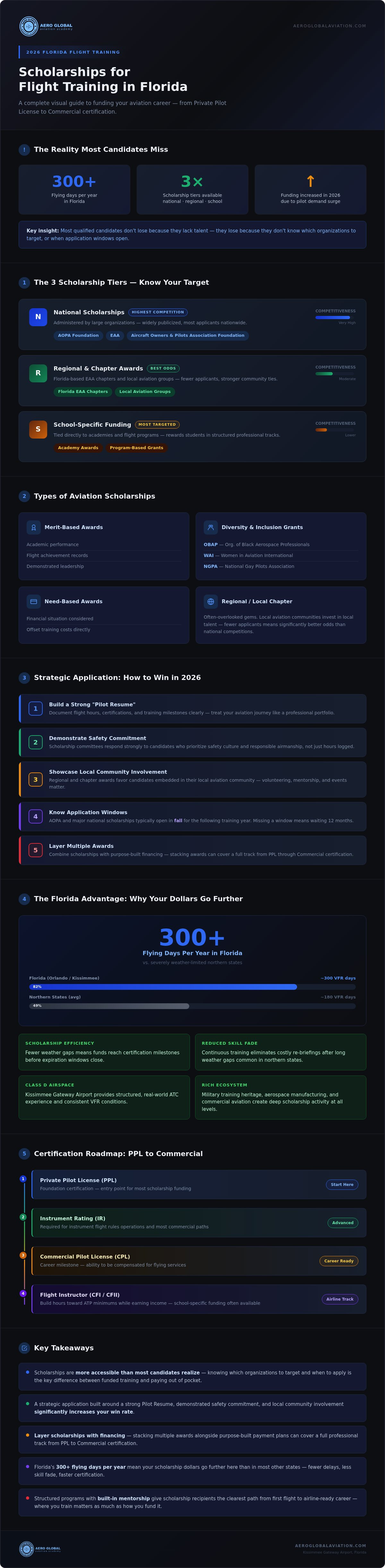
Flight training scholarships are financial awards, either merit-based or need-based, designed to offset the cost of earning FAA certifications ranging from a Private Pilot License all the way through Commercial and Instructor ratings. They're offered by corporations, non-profits, aviation foundations, and local chapters, and they exist in far greater numbers than most candidates ever discover. The key is understanding how the landscape is structured before you start applying.
The 2026 outlook is genuinely encouraging. Airline and corporate aviation demand for qualified pilots has pushed both private companies and non-profit organizations to increase their funding commitments. More scholarship dollars are entering the pipeline precisely because the industry needs pilots, and it needs them trained well. That's a real advantage for candidates who are ready to compete.
Florida occupies a unique position in this ecosystem. The state's concentration of Part 141 and Part 61 flight schools, combined with a deep aviation heritage rooted in military training, aerospace manufacturing, and commercial aviation, has made it a natural hub for scholarship activity at every level, national, regional, and school-specific. Knowing the difference between those tiers matters.
- National scholarships are administered by large organizations like AOPA, EAA, and the Aircraft Owners and Pilots Association Foundation. They're competitive and widely publicized.
- Regional and chapter awards come from Florida-based EAA chapters and local aviation groups. These attract fewer applicants, which improves your odds significantly.
- School-specific funding is tied directly to academies and flight programs, often rewarding students already enrolled in structured professional tracks.
Types of Aviation Scholarships Available
Merit-based awards typically recognize academic performance, flight achievement, or demonstrated leadership. Diversity and inclusion grants, offered through organizations like the Organization of Black Aerospace Professionals (OBAP), Women in Aviation International, and the National Gay Pilots Association (NGPA), actively expand access for underrepresented groups and carry their own dedicated application cycles. Regional Florida chapter scholarships, meanwhile, are often overlooked gems. Local aviation communities invest in local talent, and a well-crafted application targeting these awards can be far more effective than competing nationally against thousands of candidates.
Why Year-Round Training in Orlando Maximizes Funding
When you're working with scholarships for flight training Florida, efficiency is everything. Scholarship funds have expiration windows, and weather-related cancellations can quietly drain your award before you reach your certification milestones. Florida's 300-plus flying days per year lower the total cost of certification by keeping your training continuous and reducing the skill fade that forces expensive re-briefings after long weather gaps. Training at Kissimmee Gateway Airport places you in Class D airspace with consistent VFR conditions, giving you the kind of structured, uninterrupted progress that turns scholarship dollars into real ratings. That's a strategic edge that candidates training in northern states simply don't have access to.
Top Aviation Scholarships for Florida-Based Student Pilots
Florida's aviation scholarship ecosystem is genuinely deeper than most candidates realize, and the students who win funding aren't necessarily the most talented. They're the most informed. Knowing which organizations to target, and understanding how each award is structured, gives you a measurable edge before you write a single word of your application.
Start with the AOPA Foundation. As the largest pilot organization in the world, AOPA administers multiple scholarship cycles annually covering both primary training (your Private Pilot License) and advanced ratings through the Commercial level. Awards range from partial to full rating coverage, and the application windows typically open in the fall for the following training year. Florida-based students are competitive here because the state's structured training environment demonstrates clear pathways to certification completion.
The Experimental Aircraft Association (EAA) runs one of the most respected scholarship programs in general aviation. Its Ray Aviation Scholarship, for example, is designed specifically to help young pilots complete their PPL within a defined timeline. Nationally, EAA awards hundreds of thousands of dollars annually across its scholarship portfolio, though specific annual totals vary by cycle and should be confirmed directly through EAA's website for 2026.
For female aviators, the Ninety-Nines Florida Chapters represent a critical and often underutilized resource. The Ninety-Nines have maintained a presence in Florida for decades, and their chapter-level awards attract far fewer applicants than national programs, which meaningfully improves your odds. If you're a woman pursuing a career track through programs like the ones offered at Aero Global Aviation Academy, these chapter awards are worth prioritizing early in your search.
Vocational and trade-focused students shouldn't overlook the Florida Aviation Trades Association (FATA), which directs grant funding toward students pursuing flight training through structured vocational pathways. These grants are specifically designed for career-minded candidates, not hobbyist pilots, making them a strong fit for anyone enrolled in a professional curriculum.
National Powerhouse Scholarships
Three national organizations consistently deliver meaningful funding for Florida students pursuing professional certifications:
- Organization of Black Aerospace Professionals (OBAP): Training grants are available through OBAP's annual scholarship cycle, with a clear focus on candidates demonstrating both financial need and a commitment to aviation as a career.
- Women in Aviation International (WAI): WAI distributes awards across dozens of scholarship categories each year, ranging from primary ratings to advanced professional development. Their annual conference, typically held in March, is also a direct networking opportunity with scholarship committees.
- LeRoy W. Homer Jr. Foundation: Aimed at young aspiring professionals, this foundation honors the legacy of a decorated military aviator by funding students who demonstrate genuine commitment to aviation careers. Applicants tend to be high school or early college age.
Florida-Specific and Regional Opportunities
This is where the real competitive advantage lives. Most candidates hunting for scholarships for flight training Florida focus entirely on national programs and miss the regional awards where their applications would stand out immediately.
- Greater Miami Aviation Association (GMAA): The GMAA offers scholarships specifically for Florida residents, with a focus on candidates who demonstrate ties to the local aviation community. Residency requirements make these awards far less competitive than national pools.
- EAA Chapter 74 (Orlando) and Chapter 845 (Kissimmee): These local chapters administer youth-focused awards that directly benefit students training in Central Florida. Because these are community-level awards, a thoughtful application from a local student carries significant weight. Check each chapter's website directly to confirm their 2026 award availability and deadlines.
- Florida-based airline and operator scholarships: Several regional carriers and flight operators with Florida roots have established scholarship pipelines tied to their own hiring funnels. These awards often come with mentorship components and, in some cases, a pathway to a conditional job interview upon certification completion.
The pattern across every tier is consistent: structured, career-focused students enrolled in professional training tracks are the strongest applicants. That's not a coincidence. Scholarship committees fund candidates they believe will actually complete their ratings and enter the industry.
Strategic Application: How to Win Aviation Scholarships in 2026
Knowing which scholarships exist is only half the equation. The candidates who actually win funding are the ones who treat their application like a professional document, not a homework assignment. Scholarship committees reviewing dozens of essays can spot a generic submission immediately, and generic submissions don't get funded.
Start by building what experienced aviation mentors call a Pilot Resume. This isn't your standard job application resume. It's a targeted document that captures your flight hours logged, FAA written exam scores, safety courses completed (think AOPA's free online safety programs or FAA WINGS participation), and any leadership roles you've held, whether that's a student organization, a volunteer role at a local fly-in, or a ground crew position at a regional airshow. Committees funding scholarships for flight training Florida want to see candidates who are already living the culture of aviation, not just dreaming about it.
Community involvement at local Florida airports carries more weight than most applicants expect. Volunteering at Kissimmee Gateway Airport events, attending EAA chapter meetings, or participating in Young Eagles flights positions you as someone already embedded in the aviation community. That visibility matters. It also gives you authentic, specific material to draw from when you write your personal statement, which is far more compelling than abstract enthusiasm.
Your letters of recommendation deserve real strategic attention. A generic letter from a teacher who barely knows your aviation goals won't move the needle. A specific, detailed letter from your Certified Flight Instructor describing your situational awareness in the pattern, your pre-flight discipline, and your commitment to safety culture will. Ask your recommenders early, give them your Pilot Resume and a summary of the scholarship's mission, and make it easy for them to write something powerful on your behalf.
The 'Practical Mentor' Approach to Essays
Your personal statement should answer one question before anything else: why the flight deck? Not "I love flying" but the specific moment, decision, or experience that made a professional aviation career feel inevitable. From there, connect that origin story to a concrete destination. If you're enrolled in or targeting a structured program like the Career Pilot Program at Aero Global Aviation Academy, name it. Scholarship committees respond to candidates with a defined plan, not a vague aspiration. Saying "I'm training in Kissimmee's controlled airspace environment to build the instrument proficiency I'll need at the regional airline level" is a completely different statement than "I want to fly commercially someday."
Video essays are increasingly common in 2026 application cycles. Keep yours concise, shoot in good lighting with clean audio, and speak directly to the camera as if you're briefing a committee, not performing for social media. Dress professionally, reference the specific organization you're addressing, and close with a clear statement of intent. Authenticity wins over production value every time.
Common Pitfalls to Avoid
- Missing deadlines: Build a scholarship calendar in January and map every application window through October. Many awards open and close within a narrow six-week cycle, and a missed deadline is an unrecoverable error.
- Generic applications: If your essay could be submitted to any organization without changing a word, rewrite it. Reference the specific mission of each scholarship body and explain why their goals align with yours.
- Terminology errors: Misspelling "instrument rating" or confusing "solo cross-country" requirements signals carelessness to a committee of aviation professionals. Proofread every technical term twice, and ask your CFI to review your application before submission.
The candidates who win are prepared, specific, and consistent. Treat every application as a flight plan: you wouldn't depart without checking every detail, and you shouldn't submit without doing the same.
Beyond Scholarships: Financing and Payment Plans for Orlando Flight Students
Scholarships for flight training Florida rarely cover every dollar of a professional certification track. The smart move is treating scholarship awards as one layer of a broader financial strategy, not the whole plan. When you combine an award with purpose-built aviation financing, the gap between your current bank account and your Commercial Pilot License becomes a manageable monthly number rather than an impossible lump sum.
Two lenders dominate the aviation student finance space: Sallie Mae and Meritize. Sallie Mae's career training loans are available for Part 141 programs and can cover tuition, fees, and flight hours. Meritize goes a step further by factoring your academic and personal achievement history into its approval process, which benefits candidates who've already demonstrated commitment through logged hours or completed ratings. Neither lender should be your first call, but both are worth understanding before you need them.
Financing Professional Pilot Tracks
The financial logic behind a structured program like the Commercial Pilot Training path becomes clearer when you look at the destination. Regional airline first officers are entering the workforce at starting salaries that have risen considerably alongside the pilot shortage, with major carriers offering significantly higher compensation as captains accumulate hours. Training costs are real, but they're a one-time investment against a decades-long earning trajectory. That's a fundamentally different ROI calculation than most vocational training options.
The Airline Pilot Elite track, which carries students from their Private Pilot License through advanced instructor certification, also creates a built-in income bridge. Earning your Certified Flight Instructor rating means you can build the flight hours required for airline minimums while getting paid to teach. That's not a minor detail. It's a structural feature that turns the cost of advanced flight training into an earning platform rather than a pure expense.
On the tax side, vocational training costs may qualify as a deductible education expense in certain circumstances. Consult a qualified tax professional to verify whether your specific program and career situation qualify under current IRS guidelines before making any assumptions.
Strategic Budgeting for Student Pilots
Flight training costs extend beyond hourly instruction. A realistic budget accounts for all of the following:
- FAA checkride fees: Each practical exam carries an examiner fee that varies by location and examiner.
- Medical certificates: First- and second-class medicals are required at specific intervals and involve their own costs.
- Ground school materials and written exam prep: Quality study resources reduce the likelihood of a failed written, which would add both time and cost to your timeline.
- Contingency hours: Most students require additional flight time beyond published minimums. Build a buffer into your plan from day one rather than being caught short before a checkride.
Part 61's pay-as-you-go structure also offers a practical bridge while you're waiting on scholarship disbursements. Rather than pausing your training entirely, you can continue logging hours at your own pace and apply award funds as they arrive. Florida's consistent flying weather means you're rarely losing days to cancellations, so that incremental approach stays on track far better here than in most other states.
The students who reach the flight deck fastest are the ones who planned their finances as carefully as their flight plans. Talk to the team at Aero Global Aviation Academy about how to structure your funding strategy around a professional training track in Kissimmee.
Launching Your Career at Aero Global Aviation Academy
Winning a scholarship is only the beginning. What you do with that funding, and where you invest it, determines whether you reach the flight deck or stall somewhere short of your goal. Aero Global Aviation Academy in Kissimmee is built specifically for candidates who are serious about turning scholarship dollars into a professional career, not just a recreational rating.
That distinction matters. Scholarship committees funding awards for flight training Florida want to see their investment produce working pilots. A structured academy with defined certification tracks, built-in mentorship, and a professional training culture gives your application credibility before you submit a single page, and it gives your training momentum once the funds arrive.
Your Path from Kissimmee to the Airlines
The Wings Foundation program is your natural entry point. Designed as a focused Private Pilot License course, it establishes the foundational hours, skills, and FAA documentation that most scholarship eligibility requirements are built around. Completing your PPL through a structured Part 141 curriculum signals to scholarship committees that you're a candidate who finishes what they start.
From there, the Career Pilot Program carries you from your Private certificate through Commercial certification, the professional benchmark that opens the door to paid flying work. Students who enter this track with scholarship funding already in place can plan their progression with financial confidence rather than stopping and starting based on what they can afford month to month. The Airline Pilot Elite track extends that progression further, through advanced instructor certification, creating the hour-building pathway that connects your training investment to airline minimums.
Kissimmee Gateway Airport's consistent Class D airspace and Central Florida's year-round flying weather mean your training calendar stays intact. The supportive, professionally focused atmosphere at the Kissimmee campus reflects a team that's genuinely invested in each student's progress, not just their enrollment.
Ready to Take the First Step?
Your admissions conversation at Aero Global isn't a sales pitch. It's a planning session. Bring your scholarship research, your timeline, and your questions about how to layer funding across your certification track, and walk away with a personalized training roadmap that accounts for all of it.
Central Florida's aviation community is active, connected, and growing. Joining it through a structured professional program puts you in the same environment as working pilots, active CFIs, and industry contacts who can accelerate your career in ways a solo training path simply can't replicate.
The cockpit seat is a concrete destination, not a distant dream. Start your journey at Aero Global Aviation Academy today and put your scholarship strategy into motion with a team that knows exactly how to get you there.
Your Flight Deck Is Waiting: Take the Next Step Today
Scholarships for flight training Florida are real, accessible, and available to candidates who approach the process with the same discipline they'd bring to a checkride. The organizations are out there. The funding cycles open every year. And Florida's year-round flying weather means every dollar you win stretches further here than almost anywhere else in the country.
Three things determine whether you actually reach the flight deck: knowing which awards to target, building an application that committees remember, and training inside a structured professional program that turns funding into certified ratings. That's exactly what the Career Pilot Program and Airline Pilot Elite track at Aero Global Aviation Academy in Kissimmee are built to deliver, inside a mentorship-driven environment where your progress is taken seriously from day one.
Don't let another application cycle pass while you're still figuring out where to start. Download our 2026 Professional Pilot Career Guide and get a clear, personalized roadmap from your first flight lesson to an airline-ready career. The runway is yours.
Frequently Asked Questions About Flight Training Scholarships in Florida
Are there specific scholarships for flight training in Florida?
Yes, scholarships for flight training Florida exist at national, regional, and school-specific levels. National organizations like AOPA and EAA accept Florida-based applicants, while Florida-specific awards from the Greater Miami Aviation Association and local EAA chapters serve residents exclusively. That residency restriction is actually an advantage: fewer candidates compete for the same dollars, which meaningfully improves your odds compared to open national pools.
Can I use scholarships for a private pilot license (PPL) in Orlando?
Absolutely. The PPL is the most commonly funded certification tier because it's the entry point every professional pilot must complete first. Awards from EAA's Ray Aviation Scholarship and AOPA Foundation are specifically designed to cover primary training costs. Enrolling in a structured Part 141 program like the Wings Foundation course at Aero Global Aviation Academy in Kissimmee strengthens your application by demonstrating a defined training plan rather than an open-ended intention to fly.
What is the best time of year to apply for aviation scholarships?
Most major scholarship cycles open in the fall, typically between September and November, for training that begins the following year. Some chapter-level awards and diversity grants run on independent timelines, so checking each organization's website directly is essential. Build your scholarship calendar in January, map every known deadline through October, and treat each application window as a firm commitment rather than a flexible target.
Do I need to be a full-time student to qualify for flight scholarships?
Not always. Eligibility requirements vary significantly by organization. Some awards do require full-time enrollment in an accredited program, while others, particularly chapter-level and diversity grants, evaluate candidates on career commitment and financial need rather than enrollment status. Read each scholarship's specific criteria carefully before applying, and don't self-disqualify based on assumptions about requirements that may not apply to a particular award.
Can scholarships be combined with flight school financing or loans?
Yes, and this combination is often the most practical path to full certification funding. Scholarship awards rarely cover every dollar of a professional training track, so layering them with aviation-specific lenders like Sallie Mae or Meritize fills the gap without pausing your progress. Treating scholarship funds as one component of a broader financial plan, rather than a complete solution, keeps your training timeline intact and reduces the stress of waiting on a single funding source.
How do I find local EAA or Ninety-Nines chapters in Central Florida?
The EAA's official chapter locator at eaa.org allows you to search by zip code and will surface active chapters in your area, including Chapter 74 in Orlando and Chapter 845 near Kissimmee. The Ninety-Nines maintain a similar directory at ninety-nines.org where you can identify Florida section chapters. Attending a chapter meeting before you apply is a smart move: it demonstrates genuine community involvement and gives you authentic material to reference in your personal statement.
What are the most common requirements for winning a flight scholarship?
Most competitive awards look for a combination of demonstrated financial need or merit, a clear career goal in aviation, a minimum GPA or academic record, and a compelling personal statement. Many committees also weigh community involvement, safety course participation such as FAA WINGS or AOPA's online programs, and letters of recommendation from CFIs or aviation professionals. Candidates enrolled in structured professional training programs consistently rank as stronger applicants because they signal genuine commitment to completing their ratings.
Are there scholarships specifically for the Commercial Pilot License (CPL)?
Yes. Several organizations fund advanced ratings beyond the PPL, including AOPA Foundation awards that cover Commercial-level training and diversity grants from Women in Aviation International and OBAP that extend through professional certifications. Some regional carrier scholarship pipelines are specifically designed for candidates pursuing CPL and beyond, occasionally including a mentorship component or conditional interview pathway. If you're enrolled in a career-focused track like the Career Pilot Program, confirm with each scholarship body whether your current certification stage qualifies before applying.


