

Getting your instructor ratings in the wrong order is the most expensive mistake you can make in your professional pilot journey. You've likely felt the pressure of the 15-area initial CFI checkride or stared at the high cost of multi-engine time with genuine anxiety. It's a high-stakes environment, and deciding between CFI vs CFII vs MEI Florida can feel like a complex puzzle when you're just trying to get hired at a flight school in Kissimmee or Orlando.
We believe that the path to your 1,500-hour goal should be both logical and rewarding. This guide will help you master the strategic sequence of flight instructor ratings to maximize your hiring potential and build hours efficiently in the busy Florida aviation market. You'll learn why the CFI-Initial serves as your license to learn, while the CFII-Add-on is often your true ticket to getting hired quickly. We'll also clear up the confusion surrounding the 15-hour PIC requirement for your MEI. By the end, you'll have a clear roadmap to transition from a commercial pilot to a professional mentor with absolute confidence.
Key Takeaways
- Discover why the traditional sequence of starting with your CFI-Initial is often the most cost-effective path to building professional flight hours.
- Understand the specific hiring advantages of CFI vs CFII vs MEI Florida to ensure you stand out to flight schools in the competitive Orlando market.
- Learn how to navigate the FAA's 15-hour multi-engine PIC requirement so you don't stall your progress toward becoming a multi-engine instructor.
- Explore how the Airline Pilot Elite program provides the structured mentorship needed to pass the high-stakes initial instructor checkride on your first attempt.
What is CFI, CFII, and MEI? Defining the Instructor Hierarchy
The journey to the airlines truly begins the moment you earn your commercial certificate and transition into the role of a teacher. In the sunshine state, the decision regarding CFI vs CFII vs MEI Florida often centers on how quickly and efficiently you can reach that 1,500-hour milestone. Understanding the hierarchy of a Flight Instructor Certificate is the first step toward becoming a mentor who can guide the next generation of aviators.
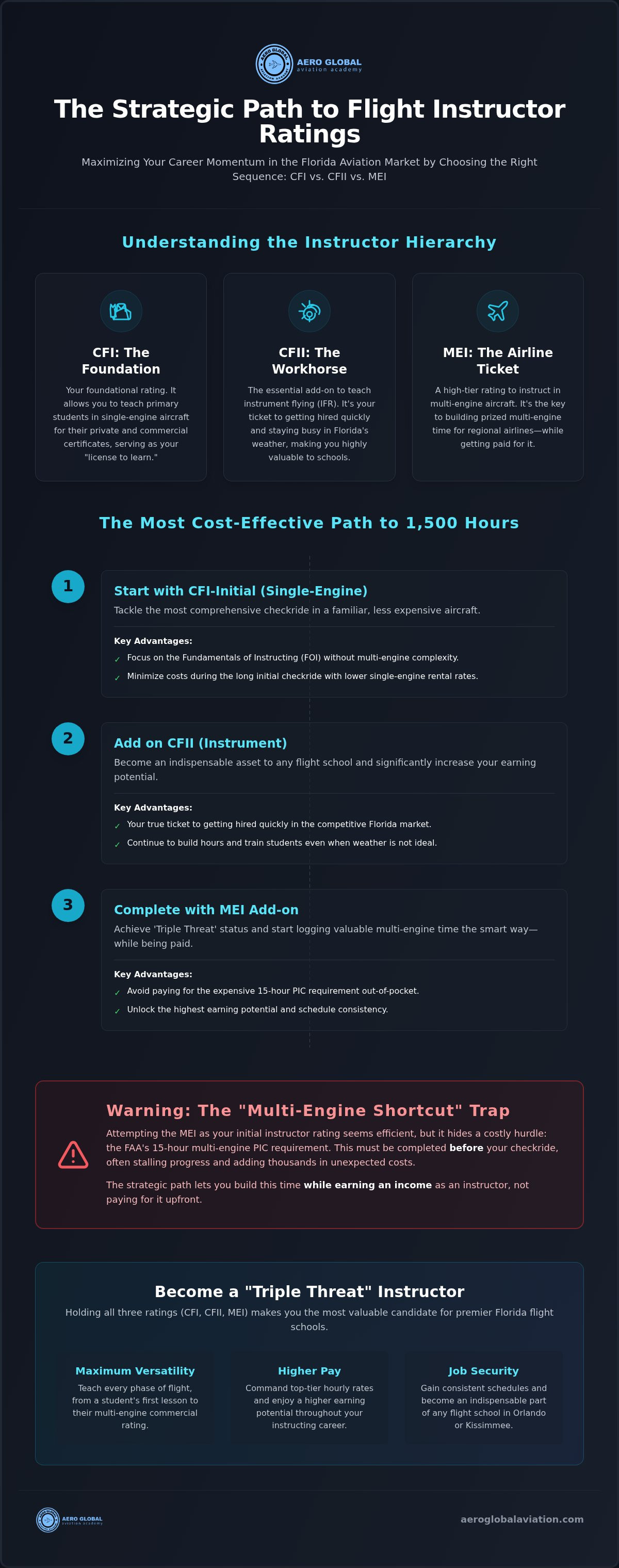
- CFI (Certified Flight Instructor): This is your foundational rating. It allows you to teach primary students in single-engine aircraft for their private and commercial certificates.
- CFII (CFI Instrument): This essential add-on empowers you to guide students through the complexities of instrument flying (IFR). It's often the most utilized rating in the Florida market due to our frequent cloud layers and rain.
- MEI (Multi-Engine Instructor): This high-tier rating permits you to provide instruction in complex, multi-engine aircraft. It's a vital tool for building the specific multi-engine time that regional airlines prioritize during the hiring process.
Florida remains the premier global hub for instructor training in 2026 because of its consistent flying weather and high volume of flight students. Schools at Kissimmee Gateway Airport (KISM) offer a high-tempo environment where you can put these ratings to work immediately, ensuring your skills stay sharp and your logbook stays full.
Privileges and Limitations of Each Rating
A 'bare' CFI is limited to teaching in single-engine land aircraft. You cannot provide instruction for instrument ratings or multi-engine certificates with this rating alone. While you can sign off a student for their solo flight or their first cross-country, you can't help them master the IFR environment without that extra 'I' on your certificate. Many instructors find the CFII to be the most valuable add-on. It allows you to keep training even when the Florida afternoon clouds roll in, making you much more useful to a flight school. Meanwhile, the MEI is your ticket to high-performance time. It's the rating that lets you log multi-engine hours while being paid, rather than paying for them out of your own pocket.
The 2026 Florida Hiring Market
Your commercial pilot training serves as the launchpad, but your instructor ratings provide the career momentum you need. In the current Orlando market, most flight schools prefer candidates who hold at least their CFI and CFII. While you can occasionally find work with just a single rating, having all three makes you a 'Triple Threat' instructor. A 'Triple Threat' instructor possesses the versatility to teach every phase of flight from private pilot to multi-engine commercial, commanding higher hourly pay and enjoying more consistent schedules across Florida's premier flight schools.
The Strategic Sequence: Which Rating Should You Get First?
Choosing your first instructor checkride is a high-stakes decision that sets the pace for your entire professional journey. While you have options, the specific sequence of CFI vs CFII vs MEI Florida pilots choose often depends on their long-term goals and current budget. Most candidates follow the traditional path by completing the CFI-Initial in a single-engine aircraft first. This allows you to focus on the heavy lifting of the Fundamentals of Instructing (FOI) without the added pressure of managing a complex multi-engine platform during a six-hour oral exam.
The FAA Requirements stipulate that your initial instructor checkride will be the most comprehensive; it covers everything from learning theory to technical maneuvers. By starting with the single-engine CFI, you minimize your hourly rental costs during this long exam. This strategic choice aligns perfectly with a well-planned airline pilot career path, where efficiency and cost-control are paramount to your success. If you want to streamline this process, our Airline Pilot Elite program provides the structured mentorship needed to navigate these choices.
CFI Initial vs. MEI Initial: The Pros and Cons
Some pilots attempt the 'Multi-Engine Shortcut' by taking the MEI as their initial instructor rating. This approach lets you tackle the complex oral exam once in a twin-engine aircraft. However, the 15-hour multi-engine PIC requirement often acts as a roadblock for this path. You must have these hours logged before you can even sit for the checkride. For many students in Kissimmee, building those 15 hours of PIC time in a twin is a significant financial hurdle compared to the accessible single-engine requirements of a standard CFI. The complexity of engine-out procedures during an initial checkride also adds a layer of risk that many find unnecessary for their first teaching certificate.
Why CFII is the Smartest Second Step
Once you've cleared the hurdle of your initial CFI, the CFII is undoubtedly the smartest next move. You can leverage your recent instrument rating knowledge while it's still fresh in your mind. CFII checkrides typically have a higher pass rate than the initial CFI because the FOI portion is significantly abbreviated. From a hiring perspective, holding a CFII makes you twice as valuable to an Orlando flight school. It allows you to keep your students moving through their training even when Florida's unpredictable weather prevents VFR flight, ensuring your logbook keeps growing regardless of the ceiling.
FAA Requirements and the 15-Hour PIC Rule
Success in the Florida aviation market requires more than just flying skills; it demands a deep understanding of the legal framework governing your certificates. Orlando flight schools increasingly prioritize the 'Triple Threat' instructor who holds all three ratings to ensure maximum scheduling flexibility. This regional market preference makes understanding the specific CFI vs CFII vs MEI Florida requirements essential for your career progression. You must first clear the hurdles set by FAR 61.183, which include being at least 18 years old, holding a third-class medical, and possessing a commercial pilot certificate with an instrument rating. You'll also need to conquer the written exams, specifically the Flight Instructor Airplane (FIA) for your initial and the Flight Instructor Instrument (FII) for your instrument add-on.
Before you can even schedule a CFI-Initial checkride in Florida, you must obtain a one-time spin endorsement. This serves as a vital gatekeeper, proving you can recognize and recover from a stall-spin scenario during instruction. It's a high-consequence maneuver that demonstrates your readiness to protect future students during their most vulnerable phases of flight training. Obtaining this endorsement early in your CFI prep prevents scheduling delays when you're ready for the practical test.
Logging Time for the MEI
The most common roadblock for aspiring multi-engine instructors is the 15-hour PIC requirement. Many pilots realize too late that they cannot count their initial multi-engine training hours toward this total because they weren't acting as the sole manipulator of the controls while being the legal pilot-in-command. According to FAA Requirements and the 15-Hour PIC Rule, you must log at least 15 hours as pilot-in-command in the category and class of aircraft appropriate to the flight instructor rating sought. Under current FAA standards, an applicant for a multi-engine flight instructor rating must log at least 15 hours as pilot-in-command in a multi-engine airplane before the practical test can occur. In Central Florida, pilots often build this time through split-time arrangements or focused PIC building programs at Kissimmee Gateway Airport. Additionally, you must remember the '5 hours in make and model' rule, which requires you to have five hours of PIC time in a specific twin, such as a Piper Seminole or Diamond DA-42, before you can legally provide instruction in that exact aircraft.
Mastering the Fundamentals of Instructing (FOI)
Transitioning from a student to a teacher involves a significant shift in perspective. The FOI exam focuses on the psychology of learning and communication, which is often the most challenging hurdle for commercial pilots used to technical data and rote maneuvers. Our mentors at Aero Global simplify these complex theories by applying them to real-world flight deck scenarios. We help you move beyond simple memorization to achieve a level of correlation where you can explain exactly why a student is struggling with a specific maneuver. Using modern study tools and structured ground schools ensures you enter your 2026 checkride with the professional authority needed to pass on your first attempt.
The Instructor Lifestyle: Balancing Work and Training in Orlando
Living the life of a flight instructor in Central Florida is a dynamic experience that requires a sharp focus on both your students' progress and your own career milestones. Many pilots wonder if they can effectively teach part-time while pursuing additional ratings. In the busy Kissimmee market, the answer is a resounding yes. Flight schools here often offer flexible scheduling that allows working professionals to maintain a steady income while they master the CFI vs CFII vs MEI Florida sequence. However, you must be proactive in managing the mental fatigue that comes with back-to-back primary students. Balancing these demands is part of the 'Practical Mentor' philosophy, where building a local reputation for checkride success becomes your most valuable currency.
Mastering the local environment is a key part of your development as a professional. Orlando's complex airspace, including the busy corridors near MCO, ORL, and SFB, serves as an elite training ground. Navigating these environments daily forces you to refine your instructional communication and situational awareness to a level that simple rural airspace can't match. This experience is exactly what airlines look for when they review your 1,500-hour logbook, as it proves you can handle high-tempo operations with ease.
Maximizing Your Time at KISM (Kissimmee Gateway)
You will find that KISM is a perfect 'learning lab' for new instructors. Choosing to base your instruction here provides a distinct advantage over Sanford or Executive because the airport's layout and traffic flow minimize long taxi delays. This means more of your lesson time is spent in the air rather than on the hot Florida tarmac. During the summer months, smart instructors schedule 'sunset' lessons. This strategy avoids the peak afternoon heat and localized thunderstorms, providing smoother air for maneuvers and maximizing your flyable hours. Over time, you'll also build a vital network with local Designated Pilot Examiners (DPEs), gaining insights into their specific expectations and helping your students achieve higher pass rates.
Financial ROI: Pay-as-you-go vs. Accelerated Tracks
Investing in your instructor ratings is a strategic move for your future earning potential. When you analyze the ROI, the months-to-payback for a CFII or MEI rating is remarkably short due to the higher hourly rates these advanced instructors command. You can often treat your advanced flight training as a tax-deductible professional expense, which significantly offsets the initial cost. For those looking to save, 'block-booking' your training time can secure lower hourly rates and ensure priority aircraft availability. If you are ready to secure your future in the cockpit, explore the Airline Pilot Elite track to see how our structured mentorship can accelerate your transition to the airlines.
Why Aero Global is the Best Choice for Instructor Ratings
Transitioning from a commercial pilot to a professional instructor is more than just a technical upgrade; it's a profound shift in responsibility. At Aero Global, our 'Practical Mentor' philosophy ensures you don't just memorize maneuvers. We empower you with the ability to diagnose student errors and communicate complex concepts with ease. When evaluating CFI vs CFII vs MEI Florida options, the environment where you train matters as much as the curriculum. Our academy provides a supportive, high-standards atmosphere where your success is our primary mission.
We pride ourselves on fleet diversity, ensuring you train in the exact aircraft you will eventually use for instruction. Whether you are mastering the single-engine stability of our primary trainers or the complex systems of our multi-engine fleet, you will build a level of comfort that translates directly to the flight deck. We also prioritize the 'Oral' portion of the instructor exam, which is often the most daunting part of the checkride. By focusing on deep correlation and teaching theory, we help our candidates achieve high pass rates and enter the industry with professional authority.
Our Airline Pilot Elite program is specifically designed to integrate these instructor ratings into a seamless career track. We don't view these certifications as isolated hurdles. Instead, we treat them as the foundation of your professional identity. This integrated approach ensures that as you build your hours toward the airlines, you are also developing the leadership and decision-making skills that major carriers prioritize in 2026.
Individualized Mentorship at Kissimmee
You won't find a one-size-fits-all approach here. At our Kissimmee Gateway Airport location, you will work one-on-one with senior instructors who bring thousands of hours of real-world experience to your training. This individualized attention allows us to tailor the pace to your specific needs, ensuring you master every detail of the FOI and technical maneuvers. Before you ever meet an examiner, you will undergo rigorous mock checkrides. We never send a candidate to an exam unprepared; these simulations build the confidence you need to perform under pressure. While you instruct at Aero Global, we also help you build a professional resume that highlights your instructional successes and technical proficiency.
Your Next Step: The Instructor Discovery Session
Choosing the right partner for your instructor ratings is a decision that will define the next 1,000 hours of your life. We invite you to visit our team at KISM to evaluate our training environment and meet the mentors who will guide your journey. This discovery session is your chance to see our fleet, discuss your specific career goals, and experience the Aero Global difference firsthand. Don't leave your professional development to chance. Contact Aero Global Aviation Academy to start your instructor journey today and take command of your future in the sky.
Take Command of Your Career in the Florida Skies
Choosing your path between CFI vs CFII vs MEI Florida is a strategic move toward your 1,500-hour goal. You now understand how the right sequence saves thousands in training costs while making you an indispensable asset to local flight schools. By tackling the Fundamentals of Instructing and meeting the 15-hour PIC requirements head-on, you position yourself for rapid advancement in Orlando's elite airspace.
Aero Global is here to guide you through every milestone with our Kissimmee-based professional mentorship. We offer specialized checkride prep for your CFI Initial and maintain a high-availability multi-engine fleet to ensure your MEI training stays on schedule. We are ready to help you bridge the gap between being a student and becoming a professional leader in the cockpit.
Transition from Pilot to Professional Mentor-Explore Instructor Ratings at Aero Global
Your journey to the flight deck of a major airline is closer than you think. Let's start this final chapter of your training together with confidence and the regional advantage only Florida can provide.
Frequently Asked Questions
How many hours of PIC time do I need for an MEI rating in Florida?
You must log at least 15 hours of pilot-in-command time in a multi-engine aircraft before you can take the MEI practical test. This is a strict FAA requirement that often catches candidates off guard if they only logged dual received time during their initial multi-engine rating. Planning your CFI vs CFII vs MEI Florida journey requires logging these hours early to avoid unnecessary delays in your professional career progression.
Is the CFI initial checkride really as difficult as people say?
The initial CFI checkride is widely considered the most demanding test in a pilot's career because of the extensive oral examination. It often lasts several hours and covers everything from learning psychology to technical maneuvers in exhaustive detail. While the difficulty is real, proper mentorship and structured ground schools make the process manageable. We focus on teaching you how to communicate effectively, which is the key to passing this high-stakes milestone.
Can I get my CFII and MEI at the same time?
While it's technically possible to combine ratings into a single checkride, most pilots choose to complete them as separate add-ons to reduce complexity. Taking the CFII and MEI together requires you to demonstrate proficiency in instrument procedures while managing a multi-engine aircraft, which significantly increases the risk of a failure. Sequencing them allows you to focus on one skill set at a time, ensuring a higher quality of instruction and a cleaner record.
How much do flight instructors typically earn in Orlando in 2026?
Flight instructors in Orlando earn an average annual salary of approximately $88,415 in 2026. Hourly wages typically range from $22.78 to $42.51 depending on your experience and the specific ratings you hold. Instructors who possess the 'Triple Threat' of CFI, CFII, and MEI often command the higher end of this pay scale because they can teach a wider variety of students and maintain more consistent schedules.
Do I need to take a written test for the MEI add-on?
You don't need to take an additional FAA knowledge test for the MEI if you already hold an existing flight instructor certificate. The MEI is considered an add-on rating, meaning you only need to complete the required flight training and pass a practical checkride with an examiner. This makes adding multi-engine privileges one of the most straightforward ways to increase your value as a professional pilot in the competitive Florida market.
What is the pass rate for first-time CFI candidates?
First-time pass rates for the CFI initial are historically lower than private or commercial ratings because of the significant shift from flying to teaching. While exact numbers fluctuate, the national average often hovers around 70 percent. This statistic highlights the importance of choosing a training center that prioritizes mock checkrides and deep theoretical understanding. Our focus on the Fundamentals of Instructing ensures our candidates are prepared for the unique pressures of the instructor exam.
How long does it take to get all three instructor ratings part-time?
Completing all three ratings on a part-time basis typically takes between four to six months for most dedicated students. This timeline depends on your personal schedule, aircraft availability, and the local weather conditions. Because Florida offers more flyable days than most other states, you can maintain steady momentum even while working. Consistency is the most important factor in ensuring you don't lose proficiency between your training sessions.
Why is Kissimmee Gateway Airport better for instructor training than MCO?
Kissimmee Gateway Airport (KISM) offers a superior training environment because it minimizes the long taxi delays and complex ground holds common at Orlando International (MCO). At KISM, you spend less time idling on the ramp and more time in the air practicing maneuvers. This efficiency is critical for instructor candidates who need to maximize their training budget while building the instructional skills necessary to succeed in the Orlando aviation industry.


