
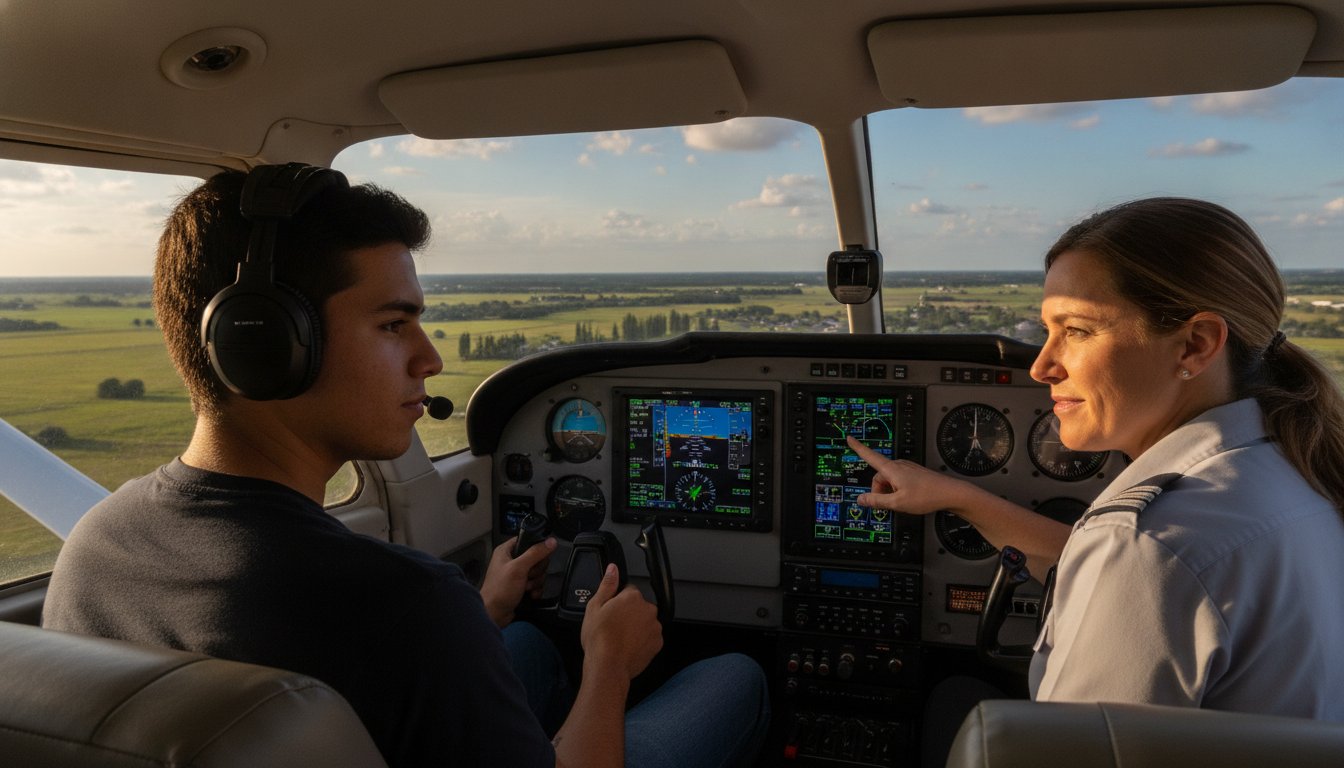
Choosing your flight instructor is the most critical hiring decision you'll make in your aviation career, yet many students treat it like a simple scheduling convenience. It's natural to feel a sense of pressure when researching how to choose a flight instructor in Orlando, especially with the complexity of Central Florida's busy airspace. You want a mentor who doesn't just check boxes but actively prepares you for the high-stakes environment of professional flight while respecting your time and financial investment.
We understand that the path to a Commercial Pilot License can feel overwhelming when you're faced with different CFI ratings and the fear of choosing an unreliable partner. This guide promises to simplify that process by giving you the exact criteria needed to select an instructor who aligns with your long-term goals. You'll walk away with a practical interview checklist and the confidence to navigate the 2026 training landscape. We will explore how to verify an instructor's recent experience under the 2024 FAA regulatory changes and ensure your progression toward the flight deck is both efficient and rewarding.
Key Takeaways
- Treat your selection as a professional hiring process to avoid training plateaus and unnecessary expenses during your journey.
- Evaluate specific ratings like CFI, CFII, and MEI to ensure your mentor's technical expertise aligns with your current training milestones.
- Master how to choose a flight instructor in Orlando who understands the nuances of Central Florida's complex airspace and shifting weather conditions.
- Identify a teaching philosophy that prioritizes personalized attention and clear communication to accelerate your progress toward a commercial license.
- Understand how structured environments, such as the Career Pilot Program, provide a reliable framework for consistent mentorship and long-term career success.
Why Your Choice of Flight Instructor is a Critical Career Decision
Your journey to the flight deck begins with a single, pivotal choice. Many prospective pilots view an instructor as a commodity, but in reality, your Certified Flight Instructor (CFI) is the primary architect of your professional foundation. This individual doesn't just teach you how to move the yoke; they instill the decision-making habits that will stay with you through every stage of your career. When you are researching how to choose a flight instructor in Orlando, you must look beyond mere availability or proximity. You're hiring a mentor who will shape your professional identity.
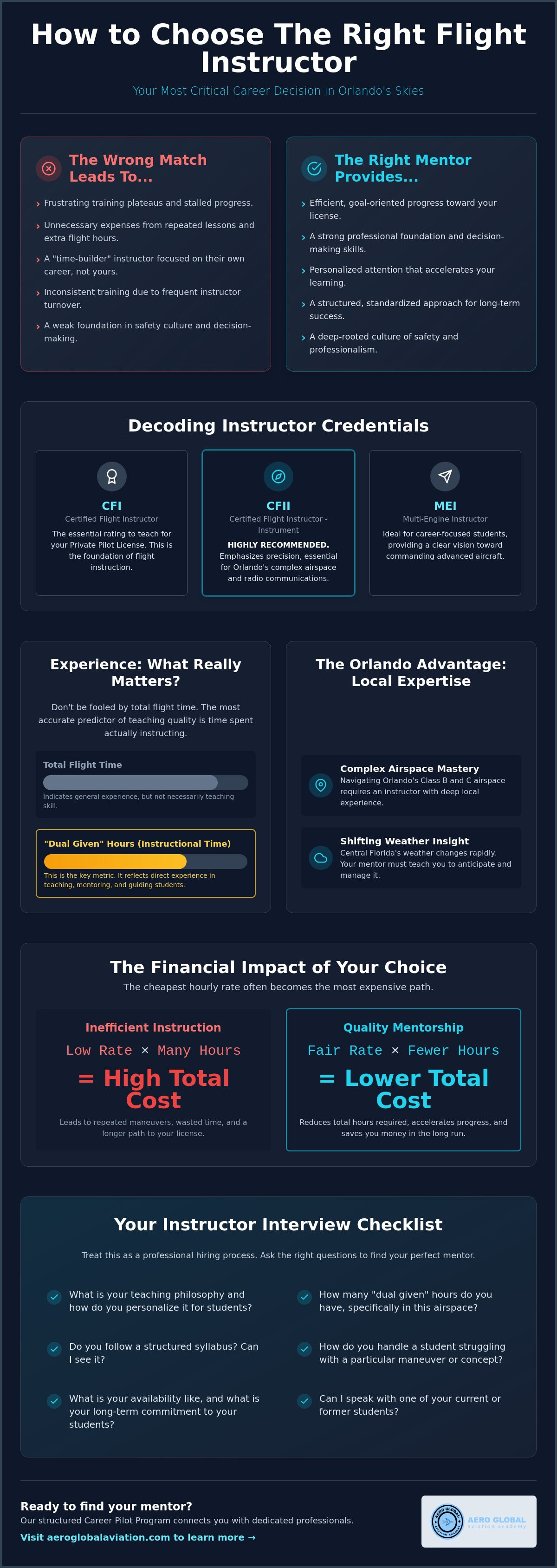
A poor match between a student and an instructor often leads to a "training plateau." This is a frustrating period where progress stalls, confidence drops, and costs begin to climb. Often, this happens because the instructor is a "time-builder" focused solely on their own airline requirements rather than your specific milestones. A dedicated professional mentor, however, prioritizes your transition to a Private Pilot License with efficiency and clarity. They ensure that every hour in the logbook translates to a tangible skill, keeping your momentum high and your goals within reach.
The Financial Impact of Instructor Selection
It's a common trap to choose the flight school with the lowest hourly rate. However, the cheapest instructor often becomes the most expensive choice if their communication style doesn't click with your learning needs. Inefficient lessons lead to repeated maneuvers and extra flight hours, which quickly erodes any initial savings. By investing in high-quality instruction from the start, you actually reduce the total hours required to reach proficiency. Consistency is also a major factor. Frequent instructor turnover can force you to re-learn concepts, adding weeks to your timeline. Finding a mentor who is committed to your long-term success is a strategic financial move that pays dividends throughout your training.
Safety and Standardization in Training
Your instructor shapes your safety culture from day one. They define what "good enough" looks like in the cockpit. This is why following a structured syllabus, such as our Wings Foundation course, is so vital. It provides a roadmap that ensures no gaps exist in your knowledge. Standardization isn't just about passing a checkride; it's a prerequisite for advanced, airline-oriented training. When your training is standardized, you build the discipline required for the Career Pilot Program and beyond. Professional mentors emphasize these standards, turning complex FAA requirements into logical, achievable steps for every student. This structured approach creates a safer pilot and a more competitive candidate for future commercial roles.
Evaluating Technical Qualifications and Experience
Technical proficiency is the backbone of flight training. Understanding how to choose a flight instructor in Orlando requires a deep dive into the technical credentials that define a mentor's capability. While every instructor must hold a valid certificate, the depth of their experience in Central Florida's complex airspace will directly impact your speed of progression. You aren't just looking for someone who can fly; you're looking for someone who has mastered the art of transferring that knowledge to a student in a high-traffic environment.
Decoding Instructor Credentials
The "alphabet soup" of instructor ratings can be confusing for newcomers. A basic CFI (Certified Flight Instructor) is qualified to teach you the fundamentals for your Private Pilot License. However, choosing an instructor who also holds a CFII (Instrument Instructor) rating offers a significant advantage. These mentors emphasize precision and radio communication from day one, which are essential skills for navigating the Class B and C airspace surrounding Orlando. For those enrolled in our Career Pilot Program, working with an MEI (Multi-Engine Instructor) early on provides a clear vision of the advanced aircraft you'll eventually command. You can verify these credentials through the FAA Airmen Certification Branch or by speaking directly with flight school management.
Experience vs. Enthusiasm
A common mistake is assuming that "total flight time" is the only metric that matters. In reality, "dual given" (instructional hours) is a much more accurate predictor of teaching quality. A pilot with 1,500 total hours but only 10 hours of instruction might still be learning how to manage a student's mistakes. Conversely, a highly motivated newer CFI with 200 hours of instructional time may be more current on 2026 aviation technology and the latest FAA safety standards. When interviewing potential mentors, ask about their student pass rate and their specific record for checkride preparation. A mentor who stays active with the latest regulatory changes, such as the 2024 shift to the Recent Experience End Date (REED) system, demonstrates a commitment to professional excellence.
Orlando's environment demands an instructor who is comfortable with rapid-fire ATC instructions and shifting tropical weather patterns. This local expertise ensures you don't just learn to fly in a vacuum but gain real-world experience in one of the busiest training hubs in the world. As you evaluate your options, look for a balance of technical mastery and a genuine passion for student success. If you're looking for a structured path that pairs you with these high-caliber mentors, exploring the Career Pilot Program is a logical next step in your professional journey.
Assessing Communication Style and Teaching Philosophy
A great pilot isn't always a great teacher. Communication is the bridge that turns complex aerodynamics into intuitive cockpit actions. When you're figuring out how to choose a flight instructor in Orlando, you need to look for the "Practical Mentor" approach. This style balances authoritative command with supportive encouragement. You want an instructor who pushes you to meet high standards while maintaining a welcoming atmosphere that makes you feel comfortable asking questions. If the instructor feels like a partner in your success rather than just a person in the right seat, you've found a winning match.
Matching your learning style to their teaching methodology is vital. Some students prefer data-driven, technical explanations, while others learn better through visual analogies. Before committing to a full course, conduct a brief "instructor interview." Ask them how they handle student mistakes and what their typical lesson structure looks like. A professional will always prioritize pre-flight briefings and post-flight debriefings. These sessions are where the real learning happens. They allow you to reflect on your performance and set clear goals for the next flight. This structured feedback loop is a key recommendation in the AOPA guide to choosing an instructor.
The Trial Lesson: Your Evaluation Tool
The discovery flight is your best opportunity to see an instructor in action. Use this time to observe how they communicate in the cockpit. Do they explain maneuvers clearly? Do they remain calm when you make a mistake? A good mentor should provide actionable feedback without being condescending. Pay attention to how they manage the stress of Orlando's busy airspace. If they stay composed while guiding you through a complex radio call, they'll likely be a steady presence throughout your training. This initial flight is a two-way evaluation, so don't be afraid to grade their performance as much as they grade yours.
Professionalism and Reliability
Reliability is non-negotiable in flight training. Red flags include frequent cancellations, showing up late, or appearing distracted during ground school. You deserve an instructor who is as invested in your timeline as you are. A professional environment ensures accountability through written training plans and digital progress tracking. This level of organization prevents the "training plateau" mentioned earlier and keeps you on track for the Career Pilot Program milestones. When your instructor is prepared, every hour in the air becomes more productive and rewarding.
Navigating the Orlando Airspace: Local Expertise Matters
Orlando isn't just a place to fly; it's a high-performance classroom that demands respect and precision. When you are researching how to choose a flight instructor in Orlando, you must prioritize local expertise above almost any other factor. Central Florida presents unique environmental challenges that you won't find in rural training environments. From the rapid development of massive afternoon thunderstorms to the dense traffic patterns of one of the world’s busiest tourism hubs, your mentor needs to be a master of this specific geography. They should understand the subtle signs of shifting Florida weather and know exactly how to guide you through a safe and efficient training day.
Mastering communication in Orlando’s complex Class B and C airspace is a significant milestone for any aspiring pilot. You'll be sharing the sky with heavy commercial jets at Orlando International (MCO) and Sanford (SFB). A local instructor who flies these corridors daily will teach you how to maintain situational awareness while managing rapid-fire ATC instructions. This isn't just about passing a checkride; it's about building the professional habits required for a lifelong career on the flight deck. An instructor familiar with regional diversion airports ensures you're never caught off guard when conditions change, providing you with a mental map of every safe haven in the region.
Training in High-Density Traffic
Learning to fly near major international hubs provides an immediate strategic advantage. Local instructors help you develop a "big league" mindset from your very first hour in the cockpit. By navigating the same corridors as commercial airliners, you build a level of confidence and radio proficiency that students in quieter areas rarely achieve. This high-traffic environment forces you to prioritize precision in every maneuver. It's the ultimate preparation for the professional world, turning the complexity of the airspace into a powerful asset for your personal development.
The 2026 Orlando Aviation Landscape
The regional aviation scene is constantly evolving, with new noise abatement procedures and airport-specific regulations becoming the norm. An expert instructor stays current on these changes to ensure your training remains compliant and professional. By leveraging Orlando's year-round flying weather, a savvy mentor will help you maximize your flight time even during the humid summer months. Kissimmee Gateway Airport (KISM) stands as the premier strategic hub for career pilots in 2026 due to its perfect balance of professional infrastructure and training accessibility.
Ready to master the skies of Central Florida with a mentor who knows the terrain? Start your journey today with our Career Pilot Program and gain the local expertise you need to succeed.
Finding Your Mentor at Aero Global Aviation Academy
Deciding how to choose a flight instructor in Orlando shouldn't feel like a gamble. At Aero Global Aviation Academy, we've removed the guesswork by building our entire training philosophy around the "Practical Mentor" concept. This means every instructor at our Kissimmee facility is more than just a teacher; they're a dedicated partner in your professional journey. We prioritize a collaborative spirit where your individual success is our primary metric. By choosing a structured academy over an independent instructor, you gain the benefit of standardized excellence and a team that is deeply invested in seeing you reach the flight deck.
Our Career Pilot Program is specifically designed to pair students with career-oriented instructors who understand the long-term milestones of the industry. If your goal is the airlines, the Airline Pilot Elite track offers the unique opportunity to train with mentors who possess real-world airline experience. These instructors bring a level of professional authority that transforms standard lessons into high-level career preparation. We maintain rigorous internal development programs to ensure our team stays current with 2026 aviation standards and the latest instructional techniques.
A Structured Path to Success
A major advantage of our academy is the seamless progression between courses. The Wings Foundation ensures you build a rock-solid PPL base without ever outpacing your instructor’s guidance. Unlike independent flight instructors who may have limited resources, our students have consistent access to a modern fleet equipped with 2026 glass-cockpit technology. This environment fosters accountability and ensures that your training remains on schedule. Training in a dedicated center also means you're surrounded by a community of like-minded peers, providing a supportive network that independent training simply can't match.
Your Next Steps in Orlando
The transition from a dreamer to a professional pilot starts with a conversation. We invite you to schedule a meeting with our Chief Flight Instructor to discuss your specific aviation goals and review how to choose a flight instructor in Orlando who fits your needs. During your first consultation, bring your questions about our curriculum, aircraft availability, and the local training environment. We'll provide a clear overview of the path ahead and help you identify the right mentor for your learning style. Taking this leap is a significant commitment, but with the right team behind you, the destination is well within reach. We look forward to welcoming you to the Kissimmee Gateway Airport and helping you launch your career with confidence.
Take Control of Your Aviation Future
Selecting the right mentor is the most influential decision you'll make as you transition from a student to a professional pilot. You now have a clear framework for how to choose a flight instructor in Orlando by prioritizing technical ratings, local airspace expertise, and a teaching philosophy that matches your professional goals. This choice determines the quality of your foundation and the efficiency of your path toward the flight deck. It's a high-stakes environment; you deserve a partner who is as committed to your success as you are.
Aero Global Aviation Academy offers a supportive home for your training at our strategic Kissimmee training location. Our FAA-certified professional instructors provide personalized attention within our structured PPL to CPL career tracks, ensuring you gain the skills needed for the airlines. We invite you to Book a Discovery Flight and Meet Our Instructors to experience our "Practical Mentor" approach firsthand. Your professional journey is within reach, and we're ready to help you clear the runway for takeoff. The view from the cockpit is even better when you have the right team in the seat beside you.
Frequently Asked Questions
How many flight hours should a good instructor have?
A high number of instructional hours, often called "dual given," is usually more important than total flight time. While the FAA requires an instructor to have at least 200 hours of flight training experience to train initial CFI applicants, a mentor with 100 to 500 instructional hours is often in a "sweet spot" of high motivation. Look for an instructor who prioritizes your milestones over their own personal hour-building goals.
Can I change my flight instructor if we are not a good match?
Yes, you absolutely can and should change instructors if your communication styles don't align. Aviation training is a significant investment; staying with a poor match can lead to a training plateau and increased costs. Professional flight schools facilitate these transitions smoothly to ensure you remain on track for your Commercial Pilot License. Your success and comfort in the cockpit are the highest priorities for any quality training program.
What is the difference between a Part 61 and Part 141 instructor?
The main difference lies in the level of curriculum structure and FAA oversight. Part 141 instructors follow a rigid, FAA-approved syllabus with specific stage checks, which is often preferred for career-track students. Part 61 instructors offer more flexibility to customize lessons based on your schedule and pace. Both paths lead to the same pilot certificates, but the structured 141 environment often provides a more predictable timeline for professional goals.
Should I choose an instructor who is also an airline pilot?
Choosing an instructor with airline experience offers invaluable insights into the professional world and standardized cockpit procedures. These mentors can teach you the "soft skills" of crew resource management and high-altitude decision-making early in your training. However, ensure their schedule allows for the consistency you need to progress. The best choice is a mentor who balances real-world experience with a genuine passion for foundational teaching.
How much does a flight instructor cost in Orlando?
Typical flight instructor rates in the Orlando area range from $50 to $90 per hour as of July 2026. While you might find varying rates, it's vital to remember that the cheapest hourly fee often results in a more expensive certificate if the instruction is inefficient. Focus on the value of the training and the instructor's ability to help you meet FAA proficiency standards in fewer total flight hours.
What questions should I ask during a flight instructor interview?
When researching how to choose a flight instructor in Orlando, you should ask about their student pass rate and their typical weekly availability. Inquire if they follow a structured written syllabus and how they handle the 2024 FAA "recent experience end date" (REED) requirements. Asking these questions during an interview helps you identify a professional who is organized, compliant, and dedicated to your specific aviation career path.
How do I know if my flight instructor is following a proper syllabus?
You'll know your instructor is following a proper syllabus if they provide a written training plan and conduct formal pre-flight and post-flight briefings. Every lesson should have clear objectives and completion standards that align with FAA Airman Certification Standards. Programs like our Wings Foundation use a standardized curriculum to ensure you never miss a critical skill, providing a transparent roadmap from your first flight to your checkride.
Is it better to have one instructor or multiple instructors during training?
Consistency with a single primary instructor is generally better for building rapport and maintaining steady progress. However, flying with a second instructor occasionally can provide a fresh perspective and ensure your skills are standardized. This is a key factor when learning how to choose a flight instructor in Orlando; look for a school that offers a primary mentor while using stage checks to verify your proficiency through a different set of expert eyes.


