
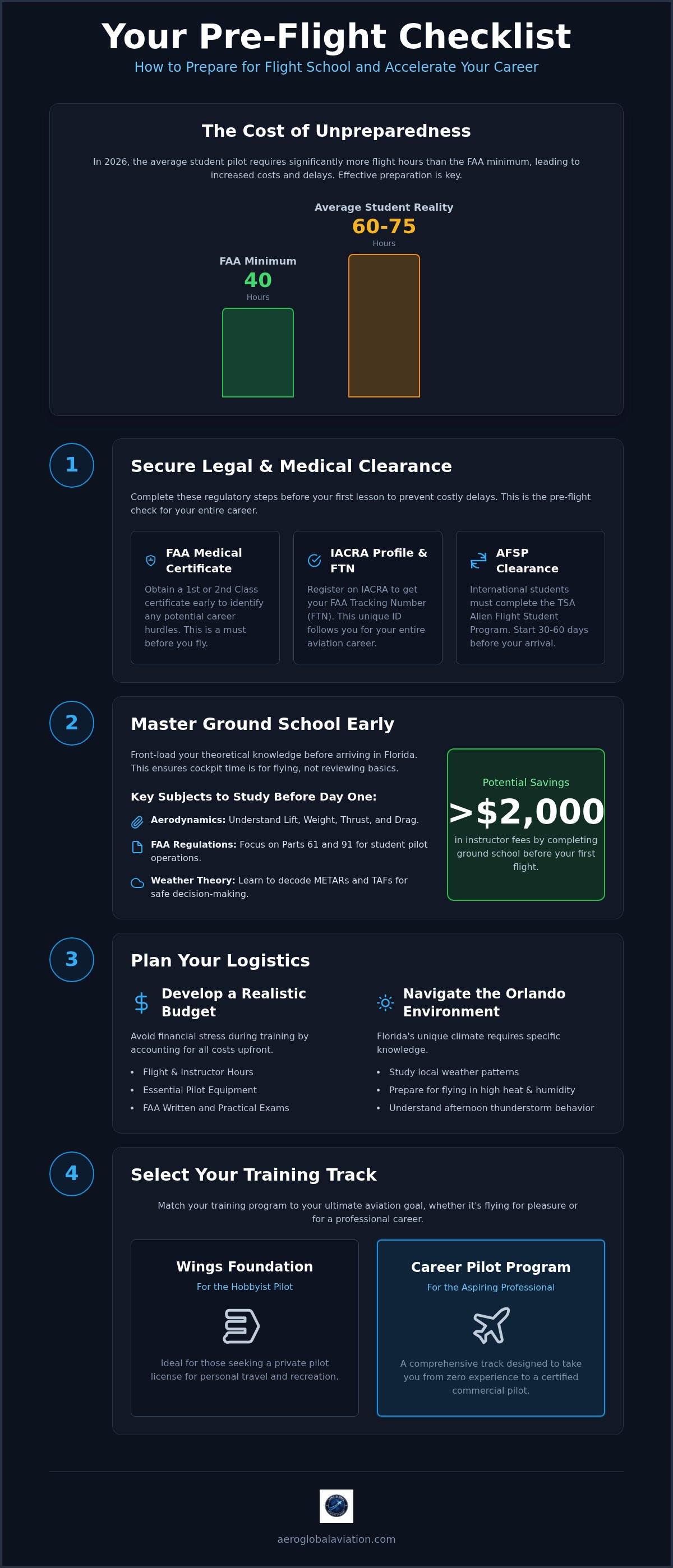
Did you know that the average student pilot in 2026 requires between 60 and 75 flight hours to earn their private license, despite the FAA minimum being just 40? It's a sobering statistic that points to one common problem: a lack of pre-flight preparation. You've likely felt the weight of this challenge already, perhaps worrying about the cost of unnecessary training hours or feeling confused by the complex FAA medical requirements. Learning how to prepare for flight school Orlando effectively is the secret to protecting your investment and accelerating your timeline to the cockpit.
We believe that your aviation journey should be as rewarding as the career it creates. This checklist gives you the professional edge you need to save time and money by front-loading your education before you ever start the engine. You'll discover exactly how to handle your medical certificate, why ground school prep is your best financial tool, and how to choose the right path, whether that's our Wings Foundation or a full career track. Let's turn that overwhelming volume of study material into a structured, achievable plan for your success.
Key Takeaways
- Secure your FAA medical certificate and Tracking Number (FTN) before your first lesson to identify any potential hurdles early.
- Front-load your theoretical knowledge through ground school to potentially save thousands of dollars in instructor fees.
- Develop a realistic 2026 budget that accounts for flight hours, equipment, and FAA exams to avoid financial stress during training.
- Master the specifics of how to prepare for flight school Orlando by learning to navigate Florida's unique weather patterns and heat.
- Select a training track that matches your destination, whether it's the hobbyist-focused Wings Foundation or the professional Career Pilot Program.
Essential Legal and Medical Prerequisites for Student Pilots
Before you ever step into a cockpit at our Kissimmee base, you need to clear the regulatory hurdles that keep the skies safe. Learning how to prepare for flight school Orlando starts with establishing your legal and medical standing. The FAA manages all pilot certification in the U.S., and completing these steps early prevents costly delays once your training begins. Think of this as your pre-flight inspection for your career; it ensures you're fit for the journey ahead.
The FAA Medical Exam: What to Expect
Your first priority is securing an FAA Medical Certificate. While a Third Class certificate is the minimum for a private pilot, we recommend aspiring professionals pursue a First or Second Class certificate immediately. This proactive step identifies any underlying health or vision issues that might affect a long-term career before you invest in your training. To get started, you'll need to locate an Aviation Medical Examiner (AME) in the Orlando or Kissimmee area. During the exam, the AME will check your vision, hearing, and general cardiovascular health. If you have any known medical conditions or take regular medications, it's helpful to discuss these with your AME before the formal examination begins to ensure you have the necessary documentation for a smooth approval process.
Setting Up Your IACRA Profile
Your digital identity in the aviation world lives within the Integrated Airman Certification and Rating Application (IACRA). This is where you'll register for your FAA Tracking Number (FTN), which is arguably the most important number in your pilot career. This unique ID follows you from your first solo flight to your final airline retirement. Creating your profile is a straightforward process, but you must ensure that your name and address match your government-issued identification exactly. Any discrepancy can cause significant administrative headaches later. Once your profile is active, it links directly to your initial private pilot license Florida application, allowing your instructor to track your progress and sign off on your certifications digitally.
For students joining us from outside the United States, the TSA Alien Flight Student Program (AFSP) is an additional, mandatory requirement. This security threat assessment must be completed before you can begin any flight training. It involves a background check and fingerprinting, so we suggest starting this process at least 30 to 60 days before your intended start date. Having your TSA clearance and your medical certificate in hand ensures that when you arrive in Orlando, you're ready to focus entirely on the excitement of your first flight.
Academic Foundations: Master Ground School Early
Ground school is the intellectual engine behind your flying. It covers meteorology, navigation, and the official FAA pilot requirements that every aviator must internalize. Many students wait until they arrive in Florida to open their books, but being proactive is a cornerstone of how to prepare for flight school Orlando effectively. By front-loading your study, you ensure that every minute in the cockpit is spent flying rather than reviewing theory on the ground. This approach is a vital part of how to prepare for flight school Orlando if you want to finish your training on a faster timeline.
The financial impact of early study is significant. On average, students who complete their ground school before their first flight can save over $2,000 in instructor fees. When you arrive prepared, your instructor doesn't have to spend expensive hours explaining basic lift or airspace classifications. Instead, you'll be ready to apply that knowledge immediately. Your primary pre-arrival goal should be the FAA Private Pilot Knowledge Test, often called "the Written." Passing this early clears a major administrative hurdle and lets you focus entirely on your physical stick-and-rudder skills.
Top Subjects to Study Before Day One
Start with the basics of aerodynamics. Understanding how lift, weight, thrust, and drag interact provides the mental framework for every maneuver you'll perform in the air. You should also dive into FAA regulations, specifically Part 61 and Part 91, which govern how you'll operate as a student pilot. Finally, master weather theory. Learning how to decode METARs and TAFs allows you to understand the local Orlando environment and make safe "go or no-go" decisions before you even check the morning briefing.
Recommended Study Tools and Resources
The FAA-H-8083 series, or the Pilot's Handbook of Aeronautical Knowledge, is your primary textbook. It's a dense but essential resource that builds your foundational knowledge. Complement this with interactive apps that offer maneuver visualization; seeing a steep turn in 3D makes it much easier to execute in a Cessna. We also recommend taking consistent practice exams to gauge your readiness and build the confidence needed to ace the actual test on your first attempt. If you're looking for a structured way to begin, our Wings Foundation syllabus provides a clear roadmap for these academic milestones.
Financial Planning and Logistical Readiness for Orlando
Planning your finances is just as critical as your pre-flight checklist. When you're looking at how to prepare for flight school Orlando, you need a budget that accounts for the reality of training, not just the minimum FAA requirements. A well-structured financial plan allows you to focus on your maneuvers rather than your bank balance. Beyond the tuition, you'll need to consider the logistical side of living in Central Florida, from finding the right housing to securing the gear that will stay with you throughout your career.
Budgeting for Your Pilot Training
A realistic budget starts with understanding how aircraft rental works. Most schools in the Orlando area use "wet" rates, which include the cost of fuel, while "dry" rates do not. You'll also need to factor in "buffer" hours. While the FAA minimum for a private license is 40 hours, most students require 60 to 75 hours to achieve true mastery. Additionally, remember to set aside funds for the Designated Pilot Examiner (DPE) fee for your checkride, which typically ranges from $800 to $1,200 in the Florida region. For those pursuing a professional track, exploring specialized financing or student pilot loans for our career pilot program can provide the necessary capital to complete your training without interruption.
Relocating to Central Florida
Location is a strategic asset in your training. We recommend researching housing in Kissimmee or near Orlando Executive Airport to keep your commute under 20 minutes. Minimizing travel time means more energy for early morning flights and late-night study sessions. Kissimmee Gateway Airport (KISM) is a hub for student pilot life, offering a community of like-minded aviators who often share housing to reduce costs. You can find excellent networking opportunities and advice on local living through AOPA Learn to Fly resources, which help newcomers integrate into the aviation community.
Mastering the local environment is a critical part of how to prepare for flight school Orlando. Central Florida offers some of the most dynamic flying conditions in the United States, providing a training ground that builds exceptional situational awareness. From the bustling commercial corridors to the unique subtropical climate, understanding these local factors ensures you stay ahead of the airplane. You're not just learning to fly; you're learning to operate in one of the busiest and most rewarding airspaces in the world.
Weather Patterns in Central Florida
Effective flight planning in Orlando requires a deep respect for the "3 PM storm" phenomenon. During the summer months, predictable afternoon thunderstorms can develop rapidly, often requiring students to schedule their primary training blocks for the early morning hours. This discipline helps you maximize the 2026 benefits of Florida's year-round flying weather, which allows for consistent, accelerated progress that isn't possible in northern climates. High humidity and soaring temperatures also play a significant role in aircraft performance. In the Florida humidity, high density altitude significantly reduces your aircraft's climb performance and increases takeoff distance, making precise performance calculations a daily necessity. Staying hydrated and managing cockpit temperatures with sunshades and pre-flight cooling are practical habits that keep your focus where it belongs: on the gauges.
Airspace Complexity and Situational Awareness
The Orlando region is home to some of the most complex airspace in the country, sitting in the shadow of Orlando International (MCO) and Orlando Executive (ORL). As a student pilot at KISM, you'll learn to navigate these high-traffic corridors with confidence. Utilizing landmarks like Disney World to the west and the Space Coast to the east makes visual navigation intuitive while you build your technical skills. We emphasize the importance of using flight following services early in your training to enhance safety and build professional radio habits. This experience is vital as you transition from advanced flight training into commercial operations where precision is mandatory. Mastering radio communication at a busy tower-controlled airport like Kissimmee Gateway prepares you for any international hub in your future career.
Ready to experience the Orlando skies for yourself? Schedule a discovery flight with our expert mentors to see how our local expertise can accelerate your aviation journey.
Choosing Your Professional Career Path at Aero Global
Selecting the right training track is the final, most crucial step in how to prepare for flight school Orlando. At Aero Global, we don't believe in a one-size-fits-all approach to aviation. Whether you want to fly for personal recreation or command a wide-body jet for a major carrier, your preparation should align with your ultimate destination. Understanding these specific programs now ensures you don't waste time or resources on training that doesn't serve your long-term vision. It's about matching your ambition with a structured roadmap designed for success.
The Wings Foundation: Building Your Base
The Wings Foundation is designed for those who want to master the art of flight as a personal achievement. A strong Private Pilot License (PPL) foundation is the key to every advanced rating you might pursue later. During your first 10 hours of instruction, you'll focus on the fundamentals of aircraft control, takeoffs, and landings, building the muscle memory required for safe operation. If your passion for the skies grows, this program serves as a seamless bridge into our more intensive professional tracks. It's the perfect starting point for hobbyists who value professional-grade instruction without the immediate pressure of a commercial career path.
Fast-Tracking Your Career with Airline Pilot Elite
For those with sights set on the flight deck, the Airline Pilot Elite track offers the most comprehensive and accelerated route. This program emphasizes earning your Certified Flight Instructor (CFI) rating early in your journey. This is a strategic move that allows you to build the flight hours required for airline entry while gaining valuable experience as a teacher. Our structured approach ensures you are fully prepared for the high standards of commercial pilot training checkrides. With the 2026 outlook for airline hiring remaining robust, this program is specifically designed to meet the industry's demand for highly skilled, professional aviators who are ready to lead.
If you're still deciding which path is right for you, we invite you to schedule a discovery flight to experience our "Practical Mentor" philosophy firsthand. It's the best way to see how our Kissimmee location and professional instructors can transform your aspirations into a tangible career. Taking this step is the ultimate way to finalize how to prepare for flight school Orlando, giving you the confidence to start your journey with a clear and attainable goal in mind.
Your Future in the Skies Begins with a Single Step
The journey to the cockpit is a series of well-planned milestones that transform an aspiring student into a professional aviator. By securing your FAA medical early and front-loading your ground school studies, you've already cleared the most significant hurdles to your success. Whether you're starting with the Wings Foundation for personal growth or diving into our comprehensive Career Pilot Program, our expert mentors in Kissimmee are dedicated to guiding you through every nuance of the Orlando flight environment. Mastering how to prepare for flight school Orlando is about more than just paperwork; it's about building the confidence and technical discipline required to lead in a high-stakes industry. The 2026 aviation landscape is full of opportunity for those who arrive ready to fly. Take the first step toward your professional goals today and experience our practical mentor philosophy firsthand.
Book Your Discovery Flight at Aero Global Aviation Academy Today
We look forward to seeing you at Kissimmee Gateway Airport. The sky isn't just a destination; it's where your new career takes flight.
Frequently Asked Questions
What is the minimum age to start flight school in Orlando?
You can start flight lessons at any age, but the FAA requires you to be at least 16 to solo and 17 to earn your Private Pilot License. Many students in the Kissimmee area begin their ground school prep earlier to gain a significant head start. Just as young learners might look to Seattle Driving Academy for foundational skills on the ground, starting at 14 or 15 allows you to build a strong theoretical foundation so you're ready to fly the moment you reach legal age.
No, a college degree isn't a legal requirement for a commercial pilot certificate. While some major airlines historically preferred degrees, the 2026 industry landscape prioritizes flight hours, certifications, and high-quality technical training. Programs like our Airline Pilot Elite track focus on getting you to professional standards quickly. Many successful pilots find that specialized flight academy certifications are the most direct and efficient path to the flight deck.
How much does it typically cost to prepare for flight school before starting?
Preparation costs generally range from $500 to $1,500, covering your FAA medical exam, ground school materials, and initial gear. Your medical exam in Orlando typically costs between $75 and $200. Investing in a quality headset and digital study tools early is a smart move. This upfront investment is a key part of how to prepare for flight school Orlando because it prevents expensive delays once your hourly flight rates begin.
Can I start flight training if I wear glasses or contacts?
Yes, you can absolutely train and fly professionally with corrective lenses. The FAA requires that your vision be correctable to 20/20 for a First or Second Class medical certificate. During your exam with a local Orlando Aviation Medical Examiner, they'll verify that your vision meets these standards with your glasses or contacts. Most pilots in the industry use some form of vision correction without any impact on their long-term career progression.
How long does the average student take to complete their PPL in Orlando?
Most students in Central Florida complete their Private Pilot License in four to six months when training consistently. While the FAA minimum is 40 hours, the national average in 2026 is closer to 60 or 75 hours. Florida's favorable weather allows for more frequent flying, which helps with skill retention. Students who master how to prepare for flight school Orlando by finishing ground school early often finish their training much faster.
What happens if I fail my FAA medical exam?
Failing an exam doesn't always mean your journey is over. Many medical issues can be managed through a "Special Issuance" process where the FAA grants a waiver based on specific health criteria. If you have concerns, we recommend scheduling a consultation with an Orlando-based AME before your formal checkup. Identifying potential disqualifying conditions early allows you to address them through proper medical channels without wasting money on flight hours you can't use.
Is it better to train under Part 61 or Part 141 in Florida?
The choice depends on your personal schedule and career goals. Part 141 schools use a highly structured, FAA-approved curriculum ideal for full-time career students. Part 61 offers more flexibility for those balancing work or family. In the busy Orlando airspace, both paths lead to the same pilot certificates. Our academy focuses on professional outcomes regardless of the regulatory structure, ensuring you meet the high standards required by modern, recruitment-heavy airlines.
How do I choose between the Career Pilot Program and the Wings Foundation?
Your choice should align with your ultimate aviation destination. If you want to fly for a major airline, the Career Pilot Program provides the structured path from zero experience to a Commercial Pilot License. If you're looking to fly for personal enjoyment or as a hobbyist, the Wings Foundation is the perfect fit. Both programs utilize our expert mentors in Kissimmee to ensure you receive the highest quality instruction and personalized attention available.


