

What if the very reasons you chose to train in the Sunshine State are the exact same factors that could ground your progress or inflate your training budget? It's no secret that Central Florida offers some of the most consistent flying weather in the world, but the unique local environment presents a steep learning curve. Many of the common mistakes student pilots make in Florida stem from underestimating how quickly afternoon thunderstorms develop or how demanding the airspace near Orlando can be for a beginner. You're likely feeling the pressure of rising flight hour costs and the anxiety of a looming checkride; however, these regional challenges don't have to stall your journey.
We believe your training should be as efficient as it is exciting. Whether you're starting with the Wings Foundation course or aiming for the Airline Pilot Elite program, mastering the local environment is the fastest way to reach your professional goals. This guide will help you navigate Florida's specific hurdles and avoid the pitfalls that often result in repeated lessons and lost momentum. You'll learn how to turn our complex skies into a powerful training tool, ensuring you reach your certification milestone with higher confidence and sharper skills. Let's look at the fifteen most frequent errors and how you can sidestep them from your very first solo flight.
Key Takeaways
- Master Florida’s dynamic weather patterns by learning to anticipate rapid thunderstorm development and humidity-driven performance changes before they impact your flight.
- Transform Orlando’s complex airspace from a source of anxiety into a strategic advantage that builds professional-grade radio and navigation habits.
- Protect your training budget by maintaining a consistent flight schedule that prevents the costly "re-learning" cycle common among part-time students.
- Identify and avoid the common mistakes student pilots make in Florida, such as overcontrolling in turbulence or neglecting ground school until the final weeks.
- Adopt a career-first mindset that prioritizes long-term professional standards over short-term checkride survival to accelerate your certification timeline.
The Florida Flight Training Landscape: Why Even Great Students Stumble
Florida is often celebrated as the world's premier flight training hub, but this reputation can create a false sense of security for newcomers. Many students arrive expecting endless blue skies and easy hours, only to realize that the transition from ground-based thinking to three-dimensional piloting is a significant mental hurdle. One of the most common mistakes student pilots make in Florida is treating the cockpit like the driver's seat of a car. While you might discover Ace Auto Clinic to ensure the peak performance of a luxury vehicle on the ground, in the high-activity environment surrounding Orlando and Kissimmee, you aren't just operating a machine; you're managing a complex system of rapid-fire communication, precise navigation, and shifting environmental factors. The "perfect" weather often masks the psychological shift required to move from a hobbyist mindset to the professional standards expected in 2026.
The 'Vacation Mindset' vs. Professional Discipline
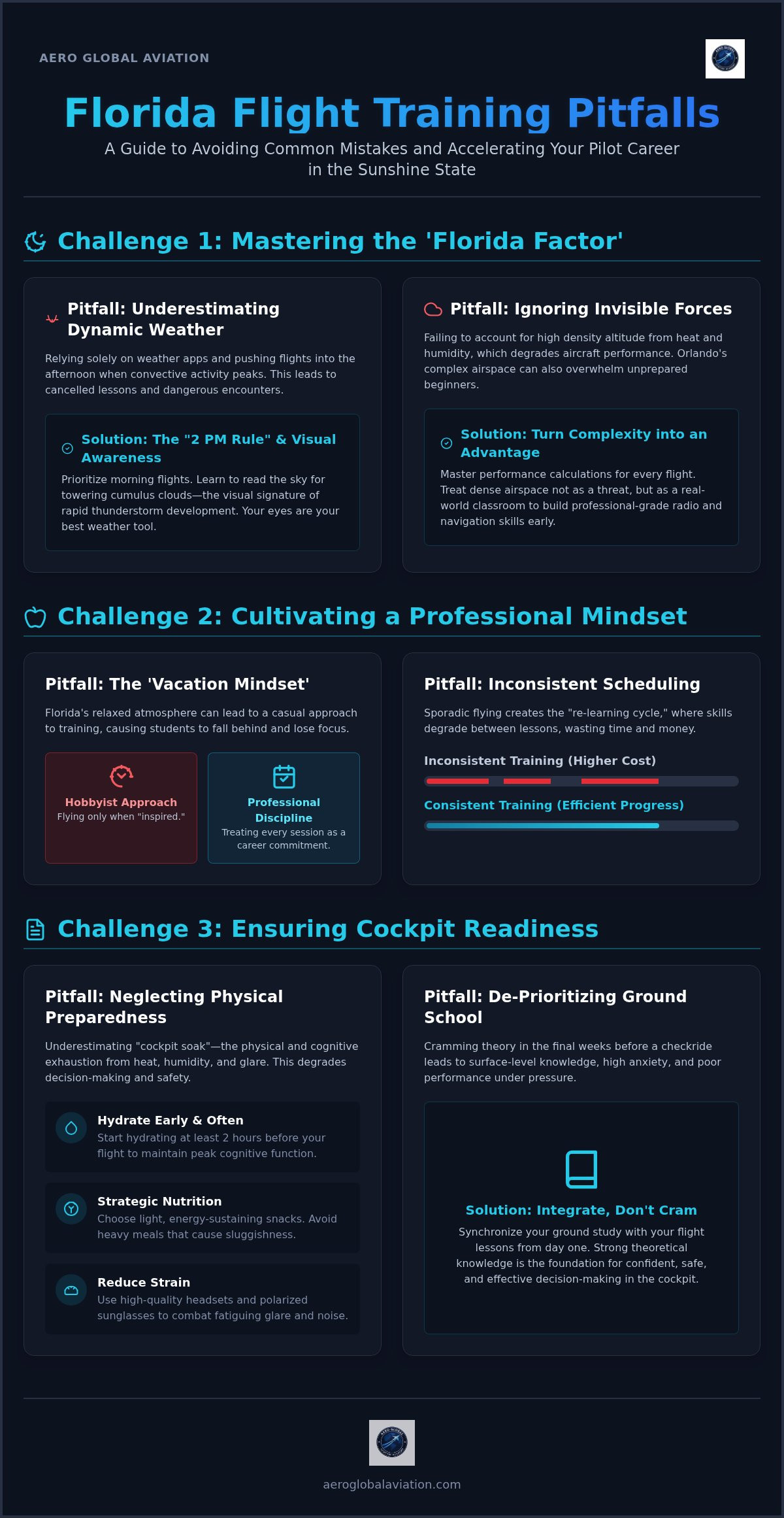
Training in a global tourist destination like Central Florida brings a unique set of distractions. It's easy to let the relaxed, holiday energy of the region bleed into your study habits. However, the path from a beginner to a professional at Aero Global Aviation Academy requires an immediate shift in identity. You must adopt the discipline of a career pilot from day one. This means sticking to a rigorous training schedule even when the sun is shining and the attractions are calling. By treating every lesson in our Wings Foundation course as a professional commitment, you build the reliability that airlines demand. Consistency is your most powerful tool to avoid the "re-learning" costs that often plague students who only fly when they feel inspired.
Physical Preparedness in the Sunshine State
The heat and humidity of the Florida climate do more than just cause discomfort; they actively degrade your cognitive performance and decision-making speed. High density altitude on humid days affects both your aircraft's lift and your own mental clarity. Another of the common mistakes student pilots make in Florida is underestimating "cockpit soak," which is the physical exhaustion that sets in after a 20-minute pre-flight on a 90-degree ramp. Recognizing the early signs of heat-induced fatigue is a critical safety skill for your first solo flights. To maintain peak focus, we encourage our students to integrate these habits into their daily routine:
- Hydration as a Pre-Flight Requirement: Start hydrating at least two hours before your scheduled block to ensure your brain stays sharp during intense maneuvers.
- Strategic Nutrition: Avoid heavy meals before flying in the heat; opt for light, energy-sustaining snacks that prevent blood sugar crashes.
- Sun Protection: Use high-quality headsets and polarized sunglasses to reduce the physical strain of constant glare, which can lead to early-onset fatigue.
By mastering these physical and psychological stressors early in your Career Pilot Program, you transform local challenges into professional strengths. You aren't just learning to fly; you're learning to perform at an elite level in a demanding environment.
Mastering the 'Florida Factor': Weather and Airspace Pitfalls
While the Florida sun offers a strategic advantage for year-round training, it also introduces environmental variables that catch many off guard. Mastering these factors is a core part of your journey toward professional excellence. One of the most common mistakes student pilots make in Florida is treating the local environment as a static backdrop rather than a dynamic, living system that demands constant respect. From the sudden surge of a sea-breeze front to the invisible weight of high humidity, the "Florida Factor" can quickly complicate a flight if you aren't prepared to adapt your planning in real time.
Convective Activity and the 2 PM Rule
In Central Florida, the clock is often your most important instrument. During the summer months, convective activity follows a remarkably predictable cycle, yet students frequently push their luck as the afternoon heat builds. Relying solely on a weather app is a mistake; you must learn to read the sky. Towering cumulus clouds with sharp, cauliflower-like edges indicate rapid vertical development that can turn into a thunderstorm in minutes. A common error is attempting a cross-country return flight just as the sea-breeze front moves inland. Instead of fighting the weather, use these patterns to your advantage by scheduling your most intensive maneuvers for the stable morning air. This proactive approach is a hallmark of our Career Pilot Program, where we teach you to think like a captain from your very first hour.
Density Altitude: The Invisible Performance Killer
Humidity and heat don't just affect your comfort; they fundamentally change how your wings and engine perform. Density altitude is the 'felt' altitude of the aircraft. On a typical July afternoon in Kissimmee, the air is much thinner than the physical elevation suggests. This means a 3,000-foot runway can feel like 1,500 feet during your takeoff roll. Many students fail to adjust their weight and balance calculations for these conditions, leading to sluggish climbs and longer landing distances. Always verify your performance charts against the current temperature and dew point to ensure you have the safety margins required for a professional-grade flight.
Airspace Awareness Near Kissimmee and Orlando
Navigating the "upside-down wedding cake" of Orlando’s Class Bravo airspace requires sharp focus and precise radio work. It's easy to commit an "altitude bust" by drifting into a tiered layer of restricted air while distracted by the sights of the nearby theme parks. You must also remain vigilant about the Disney TFR (Temporary Flight Restriction), which remains a permanent fixture of local navigation. Clear communication is vital when transitioning between satellite airports like Kissimmee and Orlando Executive. If you're feeling overwhelmed by the complexity of our local skies, our Private Pilot License Florida guide provides a detailed roadmap for mastering these local procedures with confidence.
Technical Blunders and the Professional Pilot Mindset
Florida's afternoon thermals create a bumpy ride that often triggers a physical reaction known as the "Grip of Death." This is one of the most common mistakes student pilots make in Florida; white-knuckled overcontrolling leads to pilot-induced oscillations that make every maneuver harder than it needs to be. Instead of fighting every ripple in the air, you should learn to trust the aircraft's inherent stability. Relaxing your hands allows you to feel what the plane is actually doing. This physical finesse is essential for developing the precision required for your eventual commercial checkride.
Another technical hurdle is the "lazy foot" syndrome. Because modern trainers are incredibly forgiving, many students neglect the rudder during climbs and steep turns. In the humid, heavy air of a Florida summer, uncoordinated flight is not just sloppy; it's inefficient and burns through your training budget by slowing down your progress. Mastering the rudder early ensures you aren't just a passenger in the cockpit but a pilot who truly commands the machine through every phase of flight.
Eyes Outside: The Struggle with Glass Cockpits
With the advanced G1000 avionics found in our modern fleet, it's easy to fall into the trap of instrument fixation. You might find yourself staring at the digital horizon or the moving map instead of looking out the window at the actual horizon. In the high-traffic corridors between Kissimmee and Orlando, "see and avoid" is your primary safety tool. We train you to use a structured scan pattern that keeps your eyes outside 90% of the time during VFR maneuvers. This habit builds the situational awareness that separates a student from a professional pilot who can manage complex environments with ease.
The Checklist Trap
Professionalism starts on the ground long before the engine starts. A major gap between hobbyists and career-track students is how they handle checklists. Many students simply "read" the list or rely on memory, which is a dangerous shortcut that leads to missed items. Verifying each item with a "touch and see" method ensures nothing is overlooked during the pre-flight inspection. Rushing this process is a leading cause of training delays and avoidable mechanical issues. Adopting these rigorous standards now prepares you for the high-stakes environment of Commercial Pilot Training, where precision is the only acceptable baseline. By treating every pre-flight like an airline captain, you eliminate the technical blunders that ground your progress.
Building Consistency: Planning Your Training for Success
One of the most expensive common mistakes student pilots make in Florida is treating flight training like a casual weekend activity. When you only fly once a week, you spend the first half of every lesson just trying to recover the proficiency you had seven days ago. This "re-learning" cycle can significantly inflate your training budget and stall your progress toward the flight deck. To avoid this, you must prioritize momentum. Frequent exposure to the cockpit environment ensures that your skills remain sharp and your confidence stays high.
You can also accelerate your progress without spending a dime on fuel through "chair flying." This involves sitting in a quiet space and mentally walking through every step of a maneuver or a checklist. It's a proven method used by professional pilots to build muscle memory and mental clarity. By the time you step into the aircraft, your hands should move instinctively to the controls because you've already "flown" the mission ten times in your mind.
The 3-Day Rule for Retention
Aim for at least three lessons per week to hit the "sweet spot" for skill retention. This frequency allows new concepts to move from short-term to long-term memory, which is vital for career-track students. If Central Florida's afternoon thunderstorms ground your scheduled flight, don't simply head home. Use that time at the academy to review your maneuvers with an instructor or dive into your pre-flight briefings. Staying productive during "no-fly" days keeps your mind engaged and helps you push through the mid-training slump that often leads to a plateau. Consistency is the secret to a faster certification timeline.
Mastering Ground School Early
Many students view the FAA written exam as a final hurdle to clear just before their checkride, but this is a strategic error. Your ground knowledge is the foundation for every decision you make in the cockpit. By mastering the theory early through our Wings Foundation curriculum, you eliminate the stress of "cramming" and can focus entirely on the physical skill of piloting. Our Career Pilot Program is designed to integrate this knowledge from day one, ensuring you move through your ratings with professional-grade efficiency. If you are ready to commit to a structured path, join our Career Pilot Program to begin your professional journey today.
Aero Global Aviation Academy: Turning Lessons into a Career
Aero Global Aviation Academy isn't just a place to log hours; it's where you build the professional habits that define a lifelong career. We've designed our curriculum specifically to address the common mistakes student pilots make in Florida, ensuring that every hour you spend in our aircraft moves you closer to your ultimate goal. By treating every student as a future airline professional from day one, we eliminate the hobbyist gaps that often lead to failed checkrides or inflated training costs. Our Kissimmee location serves as a strategic training asset, offering you the complex airspace and year-round flying conditions needed to develop superior command skills.
Our approach centers on the idea of the Practical Mentor. You aren't just another number in a large corporation; you're a dedicated student working alongside experts who are invested in your individual success. We use the unique environmental challenges of Central Florida as teaching tools rather than obstacles, helping you turn every weather briefing and radio call into a professional milestone. This structured environment ensures that you don't just learn to fly, but you learn to manage an aircraft with the precision required by major carriers.
The Wings Foundation Advantage
The secret to a successful career is a flawless start. Our Wings Foundation course focuses on building the core Private Pilot License (PPL) skills that prevent expensive errors during later Commercial Pilot Training. By mastering the fundamentals of stick-and-rudder coordination and situational awareness early, you create a solid base for advanced maneuvers. Our instructors act as mentors who guide you through a structured curriculum, ensuring that you progress faster because you aren't constantly correcting foundational flaws. This disciplined start is what allows our students to transition seamlessly into more complex ratings without the typical mid-training slump.
Your Path to the Flight Deck
Visualizing your journey from zero hours to the flight deck helps maintain the motivation needed for professional flight training. Whether you choose the Career Pilot Program or the comprehensive Airline Pilot Elite path, your timeline is built on the strategic advantage of our Kissimmee/Orlando location. Training here means you can fly almost every day of the year, accelerating your certification timeline far beyond what's possible in northern climates. Once you've mastered the basics, you can explore Advanced Flight Training options to earn your instructor ratings and begin building the 1,500 hours required for the airlines.
Ready to see the Aero Global difference for yourself? Your journey begins with a Discovery Flight, where you'll get your first taste of the professional standards and supportive environment we provide. We're here to help you navigate every challenge and celebrate every milestone as you turn your passion for aviation into a rewarding professional destination.
Clear Your Path to the Flight Deck
The journey to becoming a professional pilot is one of the most rewarding paths you can take, but it requires more than just logging hours. By understanding the common mistakes student pilots make in Florida, you've already taken the first step toward a more efficient and successful training experience. You now know that mastering the "Florida Factor" of weather and airspace, maintaining a rigorous flight schedule, and adopting a professional mindset from your very first pre-flight are the keys to avoiding costly delays. These habits don't just help you pass a checkride; they build the foundation for a safe and prosperous career in the skies.
At Aero Global Aviation Academy, we prepare you for the captain's seat from day one. Our Kissimmee-based training puts you in the heart of Florida aviation, where our structured Career Pilot Program and expert mentors provide the personalized attention you need to meet professional airline standards. Don't let foundational errors ground your ambition or inflate your budget. Start your professional pilot journey with Aero Global Aviation Academy today and turn your passion for flight into a tangible destination. The sky is waiting, and we're ready to help you reach it.
Flight Training Frequently Asked Questions
Is Florida's weather too dangerous for a beginner student pilot?
Florida’s weather isn't dangerous for beginners; rather, it's one of the best environments for building aeronautical decision-making skills. While afternoon thunderstorms develop quickly, the morning air remains incredibly stable and clear. Learning to identify these patterns early helps you avoid the common mistakes student pilots make in Florida. By working with your instructor to respect local weather minimums, you turn the regional climate into a powerful training tool that prepares you for real-world flying.
How often should I fly to avoid making common mistakes?
You should aim to fly at least three times per week to maintain steady progress. This frequency creates the "sweet spot" for muscle memory and knowledge retention. Flying only once a week often leads to a cycle of re-learning previous skills, which increases your total training time and budget. Consistency allows you to move quickly from foundational maneuvers to complex cross-country flights, ensuring your certification timeline remains on track for a professional career.
What is the hardest part of flight training in Orlando?
The most challenging aspect is navigating the complex, tiered airspace while managing high-frequency radio communications. Orlando’s Class Bravo environment is busy, requiring you to stay ahead of the aircraft at all times. This high-activity setting is actually a strategic advantage. It forces you to develop professional-grade radio habits and sharp situational awareness early in your training, making the transition to airline environments much smoother than training in quiet, rural areas.
Can I start my career pilot training if I've never flown before?
Absolutely. Most students at Aero Global Aviation Academy begin with zero flight hours. Our Career Pilot Program is specifically structured to take you from your very first lesson through your commercial ratings. We provide the mentorship and resources needed to build your skills from the ground up. Starting with a structured curriculum ensures you develop professional habits immediately, preventing the common mistakes student pilots make in Florida that often ground self-taught hobbyists.
How do I avoid getting overwhelmed by the Orlando Class B airspace?
Preparation is the key to managing complex airspace without feeling overwhelmed. You should study the local VFR sectional charts and identify prominent landmarks before you ever leave the ground. During flight, maintaining a disciplined scan pattern and using the advanced features of the G1000 avionics helps you stay aware of your position relative to the Class B boundaries. This proactive approach turns a busy environment into a manageable and rewarding learning experience.
What happens if I make a mistake during my first solo flight?
Making a minor error during your first solo is a normal part of the learning process. Your instructor won't sign you off for a solo flight until you've demonstrated the ability to handle various contingencies safely. If something doesn't go as planned, the priority is always to "aviate, navigate, and communicate" in that specific order. Focusing on flying the aircraft first ensures safety, while the debrief after landing provides a valuable opportunity to refine your skills.
Is it better to train in a glass cockpit or traditional gauges first?
Training in a glass cockpit from day one is highly recommended for career-track students. Modern airlines exclusively use digital displays, so learning on the G1000 system prepares you for the professional flight decks you'll occupy in the future. While traditional gauges have their place, the situational awareness provided by modern avionics is a significant safety asset. It allows you to focus more on high-level decision-making and precise navigation in Florida’s busy corridors.
How much does it cost to fix common training delays?
The most effective way to fix training delays is through increased consistency and mental preparation rather than just spending more money on flight hours. Incorporating "chair flying" at home and staying on top of your ground school modules prevents the need for repeated lessons. While we don't quote specific tuition prices, students who maintain a schedule of three flights per week generally see the best value and reach their certification goals much faster.


