

What if your dream of flying isn't an expensive gamble, but the most predictable, high-yield capital investment you will ever pitch? When you tell your family you want to pursue aviation, their immediate reaction often stems from worry over safety, substantial debt, and industry uncertainty. They see a risky, open-ended hobby. That is why successfully presenting a flight school business case to parents requires stepping away from childhood daydreams and approaching the table like an entrepreneur pitching their first venture.
You already know that earning your commercial wings demands immense personal discipline and significant resources. It is entirely fair for your family to ask tough questions about safety standards, medical contingencies, and long-term career outcomes. In this complete guide, you will learn how to build a professional, data-backed business proposal that answers their deepest concerns, proves your maturity, and turns parental skepticism into enthusiastic career support. We will cover airline hiring forecasts, proven risk mitigation strategies, and the exact roadmap needed to secure family buy-in for your flight deck journey.
Key Takeaways
- Shift from emotional passion to an investor mindset by framing flight training as an accountable capital venture with clear financial returns.
- Compare accelerated flight training timelines directly against traditional four-year degrees to highlight earlier entry into high-earning airline seniority tiers.
- De-risk the conversation before requesting funds by securing an FAA First-Class Medical Certificate and addressing strict safety protocols upfront.
- Master presenting a flight school business case to parents using a structured pitch deck that outlines milestone budgets, syllabus structure, and financing plans.
- Turn theoretical family agreement into full commitment by arranging an on-site flight academy visit to inspect aircraft and meet certified flight instructors.
Reframing Flight Training: Why You Need a Professional Business Case for Your Parents
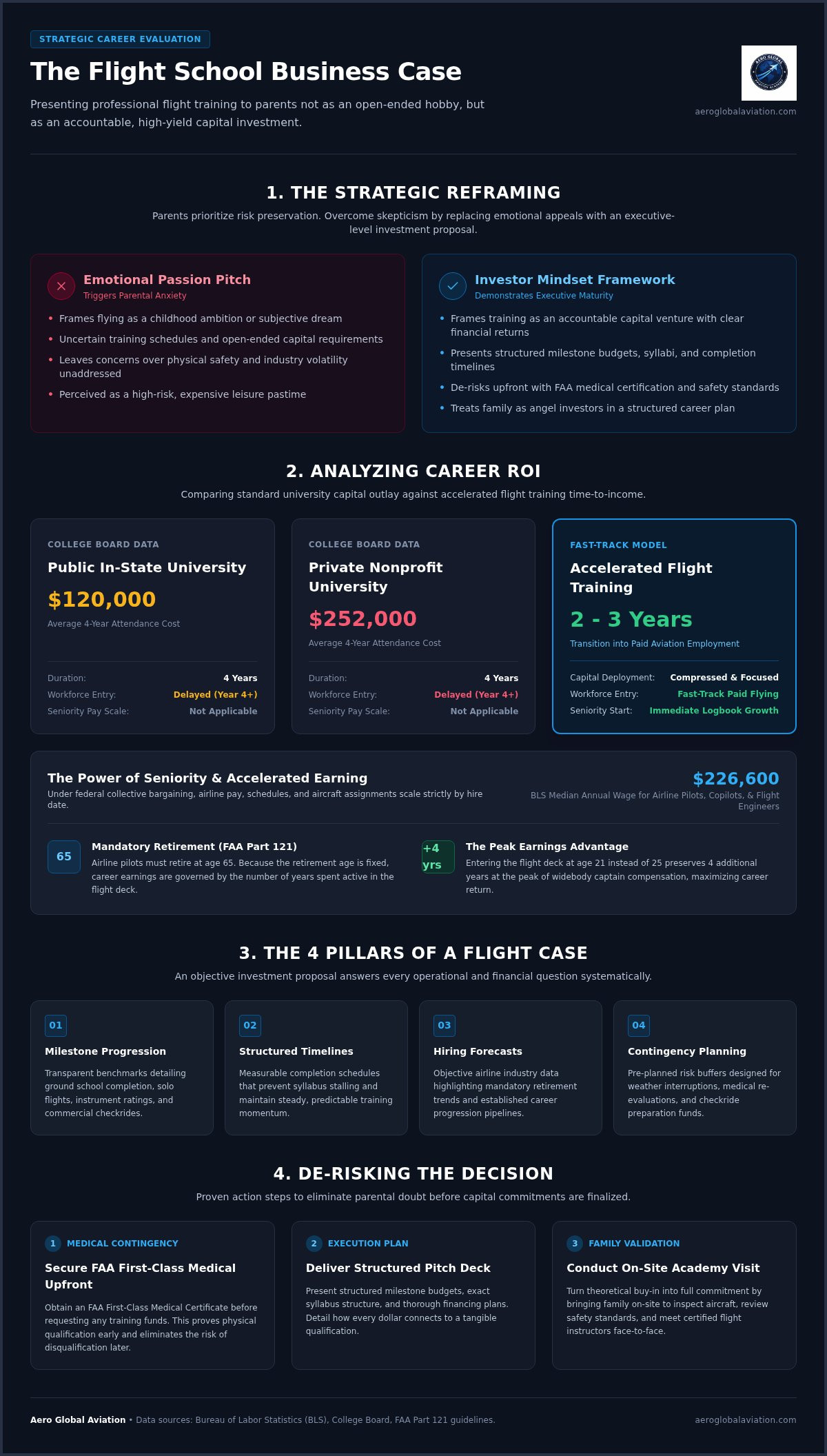
A flight school business case is an objective investment proposal. It outlines training timelines, capital requirements, operational risks, and projected career returns. When seeking family backing or loan co-signing, telling your parents that flying is your lifelong dream is rarely enough. Passion explains your ambition, but capital demands evidence of risk management. By approaching your family with formal documentation, you instantly demonstrate executive function, personal maturity, and professional dedication. Structured accountability reassures parents who fear open-ended training, unfinished licenses, and wasted funds.
Moving Beyond Passion: The Psychology of Parental Skepticism
Parents instinctively prioritize risk preservation. When they first hear about flight training, their minds immediately focus on physical safety, substantial financial exposure, and historical airline hiring cycles. Without industry data, they see an expensive pastime rather than a high-yield profession. Emotional pleading only reinforces their concern that flight school might be an impulsive phase. Shifting to an analytical framework changes everything. When presenting a flight school business case to parents, you engage them as angel investors, replacing tension with an adult, peer-level strategic evaluation.
Core Components of an Aviation Career Proposal
A comprehensive proposal leaves no operational question unanswered. Instead of vague promises, clearly outline the established flight training curriculum and stages, showing how each certificate delivers tangible qualifications.
Your business case should center on four critical pillars:
- Milestone Progression: Transparent benchmarks detailing ground school completion, solo flights, instrument ratings, and commercial checkrides.
- Structured Timelines: Measurable completion schedules that prevent syllabus stalling and maintain steady training momentum.
- Industry Hiring Forecasts: Objective data highlighting mandatory retirement trends and the established airline pilot career path.
- Contingency Planning: Built-in risk buffers designed for weather interruptions, medical re-evaluations, and checkride preparation funds.
Approaching these operational details methodically makes presenting a flight school business case to parents a collaborative conversation rather than an uphill struggle.
Analyzing Career ROI: Flight School vs. the Traditional Four-Year University
Most families accept four-year university tuition as the standard path without questioning its financial return. Over four years, College Board data indicates that public in-state attendance averages around $120,000, while private nonprofit universities easily reach $252,000. In contrast, accelerated commercial flight training compresses capital deployment into an intense, outcome-driven window. Rather than absorbing four years of tuition, housing, and delayed entry into the workforce, an aspiring pilot transitions into paid aviation employment within two to three years. Comparing these outlays directly changes the entire conversation around your education.
Accelerated Time-to-Income and Seniority Dynamics
Seniority rules commercial aviation. Under federal collective bargaining systems, your hire date determines base pay, aircraft assignment, base location, and monthly schedules. Unlike corporate roles where pay depends on annual managerial reviews, airline compensation scales systematically with time served. The Bureau of Labor Statistics pilot occupational outlook reports a median annual wage of $226,600 for airline pilots, copilots, and flight engineers. Because mandatory retirement under FAA Part 121 occurs at age 65, entering the flight deck at age 21 instead of 25 preserves four additional years at the peak of widebody captain compensation. Enrolling in a focused career pilot program fast-tracks your commercial certification, letting you start building logbook hours while traditional college students are still sitting in lecture halls.
Structuring Debt and Cash Outlays Intelligently
Smart financing proves your business acumen. When presenting a flight school business case to parents, contrast open-ended spending with milestone-based budgeting and educational lending:
- Milestone-Based Financing: Funding each rating individually, from private pilot through commercial multi-engine, keeps expenditures strictly tied to demonstrated flight performance.
- Aviation Education Loans: Specialized fixed-rate training loans provide predictable amortization, unlike high-interest consumer credit cards or personal loans.
- Earliest Income Offset: Earning your Certified Flight Instructor rating creates immediate revenue to service debt obligations while building toward the 1,500-hour airline transport pilot standard.
Reviewing how academies like Aero Global Aviation Academy structure progress tracking can help you present a grounded financial blueprint that puts parental financial concerns at ease.
De-risking the Investment: Tackling Safety, Medicals, and Industry Cycles
Every seasoned investor looks for the exit hatch before signing a check. When presenting a flight school business case to parents, your strongest move is addressing failure points before they even bring them up. Parental hesitation usually boils down to three sharp questions: What if you fail the medical exam? What if flying is dangerous? What happens if the airline market slows down? Answering these concerns with actionable, regulatory solutions turns theoretical fears into managed risks.
Medical and Academic Risk Mitigation
Eliminate health-related uncertainties on day one. Before spending tuition funds or signing training agreements, visit an authorized Aviation Medical Examiner to obtain an FAA First-Class Medical Certificate. Reviewing official FAA medical certification requirements shows parents that cardiovascular health, neurological stability, and color vision thresholds are evaluated thoroughly from the start. Under 14 CFR § 61.23, an initial First-Class certificate validates your eligibility for commercial flight deck operations. Walking into your family presentation with that signed certificate in hand serves as definitive proof that you will not drop out due to unforeseen physical disqualifications.
Safety Culture and Maintenance Transparency
Differentiate training aircraft from outdated perceptions of light airplanes. Modern flight schools deploy aircraft equipped with advanced glass cockpits, dual GPS navigation, and traffic alerting systems that mimic major commercial jets. Show your parents how strict maintenance protocols keep students protected during daily operations:
- Mandatory Inspections: Federal regulations require complete aircraft maintenance tear-downs every 100 flight hours, alongside exhaustive annual structural reviews.
- Maintenance Transparency: Reputable academies employ full-time, FAA-certified Airframe and Powerplant technicians who log all work in verifiable airframe tracking software.
- Structured Oversight: Rigorous dual flight instruction ensures students master crosswind handling, recovery procedures, and emergency operations before solo flights.
Use our evaluation criteria for the best flight schools in florida to show parents how to inspect flight line logs and verify safety practices firsthand.
Finally, address macroeconomic hiring cycles with verified industry realities. Boeing's 20-year market outlook projects a need for 674,000 new commercial pilots globally, with 123,000 needed in North America alone. Because roughly two-thirds of this demand replaces captains retiring under the mandatory age-65 rule, baseline hiring remains steady even during broader economic shifts. Should regional airline backlogs temporarily pause initial classes, your commercial ratings open immediate alternative avenues: corporate charter flying, pipeline patrol, aerial surveying, or active flight instruction. Presenting a flight school business case to parents with these built-in contingencies proves your plan can weather any storm.
How to Build and Deliver Your Pitch: A Step-by-Step Parent Presentation Blueprint
Casual dinner table remarks won't secure the backing you need for flight school. Leaving brochures around the house signals a casual hobby, not a professional career plan. Treating your family like respected angel investors means organizing a formal presentation that walks them through every phase of your aviation journey. Follow this structured five-step blueprint to present your proposal effectively:
- Step 1: Thorough Preliminary Research. Audit prospective flight schools, syllabus progression paths, completion timelines, and regional weather patterns.
- Step 2: Assemble Your Proposal Deck. Build an organized slide presentation outlining operational phases, cost structures, financing paths, and risk mitigation.
- Step 3: Schedule a Dedicated Meeting. Pick a quiet evening, set an agenda in advance, and gather everyone without digital distractions.
- Step 4: Deliver with Composure. Walk through your slides deliberately, actively invite questions, and avoid defensive emotional reactions.
- Step 5: Transition to Real-World Validation. Close your pitch by scheduling an on-site flight academy visit and discovery flight for the family.
Slide Deck Architecture: What to Include
Your slides need to guide your family along a clear technical progression. Begin with your career destination, then break down the sequential stages required to get there. Lay out the milestone path from Private Pilot to Instrument Rating, Multi-Engine qualification, and Commercial Pilot certification. Detail how structured commercial pilot training establishes precise flight competencies that make graduates employment-ready. Dedicate separate slides to syllabus timelines, medical clearances, dual-instructor oversight, and financing structures. Visual timelines turn what feels like an abstract journey into a concrete, achievable trajectory.
Handling the Hard Questions with Composure
Expect tough questions about training delays, checkride pass rates, and regional weather shutdowns. When presenting a flight school business case to parents, how you answer matters as much as the answers themselves. Stay relaxed, lean on your research, and walk through practical solutions. If your parents worry about weather delays extending training costs, highlight geographic assets: flight schools operating in Kissimmee, Florida take advantage of more than 300 flying days per year. Consistent flying weather prevents syllabus stalling and protects your budget.
Ready to move your proposal forward? Take the initiative and schedule an admissions tour with Aero Global Aviation Academy to review our training fleet and flight lines firsthand.
Validating the Decision: Next Steps and Family Campus Evaluations
A slide deck secures agreement in principle, but boots on the ground seal family commitment. After presenting a flight school business case to parents, transition the discussion from paper concepts into real-world validation. Inviting your parents to an on-site flight center lets them examine aircraft maintenance hangars, observe active flight operations, and talk directly with instructors. Experiencing the training environment transforms abstract parental worry into grounded trust in the institution handling your education.
The Family Discovery Flight Experience
Nothing builds confidence faster than seeing standard operating procedures up close. Bring your parents into the pre-flight briefing room. Let them watch you execute a disciplined exterior inspection alongside a Certified Flight Instructor, checking fuel quality, control surfaces, and engine oil levels. Experiencing an introductory flight out of a controlled airport like Kissimmee Gateway Airport shows them how operating in active, towered airspace instills professional radio communication and situational awareness right from lesson one. While on the ramp, introduce your family to lead maintenance technicians who can explain engine overhaul cycles and spare parts inventory, reinforcing your previous points about operational safety.
Selecting the Right Training Track Together
Once your family completes their facility inspection, sit down together with admissions mentors to match your business plan to a concrete syllabus. A tailored curriculum ensures you invest in the exact ratings required for your intended aviation destination:
- Wings Foundation: Ideal for testing student dedication, this course focuses strictly on earning the foundational Private Pilot Certificate before committing to advanced commercial training.
- Career Pilot Program: A comprehensive track spanning zero flight hours through Commercial Pilot certification, designed for students seeking the most direct path to commercial cockpits.
- Airline Pilot Elite: An end-to-end professional progression that covers initial flight training through advanced flight instructor ratings, establishing an immediate pipeline for building the flight hours necessary for airline transport eligibility.
Reviewing these structured options as a team turns training selection into a shared achievement. Mastering the art of presenting a flight school business case to parents concludes by taking this final step together, aligning parental backing with a clearly defined launchpad toward the flight deck.
Launching Your Professional Flight Journey with Confidence
Transforming your aviation goals into reality begins by treating your ambition with executive discipline. Successfully presenting a flight school business case to parents proves you aren't chasing a fleeting hobby; you are managing a structured capital investment. By securing an FAA First-Class Medical early, demonstrating rapid time-to-income through airline seniority dynamics, and highlighting strict maintenance standards, you turn parental anxiety into active, proud partnership.
The final bridge from your pitch deck to reality happens directly on the ramp. Central Florida provides the ultimate training ground, where our Kissimmee base offers over 300 flying days per year to keep your progress moving without costly seasonal delays. Backed by certified flight instructors committed to a student-first safety culture and structured pathways reaching from private pilot foundational work to advanced instructor ratings, you have everything needed to build an extraordinary career.
Take the definitive step to validate your proposal. Schedule a Family Campus Tour and Discovery Flight today and let your parents experience our professional training standard firsthand.
Frequently Asked Questions
How do I convince my parents that flying is safe compared to driving?
Emphasize that flight training operates under rigid federal regulations, structured syllabi, and preventative mechanical checks rather than unpredictable road conditions. While driving relies on random peer motorists, general aviation training involves licensed instructors, certified aircraft mechanics, air traffic control separation, and thorough pre-flight checklists. Point out that every single training maneuver is practiced, tested, and debriefed within controlled airspace environments before solo flight privileges are ever granted.
What happens to our investment if I lose my FAA medical certification?
Securing an FAA First-Class Medical exam before starting your training eliminates the risk of early disqualification from undiagnosed conditions. If a temporary health issue develops later, the FAA provides special issuance pathways for many manageable conditions. Because flight training certifications are permanent milestones, any completed licenses remain credited on your record even if you must pause training to resolve a medical issue.
Should I get a four-year college degree before or after flight school?
Completing flight training first is usually the most financially advantageous sequence. Entering an academy directly builds logbook hours earlier, securing an airline seniority number ahead of peers who spend four continuous years in traditional classrooms. Many pilots complete an online bachelor's degree while working as a Certified Flight Instructor or regional first officer, letting future airline paychecks fund their academic tuition.
How can I prove to my parents that airlines are actually hiring pilots?
Share mandatory retirement figures and commercial fleet forecasts directly from airline industry reports. When presenting a flight school business case to parents, highlight that federal law requires Part 121 airline captains to retire at age 65. This non-negotiable demographic turnover forces commercial airlines to recruit thousands of new first officers annually simply to keep existing routes staffed and operational.
Can my parents attend an admissions tour or discovery flight with me?
Yes, bringing family members to an admissions tour is strongly encouraged. At Aero Global Aviation Academy in Kissimmee, Orlando, parents can walk through our training fleet, meet chief flight instructors, and inspect maintenance hangars firsthand. Seeing our dispatch procedures, towered airport environment, and safety culture up close provides families with genuine peace of mind that a slideshow alone cannot match.
What if the aviation industry experiences an economic downturn during my training?
Aviation follows cycles, but holding certified commercial credentials provides versatile career flexibility. If major airline hiring pauses temporarily, pilots continue earning income through charter operations, aerial survey work, pipeline inspection, and primary flight instruction. Building logbook hours during slower hiring periods ensures you stand at the front of the line when regional and major airline recruitment cycles surge again.
How do student pilots earn money after completing commercial pilot certification?
Graduates typically work as Certified Flight Instructors to build the 1,500 flight hours required for an Airline Transport Pilot certificate. Programs like our Airline Pilot Elite track prepare students to transition immediately from trainee to paid instructor. In this role, you earn an hourly wage teaching new students while building the logbook hours needed for regional airline recruitment at zero out-of-pocket flight expense.


