
Did you know that major carriers like Delta and United are projected to hire over 4,100 pilots in 2026? While the demand is historic, the path to those flight decks often feels blocked by the high cost of hour building and the anxiety surrounding the CFI checkride. You've likely spent nights wondering whether to prioritize your CFII or MEI first, or how you'll afford to reach that 1,500-hour milestone. Enrolling in a premier flight instructor training program Orlando provides is more than just a certification step. It's your strategic bridge to a professional career in the sky.
We understand the pressure of transitioning from student to teacher. That's why we've designed this guide to help you master the art of aviation instruction with confidence. You'll learn how to handle the different CFI ratings, pass your checkride on the first attempt, and secure an immediate teaching position to build high-quality hours. From the year-round flying weather in Kissimmee to the latest 2026 FAA regulations, we're covering everything you need to transform from a commercial pilot into a practical mentor.
Key Takeaways
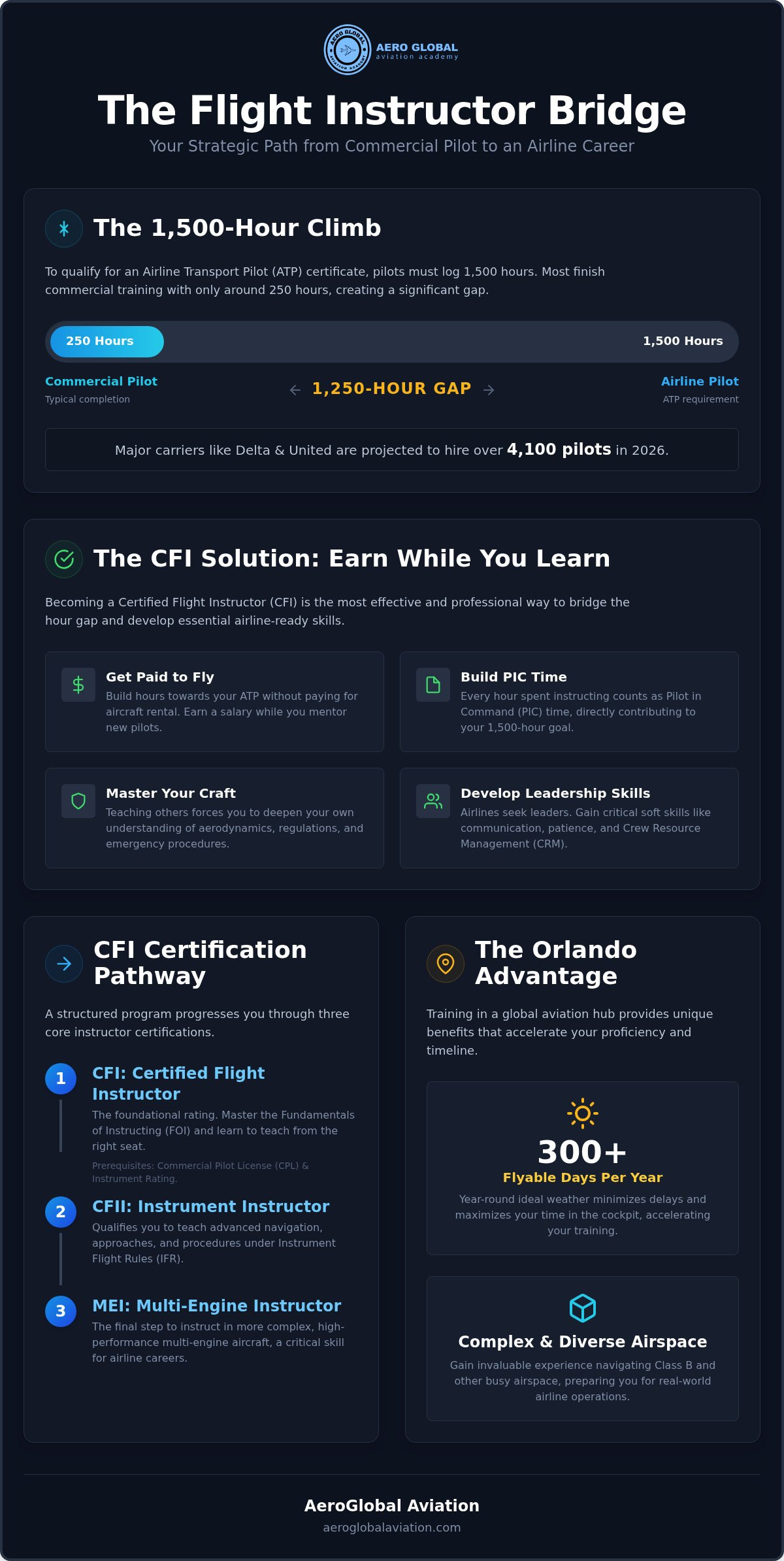
- Discover why becoming a flight instructor is the most effective way to perfect your technical skills while building the 1,500 hours required for the airlines.
- Understand the step-by-step progression of a flight instructor training program Orlando provides, covering the CFI, CFII, and MEI certifications.
- Learn how to leverage Orlando's 300 plus days of flyable weather and complex airspace to accelerate your training timeline and professional proficiency.
- Gain insights into mastering the CFI checkride, including tips for the FOI knowledge test and the specific requirements for your spin recovery endorsement.
- See how a structured track like the Airline Pilot Elite program can bridge the gap from your commercial license to a rewarding career as a professional pilot.
Mastering Flight by Teaching: Why CFI Training Is Your Professional Career Bridge
Transitioning from a commercial pilot to a Certified Flight Instructor (CFI) represents the most significant shift in your aviation journey. It’s the moment you stop being a consumer of knowledge and start becoming a creator of it. By enrolling in a flight instructor training program Orlando, you aren't just checking a box for the FAA. You’re entering a professional finishing school that sharpens your instincts and prepares you for the high-stakes environment of a commercial flight deck. This transformation turns a skilled pilot into a true master of the craft.
The 1,500-Hour Rule and the CFI Solution
The 1,500-hour rule is the primary hurdle for every aspiring airline pilot in the United States. Since most pilots finish their commercial training with approximately 250 hours, they face a massive 1,250-hour gap before they can qualify for an Airline Transport Pilot (ATP) certificate. Flight instructing is the most efficient and logical solution to bridge this divide. It allows you to earn a paycheck while building those essential hours. Instead of paying for aircraft rental, you’re getting paid to occupy the right seat and mentor the next generation of aviators.
Every hour you spend in the cockpit as an instructor counts as Pilot in Command (PIC) time. This Flight instructor overview highlights how the role builds the foundational experience needed for advanced certifications. Every hour you spend teaching a student to land in a crosswind or manage a simulated engine failure counts toward your ultimate goal. You're building a logbook that demonstrates professional reliability to future employers.
Beyond the Logbook: Developing Professional Pilot Skills
There's an old saying that you don't truly know a subject until you have to teach it. This "learning by teaching" phenomenon is where your stick-and-rudder skills become second nature. When you explain the physics of a stall or the nuances of Class B airspace to a novice, your own understanding deepens. This process forces you to master complex systems and FAA regulations to a degree that a standard student never reaches. You become an expert because you have to be the primary safety resource in the plane.
Airlines aren't just looking for hours; they're looking for leaders. Instructing builds critical "soft skills" like communication, patience, and Crew Resource Management (CRM). You'll learn to manage a cockpit, handle student anxiety, and make critical safety decisions in real-time. This psychological transition from student to mentor is a core requirement for elite airline pilot career paths. By the time you reach the airlines, you won't just be a pilot with high hours; you'll be a seasoned professional with the leadership experience necessary to command a turbine aircraft.
The Core Components of an Orlando Flight Instructor Training Program
Starting your journey in a flight instructor training program Orlando requires a solid foundation. Before you can begin teaching, you must first prove your own proficiency by holding a Commercial Pilot License (CPL) and an Instrument Rating. These prerequisites ensure you have the technical handling and navigational skills necessary to guide a student safely through the skies. In a professional advanced flight training environment, we use a structured syllabus to move you through the three core certifications: CFI, CFII, and MEI.
Modern aviation demands familiarity with advanced technology. We integrate glass cockpit systems like the G1000 into our instructor training to ensure you're ready to teach in the most common modern training aircraft. Choosing a flight instructor training program Orlando candidates trust means looking for this balance of traditional airmanship and modern tech. This technical edge makes you a more versatile mentor from your very first day on the job.
CFI Initial: The Foundation of Instruction
The initial CFI rating is often considered the most challenging checkride in aviation. It begins with the Fundamentals of Instructing (FOI), which explores the science of how people learn and retain information. You'll master the "right-seat transition," learning to fly with the same precision from the other side of the cockpit while simultaneously narrating your actions. Developing effective lesson plans for both ground school and flight maneuvers is critical here. It’s about more than flying; it’s about communicating complex concepts clearly and safely.
CFII and MEI: Expanding Your Instructional Range
While the initial CFI is your license to teach, adding your Instrument Instructor (CFII) and Multi-Engine Instructor (MEI) ratings significantly boosts your value. Given the dynamic weather patterns in Central Florida, a CFII is essential for maintaining a consistent training schedule. It allows you to teach students how to navigate through the clouds, a skill that is vital for the positive pilot career outlook reported by the BLS.
The MEI rating serves as your gateway to turbine transitions, putting you in high-performance aircraft that mirror regional jet operations. Having all three ratings makes you the most employable candidate in the industry. If you're ready to start this progression, you might consider how our Airline Pilot Elite program can streamline your path to these advanced ratings and help you secure a position in a competitive market.
Strategic Training Advantages: Why Orlando is the Global Hub for CFI Candidates
Orlando is more than a vacation destination; it's a strategic powerhouse for aviation. Choosing a flight instructor training program Orlando offers puts you in the center of a high-density training corridor where the industry moves at a professional pace. With over 300 days of flyable weather every year, you'll avoid the seasonal delays that plague schools in the north. This consistency is vital for maintaining the momentum required to master the FAA Airman Certification Standards for instructors. When you aren't fighting the weather, you can focus entirely on your instructional technique.
Beyond the climate, the complexity of the Central Florida airspace provides an unparalleled classroom. Operating in the shadow of major hubs like Orlando International (MCO) and Sanford (SFB) forces you to develop high-level radio proficiency and situational awareness early on. You aren't just learning to fly; you're learning to navigate one of the busiest airspaces in the world. This exposure is exactly what airline recruiters look for when they visit the Orlando aviation corridor to scout for new talent. The density of flight schools in the region also means that job opportunities are often available immediately upon completion of your certificate.
Kissimmee Gateway (KISM): The Ideal Training Base
Training at Kissimmee Gateway Airport (KISM) offers a distinct advantage over smaller, non-towered fields. As a towered airport with diverse traffic ranging from corporate jets to light trainers, KISM provides a realistic environment for future instructors. You have immediate access to varied instrument approaches and dedicated practice areas just minutes away. This proximity means less time spent commuting to the training zone and more time focused on perfecting your maneuvers. This efficiency is a hallmark of a quality flight instructor training program Orlando students rely on to stay on schedule.
Living and Training in the Aviation Capital
Relocating to Central Florida for your training opens doors to a vibrant aviation community. Orlando serves as a major hub for industry events and aviation conferences, allowing you to network with professional pilots and mentors on a regular basis. Between training sessions, you can immerse yourself in a lifestyle built around aviation excellence. This community support is invaluable when you're navigating the transition from student to professional. You'll find yourself surrounded by peers who share your drive, creating a collaborative spirit that makes the path to the airlines feel both attainable and rewarding.
Navigating the CFI Checkride: From Knowledge Tests to Spin Endorsements
The CFI checkride is often described as the most grueling day in a pilot's professional life. It's a day-long marathon that tests your mental endurance as much as your technical handling. To reach this final stage, you must first master the two required FAA knowledge tests: the Flight Instructor Airplane (FIA) and the Fundamentals of Instructing (FOI). These exams aren't just hurdles; they establish your baseline understanding of aeronautical science and the complex psychology of how people learn. Once your written tests are complete, you'll tackle the spin endorsement. This critical safety training involves intentional stalls and full recoveries, ensuring you can confidently recognize, prevent, and recover from spins. It's a skill you'll eventually use to protect your future students during their most vulnerable training moments.
The Art of the Ground Lesson
During the oral exam, a Designated Pilot Examiner (DPE) evaluates your ability to transfer knowledge. You'll need to use whiteboards, visual aids, and simulators to make abstract concepts tangible. Simplifying difficult subjects like aerodynamics or meteorology for a beginner is a skill that requires practice and patience. A common mistake is getting bogged down in technical minutiae that confuses a new student. Examiners look for "instructional level" knowledge, meaning you can explain the "why" behind every regulation and maneuver. By following the Flight Instructor Practical Test Standards (PTS), you can stay focused on the essential learning objectives and avoid the traps that lead to checkride anxiety.
Flight Proficiency from the Right Seat
In the cockpit, the stakes are even higher. You have to perform maneuvers to commercial standards while simultaneously narrating every action from the right seat. This requires immense mental bandwidth. You'll learn how to anticipate common student errors, such as improper rudder coordination or fixating on the instruments, and intervene safely before a situation escalates. Whether you use continuous instructional commentary or a more targeted "silent flight" approach, your goal is to maintain safety while fostering a positive learning environment. Mastering this balance is a core part of any reputable flight instructor training program Orlando offers.
Preparing for this professional milestone requires more than just hours in a logbook; it requires a dedicated mentor who has walked the path before. You need a structured environment where you can practice these "soft skills" until they become second nature. If you're ready to tackle your checkride with confidence and secure your future in the airlines, we invite you to explore our flight instructor training program Orlando to see how our Airline Pilot Elite track can help you succeed on your first attempt.
Launching Your Career with the Airline Pilot Elite Program
Choosing the right environment for your professional development is just as important as the certification itself. While many schools offer basic ratings, our Career Pilot Program provides a comprehensive roadmap designed to take you from a student pilot to a highly qualified instructor. The Airline Pilot Elite track is our premier offering, creating a seamless transition from your Private Pilot License (PPL) all the way through to your multi-engine instructor (MEI) certification. This structured path ensures that you don't just collect licenses; you build a professional identity within a flight instructor training program Orlando students trust for career results.
Our "Practical Mentor" philosophy is at the heart of everything we do. We believe that great instructors aren't born; they're coached by experts who have navigated the same challenges you face. By training in our Kissimmee facility, you're immersed in a culture of excellence where safety and instructional mastery are the standard. This approach prepares you for the realities of real-world instructing, ensuring you can handle diverse student needs and complex cockpit scenarios with confidence. When you're ready to see this environment for yourself, scheduling a discovery flight at our Kissimmee training center is the best way to experience our fleet and meet our team.
Aero Global Aviation Academy's Instructor Placement Opportunities
One of the most significant advantages of our program is the potential for immediate employment. We're committed to hiring our top graduates as staff instructors, providing you with a clear path to begin building those critical 1,500 hours. Instructing in our modern, well-maintained fleet allows you to stay current with the latest avionics and technology while earning a professional income. We don't just train you and send you on your way. We actively support your transition from CFI to the regional airlines by providing the high-quality turbine-transition hours and networking opportunities that major carriers value.
Take the First Step Toward Your CFI Rating
Securing your spot in a flight instructor training program Orlando for 2026 enrollment requires early preparation. We recommend reviewing our various financing options and flexible payment plans to ensure your training remains on schedule. Our admissions team is available to help you organize your application and documentation, ensuring a smooth start to your professional journey. Don't let the complexity of the process hold you back. Contact our admissions team today for a personalized career consultation and discover how the Airline Pilot Elite program can launch your career into the flight decks of the world's leading airlines.
Take Command of Your Aviation Future
Becoming a flight instructor is the most rewarding way to master the skies while building the hours necessary for a major airline career. You've seen how teaching sharpens your technical instincts and how Orlando's complex airspace provides a world-class training environment. By focusing on the CFI, CFII, and MEI ratings, you position yourself as a highly employable professional ready for the demands of a turbine flight deck. Choosing a flight instructor training program Orlando offers ensures you leverage 300 plus days of flyable weather to reach your goals faster.
At Aero Global, we support your journey with a personalized "Practical Mentor" training approach and a modern fleet equipped with Garmin G1000 glass cockpits. Our strategic location at Kissimmee Gateway Airport puts you in the heart of the action, surrounded by industry experts and networking opportunities. It's time to transition from being a student to becoming a leader in the cockpit. Ready to lead the next generation of pilots? Explore the Airline Pilot Elite program at Aero Global today! The sky isn't just your office; it's your destination. We can't wait to see you excel in the right seat.
Frequently Asked Questions
How long does it take to complete a flight instructor training program in Orlando?
Most students complete a flight instructor training program Orlando offers in approximately 8 to 12 weeks. This timeline depends on your starting experience level and how frequently you fly. Because Central Florida provides over 300 days of flyable weather, you'll likely progress much faster than in other regions. Staying consistent with your ground school and flight lessons is the best way to ensure you meet your professional milestones on schedule.
What are the FAA requirements to become a Certified Flight Instructor (CFI)?
To become a CFI, you must be at least 18 years old and hold a Commercial Pilot Certificate with an instrument rating. You need to have logged at least 250 total flight hours and possess at least a third class medical certificate. Additionally, you'll need to pass the Fundamentals of Instructing (FOI) and Flight Instructor Aeronautical Knowledge (FIA) written exams before completing a spin endorsement and passing your final practical checkride.
What is the average salary for a flight instructor in Florida in 2026?
As of August 2026, the average annual salary for a flight instructor in Orlando is approximately $88,329, though some reports show averages as high as $111,733. Most professional instructors in the region earn between $64,400 and $104,600 depending on their specific ratings and the school where they teach. This competitive pay allows you to earn a sustainable living while you bridge the gap to the major airlines.
Do I need to have a Multi-Engine Rating before starting CFI training?
You don't need a Multi-Engine Rating to begin your initial CFI training, but you must have it before you can pursue your Multi-Engine Instructor (MEI) certificate. Most candidates find it's more efficient to earn their single-engine CFI first. This allows them to start working and earning money while they finish the requirements for advanced ratings. Our Airline Pilot Elite program is designed to guide you through this logical progression seamlessly.
What is a spin endorsement, and why is it required for flight instructors?
A spin endorsement is a logbook certification proving you've received specialized training in spin entry, recognition, and recovery techniques. The FAA requires this for all initial flight instructor candidates to ensure they can safely manage the airplane if a student mishandles a stall. It's a vital safety skill that builds your confidence and ensures you're prepared to protect your students during high-stakes training maneuvers in the cockpit.
Can I work as a flight instructor while I build my 1,500 hours?
Yes, working as an instructor is the most common way for pilots to build the 1,500 hours required for an Airline Transport Pilot certificate. By enrolling in a flight instructor training program Orlando candidates prefer, you'll gain the credentials to get paid for every hour you spend in the air. This allows you to accumulate high-quality Pilot in Command time while helping the next generation of students achieve their own aviation dreams.
How difficult is the CFI checkride compared to the Private or Commercial checkrides?
The CFI checkride is widely considered more difficult than Private or Commercial checkrides because it focuses on your ability to teach rather than just fly. You're expected to perform maneuvers to commercial standards while simultaneously explaining the "how" and "why" to the examiner. It requires a higher level of mental endurance and a deeper understanding of FAA regulations, but with the right mentor, it's a completely attainable professional milestone.
Does Aero Global Aviation Academy offer job placement for CFI graduates?
Aero Global Aviation Academy is committed to hiring our top graduates as staff instructors to help them build their professional flight hours. While we can't guarantee a position to everyone, our Airline Pilot Elite program focuses on preparing you to meet our high internal standards. Teaching in our modern fleet at Kissimmee Gateway Airport provides an excellent transition point as you move toward your ultimate goal of flying for the airlines.


