What if the most daunting hurdle in your aviation career, the 1,500-hour flight time requirement, was actually the most rewarding part of your journey? You've likely felt the weight of the hiring gap or felt overwhelmed by the complex sequence of ratings needed to reach a major airline flight deck. It's natural to feel anxious about how to stay productive while building time, especially if you're training in regions where poor weather can ground your ambitions for weeks at a time.
Our airline pilot elite program is designed to eliminate that uncertainty by providing a seamless, structured path from your first solo to your advanced instructor certifications. We believe that your training should be as efficient as it is inspiring. By joining our community in the world-class aviation hub of Orlando, you'll take advantage of over 350 flyable days a year to accelerate your progress. This article explores how we transform aspiring aviators into professional instructors who are fully prepared for airline recruitment in 2026. You'll learn about the specific milestones that lead to a stable career and how our advanced instructor ratings ensure you're ready to bridge the gap to your professional future with confidence.
Key Takeaways
- Learn how the airline pilot elite program integrates multiple certifications into a single, high-efficiency career track designed for major airline recruitment.
- Discover why training in the Orlando-Kissimmee hub provides a strategic edge with near-perfect flying weather and exposure to complex commercial airspace.
- Understand the specific milestones of the Elite curriculum, from mastering the fundamentals of your Private Pilot License to navigating all-weather instrument flying.
- Master the strategy for bridging the 1,500-hour gap by securing advanced instructor certifications that prepare you to build flight time as a professional.
- Identify the essential prerequisites and preparation steps needed to launch your journey and stay on track for the 2026 pilot hiring wave.
What is the Airline Pilot Elite Program? A Career-First Approach
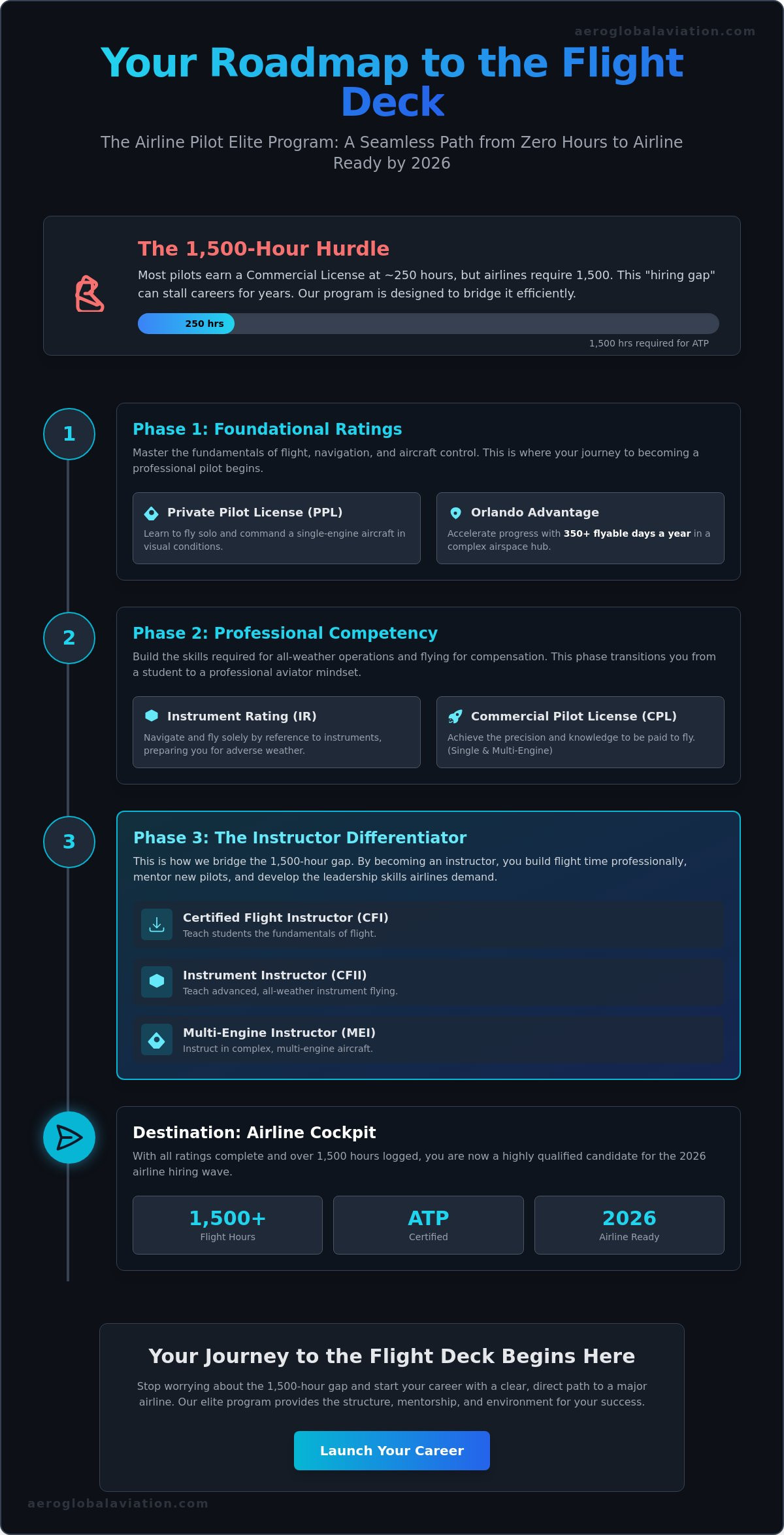
The airline pilot elite program represents a comprehensive shift in how we prepare you for the flight deck. It's built specifically for those who see themselves in the cockpit of a major carrier by 2026. This isn't just about checking boxes; it's about mastering the entire spectrum of pilot certification in the United States. We integrate your Private, Instrument, and Commercial ratings with advanced instructor certifications to ensure you never hit a career plateau. By combining these milestones into one seamless track, we provide the infrastructure you need to transition from a student to a professional aviator without the typical delays found in modular training.
Most programs teach you how to fly an airplane, but we teach you how to lead a crew. You'll move beyond the student mindset early, adopting a Captain-in-command perspective that regional airlines prioritize during recruitment. This approach addresses the projected global demand for 660,000 new pilots by 2044, positioning you exactly where the industry needs you most. You don't just learn the mechanics; you embrace the lifestyle and responsibility of a professional pilot from day one. This mindset is what separates a standard certificate holder from an elite candidate ready for the heavy demands of commercial aviation.
Beyond the Commercial License
Many students believe that earning a commercial license is the finish line. In reality, it's often where the hardest part begins. A standard Commercial Pilot License (CPL) typically leaves you with around 250 hours, but you need 1,500 to reach the airlines. Stopping there can leave you stranded without a clear path to build those remaining hours. Our Elite track solves this by building on commercial pilot training fundamentals and immediately transitioning you into instructor roles. This turns you into a mentor and a leader. These are the exact qualities that make you stand out during high-stakes airline interviews where technical skill is assumed, but leadership must be proven.
The Aero Global Aviation Academy Mentorship
You aren't just another number in a logbook here. We've built a culture in Kissimmee that rejects the impersonal "pilot factory" model. Our small class sizes mean you receive personalized attention from veteran instructors who are deeply invested in your individual success. At Aero Global Aviation Academy, you'll have direct access to school leadership for career counseling, ensuring your professional path is as clear as the Florida skies. We balance technical rigor with a supportive environment. This collaborative spirit helps you navigate the complexities of advanced training with confidence and regional pride, knowing you have a dedicated team behind every solo and checkride.
The Elite Curriculum: Your Roadmap from Zero to Professional
A successful aviation career isn't built on isolated certificates; it's built on a cohesive training timeline that keeps you in the air. The airline pilot elite program provides this continuity by bridging the gap between recreational flying and professional command. We've structured this curriculum as a total immersion experience. This design minimizes the downtime that often plagues modular training, ensuring your skills remain sharp as you move from one milestone to the next. You don't just learn to fly here. You follow a proven roadmap designed to maximize skill retention and professional readiness.
Every phase of your training is intentional. We start with the basics and layer on complexity until you're ready for the demands of a commercial flight deck. By the time you finish, you'll have more than just a license. You'll have the professional presence required to succeed in the 2026 hiring environment. If you're curious about the official standards we meet, you can review the FAA requirements to become a pilot to see how our program aligns with federal regulations.
The Foundational Ratings
Your journey begins with the Private Pilot License (PPL). This is where you master the fundamentals while navigating the vibrant Central Florida skies. To be eligible for this certificate, you must be at least 17 years old. Once you've mastered the basics, we transition you into the Instrument Rating (IFR). This phase is critical for developing precision; you'll learn to navigate complex airspace solely by reference to your instruments. These early stages are about building the discipline required for advanced flight training modules. Mastering these foundations in the high-density traffic near Orlando prepares you for the professional world far better than training in isolated areas.
The Professional and Instructor Edge
After the foundations, you'll enter the professional phase with your Commercial Multi-Engine rating. You'll handle complex aircraft and high-performance maneuvers, learning to operate with the precision of an airline captain. However, the true "Elite" advantage comes with your instructor certifications. The airline pilot elite program includes both CFI and CFII ratings. We believe the CFI rating is your most valuable tool for reaching the 1,500-hour airline requirement. Teaching others forces you to master your own flying skills at a level that few other pilots achieve. It turns the 1,500-hour gap into a period of professional growth rather than a waiting game. If you're ready to see how this roadmap fits your goals, consider starting your journey with our dedicated mentorship team today.
The Orlando Advantage: Why Training in Kissimmee Matters
Selecting a flight school isn't just about the planes; it's about the environment where you'll build your skills. For students in the airline pilot elite program, the Central Florida climate serves as a strategic advantage that northern schools simply can't match. With over 350 days of flyable weather each year, your training schedule remains consistent and predictable. This reliability is vital for maintaining momentum. When you aren't fighting seasonal groundings or unpredictable storm fronts, you spend more time in the cockpit and less time waiting for the clouds to clear. This consistency directly supports your goal of being ready for airline recruitment by 2026.
Maximized Training Efficiency
Efficiency is the cornerstone of our approach in Kissimmee. Because we enjoy such consistent conditions, students often see a more rapid progression through our career pilot program compared to those in less favorable climates. You'll benefit from a steady flight rhythm that reinforces muscle memory and technical knowledge. Beyond the sunshine, our location offers diverse training opportunities. You can practice coastal navigation or explore various terrain features just minutes from our hangar. This variety ensures you're a well-rounded aviator ready for any environment, which is a hallmark of a truly elite education.
Professional Airspace Exposure
Training at Kissimmee Gateway Airport (KISM) places you at the heart of one of the world's most active aviation hubs. You're just a short distance from Orlando International (MCO), which means you'll share the sky with heavy commercial traffic from day one. This proximity isn't just exciting; it's a critical part of your education. You'll learn to communicate with Air Traffic Control (ATC) within complex Class B and Class C airspaces, building the high-level situational awareness required for a career as a professional pilot.
The pace of professional flying is fast. By immersing yourself in this high-density environment, you'll develop the radio proficiency and mental sharpness that major airlines look for. You aren't just learning to fly in a vacuum; you're learning to operate within the same systems used by the captains you aspire to join. This real-world exposure ensures that when you finally reach a regional flight deck, the environment feels familiar rather than overwhelming. Our strategic location turns every training sortie into a professional rehearsal, giving you the confidence to lead in any airspace while networking in a global aviation center.
Bridging the 1,500-Hour Gap: The Instructor Differentiator
The transition from 250 flight hours to the 1,500 hours required for an Airline Transport Pilot (ATP) certificate is the most challenging period for any aspiring aviator. While many programs leave you to figure out this hour gap on your own, our airline pilot elite program builds the solution directly into your curriculum. By integrating Certified Flight Instructor (CFI) and CFII ratings, we ensure you have a professional role waiting for you as soon as you earn your commercial certificate. This isn't just about building time; it's about professional evolution. You'll move from a student mindset to a professional mentor, gaining the flight time you need while helping others reach their own milestones.
Airlines consistently favor candidates with significant instruction experience. When you teach, you master the nuances of aerodynamics, regulations, and systems at a level that simply flying can't provide. You develop the leadership and communication skills necessary to manage a crew and handle high-pressure situations. This experience transforms you from a pilot who can fly a plane into a leader who can manage a flight deck. It's a strategic move that pays off during technical interviews and throughout your entire career. You'll find that the mastery gained through instruction makes the transition to complex airline jets much smoother.
Earn While You Learn
Becoming a flight instructor is your first professional job in aviation. It shifts the financial dynamic of your training; you move from paying for every hour in the logbook to getting paid to build that critical experience. Every hour you spend teaching a student is an hour spent refining your own Captain-in-Command decision-making skills. You'll encounter real-world scenarios that challenge your situational awareness and judgment every day. This daily practice ensures that when you sit across from an airline recruiter, your technical knowledge is second nature and your confidence is earned. It's the most reliable way to stay sharp while reaching the FAA mandates.
Career Longevity and ROI
The return on investment for the Elite track is significantly higher than basic CPL training because it accelerates your entry into the high-earning years of your career. With the median annual wage for airline pilots reported at $226,600 in May 2024, every month you save on your path to the airlines has a tangible financial value. We often hear from career changers who worry about timing. If you're wondering, is 40 too old to become a pilot?, the answer in 2026 is a resounding no. The industry demand is so high that a structured path makes a late-start career both viable and lucrative. You'll find that the accelerated path to a First Officer position is more attainable than ever when you have the right ratings in hand. If you're ready to turn your passion into a paycheck, apply for our elite training track and start building your 1,500 hours today.
Getting Started: Your Journey to the Flight Deck Begins Here
Transitioning from a dreamer to a pilot starts with a single, decisive action. The airline pilot elite program is designed for those ready to commit to a full-time, immersive experience that leads directly to a professional career. Before you step into the cockpit, you'll work with our admissions team to map out a personalized 2026-2027 timeline. This ensures your training aligns perfectly with the projected hiring waves at regional and major airlines. We don't just sign you up for classes; we help you engineer a career path that accounts for every rating and hour-building milestone discussed in the previous sections.
Understanding the logistics of flight training is just as important as mastering the flight controls. You'll need to explore various financing options, such as specialized aviation loans and structured payment plans, to fuel your progress. While flight training represents a significant investment, the potential return in a high-demand market makes it a strategic move for your future. Our team is here to guide you through these practical considerations so you can focus entirely on your training once you arrive in Kissimmee. We prioritize clarity and planning to ensure your transition into the cockpit is as smooth as possible.
Enrollment Steps and Requirements
Your journey officially begins with a visit to an FAA-authorized medical examiner. Obtaining your FAA First-Class Medical Certificate is the most essential first step. This certificate confirms you meet the physical standards required for an airline career, ensuring there are no medical hurdles to your professional aspirations. You'll also need to gather documentation for TSA and school onboarding, including proof of citizenship or appropriate visa status. We recommend setting realistic expectations for full-time immersion. This program requires your full attention, but the rewards of reaching the flight deck ahead of your peers are well worth the dedication.
Book Your Discovery Flight in Kissimmee
If you're ready to move beyond theory, the best way to start is with a Discovery Flight. This introductory lesson gives you a front-row seat to the Aero Global Aviation Academy difference. You'll meet your practical mentor, tour our professional training fleet, and walk through the hangars where your transformation will take place. The highlight of the day is taking the controls yourself. Feeling the aircraft respond to your input over the Central Florida landscape is an experience that clarifies your goals like nothing else. It's the moment where "someday" becomes "today."
Schedule your discovery flight and start your Elite journey today!
Take Command of Your Future on the Flight Deck
Your journey toward a major airline flight deck is a strategic mission rather than a series of disconnected ratings. By choosing the airline pilot elite program, you're securing a comprehensive PPL to CFI curriculum that positions you perfectly for the high-stakes recruitment cycles of 2026. You now understand how training in Kissimmee maximizes your efficiency and how the instructor path transforms the 1,500-hour gap into a period of professional leadership and growth.
At Aero Global Aviation Academy, we provide the expert mentorship and the professional training fleet you need to succeed. Our career aviation professionals are deeply invested in your individual success, ensuring you transition from a student to a capable Captain-in-command with confidence. It's time to stop viewing the airlines as a distant goal and start treating them as your tangible destination. Enroll in the Airline Pilot Elite Program at Aero Global Aviation Academy today and begin your journey toward the flight deck. We're ready to help you clear the path to your professional future. The horizon is wide, and we're excited to see you reach it.
Frequently Asked Questions
What is included in the Airline Pilot Elite program?
The airline pilot elite program includes every certification required to move from zero experience to a professional instructor role. You'll complete your Private Pilot License, Instrument Rating, and Commercial Multi-Engine rating before finishing with your Certified Flight Instructor (CFI) and CFII certificates. This comprehensive track ensures you have the credentials to start building professional flight hours immediately after graduation.
How long does it take to complete the program from zero experience?
Completion time varies based on your dedication and the frequency of your flights, but most full-time students can finish the curriculum in approximately 10 to 12 months. Our immersive structure is designed to keep you in the air consistently, allowing you to move through phases without the delays typical of part-time training. This accelerated pace is ideal for those targeting the 2026 airline recruitment window.
Why should I choose an 'Elite' program over a standard pilot course?
Choosing this track provides a seamless bridge to your first professional job, whereas standard courses often stop at the commercial license. By including advanced instructor ratings, we prepare you to build the 1,500 hours required for an Airline Transport Pilot certificate while getting paid. It's a career-focused infrastructure that prioritizes your long-term employment rather than just teaching you how to fly an airplane.
Do I need a college degree to join the Airline Pilot Elite program?
You don't need a college degree to enroll in our training or to earn your FAA certifications. While many major airlines have historically preferred a four-year degree, many regional carriers have adjusted their requirements to focus on flight experience and technical proficiency. We recommend checking the specific hiring policies of your target airlines, but you can certainly begin your professional training with a high school diploma or equivalent.
Can I build my 1,500 hours at Aero Global Aviation Academy after graduating?
We frequently hire our top-performing graduates to serve as instructors within our academy. This allows you to build your 1,500 hours in a familiar environment while receiving mentorship from our senior staff. It's a collaborative arrangement that benefits both the school and your career, providing a stable path to reach the flight time mandates for an ATP certificate while you mentor the next generation of pilots.
Is financing available for the full professional pilot track?
Many students utilize specialized aviation loans to fund their professional training. While we don't provide direct financing, we can point you toward various lending partners that offer programs tailored to flight students. You should research different loan structures and payment plans to find the option that best fits your financial situation as you prepare for your future career. Our admissions team can discuss how other students have managed their training investments.
What are the medical requirements for becoming an airline pilot in 2026?
To fly for a commercial airline, you must hold an FAA First-Class Medical Certificate. This involves an examination by an Aviation Medical Examiner (AME) to verify your vision, hearing, and overall physical health. We strongly suggest obtaining this certificate before you begin the airline pilot elite program to ensure you meet the long-term health standards required for a career on a professional flight deck.
How does the Florida weather benefit my training timeline?
The Florida climate provides over 350 days of flyable weather per year, which is significantly more than most northern regions. This consistency means you'll face fewer cancellations and can maintain a steady flight schedule. Maintaining this momentum is crucial for building muscle memory and ensuring you complete your ratings on a predictable timeline, helping you reach your career goals faster than in regions with harsh winters.


