

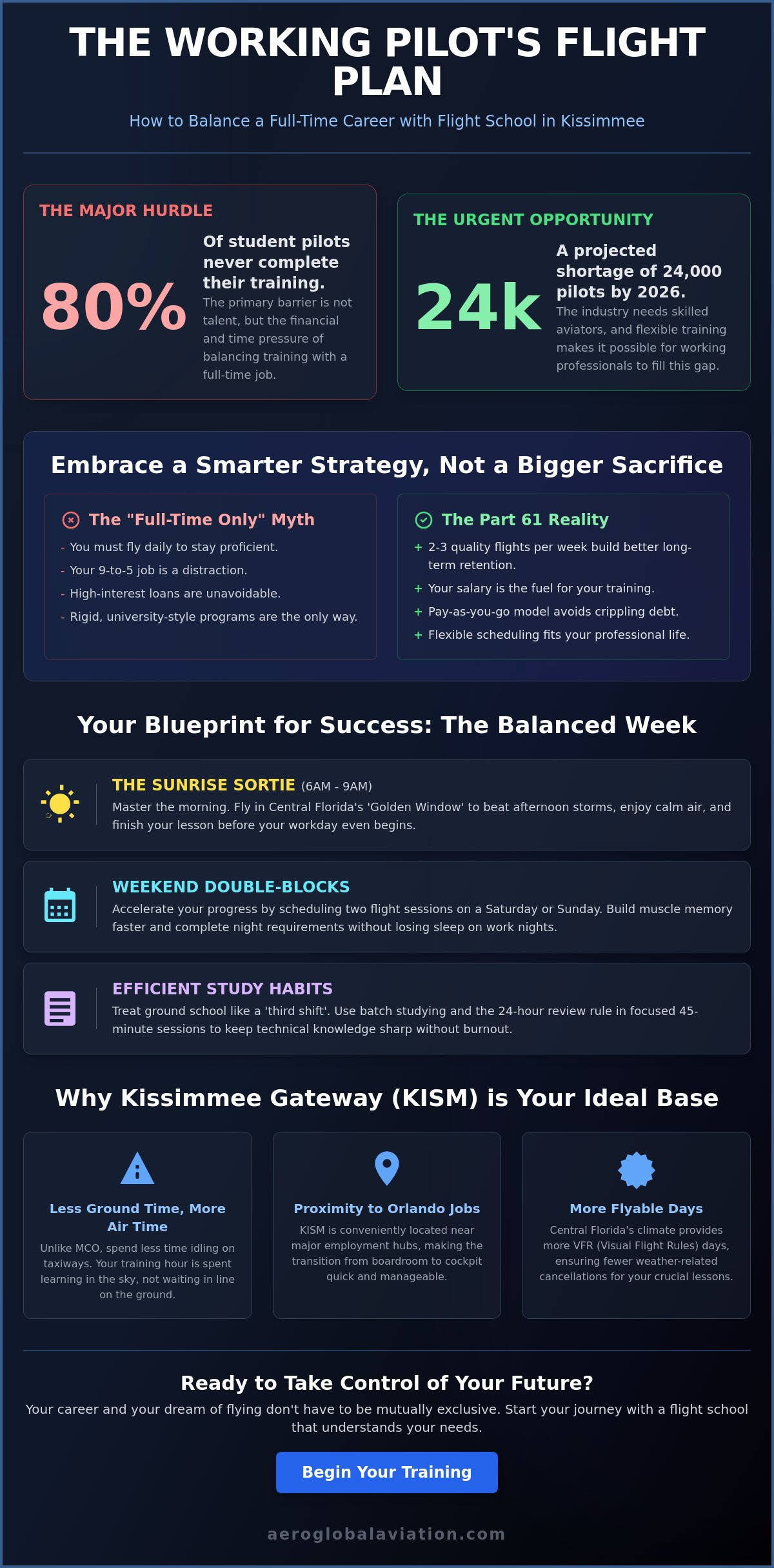
Did you know that approximately 80% of student pilots never complete their training? For most, the barrier isn't a lack of talent but the intense pressure of funding a dream while maintaining a full-time career. If you are worried about burnout or the financial strain of tuition, you aren't alone. It's a common concern for those trying to manage Orlando area commutes alongside rigorous study sessions. You shouldn't have to choose between your current livelihood and your future in the sky.
Successfully balancing a job while in flight school Kissimmee is about strategy rather than sacrifice. With the industry facing a projected shortage of 24,000 pilots by 2026, there's never been a better time to start your journey. This guide provides a clear roadmap for part-time training that fits your life. You'll discover how to maintain financial stability while building hours and moving steadily toward your Commercial Pilot License. We will look at flexible scheduling options and local tips to keep your momentum high from your first takeoff at Kissimmee Gateway Airport to your final checkride.
Key Takeaways
- Master the "Sunrise Sortie" strategy to complete flight lessons before Florida afternoon storms while still making it to your office on time.
- Discover how the flexibility of Part 61 training allows you to cash-flow your journey, helping you avoid high-interest debt through a pay-as-you-go model.
- Learn why balancing a job while in flight school Kissimmee is achievable by utilizing weekend double-blocks and customized pacing within the Career Pilot Program.
- Implement the 24-hour review rule and batch-studying techniques to ensure your technical knowledge stays sharp even during a busy work week.
- Explore the Wings Foundation as an ideal entry point to earn your Private Pilot License while maintaining your current professional responsibilities.
Can You Balance a Job and Flight School in Kissimmee?
The profile of a flight student has shifted dramatically in 2026. While the image of a young student spending every waking hour at the airfield persists, the reality is that many of today's most successful aviators are established professionals. These working student pilots are leveraging their existing careers to fund their transition into the cockpit. Unlike rigid university aviation programs that demand a fixed, full-time schedule, the Part 61 training environment offers the adaptability you need. Balancing a job while in flight school Kissimmee isn't just possible; it's a strategic way to enter a field where the FAA pilot certification requirements are rigorous but attainable through consistent, paced effort.
Instead of viewing your 9-to-5 as a distraction, try seeing it as the fuel for your flight training journey. Your salary provides the financial independence to train without the weight of high-interest student loans. Balancing a job while in flight school Kissimmee requires a partner school that understands your time is your most valuable asset. In Kissimmee, high aircraft availability means you aren't fighting a hundred other students for a single aircraft. You can book your slots around your work meetings, ensuring that your career and your training move forward in tandem.
The Myth of the 'Full-Time Only' Pilot
You don't need to be at the airport five days a week to become a proficient pilot. A common misconception is that skills erode instantly if you aren't flying daily. In reality, scheduling 2 to 3 quality flights per week is often more effective for long-term retention than a cram style approach. This pace allows your brain to process new maneuvers and radio procedures while you're at your desk. Having a non-aviation income also provides a psychological safety net. If Florida weather grounds a flight, it's a minor scheduling hiccup rather than a financial crisis.
Why Kissimmee Gateway (KISM) is Ideal for Workers
Location is everything when you're managing a professional calendar. Kissimmee Gateway Airport (KISM) offers a distinct advantage over larger hubs like Orlando International (MCO). You'll spend significantly less time idling on the taxiway and more time actually learning in the air. Its proximity to major Orlando employment sectors makes the post-work commute manageable, allowing you to transition from the boardroom to the cockpit in minutes. Plus, our local climate provides more flyable days per year, ensuring your weekend blocks aren't constantly cancelled by weather.
Strategic Scheduling: Making Training Work Around Your 9-to-5
Successfully balancing a job while in flight school Kissimmee requires a shift in how you view your calendar. It's not about finding extra time; it's about reallocating the hours you already have. Following the FAA guidelines on becoming a pilot means meeting specific flight time requirements, and for the working professional, this often means becoming a regular at the airport before the sun fully peaks over the horizon. These 'Sunrise Sorties' are your secret weapon for making steady progress without interrupting your career path.
While your colleagues are still on their first cup of coffee, you've already completed a pre-flight check and practiced several touch-and-goes. In Central Florida, the afternoon sky often brings convective activity and sudden thunderstorms that can ground a student pilot. By flying in the early morning, you beat the heat, avoid the turbulence, and arrive at your office with a massive sense of accomplishment before the workday even starts. It's a disciplined rhythm that builds the exact kind of time-management skills airlines look for in future captains.
Weekends offer another opportunity to accelerate your progress through 'Double-Blocks.' This strategy involves scheduling two flight sessions in a single day, perhaps one in the morning and one in the evening. This helps you build muscle memory faster and allows you to knock out the mandatory night flying requirements without sacrificing sleep on a work night. For ground school, treat it like a 'third shift.' Dedicate 45 minutes after dinner to test prep, ensuring you're ready for the FAA written exam without feeling overwhelmed by a single marathon study session.
The Morning Advantage in Central Florida
The 6:00 AM to 9:00 AM window at KISM is truly the 'Golden Window' for local aviators. The air is still, the radio traffic is light, and you'll find that you can accomplish more in one hour of calm morning air than in two hours of bumpy afternoon heat. It's a productive start that sets a professional tone for the rest of your day, leaving your evenings free for family or rest.
Leveraging Modern Flight Training Software
Don't overlook the power of modern technology to save you time. Use digital scheduling apps to monitor for last-minute cancellations, which are often great opportunities to snag an extra hour in the cockpit. You can also utilize remote ground school modules during your lunch break to keep your knowledge fresh. If you're stuck at your desk, keep a cockpit poster nearby for 'chair flying,' which helps you internalize checklists and flow patterns without leaving your seat. If you're ready to see how a professional schedule fits into our training environment, explore the options at Aero Global Aviation Academy.
The Financial Advantage of Working During Your Career Pilot Program
Choosing to keep your current career while training provides a level of financial security that full-time students often lack. When you're balancing a job while in flight school Kissimmee, you gain the ability to pay as you go. This model is a powerful alternative to taking on massive debt before you've even earned your first rating. By cash-flowing your private pilot license florida, you maintain control over your finances. You can pause training if your work schedule requires it without the pressure of monthly loan interest stacking up.
As you progress toward commercial pilot training, the costs naturally increase. However, a steady paycheck acts as a stabilizer. Some employers in aviation-adjacent fields even offer tuition reimbursement or professional development funds that can be applied to your ratings. You might also find tax advantages if your training is directly related to maintaining or improving skills for your current professional role. This financial buffer reduces the stress of training, allowing you to focus on your maneuvers rather than your bank balance.
Debt-Free Flight Training Strategies
Think about the long-term impact of interest. A $100,000 loan can easily double in cost over a ten-year repayment period; that is a heavy burden to carry into a new career. In contrast, a two-year working timeline allows you to invest your actual earnings into your logbook. Start by setting up a dedicated "Flight Fund" from your monthly salary. Treat your flight training like a recurring utility bill. This disciplined approach ensures you're always ready for your next lesson. Don't forget to look for scholarships specifically designed for working adults. Many organizations value the maturity and work ethic that non-traditional students bring to the flight deck.
ROI: Professional Salary vs. Training Investment
With the median airline pilot salary climbing to $239,200, the return on investment for your certification is one of the most compelling in the professional world. While a full-time student might finish a few months earlier, the working student often enters the airline pilot career path with significantly more financial freedom. Finishing your training debt-free puts you years ahead of your peers. You'll be able to enjoy your high airline salary immediately rather than spending the first decade of your career paying back the bank. Balancing a job while in flight school Kissimmee is the smartest financial move you can make for your future.
Success Strategies: Managing Ground School and Flight Hours
Managing the cognitive load of ground school is often the biggest hurdle for working professionals. When you're balancing a job while in flight school Kissimmee, you can't always afford four-hour study marathons. Instead, use batch-studying. Break your ground school modules into 20-minute daily increments. This keeps the material fresh without leading to burnout. Pair this with the 24-hour review rule: spend 15 minutes reviewing your previous flight lesson notes within 24 hours of landing. This simple habit significantly improves long-term retention, reducing the number of repeat lessons you'll need and saving you money in the long run.
Transparency with your employer is equally vital. Most managers appreciate a goal-oriented employee. Explain your training path and ask for small, aviation-friendly adjustments, such as a consistent Tuesday morning off for a flight block in exchange for later Tuesday evening hours. Setting these clear boundaries helps you avoid the "Mid-PPL Slump," a common phase where the initial excitement wears off and the technical requirements intensify. By having a predictable schedule, you can maintain your professional performance while steadily checking off your flight requirements.
Mastering the FAA Written Exams
One of the best ways to streamline your progress is to conquer the written exam before you start intensive flight blocks. Modern mobile apps allow you to practice Part 61 ground school questions during your commute or lunch break. By getting the written out of the way, you can focus entirely on the physical skills of flying when you're at the controls. Create a "No-Fly Zone" on your calendar; dedicate at least two nights a week where you focus solely on your books. This dedicated time ensures you aren't just memorizing answers but actually understanding the aerodynamics and regulations required for a safe career.
Maintaining Proficiency Between Lessons
When you can't get to the airport, use "chair flying" to stay sharp. Sit in a quiet room and visualize every step of a maneuver, from your hand movements on the throttle to the view out the window. If your instructor allows it, record your flight lessons. Listening to the radio calls and instructor feedback during your drive to work turns a boring commute into a valuable review session. Engaging with local Kissimmee pilot groups also provides a community of peers who understand the unique challenges of training while working. If you're ready to build a training plan that respects your professional time, contact our team at Aero Global Aviation Academy to get started.
How Aero Global Aviation Academy Supports Working Professionals
At Aero Global Aviation Academy, we don't just teach you how to fly; we partner with you to build a sustainable career. We understand that your professional commitments are non-negotiable. That is why we've designed our programs to be flexible, mentor-led, and outcome-focused. Whether you're just starting or are ready to commit to a full career transition, balancing a job while in flight school Kissimmee becomes a manageable reality through our structured yet adaptable training paths. We focus on personalized attention, ensuring you never feel like just another number in a large, impersonal corporation.
A key part of our success is our personalized instructor matching. We pair you with a Certified Flight Instructor (CFI) who understands the professional grind. Your instructor acts as a practical mentor, helping you navigate the technical requirements of the FAA while respecting the demands of your 9-to-5. For those aiming for the highest levels of certification, our Airline Pilot Elite track provides a long-term, mentor-led path that takes you from your first flight all the way to advanced instructor ratings. This ensures you have a consistent guide as you build the hours necessary for your future career.
Wings Foundation: Your PPL Milestone
Our Wings Foundation course serves as the perfect entry point for those testing the waters of aviation. It focuses solely on the Private Pilot License (PPL), allowing you to achieve a standalone milestone without the pressure of a long-term commercial commitment. We structure this course specifically for evening and weekend learners. With our flexible aircraft scheduling at our Kissimmee training center, you can book your sessions around your work meetings. This allows you to focus on the joy of flight while checking off your first major professional requirement.
The Career Pilot Program for Professionals
Once you've earned your wings, transitioning into our career pilot program allows you to bridge the gap between a hobby and a profession. We help you build the hours required for your Commercial Pilot License (CPL) while you maintain your current job. This program is designed for efficiency, leveraging the favorable local climate and our strategic location at KISM to maximize your time in the air.
Your future in the sky doesn't have to wait for a "perfect" time that may never come. With 5,000 airline pilots reaching retirement age in 2026 alone, the industry is waiting for professionals like you to step into the cockpit. Take the first step by booking a discovery flight at Aero Global Aviation Academy to evaluate your personal timeline and see how our fleet fits into your life. Balancing a job while in flight school Kissimmee is the strategic move that turns your aspiration into a tangible destination.
Take Command of Your Aviation Future
Achieving your professional pilot goals while maintaining your current career is more than just a possibility; it's a strategic investment in a debt-free future. By embracing the "Sunrise Sortie" and utilizing the flexibility of Part 61 scheduling, you can build your logbook without sacrificing your financial stability. You've learned that balancing a job while in flight school Kissimmee allows you to cash-flow your training, putting you years ahead of your peers once you reach the airline flight deck. Our strategic location at Kissimmee Gateway Airport ensures you spend less time on the ground and more time mastering the skills needed for your Commercial Pilot License.
You don't have to navigate this transition alone. Our expert mentors specialize in working with adult learners, providing the personalized guidance necessary to manage both ground school and professional responsibilities. It's time to turn your aspirations into a tangible destination. Schedule a Discovery Flight at Aero Global Aviation Academy and build your custom training schedule today! Your journey toward a rewarding career in the skies is ready for takeoff, and we are here to support every mile of your progress.
Frequently Asked Questions
Is it possible to finish flight school in a year while working full-time?
Yes, it's entirely possible if you maintain a disciplined schedule of 2 to 3 flights per week. While full-time students might finish faster, a working professional can complete their Private Pilot License (PPL) in 4 to 6 months and move into advanced ratings within the year. Success depends on your commitment to "Sunrise Sorties" and weekend blocks to ensure consistent progress toward your long-term aviation goals.
How many hours a week should I dedicate to flight school if I have a job?
You should aim for 10 to 15 hours per week to ensure steady skill retention and progress. This typically includes 4 to 6 hours of actual flight time and several hours of ground study. Spreading this across early mornings and weekends helps you maintain momentum. Balancing a job while in flight school Kissimmee is much easier when you treat your training as a high-priority part-time commitment rather than a casual hobby.
Can I get financing for flight school if I'm still working?
Yes, many students qualify for flight training loans even while maintaining their current employment. Having a steady income often makes you a more attractive candidate for third-party lenders who partner with flight schools. You can also choose our pay-as-you-go model. This allows you to use your monthly salary to cover costs without taking on the heavy burden of high-interest debt that often accompanies full-time, loan-funded programs.
What happens if I have to take a break from training due to work commitments?
You can pause your training at any time without financial penalty due to the flexible nature of Part 61 programs. While it's best to stay consistent to avoid skill fade, our instructors will help you pick up exactly where you left off. We focus on a student-centric approach that respects your professional life, ensuring your path to a Commercial Pilot License remains attainable regardless of temporary spikes in your work responsibilities.
Are there 'aviation-friendly' jobs in Kissimmee that help with hour building?
Yes, the Kissimmee Gateway Airport area offers several roles, such as airport operations, line service technicians, or administrative positions at local aviation companies. These jobs keep you immersed in the airport environment and provide networking opportunities with experienced pilots. Working in the industry while training provides valuable context for your ground school studies and helps you understand the professional landscape you're about to enter as a commercial pilot.
How do I explain my flight school schedule to my current boss?
Frame your flight training as a professional development goal that demonstrates high-level discipline and time-management skills. Most employers appreciate employees who are driven to achieve complex certifications. You might suggest a slightly adjusted schedule, such as coming in an hour later on flight days. This ensures you can maximize the calm morning air at KISM without affecting your workplace productivity or missing important meetings.
Is ground school harder to pass if I'm not doing it full-time?
It isn't harder to pass, but it does require a more structured approach to your weekly study habits. Using batch-studying techniques and mobile test-prep apps allows you to master the material in short, focused bursts throughout your workday. Many working students actually perform better on written exams. They apply the same professional discipline to their studies that they use to succeed in their current careers every day.
Does Aero Global Aviation Academy offer weekend flight lessons?
Yes, we offer full weekend availability to accommodate the busy schedules of our working students. We understand that Saturday and Sunday are often the best times for "Double-Blocks," allowing you to build hours rapidly without weekday work stress. Our goal is to provide accessible, high-quality training that fits your life. We make balancing a job while in flight school Kissimmee a seamless and rewarding experience for every aspiring pilot.


